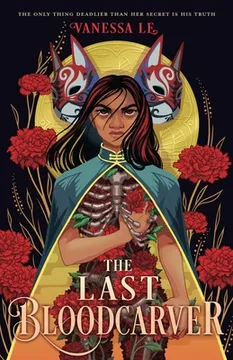


Plot Summary
The Patient Beneath Silk
In Theumas, Yarongese Nhika survives by selling fake herbal remedies and hiding the ability that lets her reshape a person’s body through touch. When a wealthy man hires her for his dying wife, she diagnoses a blood clot and secretly dissolves it, spending her own energy to save the woman.
Her client sees enough to recognize her as a bloodcarver, a feared figure from stories, and reaches for a knife instead of thanking her. Nhika disarms him but hears men breaking into the house. She escapes onto the balcony, only to find that he has summoned the Butchers, black-market traffickers who hunt people like her. A compassionate act has exposed her secret and turned her into prey.
Nhika’s gift is both medical knowledge and a liability: every healing requires intimacy, yet the society around her interprets that intimacy as threat. Her client’s reversal makes the story’s central contradiction immediate. The ability that could make her valuable to a community instead marks her for capture, while her poverty leaves little room to use it safely.
A Heartsooth on Auction
Nhika flees across rooftops and alleys, where a young man, Ven Kochin, helps her briefly before she races on. The Butchers catch her, and after she uses a touch to burst a captor’s blood vessels, they cage her as a genuine prize. A rich buyer stabs her to test whether she can heal a fatal wound; Nhika survives by repairing her organs while making herself seem dead.
The bidders return. A fox-masked man offers a million chem and calls her a heartsooth, the name her family uses for her gift. Before he can claim her, teenage heiress Congmi Mimi offers more and buys her outright. Nhika leaves the auction alive, but has no idea what either buyer intends.
The auction converts a person into competing fantasies: an assassin, a cure, a delicacy, or a miracle. Nhika survives by reading bodies and managing other people’s expectations, but the disguised bidders know more about her identity than she does about them. Kochin’s use of her inherited name is a small breach in her isolation, though it arrives inside a market built to erase her personhood.
Bought for a Comatose Man
Mimi collects Nhika in a hearse and brings her to the Congmi manor, where her older brother Andao and their attendant, Dep Trin, object to the purchase. Mimi explains that the family’s driver, Hendon, survived the carriage accident that killed their father but remains comatose. She wants Nhika to wake him.
The family offers food, a room, access to the late Mr. Congmi’s anatomy library, and payment, while requiring Nhika to pose as an educated acquaintance at the funeral. She examines Hendon and finds swelling in his brain, but reducing it does not restore consciousness. When she admits she cannot yet help, the Congmis offer her time and resources to learn. Nhika accepts, drawn by a rare chance to practice and study.
Mimi’s purchase is ethically compromised, even though she intends to rescue Nhika from the traffickers. The Congmis initially treat her as both a person and a service they have acquired, and Nhika recognizes the resemblance to every other transaction in her life. What changes her decision is not luxury but access to knowledge: the library offers a route back toward the teaching her family lost.
The Brain She Cannot Mend
Nhika’s first attempt to heal Hendon fails because she cannot understand the injury deep in his brain. Her frustration revives the memory of her mother, whose paralysis she could not cure when she was twelve. The Congmis let her stay and study rather than sending her away. During the family’s mourning, Nhika overhears Mimi grieving and learns that the siblings suspect their father’s accident may have been murder.
At the wake, she meets Dr. Santo, Mr. Congmi’s close friend and a prominent medical researcher, and Ven Kochin, now Santo’s aide. Kochin recognizes her from the street, questions her place among the elites, and warns her that she does not belong. His contempt unsettles her more than the usual suspicion of a bloodcarver.
The failed treatment makes Nhika’s professional limit inseparable from her private grief. She is not simply trying to solve an unfamiliar brain injury; she is confronting the old belief that her gift failed its most important test. Meanwhile, the funeral’s polished respectability conceals political and personal uncertainty. Kochin’s warning gives social exclusion a human voice, but his attention also suggests that he sees more than her disguise.
A Name Beneath the Brain
At the funeral banquet, Nhika hears industrial candidates Nem and Ngut discuss Mr. Congmi’s death and learns that he had been seeking political office. Andao is already under pressure from Nem to support a war effort, though his father was a pacifist.
Nhika returns to Hendon’s case and, through newer anatomy books, identifies the thalamus as the likely site of the obstruction keeping him unconscious. Santo grants her access to his medical-center library, but the technical papers on brain chemicals offer no clear solution.
Kochin appears with children’s biology books, a deliberate insult. Later, Nhika discovers older heartsooth texts hidden beneath their covers. Their illustrated methods reconnect her to her grandmother’s teaching and suggest that healing requires learning a living body through touch.
The thalamus gives Nhika a name for the barrier, but naming alone does not make it legible. The contrast between modern publications and inherited practice exposes two forms of knowledge that do not translate neatly into one another. Kochin’s apparent mockery becomes complicated by the hidden texts: he has insulted her in public, yet quietly placed a fragment of her culture within reach.
The Books Remember
Nhika understands from the heartsooth books that diagrams cannot replace direct learning from another body. She asks for a healthy template, and Trin offers himself. By sensing his healthy brain alongside Hendon’s damaged one, Nhika sees where Hendon’s neural pathways are broken.
She rebuilds tissue and connections, supplying energy from her own body until Hendon’s brain begins working again. Nhika collapses from exhaustion. When she wakes, Hendon is conscious, though weak and missing parts of his memory.
The family celebrates his recovery, then holds a dinner in his honor. That night, a nightmare jolts Hendon into recalling a fox-masked figure at the crash. In his confusion, he identifies Nhika, placing suspicion on the person who saved him.
Nhika succeeds when she stops treating knowledge as something she can extract from books alone and accepts the relational method her grandmother taught. Trin’s consent makes the treatment possible, and his trust contrasts with the fear that has surrounded her gift. Yet the cure cannot repair memory with perfect precision. Her achievement saves Hendon, while the returning fragments create a new danger.
The Fox in Hendon’s Nightmare
Hendon’s memory of the crash comes back in a night terror. He recalls a gunshot, a fox mask, and a familiar presence, then mistakenly names Nhika as the masked figure. The Congmis question her, and Mimi’s trust falters despite Nhika’s insistence that she was not there. Nhika goes to the address Kochin gave her, a cramped shop in the Pig Borough, carrying the recovered heartsooth books and a knife.
Inside, she finds Kochin’s fox mask and confronts him as Mr. Congmi’s killer. They struggle; Nhika stabs him, but when she reaches to control his heart, his own influence blocks hers. Kochin soothes her in return. He is a heartsooth, too. As Trin arrives, Nhika chooses to escape with Kochin rather than return to the Congmis.
The mistaken identification forces Nhika to choose between the fragile trust she has built and the possibility of kinship she has never had. Kochin’s counter-soothing transforms their fight into recognition: his body answers her gift with the same language. That recognition does not absolve him of the murder she suspects, but it makes the choice to leave emotionally intelligible and morally costly.
A Letter From the Fox
On Kochin’s houseboat, Nhika learns that he is Yarongese through his mother and that Dr. Santo has controlled his heartsoothing for years. A letter from Santo ordered him to eliminate Mr. Congmi and leave no witnesses.
Kochin takes Nhika to his rural hometown, intending to leave her with his family, but she discovers his note asks them to move away and take her, without asking her. His mother, Yetunla, welcomes Nhika and confirms that Kochin has been estranged from home. Nhika confronts him at the shore.
He admits Santo threatened his family and forced him to kill, first by exploiting his gift for transplants and then by threatening his mother. Nhika refuses to be sent away and persuades him to return with her, carrying Santo’s letter as evidence.
Kochin’s protection repeats the very paternalism Nhika has suffered from: he decides what risks she can bear and calls the decision care. Her insistence on choosing for herself marks a shift from survival through flight to deliberate participation. Their shared heritage creates intimacy, but it does not erase the coercion that has shaped Kochin’s choices or the harm he has caused.
Back Through the Gates
Nhika returns to the Congmis with Santo’s letter, but the siblings initially suspect she has joined the masked killer. She explains that Santo ordered the murder because Mr. Congmi discovered his research was fraudulent and relied on a heartsooth’s ability.
Kochin arrives and admits he killed Mr. Congmi under threat. Before the family can decide what to do, Santo visits. Nhika suspects his timing and finds Hendon paralyzed and unable to breathe after a drug treatment. Kochin recognizes a muscle-blocking drug, while Nhika stimulates Hendon’s diaphragm and keeps him breathing as Kochin clears the toxin.
Hendon confirms that Santo administered it and that Kochin had saved him at the crash. The Congmis accept that Santo is dangerous and agree to help expose him, though Mimi remains unwilling to forgive Kochin.
Trust here is not a feeling that can be demanded; it is rebuilt through evidence and action. Nhika returns despite having been accused, and Kochin’s confession makes the truth harder to dismiss. The second rescue also gives the Congmis a direct reason to revise their judgment of both heartsooths. Mimi’s grief remains intact, preventing alliance from being mistaken for easy absolution.
Santo’s Private Archive
To prove Santo tried to kill Hendon, Nhika and Kochin break into his mansion while the Congmis keep him at dinner. They find no drug in his office, but his private study holds Daltan records of heartsooth vivisections, brutal images that reveal the history of persecution behind Nhika’s fears.
A photograph of Santo’s dead son, Leitun, hints at the grief beneath his work. In the carriage house, they locate the experimental muscle relaxant, sancuronium, and evade a returning maid when Kochin pretends to be Santo’s aide.
Nhika and Kochin understand that Santo’s medical ambition is bound to personal loss, but they do not yet know how far he will go. The bottle gives the Congmis a possible means to connect his methods to Hendon’s attempted death.
The archive makes the history of violence visible rather than abstract. Nhika’s fear of being studied or dissected is grounded in the images Santo has collected, and his scholarship now appears ethically inseparable from exploitation. The portrait of Leitun complicates the antagonist without excusing him: private grief can explain a fixation, but it cannot make other people’s bodies instruments of repair.
The Dead Man’s Evidence
The group devises a way to turn Santo’s own drug into evidence. At the Congmi mausoleum, the siblings authorize the exhumation of their father. Nhika and Kochin introduce sancuronium into the corpse and use heartsoothing to distribute it, creating physical signs that investigators can test. Mimi asks Nhika to perform the work, making the family’s trust visible even as the act renews her grief.
That night, Nhika and Kochin enter Santo’s medical-center office and plant the remaining drug where investigators can connect it to him. Kochin also finds a file Santo kept on him, filled with blackmail material about his family and his gift, and destroys it. As they finish, Santo appears with a pistol, having anticipated the break-in.
The plan makes justice depend on a painful compromise: the Congmis must disturb their father’s grave to give his death an evidentiary form. Mimi’s consent is not forgiveness; it is an active decision to pursue accountability despite personal cost. Destroying Kochin’s blackmail file removes one instrument of control, but Santo’s arrival shows that material proof alone cannot neutralize a man willing to use force.
A Heart Passed On
Santo shoots Kochin, then wounds Nhika when she tries to help him. He demands that she revive Leitun, whose preserved body is kept in a machine-filled casket. Nhika knows resurrection is beyond her, so she destroys the corpse rather than let Santo keep hunting heartsooths for the same impossible promise. Santo locks her in another casket, but Mimi and Trin find and free her.
In the surgical ward, Trin shoots Santo in the leg, and Nhika overpowers him through touch, then chooses not to kill him. She reaches Kochin on the operating table, badly wounded. With her own energy failing, Nhika transfers her healing ability and life into him. Kochin survives; Nhika dies, leaving him her ring and the gift she had spent her life trying to preserve.
The final choice resolves Nhika’s conflict between using her gift to survive and using it to heal. Santo treats life as a problem to be controlled, even when the desired cure is impossible; Nhika rejects that logic by protecting the living person before her. Her transfer is both intimate and cultural inheritance, though its cost is absolute. The gift survives in another person, but not without loss.
Epilogue
At Nhika’s honorary grave, Kochin wears her bone ring and carries the scar left by his own wounds. Mimi, Andao, and Trin visit to tell her that Santo has received a life sentence. Kochin tells them he plans to return home, but privately resolves to search for a way to bring Nhika back.
He now possesses her heartsoothing, and he refuses to accept that death must be final. The grave contains no body, only a name and an anatomical heart carved in stone, while Kochin leaves with grief sharpened into a new purpose.
The epilogue grants justice without granting emotional closure. Santo is punished, but the damage he caused cannot be reversed, and Kochin’s inheritance of Nhika’s gift becomes both consolation and burden. His plan to resurrect her echoes Santo’s fixation on Leitun, raising a deliberate question about whether love can become another form of refusal to accept limits. The empty grave and the ring keep Nhika present as memory, but Kochin’s hope risks turning remembrance into pursuit.
Analysis
The novel places medical innovation beside a form of healing that cannot be separated from touch, consent, and cultural memory. Theumas trusts machines, credentials, and repeatable procedures, while heartsoothing travels through embodied teaching that colonization and displacement have nearly erased. Neither system is simply dismissed: Nhika studies anatomy, and Kochin applies medical knowledge to his gift. The conflict arises when institutions claim authority over bodies while refusing to recognize the people who understand them.
Nhika’s arc is a shift from self-protective usefulness to chosen responsibility. She begins by treating compassion as a costly reflex, then discovers that healing Hendon requires trust from another person and a willingness to learn from living bodies. The Congmis offer shelter but initially reproduce the transactional logic of the world outside their gates. Their later alliance matters because trust is earned through actions, contested after betrayal, and rebuilt without requiring Mimi to stop grieving.
Kochin and Santo are distorted mirrors. Both are shaped by loss and by the wish to overcome medicine’s limits. Santo converts grief into control, using research and social authority to claim other people’s bodies. Kochin has been coerced into similar acts, but his reluctance and his bond with Nhika leave room for ethical choice. Nhika’s final sacrifice refuses Santo’s fantasy that love can reverse death, even as the epilogue shows Kochin tempted by that same hope. The story therefore treats legacy not as a monument or a perfected tradition, but as a practice passed between people, altered by history, and kept alive through care.
People Also Read



Characters
Suonyasan Nhika
The last hidden healerNhika is an eighteen-year-old Yarongese heartsooth living on the margins of Theumas. By touch, she can enter another person’s anatomy and alter its workings, but healing consumes energy and exposes her to fear, exploitation, and danger. Orphaned young and separated from the culture her family fled, she disguises her knowledge as folk medicine and survives through improvisation. Her sharp humor and practiced suspicion protect her from dependence, while her recurring impulse to heal reveals a compassion she tries to treat as a liability. The family bone ring she wears connects her to generations she never knew. Her central struggle is not simply learning more medicine, but deciding whether she can belong without concealing the gift that defines her.
Ven Kochin
The masked heartsoothKochin is a young physician’s aide with a polished public manner and a private connection to Yarongese heartsoothing through his mother. He is observant, ambitious, and accustomed to hiding vulnerability behind wit and status. His medical knowledge and his gift make him valuable to people with power, a fact that has shaped his understanding of what his ability can cost. He is drawn to Nhika because she recognizes a part of him that his professional world cannot safely acknowledge. His protectiveness is sincere but can become controlling, especially when fear convinces him that deciding for another person is the same as keeping them safe.
Congmi Mimi
The impulsive heiressMimi is the younger Congmi sibling, a teenager raised amid wealth, public attention, and the expectations attached to her family name. She acts quickly when someone she loves is in danger, sometimes without considering the moral complications of her choices. Her loyalty to her father and Hendon gives her courage, while her grief can make her suspicious and fiercely protective. Mimi’s outward playfulness coexists with a serious need to be taken seriously by her older brother and the adults around her. Her relationship with Nhika begins as a bargain shaped by desperation, but Mimi is capable of recognizing when she has treated another person unfairly.
Congmi Andao
The burdened heirAndao is Mimi’s older brother and the heir to Congmi Industries. He is disciplined, tired, and conscious that every decision he makes will be measured against his father’s legacy. His caution is not cowardice; it reflects the political and industrial pressures gathering around his family. Andao relies on Trin’s judgment and affection, though he must learn to make choices that cannot be delegated to either his father’s memory or his family’s advisers. His pacifist instincts and reluctance to commit his company to war reveal a moral identity distinct from the power he inherits.
Dep Trin
The guarded protectorTrin is the Congmis’ attendant, bodyguard, and trusted companion to Andao. Broad-shouldered and watchful, he often lets his pistol and clipped manner speak before his concern does. His loyalty comes from a history of being given an opportunity when he had little reason to expect one, and he repays that kindness through practical care. Trin is wary of Nhika because he sees the danger she brings into the household, but he is also perceptive enough to recognize the person behind her threats. His steady presence gives Andao room to grieve and decide for himself.
Dr. Santo
The celebrated physicianDr. Santo is a respected physician and research director, as well as a close friend of the Congmi family. He is professionally curious and personally attentive, especially toward the young people he has watched grow up. His work is driven by a profound history of loss and a desire to push medicine beyond its current limits. That drive can make him compelling to those seeking a place in medicine, but his confidence in research and innovation risks obscuring the people affected by his choices. He represents the uneasy overlap between genuine scientific ambition, grief, and the authority granted to celebrated experts.
Hendon
The recovering witnessHendon is the Congmi family’s longtime driver and close friend, whose carriage accident leaves him comatose. His bond with the siblings is familial rather than merely professional, which is why they spend so much to give him a chance to recover. Patient and warm by temperament, he becomes important to the family’s understanding of what happened on the road. His vulnerable condition also reveals the limits of both medicine and heartsoothing: survival and recovery do not immediately restore a person’s strength, memory, or certainty.
Congmi Vun Quan
The absent industrial fatherMr. Congmi is the late founder of Congmi Industries and father to Mimi and Andao. A brilliant engineer with interests in biology and medicine, he built a public legacy through inventions and philanthropy. His children remember him not only as an industrial leader but as a parent whose principles still shape their decisions. His death brings personal grief into contact with business rivalries, political ambition, and questions about the cost of progress.
Yetunla
Kochin’s welcoming motherYetunla, whom Nhika calls Auntie Ye, is Kochin’s Yarongese mother and a heartsooth who has made a life for her family outside the city. She is warm without being naïve and immediately recognizes that Nhika carries knowledge of her son’s hidden life. Her care is expressed through hospitality, tea, and an open invitation rather than pressure. Through her, Nhika glimpses a family where Yarongese identity and heartsoothing can be acknowledged at home.
Nhika’s grandmother
The inherited teacherNhika’s grandmother taught her the foundations of heartsoothing and preserved the family’s knowledge after displacement from Yarong. She valued consent, careful practice, and healing over harm, even when Nhika was young enough to treat her gift as play. Her lessons survive in memory and in the old books Nhika later encounters. She represents a form of cultural inheritance that is not fixed or pristine, but adapted and carried forward through imperfect teachers.
Leitun
Santo’s remembered sonLeitun is Dr. Santo’s late son, remembered through family photographs and the medical history that shaped his father’s work. His illness and loss remain central to Santo’s private understanding of medicine, even as others know him only through fragments.
Nem Boch Kenyi
The war-minded candidateNem is an industrialist and candidate for commissioner who presses Andao to support a war effort. He is forceful and politically ambitious, treating the Congmi name and factories as assets that should be put to use. His pressure reveals the conflict between the late Mr. Congmi’s pacifism and the demands gathering around his heir.
Ngut Lien Buon
The rival industrialistNgut is a prominent automaton manufacturer and a candidate for commissioner. His public respect for Mr. Congmi coexists with a long business rivalry, making him one of the many powerful figures whose relationship to the dead man is difficult to read.
Nhika’s mother
The unfinished lessonNhika’s mother is a Yarongese refugee whose progressive illness leaves Nhika struggling to use her gift before she has mastered it. Her tenderness and acceptance remain central to Nhika’s memories of family, failure, and what it means to continue after loss.
Nhika’s father
The sailor rememberedNhika’s father is a sailor whose work kept him away from home for long stretches. His family remembers him through stories of the sea and the loving welcome that greeted his return. His absence becomes part of Nhika’s early experience of instability and loss.
Plot Devices
Heartsoothing
Touch as inherited medicineHeartsoothing lets its practitioners sense and alter another person’s anatomy through skin contact. Healing consumes energy, requires knowledge, and can become dangerous when used without consent or care. Nhika’s version emphasizes close sensory access and drawing on her own stores, while Kochin’s training includes techniques for clearing drugs and treating bodies through a more detached perspective. The contrast between their schools allows the story to explore both practical technique and cultural inheritance.
The Bone Ring
A portable family historyNhika’s fractured ring is made from bone and onyx, with pieces tied to heartsooths in her family line and her family name inscribed inside. She wears it through capture, escape, and the search for a place among people who do not know her heritage. The ring turns lineage into a physical object she can carry, and it becomes the clearest symbol of what she hopes to preserve and pass on.
The Fox Mask
A clue with two facesThe fox mask first links Kochin to the Trickster Fox of Yarongese folklore and makes him seem like a threat to Nhika. Hendon’s broken memories later identify a fox-masked figure at the crash, directing suspicion toward Nhika before the truth is understood. The mask conceals identity while carrying a culturally specific warning about misused gifts and deception.
Sancuronium
A drug turned evidenceSancuronium is an experimental muscle relaxant that can paralyze the muscles needed for breathing. Kochin recognizes it when Hendon is dosed, and the group later steals a vial and uses it to connect Santo’s medical work to the deaths he tries to conceal. The drug shifts the conflict from private suspicion toward material proof that can be investigated.
The Heartsooth Texts
Knowledge restored through touchOld illustrated books preserve a Yarongese method of learning anatomy through networks of influence rather than isolated structures. Nhika initially cannot read all their language, but their diagrams remind her that a living body can serve as a teacher. The texts lead her to ask Trin to act as a healthy template, making possible the treatment that wakes Hendon.
Download PDF
Download EPUB
.epub digital book format is ideal for reading ebooks on phones, tablets, and e-readers.








