

Plot Summary
Prologue
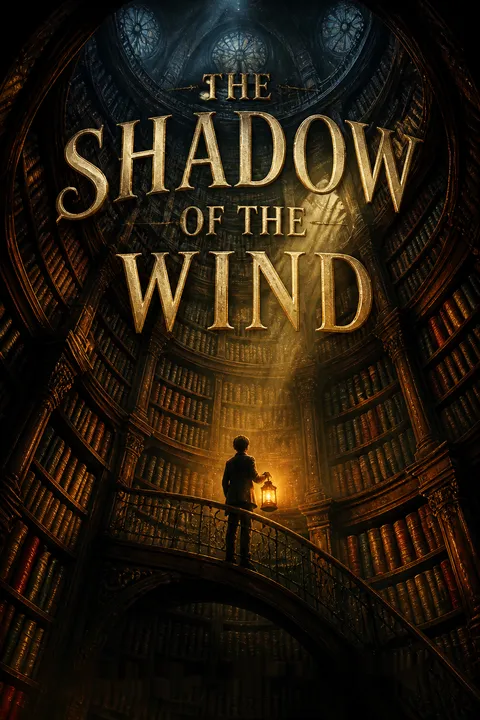
After his mother’s death, ten-year-old Daniel Sempere lives above his father’s bookshop, speaking to her in the dark because he fears forgetting her face. His father takes him before dawn to the secret Cemetery of Forgotten Books, where each visitor must adopt one volume and keep it alive.
Daniel chooses The Shadow of the Wind, a novel by the unknown Julian Carax, and reads through the night. Its story becomes his first private world, though he has no idea that the author’s vanished life will soon reach into his own.
The opening makes reading an act of care before it becomes an investigation. Daniel’s adoption of the book answers his fear of losing his mother with a promise to preserve another person’s words. The Cemetery turns forgotten books into a social responsibility: a reader does not merely consume a story but inherits it. That idea gives the novel’s mystery its emotional stakes. Daniel’s attachment to Carax is not initially scholarly; it is a child’s attempt to hold on to something that might otherwise disappear, just as his mother’s face is already slipping from memory.
The Author Nobody Knows
Daniel expects his father to recognize the author, but even the bookseller Gustavo Barcelo cannot explain why Carax’s books have vanished. Barcelo knows the edition is rare and offers money for Daniel’s copy. Daniel refuses, asking instead for information. At the Ateneo, Barcelo introduces his blind niece, Clara, who has studied Carax’s scarce novels.
She explains how a tutor’s copy first drew her into reading and how she has searched in vain for more. Her account includes a rumor that a faceless man tracks down Carax’s books and burns them. Daniel leaves with his curiosity sharpened: the novelist is not simply obscure. Someone seems determined to erase him.
Daniel’s refusal to sell the book establishes a distinction between ownership and responsibility. Barcelo sees a valuable rarity; Daniel wants the life behind it. Clara’s blindness gives the conversation a precise reversal: she reads through other people’s voices, while Daniel relies on print to give shape to what he cannot retrieve about his mother. The rumored book burner converts a literary puzzle into a threat. From this point, preservation is no longer sentimental alone. It may expose the people who have made forgetting deliberate.
Clara’s Borrowed Barcelona
Daniel begins visiting Clara regularly, reading Carax aloud and guiding her through Barcelona. She describes her father’s wartime disappearance and the inspector, Javier Fumero, who killed him and later rose through the police. Clara also recounts a stranger who approaches her in the street, asks about Barcelo and Daniel, and once lets her touch what feels like a leather face covering.
Daniel dismisses the story, even as his own father urges him to spend time with Tomas Aguilar, his childhood friend. One night Daniel sees a limping man watching from the street, matching a scene in Carax’s novel. The resemblance makes the fiction feel less safely contained.
Daniel’s fascination with Clara grows inside an unequal relationship: he mistakes access to her private world for the possibility of being loved by her. Her history, meanwhile, places personal grief inside the political violence of postwar Barcelona. The unseen watcher unsettles Daniel because the novel has already given him a script for interpreting what he sees. Literature becomes both a lens and a trap: it helps him recognize danger, but it also encourages him to confuse resemblance with understanding.
The Devil Wants a Book
On his sixteenth birthday, Daniel waits for Clara, but she sends Bernarda with regrets and a small gift. Hurt and furious, he walks alone to the harbor, where the limping stranger finds him. The man knows Daniel has Carax’s novel and offers a fortune for it, then admits that he collects the author’s books to destroy them.
When he strikes a match, Daniel sees a face ruined by fire. The stranger knows about Clara and warns Daniel to keep her out of the dispute. Daniel claims that Adrian Neri, Clara’s music teacher, has the book, buying himself a moment to escape. The fictional devil has become a real pursuer, and Daniel’s lie points him toward Clara’s home.
The birthday disappointment makes Daniel vulnerable before the stranger exploits his attachment to Clara. His refusal to sell the novel echoes his earlier promise, but now the promise carries danger and the possibility of harm to someone else. The burned face makes the book’s imagery physically present without settling whether Carax’s fiction predicts reality or merely supplies Daniel with a vocabulary for fear. His lie is an adolescent attempt at control. It gives him a next move, but also forces him toward a painful discovery.
The Night Clara Betrays Him
During a citywide blackout, Daniel enters the Barcelo apartment to retrieve the novel before the faceless man can reach it. In Clara’s bedroom, he finds her with Neri. Neri drags Daniel outside, beats him, takes the apartment keys, and throws the book after him. A homeless stranger, Fermin Romero de Torres, shares wine with Daniel and helps him through the storm.
Rather than return to Clara, Daniel carries the book to the Cemetery of Forgotten Books and hides it behind a marked route through the labyrinth. At dawn, he finds his father still waiting after the ruined birthday dinner. His father gives him the expensive fountain pen he had promised for years, and Daniel accepts a gift that speaks of love without demanding an explanation.
Daniel’s humiliation is not only romantic. It forces him to recognize that Clara’s life and desires do not exist to confirm his fantasies. His decision to hide the book, rather than surrender it, marks a shift from possessive devotion toward custodianship. Fermin’s modest kindness answers the night’s cruelty with practical care, while Daniel’s father answers absence with a long-kept promise. The pen and the buried novel become paired inheritances: one offered by family, the other protected by a choice Daniel must now make for himself.
Fermin Joins the Shop
Months later, Daniel finds Fermin living beneath the arches and brings him to the Sempere shop. Daniel’s father gives the homeless man a bath, clean clothes, a room, and work finding rare books. Fermin proves an uncanny researcher, but a night terror exposes the torture scars covering his body.
The doctor identifies them as burns, and Daniel begins to understand that Fumero’s name carries personal danger for his friend. Fermin settles into the household and becomes a source of wit and practical help. Daniel also renews his friendship with Tomas, whose inventions and guarded loyalty restore a bond Daniel had neglected during his years pursuing Clara.
The shop becomes a counter-institution to the state’s treatment of the vulnerable. Where Fumero uses exposure and pain to reduce people to instruments, the Sempere household offers Fermin work without requiring him to explain his past first. His transformation does not erase trauma; the night terror shows how quickly a safer present can be invaded. Daniel’s renewed friendship with Tomas also corrects an earlier narrowing of attention. He begins to learn that intimacy is sustained by reciprocity, not by fixation on one person.
A Photograph Points North
A charred-edged photograph appears mysteriously in the bookshop, showing a young Julian beside a girl in front of his father’s hat shop. Daniel identifies the location through Isaac’s account and visits the abandoned Fortuny apartment with its caretaker. Inside Julian’s locked room, he finds drawings, crucifixes, a photograph of the girl at the Aldaya mansion, and a key hidden in a music box.
The caretaker also produces an old letter addressed to Julian from Penelope Aldaya. Its words suggest that she loved him and expected him to return, but feared her family. Daniel’s attention shifts from the question of who is burning Carax’s books to the older question of what happened to the young couple.
The photograph and letter make memory material, but neither object offers a complete account. Each has survived through an accidental custodian, and each is vulnerable to misreading when separated from its history. Daniel is learning to investigate by connecting objects, testimony, and place rather than trusting any single narrator. The locked room also turns family history into architecture: what the Fortuny household cannot speak has been sealed behind a door, surrounded by religious symbols that express guilt without explaining it.
Bea Enters the Story
At the university, Daniel meets Beatriz Aguilar, Tomas’s sister, who is expected to marry a military lieutenant and leave Barcelona. Their first meeting ends in a wary truce, but Bea later takes Daniel to the abandoned Aldaya mansion, where she has obtained a key through her father’s property business. She recounts the house’s grim history and explains that the family’s summer residence has stood empty for decades.
In the firelit rooms, Daniel tells her about Carax, Clara, and the faceless pursuer. Bea burns the letter she had prepared to hurry her marriage, and she and Daniel become lovers. Their intimacy gives Daniel a life beyond his old obsession, but ties their future to the very house at the center of Carax’s mystery.
Bea’s choice is not simply a rejection of one suitor for another. She is trying to distinguish a life she wants from an escape arranged by family expectations. Daniel, in turn, moves from imagining women through novels to listening as Bea makes a consequential decision of her own. Their intimacy is shaped by the mansion’s history, but it is not merely a reenactment of Carax and Penelope. The difference matters: Daniel and Bea can name their choices, even when fear and inheritance threaten to narrow them.
Two Coffins Below
On a later visit to the estate, Daniel arrives early and explores the cellar, where a chapel holds headless dressmaker’s forms marked with women’s names. He revives the neglected boiler to warm a bathroom for Bea, but a violent disturbance drives them from the room. A hidden door stands open, revealing a crypt.
Daniel descends and finds two coffins, one bearing Penelope Aldaya’s name and dates. A voice from the darkness orders him out, and he recognizes the burned stranger as Lain Coubert. Daniel rushes Bea into the snow without explaining what he saw. Afterward, Bea stops contacting him. The romance that began in the mansion now carries the weight of a discovery Daniel has not yet understood.
The crypt turns the mansion from a romantic refuge into a sealed record of violence. Penelope’s coffin answers one question but multiplies others: who buried her there, who concealed the room, and why does Coubert guard it? Daniel’s failure to tell Bea what he saw creates distance at precisely the moment she needs honesty. The sequence exposes a recurring danger in his behavior: he treats knowledge as something he can carry alone, even when withholding it shifts the burden onto someone he loves.
The Schoolyard Origins
Fermin helps Daniel trace the false legal address used to manage the Fortuny property, then joins him at San Gabriel’s school. There, Father Fernando Ramos recalls Julian’s school friendships with the wealthy Jorge Aldaya and the thoughtful Miquel Moliner. He also identifies Fumero as a former classmate, a troubled boy whose fixation on Penelope turned dangerous after he saw her with Julian.
Fumero once fired at Julian, and Miquel stopped him before the next shot could kill his friend. Fernando directs Daniel and Fermin to Jacinta Coronado, Penelope’s former governess. The investigation now links the modern inspector to the old triangle, suggesting that the hunt for Carax’s books is bound up with a personal grievance.
The school’s class hierarchy helps explain how violence becomes ordinary: poor pupils are tolerated as exceptions, while wealthy families control the routes available to everyone else. Fumero’s history makes his authority less a break from his childhood than its most powerful continuation. Yet Miquel’s intervention shows that the past also contains acts of resistance. Daniel’s inquiry is no longer a search for an author’s biography; it is a reconstruction of relationships whose consequences have been hidden by institutional records and public silence.
Jacinta Remembers Penelope
Disguised as undertakers, Daniel and Fermin enter the Santa Lucia hospice and find Jacinta Coronado among its abandoned residents. She remembers that young Penelope planned to marry Julian and that the Aldayas’ father discovered them together. Jacinta was expelled and later confined to an asylum after she tried to reach Penelope.
Her account confirms that Julian left for Paris without the girl, but she never learned what became of her. Outside the hospice, Fumero and two officers ambush Daniel and Fermin. Fumero beats Fermin brutally, then threatens both men over their questions about the past. Daniel’s silence leaves him ashamed, while the assault makes clear that the inspector will use the police to prevent the truth from surfacing.
Jacinta’s testimony is powerful because it comes from someone the city has made easy to disregard. The hospice’s neglect mirrors the larger political erasure surrounding the Aldayas and the war. Her memory restores emotional detail to the lovers’ separation, but cannot provide the ending, showing how trauma fragments testimony without making it worthless. Daniel’s inability to protect Fermin repeats his earlier paralysis during the beating outside Clara’s home. The pattern becomes morally significant: learning the truth is not enough if Daniel remains passive when power turns knowledge into danger.
Nuria’s Last Warning
Gustavo Barcelo joins Daniel’s investigation and uncovers a discrepancy in the morgue records: Julian’s father did come to identify the body, but a third policeman controlled the scene. Daniel confronts Nuria Monfort, Isaac’s daughter and Carax’s former publisher, about the false lawyer, the hidden mail, and her missing husband.
He accuses her of protecting Jorge Aldaya, but she refuses to explain and sends him away. Soon afterward, a newspaper reports that Nuria has been stabbed and names Fermin as the fugitive killer. Fumero searches the Sempere home for Fermin and threatens Daniel at gunpoint. The report is false, but Daniel has no proof. Nuria’s death leaves her account of Carax’s life in Isaac’s hands.
The false report demonstrates how official language can manufacture guilt as efficiently as a weapon. Daniel’s confrontation is understandable, but his certainty outruns his evidence; he mistakes an incomplete account for a settled accusation. Nuria’s refusal to disclose everything is not simple deceit, as her later manuscript shows, but a strategy shaped by surveillance and fear. The scene asks whether truth can be demanded without regard for the conditions under which a person has survived. Daniel must learn that suspicion is not the same as knowledge.
Penelope’s Hidden Pregnancy
Isaac gives Daniel the manuscript Nuria left behind, and its first revelations recast Carax’s history. Nuria met him in Paris while working for the publisher Cabestany, then fell in love with him during a visit to his attic. Carax still loved Penelope, and his childhood friend Miquel continued financing his books.
Years earlier, Miquel helped Julian and Penelope plan an escape to Paris, but Penelope was confined by her father after the lovers were discovered. Julian left believing she would follow.
Nuria’s account then reveals the family secret behind Don Ricardo Aldaya’s fury: Julian and Penelope shared the same biological father. Penelope was imprisoned while pregnant, and her family concealed what happened. Daniel finally understands that her letter and grave belong to a crime, not a failed romance.
The revelation changes the moral shape of the story without making the lovers’ feelings unreal. Their relationship is tragic because the family structure has concealed a fact neither young person could know, while the powerful adults use shame to control them. Nuria’s narrative also complicates the idea of a single, authoritative history: what Daniel learned from letters and witnesses was partly true, but radically incomplete. Her manuscript asks the reader to revise judgment rather than simply collect facts, a demand mirrored in Daniel’s growing responsibility toward the people behind the evidence.
Miquel Takes Julian’s Name
Nuria’s manuscript explains how Fumero manipulated Jorge Aldaya into challenging Carax in a Paris duel, then pursued the writer when he returned to Barcelona in 1936. Miquel found Julian near the abandoned mansion and helped him hide, but police tracked them to a café. Miquel took Julian’s passport and book, then faced the officers while Julian escaped.
The police recorded Miquel’s body as Julian Carax, giving Fumero the false death he needed. Nuria later learned that Carax had gone back to the mansion and found Penelope and their infant son buried in its crypt. He burned his surviving novels and was badly burned himself. The man Daniel feared as Coubert was the ruined writer he had sought to understand.
Miquel’s sacrifice is a deliberate act of authorship over identity: he gives his life to let Julian escape, while the state turns that gesture into a false record. The novel’s recurring concern with names becomes concrete here. A passport, a book, and a police signature can make one man disappear and another officially dead. Carax’s return to the crypt then shows that survival is not the same as recovery. Faced with the truth, he destroys the work that had carried his former self, transforming the mystery into a human aftermath.
Nuria Guards the Last Copy
Nuria cared for Carax through months in hospital, then sheltered him in the Fortuny apartment under Miquel’s identity. His burned face and damaged voice turned him into the figure called Lain Coubert, and he began stealing and burning his novels. Nuria hid the surviving copies in the Cemetery of Forgotten Books, including the one Daniel adopted.
She kept Carax supplied and secretly watched him as he later lived near Penelope’s remains in the Aldaya mansion. Over time, he stopped destroying books and became interested in Daniel, whose attachment reminded him of his younger self. Nuria’s manuscript ends with her warning that Fumero is using Daniel’s investigation to locate Carax, making Daniel’s next move urgent.
Nuria’s care is neither a simple romance nor a clean redemption. She protects Carax while living beside his violence and self-erasure, and she preserves the books even when their author rejects them. Her choices expose the cost of loyalty when it becomes a private substitute for safety or justice. Daniel’s childhood adoption now returns with greater force: the book survived because Nuria hid it, but its survival has brought him into the conflict she hoped he could avoid. Inheritance here means receiving both a story and its unfinished danger.
Snow at the Angel of Mist
After reading Nuria’s account, Daniel rushes to the Aguilar home and learns that Bea has disappeared and is pregnant. Tomas, believing Daniel has ruined his sister’s life, beats him. Fermin and Don Federico hide Daniel and treat his injuries, but Daniel slips away through the snow and reaches the Aldaya mansion. He finds Bea sheltered in Penelope’s old room and learns that Carax has been caring for her.
Fumero enters the house to find the writer. In the library, Carax attacks him, but Inspector Palacios hesitates to intervene decisively. Fumero fires at Carax; Daniel throws himself into the shot. Carax then stops Fumero from shooting Bea, and a transformed Coubert drags the inspector into the garden, where the angel statue pierces him.
The climax binds the novel’s central relationships into one choice. Daniel moves from watching violence to placing his own body between a friend and a gun, correcting the passivity that haunted him after Fermin’s earlier beating. Bea is not merely the person to be rescued: she has survived on her own and returns to Daniel by choice. Carax’s apparent transformation into Coubert leaves supernatural interpretation open, but the emotional fact is clear. The persecutor who tried to erase a life is finally confronted by the damaged person he failed to destroy.
A Pen Returns to Paris
Daniel wakes in hospital after losing most of his blood; Fermin’s donation helps keep him alive. Fumero’s death is publicly disguised as a struggle with criminals, while Penelope’s and her child’s remains are never recovered. Daniel believes he sees Carax at his bedside and urges him to write again, but Bea says no visitor came. The fountain pen disappears from its case.
Three months later, Daniel and Bea marry, and their son is named Julian. In 1966, they run the bookshop together, Fermin keeps the Cemetery of Forgotten Books, and Daniel’s father lives upstairs. A Paris parcel arrives: a new novel by Carax under another name, dedicated to Daniel and Bea. The writer has found a way back to the page.
The ending refuses to make survival equivalent to closure. Daniel recovers, but Carax’s visit remains uncertain, and the missing pen can signify either a supernatural return or a gift carried forward through memory. Naming Daniel’s son Julian does not repair the dead child’s absence; it creates a future that acknowledges the past without reproducing it exactly. The bookshop and the Cemetery remain fragile institutions in a changing city, yet the new novel proves that preservation can enable renewal. A story survives not by remaining untouched, but by reaching another reader.
Epilogue
By 1966, Daniel and Bea manage the Sempere bookshop and raise their son Julian. Fermin and Bernarda have a family, Tomas has built a life in Germany, and Fermin has become keeper of the Cemetery of Forgotten Books. The city has changed, and the shop’s trade is dwindling, but the family holds on.
Then a parcel arrives from Paris containing a novel called The Angel of Mist, written under another name. Its dedication links Daniel and Bea to the book’s return. At the close, Daniel takes his young son to the Cemetery, repeating the dawn journey that began his own life among books.
The final frame turns repetition into inheritance rather than a closed circle. Daniel does what his father once did, but now he carries both the damage and the knowledge gathered across the intervening years. His son’s presence gives the earlier story a future without erasing its losses. Carax’s new book arrives under a different name, suggesting that authorship can survive the destruction of a public identity. The bookshop’s decline also prevents the ending from becoming a victory over history: memory persists through deliberate acts of care, not because the world naturally protects it.
Analysis
The novel makes the preservation of books inseparable from the preservation of people. Daniel begins with a simple fear, that his mother’s face will disappear from memory, and adopts a novel as a way to keep something alive. His investigation then shows that forgetting is not always passive. Fumero manipulates records, institutions, and public stories; the Aldayas bury their family crime; and Carax tries to erase his own work after the truth destroys his imagined future. Against these forces, care takes practical forms: Isaac keeps the Cemetery, Nuria hides the novels, the Semperes give Fermin shelter, and Daniel eventually risks his life for Bea and Carax.
The book also asks how stories can distort as well as preserve. Daniel reads his life through Carax’s fiction, recognizing patterns but repeatedly mistaking resemblance for knowledge. His infatuation with Clara and his suspicion of Nuria show how a narrative can become a projection screen. The correction comes through listening to witnesses, accepting contradictory evidence, and revising the story he has told himself. Nuria’s manuscript makes this ethical demand explicit without turning her into an all-knowing narrator: even her careful account is shaped by love, guilt, fear, and omissions.
Barcelona’s postwar setting gives these private choices political weight. The city is full of people trained to keep quiet, while official power rewards those who can turn violence into respectable procedure. Against that climate, memory is a form of resistance, but not a guarantee of justice. The ending offers continuation rather than repair. Daniel and Bea build a family, the bookshop persists, and Carax may write again, yet missing bodies and lost years remain. The novel’s hope is therefore modest and earned: stories survive when people choose to carry them forward, knowing that preservation cannot undo what happened.
Review Summary
The Shadow of the Wind is a widely beloved novel that captivates readers with its intricate plot, atmospheric setting in Barcelona, and passionate characters. Many praise Zafón's lyrical prose and the book's exploration of love, loss, and the power of literature. However, some critics find the writing overwrought, the characters one-dimensional, and the plot convoluted. Despite mixed opinions, the novel's enchanting storytelling and themes of books and reading resonate strongly with many readers, making it a modern classic for some and a disappointment for others.
People Also Read




Characters
Daniel Sempere
The book’s young guardianDaniel is a Barcelona bookseller’s son whose childhood grief makes him alert to absence and preservation. He adopts a forgotten novel, then pursues its author with a mix of literary curiosity, romantic impulsiveness, and a growing sense of duty. His first attachments often blur admiration with possession, especially when he believes that understanding another person means gaining access to them. Friendship with Tomas, Fermin’s practical care, and his growing relationship with Bea challenge that habit. Daniel’s defining strength is not fearlessness but his capacity to revise his judgment and act more responsibly after recognizing harm.
Julian Carax
The vanished Barcelona novelistCarax is a writer whose novels circulate as rumors, rare objects, and memories among the people who knew him. He is imaginative, guarded, and drawn to lives of artistic freedom, but he carries old wounds that make intimacy difficult. His childhood friendships and his connection to the Aldaya family place him between social worlds that do not meet on equal terms. To Daniel, Carax first appears as an author to rescue from oblivion; the investigation gradually makes him a person whose choices have affected many lives. His story tests the distance between a writer’s imagined self and the person who must live beyond the page.
Beatriz Aguilar
Daniel’s fierce counterpartBea is Tomas’s sister, raised in a wealthy household where her father expects obedience and a conventional future. She is observant, proud, and more candid with Daniel than her family expects her to be. Her attraction to him grows alongside her uncertainty about marriage and her desire to escape a life chosen for her. Bea is not simply a romantic answer to Daniel’s earlier longing for Clara. She makes decisions, withholds what she is not ready to share, and insists on being treated as a person with her own fears and appetites.
Nuria Monfort
The keeper of Carax’s pastNuria is a translator and former publishing secretary whose work brings her into contact with Julian Carax and his books. She is intelligent, restrained, and practiced at concealing what danger has taught her to protect. Her connection to Isaac, her marriage to Miquel, and her knowledge of Carax place her at the center of several competing loyalties. Nuria’s neat habits and careful silences suggest someone trying to impose order on a life shaped by uncertainty. She understands that testimony can endanger both speaker and listener, and she chooses her moments to reveal what she knows.
Fermin Romero de Torres
The shop’s streetwise sleuthFermin is a homeless former intelligence operative whose quick wit masks hunger, fear, and the lasting effects of political torture. Daniel and his father offer him work and a place in their household, and he repays them with exceptional research skills and fierce loyalty. Fermin jokes about nearly everything, but his humor is a means of staying human rather than proof that he has escaped pain. His love for Bernarda awakens a wish to become dependable and worthy of trust. He is often the most perceptive person in the room, especially when Daniel’s emotions obscure the evidence.
Javier Fumero
Barcelona’s feared inspectorFumero is a police inspector whose power rests on intimidation, political opportunism, and a talent for making violence appear official. He moves through Barcelona’s institutions with the confidence of someone who expects others to fear consequences more than injustice. His interest in Carax and the people surrounding him makes the past feel active rather than safely concluded. Fumero’s cruelty is personal as well as political, and his presence forces Daniel to decide whether investigation is merely curiosity or a responsibility that can demand courage.
Miquel Moliner
Carax’s loyal school friendMiquel is a wealthy, sharp-minded young man who distrusts the privilege into which he was born. He redirects his resources toward causes he considers worthwhile, including the publication of Carax’s novels. His wit can be cutting, but beneath it lies deep loyalty and a serious awareness of mortality. Miquel’s friendship with Carax begins at school and shapes many later decisions, while his relationship with Nuria reveals the emotional cost of loving someone whose heart is elsewhere. He tends to express devotion through practical acts rather than claims.
Penelope Aldaya
The hidden Aldaya daughterPenelope is the daughter of a powerful Barcelona family and the young woman whose connection to Carax lies behind the novel’s central mystery. She is sheltered by wealth and family supervision, but her interests and feelings reach beyond the boundaries set for her. Her beauty draws attention, yet the story’s deeper concern is how little control she possesses over the household that claims to protect her. Penelope becomes a figure onto whom other characters project hope, guilt, and rivalry, making it important to distinguish the person from the legend built around her.
Isaac Monfort
The Cemetery’s watchmanIsaac guards the Cemetery of Forgotten Books and treats its strange rules with dry humor and careful seriousness. He is Nuria’s father, though their relationship is marked by distance and missed opportunities to understand one another. Isaac respects Daniel partly because of his connection to the Sempere family, but he does not mistake affection for permission. His stories about lost love and regret reveal the private history beneath his gruff manner.
Tomas Aguilar
Daniel’s inventive childhood friendTomas is a physically imposing, socially reserved boy who builds ingenious devices from discarded parts. His stammer and intimidating appearance conceal a gentle temperament, fierce intelligence, and deep loyalty to Daniel. He is often more perceptive than he lets on, especially about the people closest to him. His relationship with his demanding father complicates his sense of what strength should look like, while his friendship with Daniel offers a rare place where he can be accepted without performing.
Mr. Sempere
Daniel’s steadfast fatherDaniel’s father runs the family bookshop with modest means and a quiet devotion to his son. He rarely discusses the war, partly because of a promise to Daniel’s late mother, but his reserve comes from grief rather than indifference. He expresses affection through practical care and long-kept promises, including the fountain pen Daniel once thought impossible to own. His concern about Daniel’s choices can sound like disapproval, yet it grows from hard-earned knowledge of how quickly youthful certainty can lead to pain.
Clara Barcelo
Daniel’s first impossible loveClara is Gustavo Barcelo’s blind niece and one of the earliest readers of Carax’s work. She is perceptive, self-contained, and skilled at drawing people into conversation, though her warmth can be mistaken for romantic promise. Having lost her father to political violence, she is wary of trust and alert to the danger of admiration. Clara’s love of books grows from a life in which other people have often mediated the world for her, but her independence is not reducible to her blindness.
Bernarda
The household’s tender anchorBernarda works for Gustavo Barcelo and becomes a maternal presence in Daniel’s life. Her piety, generosity, and emotional openness coexist with the painful history that brought her to Barcelona. She has a habit of giving care before anyone asks, especially to people who appear abandoned. Her experiences have left her vulnerable to mistreatment, but not cynical about the possibility of tenderness. She provides a counterweight to the novel’s harsher households.
Gustavo Barcelo
The flamboyant book dealerBarcelo is a wealthy secondhand bookseller who treats rare volumes as both business and passion. His theatrical manners and appetite for display conceal genuine respect for committed readers. He tries to buy Daniel’s Carax novel, then becomes an ally when the investigation grows dangerous. As Clara’s uncle, he is protective without fully understanding her emotional life. His book knowledge and social connections give Daniel access to people he could not reach alone.
Jacinta Coronado
Penelope’s devoted governessJacinta raises Penelope and becomes her closest confidante within the Aldaya household. She is nurturing, observant, and deeply attached to the child she cares for, while her own longing for motherhood shapes her sense of belonging. Her loyalty to Penelope leads her to protect the girl even when the powerful family turns against her. In later life, her memory is a fragile but essential record of what happened inside the mansion.
Jorge Aldaya
The heir beside CaraxJorge is the son of an industrial dynasty and Carax’s schoolmate. Raised among privilege and expectations, he is more insecure than his status suggests. His friendship with Carax brings him into contact with a world beyond family wealth, while his attachment to his sister places him inside conflicts he cannot control. Jorge’s story shows how inherited power can shelter a person and burden him at the same time.
Sophie Carax
Julian’s French-born motherSophie is a music teacher who arrives in Barcelona without family protection or financial security. Her marriage to Antoni Fortuny gives her a home but not the affection she needs. She is loving toward Julian and tries to protect his independence, even when she is constrained by social expectations and fear. Sophie’s history reveals how a woman’s limited choices can shape a child’s sense of identity long before he understands the facts.
Antoni Fortuny
The embittered hatterAntoni Fortuny owns the hat shop where Julian grows up and measures himself against a son who does not share his practical ambitions. He is devout, proud of his craft, and deeply insecure about the family he believes he has lost. His rigid ideas about respectability turn affection into control, though loneliness complicates his harshness. The hatter’s apartment preserves traces of Julian’s childhood and becomes a key site in Daniel’s investigation.
Fernando Ramos
The priest who remembersFernando is a former San Gabriel pupil who becomes a priest and teacher. As a boy, he belonged with Carax and Miquel among students who did not fit the school’s wealthy majority. He remembers the friendships and tensions that later witnesses have forgotten or concealed. His earnestness makes him willing to help Daniel, but his religious position and long separation from the world make him cautious about reopening painful history.
Enrique Palacios
The conflicted police lieutenantPalacios serves under Fumero and initially appears to Daniel as one more instrument of police surveillance. Unlike his superior, he shows signs of discomfort with the violence around him and takes personal risks to help Daniel. His conflict is not between innocence and guilt but between obedience and conscience. Palacios’s hesitant gestures matter because they reveal how moral resistance can begin before a person has the courage to make a public break.
Don Federico Flavia
The neighborhood watchmakerDon Federico repairs clocks and other mechanisms for the neighborhood, and Daniel’s father trusts his skill and kindness. He is a private man whose clothing and social life draw the attention of people eager to punish difference. His gentleness is not weakness; he continues to help others despite the risks attached to being himself. His precision at work contrasts with a society that treats humane complexity as a flaw.
Merceditas
The generous neighborMerceditas lives in Daniel’s building and brings food and small kindnesses to the Semperes. Her cheerful social manner sits beside a practical understanding of hardship. She is one of the neighborhood’s ordinary sources of support.
Adrian Neri
Clara’s polished music teacherNeri teaches music to Clara and cultivates the manner of a promising young composer. His confidence and social polish make him welcome in Barcelo’s household, while Daniel sees him as a rival. Neri represents the adult world Daniel is eager to enter but does not yet understand.
Don Ricardo Aldaya
The family’s commanding patriarchDon Ricardo is a wealthy industrialist who expects deference and influence in every room he enters. He admires boldness when it serves his own purposes and is accustomed to shaping the futures of people around him. His patronage gives Julian access to a privileged education, but it also places the boy inside a family system whose power is difficult to challenge.
Don Anacleto Olmo
The neighborhood’s ornate teacherDon Anacleto teaches literature and turns every report into a grand performance. His theatrical speech can distract from his genuine concern for the people around him. He gives the neighborhood a comic voice without being blind to its cruelty.
Plot Devices
The Cemetery of Forgotten Books
A sanctuary for lost writingThe hidden library preserves books that have fallen out of public memory. Each visitor adopts one volume and accepts a duty to keep it safe. Daniel’s choice of Carax’s novel initiates the central mystery, while Nuria later uses the Cemetery to shelter the surviving copies from the book burner. The labyrinth makes preservation physical: a book can be saved, but only through a reader’s attention, memory, and willingness to protect it.
Carax’s Vanishing Books
A mystery made materialCarax’s rare novels connect the characters across decades. Their scarcity brings Daniel to Barcelo, while the repeated fires suggest that someone wants the author removed from memory. The novels are also clues, because their characters and scenes echo events in Carax’s life. In the end, the books are not merely evidence of his existence. They are the part of himself he can neither entirely destroy nor recover alone.
Letters and Photographs
Fragments that correct the recordA portrait, Penelope’s letter, police records, and Nuria’s manuscript each reveal a partial version of the past. The objects survive because individuals hide, keep, or pass them on, yet no single artifact tells the whole truth. Daniel must compare their contents with testimony from people such as the Fortuny caretaker, Fernando, and Jacinta. The device makes memory an investigative process in which evidence can mislead until its context is restored.
The Angel of Mist
A house that keeps secretsThe abandoned Aldaya mansion gathers the novel’s romantic and criminal histories in one location. Its ruined rooms, hidden crypt, sealed door, and angel statues make family secrets part of the building’s physical structure. Daniel and Bea use the estate as a refuge, while Daniel’s discoveries there uncover Penelope’s fate and draw Fumero toward Carax. The house acts less as a supernatural explanation than as an archive of violence that its owners tried to bury.
Nuria’s Manuscript
A witness rebuilds the pastAfter Nuria’s death, her written account gives Daniel the history that scattered clues and guarded witnesses could not supply. It reveals her relationship with Carax and Miquel, explains the false identification of the body, and reconstructs Carax’s life after the fire. The manuscript also exposes the limits of Daniel’s earlier assumptions. Its form matters: a private testimony, entrusted through Isaac, reaches the reader only after its author can no longer defend or revise it.
FAQ
Synopsis & Basic Details
What is The Shadow of the Wind about?
- A young boy's quest: In post-war Barcelona, Daniel Sempere discovers a forgotten novel, "The Shadow of the Wind," and becomes obsessed with its mysterious author, Julian Carax.
- Unraveling a mystery: Daniel's search for the truth about Carax leads him through a labyrinth of secrets, forbidden love, and a shadowy figure determined to erase the author's existence.
- Intertwined destinies: The story explores the power of books, the enduring impact of the past, and how the lives of Daniel and Julian become inextricably linked through a shared love for literature and a city steeped in secrets.
Why should I read The Shadow of the Wind?
- Intricate plot and mystery: The novel offers a compelling mystery with numerous twists and turns, keeping readers engaged and guessing until the very end.
- Rich characters and relationships: The characters are complex and well-developed, with intricate relationships that explore themes of love, friendship, and betrayal.
- Atmospheric setting: The vivid portrayal of post-war Barcelona creates a haunting and atmospheric backdrop for the story, immersing readers in a world of shadows and secrets.
What is the background of The Shadow of the Wind?
- Post-Civil War Barcelona: The novel is set in the aftermath of the Spanish Civil War, a period of political turmoil, social unrest, and lingering trauma, which shapes the atmosphere and the characters' experiences.
- Literary and cultural references: The story is rich with literary allusions, particularly to classic gothic and romantic novels, and explores the power of books and storytelling.
- Historical context: The historical backdrop of the war and its aftermath adds depth to the narrative, highlighting the impact of political events on individual lives and the collective memory of a city.
What are the most memorable quotes in The Shadow of the Wind?
- "Every book, every volume you see here, has a soul. The soul of the person who wrote it and of those who read it and lived and dreamed with it.": This quote encapsulates the novel's central theme of the power of books and their connection to human experience.
- "Those first images, the echo of words we think we have left behind, accompany us throughout our lives and sculpt a palace in our memory.": This quote speaks to the lasting impact of early reading experiences and the way they shape our perceptions of the world.
- "This is a world of shadows, Daniel, and magic is a rare asset.": This quote highlights the novel's exploration of the interplay between reality and illusion, and the importance of imagination and wonder in a world often marked by darkness.
What writing style, narrative choices, and literary techniques does Carlos Ruiz Zafón use?
- Gothic and Romantic elements: Zafón employs a rich, atmospheric style with elements of gothic and romantic literature, creating a sense of mystery, suspense, and emotional intensity.
- Multiple narrative layers: The novel features a complex, multi-layered narrative structure, with stories within stories, mirroring the structure of the Russian dolls mentioned in the text.
- Metaphorical language and symbolism: Zafón uses vivid, metaphorical language and recurring symbols to enhance the novel's themes and create a sense of depth and meaning.
Hidden Details & Subtle Connections
What are some minor details that add significant meaning?
- The recurring motif of the color blue: The color blue appears in various contexts, such as the blue haze of the Raval quarter, Clara's turquoise dress, and the blue smoke of the mysterious stranger, symbolizing mystery, melancholy, and the ethereal nature of the past.
- The significance of names: The name "Carax" is revealed to be Julian's mother's surname, not his father's, hinting at his illegitimacy and the complex family history that haunts him.
- The description of the Montblanc pen: The detailed description of the pen, which Daniel desires as a child, foreshadows his later role as a writer and the power of words to shape his destiny.
What are some subtle foreshadowing and callbacks?
- The stranger on the balcony: The description of the stranger with a limp, smoking in the shadows, foreshadows the later revelation of Lain Coubert's identity and his connection to Julian Carax.
- The mention of Montjuic Castle: The early mention of Montjuic Castle as a place where people disappeared foreshadows the later revelation of Clara's father's fate and the dark history of the city.
- The recurring image of burned paper: The smell of burned paper, associated with the mysterious stranger, foreshadows his role in destroying Julian Carax's books and his connection to the fire at the warehouse.
What are some unexpected character connections?
- Isaac and Nuria Monfort: The revelation that Isaac, the keeper of the Cemetery of Forgotten Books, is Nuria Monfort's father adds a layer of complexity to their characters and their connection to Julian Carax.
- Fermin and Inspector Fumero: The connection between Fermin and Inspector Fumero, revealed through Fermin's past, highlights the pervasive nature of violence and corruption in the city.
- Clara and Julian Carax: The subtle connection between Clara and Julian, both having lost their sight in a way, creates a parallel between their experiences and their shared love for literature.
Who are the most significant supporting characters?
- Isaac Monfort: As the keeper of the Cemetery of Forgotten Books, Isaac is a key figure who guides Daniel on his journey and provides crucial information about Julian Carax.
- Gustavo Barcelo: As a passionate bookseller and Clara's uncle, Barcelo plays a significant role in Daniel's life, offering him guidance and support in his quest.
- Mercedes Pietro: As a fellow worker at the publishing house, Mercedes provides Nuria with a sense of camaraderie and understanding, highlighting the shared experiences of women in a male-dominated world.
Psychological, Emotional, & Relational Analysis
What are some unspoken motivations of the characters?
- Daniel's desire for connection: Daniel's obsession with Julian Carax stems from a deep-seated need to connect with his deceased mother and find meaning in his own life.
- Nuria's guilt and longing: Nuria's actions are driven by a sense of guilt over her past relationship with Julian and a longing for a connection that she can never fully realize.
- Fermin's need for redemption: Fermin's loyalty to Daniel and his desire to protect him stem from a need to atone for his past actions and find redemption through friendship.
What psychological complexities do the characters exhibit?
- Julian Carax's self-destructive tendencies: Julian's self-destructive behavior, his isolation, and his obsession with his past reveal a deep-seated psychological trauma and a struggle with his own identity.
- Inspector Fumero's sociopathic traits: Fumero's cruelty, his lack of empathy, and his obsession with power reveal a sociopathic personality driven by a need for control and vengeance.
- Clara Barcelo's coping mechanisms: Clara's blindness and her reliance on others to describe the world around her highlight her vulnerability and her complex coping mechanisms for dealing with her loss.
What are the major emotional turning points?
- Daniel's discovery of Penelope's letter: The discovery of Penelope's letter marks a turning point in Daniel's emotional journey, as he begins to understand the depth of Julian's love and the tragedy of their separation.
- Fermin's revelation of his past: Fermin's confession about his past with Fumero is a major emotional turning point, revealing his vulnerability and the deep scars he carries.
- Daniel's encounter with the burned man: Daniel's encounter with the burned man at the docks is a major emotional turning point, as he realizes the true danger he is in and the lengths to which his enemies will go.
How do relationship dynamics evolve?
- Daniel and Fermin's bond: The relationship between Daniel and Fermin evolves from a chance encounter to a deep friendship based on mutual respect, loyalty, and shared experiences.
- Daniel and Bea's complex romance: The relationship between Daniel and Bea is marked by both passion and conflict, as they struggle to navigate their feelings for each other amidst the chaos of their lives.
- Julian and Nuria's unspoken connection: The relationship between Julian and Nuria is characterized by a deep, unspoken connection, a shared understanding of loss and longing that transcends words.
Interpretation & Debate
Which parts of the story remain ambiguous or open-ended?
- The true identity of Lain Coubert: The true identity of Lain Coubert, the shadowy figure who seeks to destroy Julian Carax's books, remains ambiguous, leaving readers to speculate about his motivations and his connection to the other characters.
- The nature of the Cemetery of Forgotten Books: The origins and purpose of the Cemetery of Forgotten Books are never fully explained, adding to the sense of mystery and wonder that surrounds the library.
- The ultimate fate of Julian Carax: While Julian's death is implied, the details of his final moments and his ultimate fate remain somewhat ambiguous, leaving readers to ponder the meaning of his life and his legacy.
What are some debatable, controversial scenes or moments in The Shadow of the Wind?
- The nature of Daniel's obsession with Julian Carax: Some readers may question the extent of Daniel's obsession with Julian Carax, wondering whether it is a healthy pursuit or a form of escapism.
- The portrayal of Inspector Fumero: The portrayal of Inspector Fumero as a complex and multifaceted villain may be seen as controversial, as it challenges traditional notions of good and evil.
- The ending of the novel: The ending of the novel, with its blend of tragedy and hope, may be interpreted in different ways, leaving readers to debate the ultimate meaning of the story.
The Shadow of the Wind Ending Explained: How It Ends & What It Means
- Julian's sacrifice: Julian Carax sacrifices himself to save Daniel and Bea from Inspector Fumero, a final act of redemption that highlights the themes of love and sacrifice.
- Daniel's survival and legacy: Daniel survives his encounter with Fumero and carries forward Julian's story, becoming a keeper of his memory and a guardian of his legacy.
- The cyclical nature of stories: The ending emphasizes the cyclical nature of stories, as Daniel's son, Julian, is introduced to the Cemetery of Forgotten Books, suggesting that the cycle of discovery and remembrance will continue.
El cementerio de los libros olvidados Series

Download PDF
Download EPUB
.epub digital book format is ideal for reading ebooks on phones, tablets, and e-readers.








