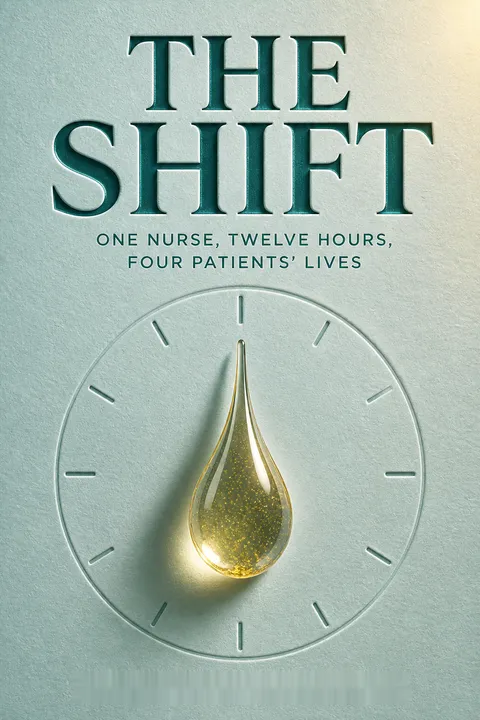


Key Takeaways
In a hospital, competence means acting without knowing how the story ends
The future stays hidden. Brown begins a twelve-hour oncology shift already afraid of the moment a patient might suddenly crash. Her job demands constant judgment about whether to intervene, wait, or ask for help, even though the body can conceal danger and no one can know exactly what will happen. During this shift, Richard Hampton improves unexpectedly while receiving a risky cancer drug. Sheila Field, admitted for a blood-clotting disorder, is found to have a perforated bowel and faces dangerous surgery. The nurse has to keep caring for both without access to certainty.
Action replaces prediction. The title’s shift is both a workday and a glimpse into people’s lives at their most vulnerable. Brown’s standard is not perfect foresight. It is careful attention, honest communication, and action despite not knowing how each story will end.
What's striking is the distinction between uncertainty and incompetence. In decision theory, a choice is judged by what could reasonably be known at the time, not only by what becomes obvious afterward. That distinction matters in medicine, where hindsight can make a hidden risk seem as if it should have been visible all along. Brown’s narrative also shows why uncertainty needs institutional support: clear escalation routes, enough staff, and permission to ask questions. Individual judgment matters, but no nurse can be expected to predict every turn in a patient’s illness.
Treat nurse staffing as a safety measure, not a budget variable
Numbers change attention. Brown starts with three patients, a lighter load than the usual four, and immediately recognizes the difference. With three, there is more room to talk with families, notice changing symptoms, and respond before small problems grow. A fourth patient could arrive at any moment. Some nurses on the floor carry five or six, while the sickest transplant patients may need a nurse for just two.
Acuity matters. Brown argues that staffing is not simply about whether patients feel cared for. Research she cites links excessive nurse workloads, beyond an appropriate level for the patients’ condition, with a greater chance of preventable death. There is no single safe number for every floor: the work changes with the severity and needs of each patient. But attention is finite, and increasing the load reduces time available per person.
The book makes staffing legible as a safety condition rather than a perk for workers. This aligns with safety engineering, where systems are designed around human limits instead of assuming flawless performance under pressure. Patient count alone is an imperfect measure, however. Four stable patients may demand less than two patients with rapidly changing conditions. The stronger policy question is how staffing responds to acuity, admissions, and emergencies, not whether a unit can meet a fixed ratio on paper. Brown’s point is that understaffing distributes risk downward, onto nurses and patients.
Let checklists catch errors, but never mistake records for care
Documentation has two faces. Brown spends much of the shift recording medications, assessments, pain levels, fall risks, and discharge instructions. Electronic systems demand detailed entries, sometimes while urgent care is happening. She worries that documentation can become a stand-in for the thing it is meant to record: time spent documenting a fall risk is time not spent helping a confused patient move safely.
Some checks matter deeply. Before Richard receives chemotherapy, two nurses independently confirm his dose, calculations, and treatment plan. That laborious double-check is a meaningful safeguard against a potentially dangerous error. By contrast, the paperwork attached to a fall assessment can be repetitive and poorly designed. The difference is whether a process helps staff notice risk and act, or mainly proves that a box was checked.
This is a practical version of a familiar measurement problem: once a proxy for quality becomes the target, it can crowd out the quality itself. A completed form is evidence of documentation, not automatically evidence of safe care. Yet abandoning records would also erase information needed for continuity, accountability, and error detection. The design challenge is to make documentation serve the clinical encounter, with concise interfaces and checks tied to decisions. Brown’s chemotherapy example shows that standardization can be powerful when it protects attention rather than merely consuming it.
A quiet patient can be critically ill; do not mistake calm for safety
Pain does not perform. Sheila tells Brown that her abdomen hurts, but she is subdued and tucked under blankets. Brown gives her pain medicine and plans to examine her. A scan later reveals free air in her abdomen, a sign that her bowel has perforated. The danger is serious, yet Sheila’s outward behavior does not match the dramatic distress Brown expects from an abdominal emergency.
Old cases shape new judgments. Brown remembers another patient with loud abdominal pain whose scan showed no perforation. Without realizing it, she had treated that experience as a template: a true emergency should look more dramatic. She recognizes the mistake, while also noting that diagnosing an acute abdomen is difficult and imaging was needed to confirm what was happening. Her lesson is not that intuition is useless, but that a patient’s presentation can defeat expectations.
The episode illustrates how availability bias works: a vivid recent case can become a misleading reference point for the next one. It also cautions against equating visible distress with clinical severity. Patients vary in how they express pain, and illness can impair communication or make someone unusually quiet. At the same time, hindsight can unfairly turn an uncertain presentation into an obvious miss. The useful response is structured reassessment and openness to new evidence, not a demand that clinicians possess perfect intuition.
Challenge clinical decisions respectfully when silence could cost a patient time
Advocacy crosses rank. Sheila’s surgeon initially considers delaying her operation. Brown worries that waiting could allow further damage and tells him why an operation that night may spare Sheila another exhausting trip to anesthesia and back. The surgeon weighs the risks, including his team’s fatigue, and ultimately operates that night. Brown cannot make the decision, but she can make sure Sheila’s interests are clearly represented.
Hierarchy shapes speech. Brown connects this tension to the Doctor-Nurse Game, a term used in articles by psychiatrist Leonard Stein. The phrase describes unspoken rules in doctor-nurse interactions, including nurses presenting ideas as if they were the doctor’s, or taking a more confrontational role to correct a doctor’s oversight. Brown experiences both patterns. The exchange shows why respectful persistence matters, especially when the person closest to the patient has information the decision-maker may not have.
The scene makes advocacy more precise than simply speaking up. It requires a concrete concern, a reason tied to the patient, and a willingness to raise it despite status differences. Research and practice around psychological safety emphasize that teams need ways to voice concerns without punishment, but speaking up cannot guarantee agreement or a better outcome. Medical decisions also involve competing risks, including fatigue. Brown’s account respects the surgeon’s responsibility while insisting that nurses’ observations and patient-centered concerns belong in the decision.
Read a difficult patient’s behavior as adaptation to lost control
Candace’s vigilance has a history. When she arrives for a transplant, she brings disinfectant wipes, scrutinizes the room, and insists that her central line needs a dye study. Staff see her as demanding. Brown learns that Candace previously endured a disastrous operation and lasting pain. In a hospital where infection is a real threat to an immunocompromised patient, her concern about cleanliness is not baseless, even if the line proves to be working.
Empathy is not automatic agreement. The urgent dye study delays other radiology work, and the physician who performs it is frustrated that it was requested as an emergency. Brown validates Candace’s worries but also sees the cost of an unnecessary priority. When Candace objects to being transported on a stretcher because no one explained the rule, a clear explanation resolves the conflict. Understanding the fear makes better care possible without making every demand right.
Candace’s case invites a useful distinction between behavior and motive. What looks like hostility may be an attempt to regain predictability after illness, past harm, or dependence on strangers. Patient-centered care takes that interpretation seriously, while still requiring fair triage and clinical judgment. Empathy should improve the conversation, not erase constraints or guarantee the requested intervention. Brown’s account is strongest when it holds both truths together: the patient has expertise about her own history, and hospitals must explain why one concern receives priority over another.
When treatment takes over, ordinary comforts help preserve personhood
Small needs are still real. Dorothy, hospitalized for leukemia treatment, is upset because she cannot get her heartburn medicine when she wants it. Brown changes its scheduled time, then joins the medical team in celebrating Dorothy’s improved blood count with a silly dance. The moment does not alter the treatment, but it gives Dorothy room to be more than a diagnosis. Later, Brown helps her pack for home and passes along the candy Dorothy has kept for staff.
Presence can be the work. Brown recalls another patient, Joe, whose transplant had failed and whose cancer was expected to return. She spends an unusually quiet afternoon listening as he repeats his fears and regrets. She offers no fix. He needs someone to witness what he is facing. In a shift full of medication, alarms, and forms, attention, humor, and familiar routines are also parts of care.
These moments resemble relational care, an approach that treats trust and recognition as part of the work rather than decorative extras. A patient’s preferred medication time or a shared joke can restore a little agency in an environment where schedules and bodily needs are controlled by others. Listening also gives distress a place to be expressed without forcing premature reassurance. Still, these acts depend on time. Celebrating personal care while leaving staffing and workload untouched risks romanticizing unpaid emotional labor. Human connection deserves institutional room, not just individual sacrifice.
Treat teamwork as infrastructure, not a substitute for adequate staffing
No one can split in two. Brown’s shift piles a risky infusion, a surgical emergency, a difficult admission, and Dorothy’s discharge onto one nurse. She jokes about wanting to become a superhero who can duplicate herself, but the need is real. Colleagues help: one prepares Richard’s premedication, others double-check chemotherapy, deliver food, and cover tasks for a newer nurse. Their small acts make the work more manageable and safer.
The worker is human, too. Brown becomes dizzy from not eating and takes a brief lunch only after her patients are stable. She notes that nurses often work through breaks because no one is available to cover their patients. A twelve-hour shift, constant calls, and growing documentation all draw on limited attention. Mutual aid matters, but it cannot make an overloaded system sustainable.
The book resists the heroic-worker story in which extraordinary effort is treated as proof that the system works. In organizational psychology, reliable teams build redundancy so that one person’s missed task or overload does not become a patient’s crisis. Colleagues helping each other is a form of that redundancy. But informal generosity can conceal staffing failures if management counts on it as routine capacity. Brown’s skipped meal and accumulating demands make a clear distinction: teamwork can absorb shocks, but it cannot indefinitely replace sufficient coverage and rest.
Keep hope beside probability, not in place of it
A good day is not a forecast. Richard becomes more alert and no longer needs oxygen while receiving Rituxan, lifting Brown’s spirits. Weeks later, he is back in the hospital, and the improvement has not lasted. Dorothy goes home after leukemia treatment but returns months later and dies. Other patients fare differently: Ray, Candace, and Irving leave the hospital cancer-free, while Sheila survives emergency surgery and a month-long stay.
Outcomes are not moral verdicts. In the afterword, Brown points to biology, treatment timing, transplant matches, insurance, and geography as factors in who gets a chance to recover. A demanding patient is not doomed by personality, nor does optimism guarantee remission. Hope helps people live through uncertainty, but it cannot turn a temporary improvement into a promise.
This ending counters survivorship bias, the tendency to treat visible success as proof that a strategy or attitude caused it. Brown’s patients receive different outcomes despite effort, courage, and care. Naming luck does not make action pointless; it prevents recovery from being mistaken for moral merit and illness for personal failure. Hope is most durable when it supports meaningful action without making promises about results. That distinction serves clinicians and families alike: optimism can accompany honest risk estimates rather than replacing them.
Analysis
The book compresses the moral and operational strain of bedside nursing into one shift. Its structure matters: readers encounter the work in real time, through interrupted tasks, changing priorities, alarms, and incomplete information. A schedule that might look like a list of procedures becomes a series of judgments about attention, authority, risk, and what a patient needs beyond treatment. Brown’s English-literature background is present in the way she uses recurring images and stories, but the narrative does not turn illness into a neat lesson. Several patients improve, one returns, one dies, and one survives a dangerous operation. The different endings resist a tidy equation between good care and good outcomes.
The book’s most important contribution is its account of nursing as both skilled observation and relationship. Technical work, such as checking a chemotherapy dose, is inseparable from noticing a change in breathing, interpreting a patient’s pain, or translating a physician’s plan into something a frightened family can understand. Yet the systems surrounding that work often make its human dimensions hard to see. Documentation, staffing decisions, phone interruptions, and fragmented physician coverage are not background details. They shape what clinicians can notice and how patients experience care.
Brown’s memoir is not a staffing study or a clinical guide. It draws on one oncology floor, one nurse’s memory, and cases whose details are changed or combined to protect privacy. Its judgments about systems are therefore grounded testimony, not a universal measurement of every hospital. That limitation also clarifies the book’s value: it makes visible the practical consequences of policies that can otherwise appear abstract. The reader sees how a missing break, unclear handoff, or unchallenged decision enters a room with a vulnerable person in it. The enduring question is not whether care can eliminate uncertainty. It is whether healthcare systems help people respond to uncertainty with sufficient skill, time, honesty, and support.
Review Summary
The Shift receives mostly positive reviews, praised for its insightful portrayal of a nurse's demanding 12-hour shift in an oncology ward. Readers appreciate Brown's detailed account of patient care, medical procedures, and the challenges faced by nurses. Some criticize the repetitive nature and slow pacing. The book offers valuable perspective on hospital operations and the nursing profession. While some find it boring, others are deeply moved by Brown's compassion and dedication. Overall, it's considered an eye-opening read about the realities of nursing.
People Also Read


Glossary
Voice care
Recorded nursing handoffA hospital handoff method in which an outgoing nurse records a spoken report about each patient for the incoming nurse to hear by phone. It allows nurses to receive report without gathering everyone in one place, but can lose visual cues and personal context that may emerge in direct conversation.
Doctor-Nurse Game
Unspoken rules of collaborationA phrase used in articles by psychiatrist Leonard Stein to describe patterned interactions between doctors and nurses shaped by professional hierarchy and gender history. Nurses may frame a recommendation so a doctor can adopt it as his own, or speak more directly to correct a perceived oversight. Brown uses the term to examine how authority affects clinical communication.
Negative Capability
Remaining within uncertaintyJohn Keats’s term for tolerating uncertainty, doubt, and unanswered questions without forcing a premature explanation. Brown applies it to the emotional difficulty of caring for patients when clinicians cannot yet know what will happen or when a treatment or operation will occur.
Absolute Neutrophil Count (ANC)
Measure of infection-fighting cellsA laboratory measure of neutrophils, a type of white blood cell that helps the body fight infection. In Dorothy’s case, her care team watches the count as her immune system recovers after chemotherapy. Brown notes that a count reliably above 500 can indicate that Dorothy is ready to leave the hospital.
Systemic Inflammatory Response Syndrome (SIRS)
Severe body-wide inflammatory responseA dangerous systemic response that can occur in advanced sepsis. Brown describes how infection can trigger widespread inflammation, fluid leaving the bloodstream, falling blood pressure, and eventual organ failure. In Sheila’s case, a perforated bowel risks releasing intestinal bacteria into the abdomen and causing a worsening infection.
Autologous transplant
Transplant using a patient’s cellsA stem cell transplant in which a patient receives their own previously collected cells, rather than cells donated by another person. Brown describes Candace’s treatment as an autologous transplant. The cells are infused through a central line after high-dose chemotherapy, which has damaged the patient’s ability to make new blood cells.
Third tube
Extra blood-typing sampleA hospital safeguard intended to help confirm that blood samples for typing and screening belong to the correct patient. The intended process calls for a separate sample later, but Brown describes a workaround in which the extra tube is drawn with the others and sent afterward. Delaying its delivery does not make it an independently collected sample.
FAQ
What's "The Shift: One Nurse, Twelve Hours, Four Patients' Lives" about?
- Nonfiction narrative: "The Shift" is a nonfiction account by Theresa Brown, a nurse, detailing a single twelve-hour shift on a bone-marrow transplant/medical oncology floor in a teaching hospital in Pennsylvania.
- Focus on four patients: The book follows the lives of four patients during this shift, providing an intimate look at their medical challenges and personal stories.
- Insight into nursing: It offers a detailed portrayal of the nursing profession, highlighting the emotional and physical demands of the job.
- Healthcare system exploration: The book also delves into the complexities and challenges of the modern healthcare system from a nurse's perspective.
Why should I read "The Shift"?
- Real-life perspective: It provides a genuine, firsthand account of the daily life of a nurse, offering insights that are often overlooked in discussions about healthcare.
- Emotional depth: The book captures the emotional highs and lows of nursing, making it a compelling read for anyone interested in the human side of medicine.
- Educational value: Readers gain a better understanding of medical procedures, patient care, and the healthcare system's inner workings.
- Inspiration and empathy: The stories of the patients and the dedication of the healthcare professionals can inspire empathy and a deeper appreciation for the nursing profession.
What are the key takeaways of "The Shift"?
- Nursing challenges: The book highlights the physical and emotional challenges nurses face, including long hours, emotional stress, and the need for quick decision-making.
- Patient care complexity: It illustrates the complexity of patient care, showing how nurses must balance medical tasks with emotional support for patients and their families.
- Healthcare system critique: Brown provides a critique of the healthcare system, pointing out inefficiencies and the impact of administrative decisions on patient care.
- Human connection: The narrative emphasizes the importance of human connection and empathy in healthcare, both for patient recovery and for the well-being of healthcare providers.
What are the best quotes from "The Shift" and what do they mean?
- "Work is love made visible." This quote underscores the dedication and compassion that nurses bring to their work, highlighting the emotional investment required in patient care.
- "If we could know the future, our jobs would be a lot easier." This reflects the uncertainty inherent in healthcare, where outcomes are unpredictable, and decisions must be made with incomplete information.
- "In the midst of life, we are in death." This quote from the Episcopal Book of Common Prayer captures the constant presence of mortality in the hospital setting, reminding readers of the fragility of life.
- "The cutting edge of health care sometimes nestles just next to the razor’s edge of survival." This illustrates the fine line between life-saving interventions and the risks they pose, emphasizing the high stakes of medical care.
How does Theresa Brown portray the nursing profession in "The Shift"?
- Realistic depiction: Brown provides a realistic portrayal of nursing, showing both the rewarding and challenging aspects of the profession.
- Emotional labor: The book highlights the emotional labor involved in nursing, as nurses must manage their own emotions while providing support to patients and families.
- Multitasking demands: It emphasizes the multitasking nature of nursing, where nurses juggle medical tasks, patient care, and administrative duties.
- Advocacy role: Brown portrays nurses as patient advocates, often acting as intermediaries between patients and doctors to ensure the best care.
What specific challenges do nurses face according to "The Shift"?
- Long hours: Nurses often work twelve-hour shifts, which can be physically and emotionally exhausting.
- Emotional stress: They deal with the emotional stress of caring for critically ill patients and supporting their families.
- Administrative burdens: Nurses face increasing paperwork and administrative tasks, which can detract from patient care.
- Resource limitations: They often work with limited resources and must make difficult decisions about prioritizing care.
How does "The Shift" explore the healthcare system?
- System inefficiencies: Brown critiques inefficiencies in the healthcare system, such as understaffing and excessive paperwork, which impact patient care.
- Economic pressures: The book discusses the economic pressures on hospitals, including the focus on "heads in beds" for revenue.
- Patient-nurse dynamics: It highlights the dynamics between patients and nurses, showing how systemic issues can affect these relationships.
- Advocacy for change: Brown advocates for changes in the healthcare system to better support nurses and improve patient outcomes.
What role do empathy and human connection play in "The Shift"?
- Central theme: Empathy and human connection are central themes, as Brown emphasizes their importance in patient care and recovery.
- Patient interactions: The book illustrates how nurses use empathy to build trust and rapport with patients, which can aid in their healing process.
- Support for nurses: Human connection is also vital for nurses, providing emotional support and camaraderie in a demanding job.
- Impact on outcomes: Brown suggests that empathy and connection can positively impact patient outcomes and the overall healthcare experience.
How does Theresa Brown address the unpredictability of healthcare in "The Shift"?
- Unpredictable outcomes: Brown highlights the unpredictability of patient outcomes, where even the best medical interventions can have uncertain results.
- Decision-making challenges: Nurses and doctors must make decisions with incomplete information, often under time pressure.
- Adaptability: The book emphasizes the need for adaptability and quick thinking in healthcare, as situations can change rapidly.
- Emotional resilience: Brown discusses the emotional resilience required to cope with the unpredictability and stress of the job.
What insights does "The Shift" provide about patient care?
- Holistic approach: Brown advocates for a holistic approach to patient care, considering both medical and emotional needs.
- Communication importance: Effective communication between nurses, patients, and families is crucial for successful care.
- Patient individuality: The book emphasizes recognizing each patient's individuality and tailoring care to their specific needs.
- Role of advocacy: Nurses often act as advocates for patients, ensuring their voices are heard and their needs are met.
How does "The Shift" depict the relationship between nurses and doctors?
- Collaborative efforts: The book portrays the collaborative efforts between nurses and doctors, essential for effective patient care.
- Power dynamics: Brown explores the power dynamics in the hospital, where nurses must navigate their roles in relation to doctors.
- Communication challenges: Effective communication is highlighted as a challenge, with nurses often acting as intermediaries between patients and doctors.
- Mutual respect: Despite challenges, the book emphasizes the importance of mutual respect and understanding between nurses and doctors.
What personal experiences does Theresa Brown share in "The Shift"?
- Career transition: Brown shares her transition from teaching English to becoming a nurse, highlighting her motivations and challenges.
- Emotional moments: She recounts emotional moments with patients and their families, illustrating the personal impact of her work.
- Professional growth: The book details her professional growth and the lessons learned from her experiences on the hospital floor.
- Balancing roles: Brown discusses balancing her roles as a nurse, writer, and mother, providing insight into her personal life.
Download PDF
Download EPUB
.epub digital book format is ideal for reading ebooks on phones, tablets, and e-readers.








