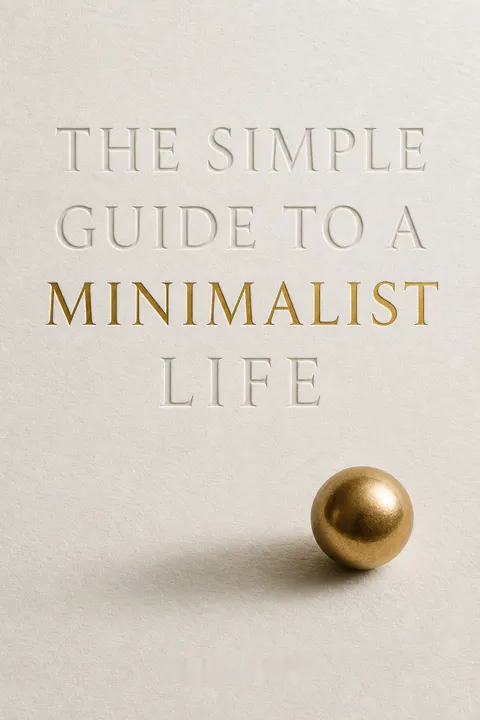


Key Takeaways
Remove what is unnecessary to make your best day possible
Less should serve more. Babauta defines a minimalist life as removing what is unnecessary so there is room for what brings joy and value. The goal is not an empty home or a life without pleasure. It is to identify what matters personally, then stop giving the rest so much space, money, and attention. A minimalist day will look different for each person because people value different things.
Picture the day you want. Babauta describes waking early, reading with coffee, running, writing, and spending time with family. The details are his, not a prescription. The useful exercise is to imagine a satisfying ordinary day, then ask which possessions, obligations, and distractions support it. Minimalism is a continuing process of reviewing those choices, not a finish line.
The book’s strongest distinction is between having less as an aesthetic and having less as a means. That makes the idea adaptable: a crowded kitchen may be useful to someone who loves cooking, while a sparse room may not be. The focus on an ordinary day also counters the tendency to plan life around rare vacations or purchases. One useful test is whether a reduction gives back something tangible, such as time, calm, or attention. Without that test, minimalism can become another standard to perform, complete with pressure to own the fewest objects.
Define enough before the next impulse purchase defines it for you
Wanting can renew itself. Babauta argues that clearing clutter will not last if the urge to acquire remains untouched. He distinguishes necessities, such as food, shelter, basic clothing, and loved ones, from the many extras people come to treat as indispensable. His point is not that every extra is bad, but that buying something new often answers a feeling of dissatisfaction only briefly.
Insert a pause. His 30-day list is a record of nonessential items someone wants to buy, with the date each desire appears. The purchase waits at least 30 days. Often the urge fades; if it remains, the person can reconsider it with more perspective. The book also redirects pleasure from owning toward doing: cooking, walking, creating, and spending time with friends.
The delay works like a cooling-off period in behavioral economics: it separates a strong momentary urge from a lasting preference. It can also reveal what a purchase represents, whether novelty, status, comfort, or a hoped-for improvement in daily life. That information is more useful than simply scolding oneself for wanting things. The idea has limits, since some purchases are time-sensitive or essential, and not every person has equal freedom to choose what counts as necessary. The method is best used for discretionary buying, not as a moral test of self-control.
Protect your day by choosing only a few high-impact commitments
A calendar can accumulate clutter. Work projects, volunteer roles, family activities, and side jobs may each seem worthwhile, yet together they can crowd out the activities a person values most. Babauta recommends listing regular and upcoming commitments, then identifying the four or five that matter most. For the rest, the task is to withdraw when possible and become more selective about new requests. Saying no can disappoint someone, but the book argues that the feared fallout is often manageable.
Choose the day’s work. Babauta calls a day’s three highest-impact tasks its Most Important Tasks, or MITs. They should receive attention before lower-priority tasks. He also recommends leaving unscheduled space between appointments, so delays do not make the whole day feel like a failure.
This approach treats attention as a finite resource, not an endlessly stretchable one. A calendar audit makes hidden commitments visible, while a small daily priority list forces trade-offs into the open. The advice also recognizes a social reality: people often accept requests to avoid immediate discomfort, then pay for that yes in lost time. Still, obligations cannot always be dropped, especially caregiving or work imposed by circumstance. In those cases, the same principle can help identify small areas of control, such as protecting one block of uninterrupted time or renegotiating a deadline.
Clear one small area, then make putting things away routine
Start smaller than the mess. A cluttered home can feel too large to tackle at once, so Babauta recommends working on a single surface, shelf, or drawer. He cites beginning with the kitchen sink, a task that may take only five to ten minutes and can create momentum. For each item, decide whether it is used and valued, then keep, donate, recycle, or discard it. Items that are hard to decide about can go into a dated maybe box; if they remain unused after six months, let them go.
Prevent the return. Give retained objects a regular place and practice returning them there. The book also suggests photographing sentimental objects when the memory matters more than the physical item. Decluttering is not a one-time purge. It depends on repeatable habits that stop new piles from forming.
The small-area method reduces the psychological barrier to starting, while a designated home for each item reduces later decision-making. Together, these ideas turn tidiness from a heroic cleanup into a maintenance routine. The maybe box is a useful bridge for people who find immediate disposal stressful, though it can become storage in disguise unless the review date is honored. Sentimental objects also carry meanings that a photograph may not preserve for everyone. The deeper lesson is not to erase attachment, but to distinguish the memory or relationship from the object that happens to represent it.
Make tools and workspaces serve the task, not old habits
Question the default setup. Babauta applies minimalism to work as well as possessions. He describes moving away from paper files, desk supplies, and scattered notes toward a mostly digital workflow. His broader suggestion is to identify what a job actually requires, then remove tools that remain only because they have always been there. A clear desk, a single place for incoming papers, and fewer visual distractions can make focused work easier.
Reduce the filing burden. For digital documents, he proposes four broad folders: Inbox, Working, Read, and Archive. The first three are reviewed regularly, while search helps retrieve archived material without elaborate folder trees. He favors simple software and a clear computer desktop, arguing that tools should support creation rather than invite endless organizing. His online storage approach reflects the technology available when the book appeared in 2009.
This is an early version of a useful design principle: reduce friction around the work itself, not just around the objects on a desk. Searchable files and a small number of intake categories can prevent classification from becoming a second job. The same logic applies to notifications and apps, which compete for attention even in a physically tidy office. The digital solution is not automatically simpler, however. Cloud storage introduces privacy, access, and backup questions, and a folder system that suits one person may frustrate another. The right measure is reliable retrieval with minimal maintenance.
Automate the basics, but never spend money you do not have
Make fewer money decisions. Babauta’s plan begins with reducing consumer spending and building an emergency fund. He suggests first saving at least $500, then gradually reaching $1,000 or more. After that initial cushion, direct much of the extra money toward paying off debt while continuing to save. These amounts are his suggested starting figures, not universal targets.
Use simple guardrails. He favors cash or debit over borrowing, and suggests separating cash for categories such as groceries and fuel so the remaining amount is visible. Automatic deposits, savings transfers, and bill payments reduce repetitive administration, with a weekly account check for oversight. His purchase rule is straightforward: buy only when the item is genuinely needed and the money is already available. Cutting recurring expenses, from unused subscriptions to excess storage, can free funds for savings and debt repayment.
The advice combines two different strengths: automation lowers the mental load of routine payments, while visible limits make discretionary spending harder to ignore. This is a practical way to design around predictable temptation rather than relying on constant restraint. But automation can also conceal a problem if income varies, balances are tight, or an unexpected bill arrives. Emergency savings needs differ with health, housing, dependents, and job stability, so the book’s dollar amounts should be treated as examples. The enduring principle is to pair convenience with monitoring and to avoid borrowing for purchases that can wait.
Simplify daily routines without confusing less with healthier
Choose manageable habits. Babauta’s advice on food is to favor less processed ingredients, cook simply, and avoid routinely eating oversized portions. He points to fruits, vegetables, beans, and whole grains, and gives examples such as oats with fruit or bean-based meals. He also describes eating until nearly full and cites an Okinawan practice of stopping before complete fullness. These are the author’s recommendations, not individualized medical guidance.
Lower the setup cost. For fitness, he proposes starting with short walks and building toward regular activity, using bodyweight exercises when equipment or gym access is a barrier. For clothes and grooming, he recommends a coordinated wardrobe, durable basics, and fewer products. Across these routines, the aim is to remove unnecessary complexity while retaining what supports health, comfort, and daily life.
The useful connection is between simplicity and repeatability. A meal that can be prepared with ordinary ingredients, or movement that requires no commute to a gym, is easier to fit into a real week. Yet simplicity is not a substitute for personal needs: nutrition, exercise capacity, and grooming choices vary with health, culture, work, and identity. The book’s broad prescriptions should not be mistaken for universal standards, especially its claims about eating less. A better application is to remove needless barriers while keeping routines adequate, safe, and enjoyable for the person using them.
Pack for the trip you are taking, not every imagined problem
Carry only what earns its place. Babauta describes traveling with a small carry-on rather than checked luggage. His example includes a few changes of clothes, basic toiletries, travel documents, a book, and a camera. The exact list depends on the trip, but the decision rule is to ask whether an item is needed enough to justify carrying it. Washing clothes during travel and buying ordinary necessities at the destination can replace packing for every possibility.
Leave room in the itinerary. The book also argues against scheduling every hour or treating a destination as a checklist. A few planned priorities can coexist with time to rest, eat, wander, or talk with local people. A flexible plan makes delays and unexpected discoveries less likely to feel like failures. Traveling lightly, in this sense, means reducing both baggage and the pressure to see everything.
Packing and planning are two versions of the same forecasting problem: people try to eliminate uncertainty by carrying or scheduling more. A lighter approach accepts that small uncertainties are part of travel and that many needs can be handled locally. This can make a trip calmer, but it is not equally practical for every traveler. Disability, medication, weather, work obligations, and access to services may require more preparation. The principle is not to pack as little as possible; it is to distinguish a genuine contingency from an imagined one and prepare proportionately.
Cut resource use at the source, not only at the recycling bin
Consume less before sorting waste. Babauta connects minimalism with sustainability: fewer purchases mean fewer materials, packages, and resources used in production and transport. Recycling and choosing greener products can help, but he sees reduced consumption as the more fundamental change. His examples include eating less meat, choosing food with less packaging, driving less, and living in a smaller home when practical.
Make the scale personal. The book does not present sustainability as a checklist that every reader must follow identically. It frames it as a general habit of asking what a choice requires from the world. Walking, cycling, public transit, carpooling, and consolidating errands are offered as ways to reduce driving. The point is not purity. It is to make ordinary decisions with some awareness of their material costs.
The emphasis on prevention aligns with a basic principle of environmental accounting: avoiding demand can reduce impacts across extraction, manufacturing, packaging, and disposal, rather than addressing waste only at the end. It also broadens sustainability beyond consumer labels, since a product marketed as green still uses resources. At the same time, individual choices are shaped by infrastructure and income. A person without reliable transit cannot simply choose to drive less, and housing size may not be within reach. Personal restraint matters, but it works best alongside systems that make lower-impact options accessible.
Make shared spaces simpler without policing loved ones' lives
Start with what is yours. Babauta has six children and acknowledges that family life will not resemble an empty minimalist home. His advice is to accept that children may value their possessions differently, model the behavior rather than demand agreement, and set workable boundaries. For example, children’s belongings can be kept in bedrooms or designated play areas, with bins and clear places that make cleanup easier.
Make room for compromise. A regular family cleanup, a small purge after birthdays or holidays, and involving children in decisions can contain clutter without expecting perfection. With adult partners or relatives, the book recommends explaining the reason for the change, asking for help, and agreeing on shared spaces. If loved ones do not adopt minimalism, acceptance may be more peaceful than trying to control them.
This section gives minimalism a social dimension: a home is shared infrastructure, not a private display of one person’s ideals. Boundaries can protect common rooms while preserving personal areas where others retain choice. That distinction is especially important with children, whose ability to organize develops over time and whose preferences deserve some respect. The author’s example also makes the advice more credible: family life is inherently more complicated than a solitary ideal. The tension remains real, since a boundary that feels fair to one household member may feel restrictive to another, so negotiation matters more than aesthetic uniformity.
Analysis
This book is best understood as a practical guide to editing, not a manifesto for owning a fixed number of objects. Its central proposal is that possessions, commitments, routines, and consumption all compete for limited space and attention. Removing unnecessary demands can make room for the activities and relationships a person values. That idea links the chapters on decluttering, scheduling, finances, travel, work, family, and sustainability.
The structure is intentionally modular. Babauta presents separate guides rather than a universal sequence, and repeatedly acknowledges that readers’ circumstances differ. This makes the book accessible, but also means its advice can feel like a collection of tools rather than a tightly argued theory. The most coherent thread is the cycle of noticing what matters, reducing what interferes, and maintaining the result through simple habits. The 30-day waiting list, a designated home for objects, and a small daily task list are all ways to replace vague intentions with concrete decisions.
Its most persuasive contribution is the distinction between subtraction and deprivation. Minimalism is valuable only when it improves the life left behind. That framing prevents a sparse room, a tiny wardrobe, or a paperless office from becoming goals in themselves. The examples are personal and grounded, especially the author’s account of balancing a minimalist philosophy with a large family. Readers can see the principle adapting to real constraints rather than requiring perfect consistency.
The book also reflects its 2009 moment. Its technology recommendations rely on particular software and assumptions about online storage that have changed, and its health claims are not presented with the nuance expected from current clinical guidance. The durable insight is less specific: test inherited routines, simplify where it helps, and judge the result by whether it creates more time, calm, usefulness, or lower consumption. Its practical value lies in that adaptable test, not in copying the author’s exact lifestyle.
Review Summary
The Simple Guide to a Minimalist Life receives mixed reviews. Some readers find it practical and inspiring for simplifying their lives, praising its concise advice on decluttering, finances, and lifestyle choices. Others criticize it as repetitive, outdated, and overly extreme in its recommendations. Many appreciate the minimalist principles but feel the book lacks depth and nuance. Some find certain suggestions unrealistic or unnecessary. Overall, reviewers agree it may be helpful for those new to minimalism but offers little new insight for those already familiar with the concept.
People Also Read


Glossary
Minimalist life
Less for what mattersBabauta’s term for a life that removes unnecessary possessions, activities, and distractions to create room for what brings value and joy. It is not defined by a particular number of belongings or by an austere appearance. The form it takes depends on an individual’s priorities and circumstances.
30-day list
A pause before buyingA written list of nonessential things a person is tempted to purchase, with the date each item is added. The person waits at least 30 days before buying. The delay is meant to reveal whether the desire persists after the immediate impulse has passed.
Most Important Tasks (MITs)
Three daily prioritiesBabauta’s name for the three high-impact tasks selected as a day’s main work. They should be chosen deliberately and tackled before lower-priority tasks when possible. The technique narrows an expansive to-do list to a manageable focus rather than treating every task as equally urgent.
maybe box
Temporary undecided storageA box for possessions a person cannot yet decide whether to keep or discard while decluttering. The box is dated and stored out of the way. If the items remain unused over the following six months, the person lets them go. It serves as a temporary aid, not a permanent storage system.
clean eating
Food close to natural formBabauta’s description of eating foods in a minimally processed state. His examples include fruits, vegetables, beans, nuts, and whole grains, alongside moderation in treats and restaurant meals. He presents this as a personal target rather than a strict rule or a required diet.
FAQ
1. What is "The Simple Guide to a Minimalist Life" by Leo Babauta about?
- Practical Minimalism Guide: The book is a practical guide to adopting minimalism in all areas of life, from possessions and home to work, finances, and relationships.
- Focus on Essentials: Babauta emphasizes stripping away the unnecessary to make room for what truly brings joy and meaning.
- Personal Experience: The author shares his own journey and experiences, offering advice, principles, and step-by-step suggestions.
- Flexible Approach: The book is structured as a series of guides rather than a strict program, allowing readers to find their own minimalist path.
2. Why should I read "The Simple Guide to a Minimalist Life" by Leo Babauta?
- Reduce Stress and Clutter: The book offers actionable strategies to reduce physical, mental, and emotional clutter, leading to a calmer, more focused life.
- Gain More Freedom and Time: By minimizing commitments and possessions, readers can reclaim time and space for what matters most.
- Sustainable and Frugal Living: Babauta connects minimalism to sustainability and frugality, showing how less consumption benefits both the individual and the planet.
- Accessible and Encouraging: The tone is supportive and non-judgmental, making minimalism approachable for beginners and adaptable for different lifestyles.
3. What are the key takeaways from "The Simple Guide to a Minimalist Life"?
- Omit Needless Things: Focus on removing what isn’t essential, but don’t aim for emptiness—fill your life with what brings joy.
- Contentment Over Consumption: Learn to be happy with what you have, breaking the cycle of always wanting more.
- Minimalism Is a Process: Minimalism isn’t a one-time event but an ongoing process of editing and refining your life.
- Quality Over Quantity: Choose fewer, higher-quality possessions, relationships, and activities.
- Minimalism Is Personal: There’s no single right way—each person’s minimalist life will look different based on their values and needs.
4. How does Leo Babauta define a minimalist life in "The Simple Guide to a Minimalist Life"?
- Stripped of the Unnecessary: A minimalist life is one where the unnecessary is removed to make space for joy and meaning.
- Freedom and Lightness: Minimalism brings peace, freedom, and a sense of lightness by reducing physical and mental burdens.
- Rejecting the ‘More’ Mindset: Minimalists avoid the constant pursuit of more—more stuff, more busyness, more consumption.
- Embracing Contentment: The focus is on being content with enough and finding happiness in doing, not owning.
5. What are the core minimalist principles in "The Simple Guide to a Minimalist Life"?
- Omit Needless Things: Remove what isn’t essential, but keep what truly matters.
- Identify the Essential: Regularly ask what is most important and what brings happiness or impact.
- Make Everything Count: Ensure that everything you keep or do is worthy and meaningful.
- Fill Life with Joy: Don’t just remove things—add in what brings joy and fulfillment.
- Continuous Editing: Minimalism is a constant process of revisiting and refining your life.
6. How does Leo Babauta recommend starting the minimalist journey in "The Simple Guide to a Minimalist Life"?
- Acknowledge You Have Enough: Begin by realizing that you already have what you need, which curbs the urge to acquire more.
- Declutter Possessions: Start cutting back on physical clutter at home or work, either quickly or gradually.
- Simplify Your Schedule: Reduce commitments and create breathing room for what’s important.
- Edit Everything Gradually: Apply minimalist principles to all areas of life, making small, consistent changes over time.
7. What practical advice does "The Simple Guide to a Minimalist Life" give for decluttering and organizing?
- Start Small: Begin with one area, like the kitchen sink, and expand gradually to other surfaces and rooms.
- Use a Decluttering System: Remove everything from a surface, decide what to keep, donate, or discard, and only put back essentials.
- Address Emotional Barriers: Overcome fears of needing things later, wasting value, or losing sentimental items by using strategies like the “maybe” box or taking photos.
- Maintain with Habits: Develop routines to keep spaces clear and ensure everything has a designated place.
8. How does "The Simple Guide to a Minimalist Life" address minimalism in specific areas like home, work, and travel?
- Minimalist Home: Keep only essential furniture and clear surfaces, use simple decorations, and store items out of sight.
- Minimalist Workspace: Eliminate unnecessary tools and papers, keep a clear desk, and use digital solutions for organization.
- Minimalist Travel: Pack light, bring only essentials, keep itineraries flexible, and focus on experiences rather than possessions.
9. What does "The Simple Guide to a Minimalist Life" say about minimalism in food, fitness, and finances?
- Minimalist Food: Eat less, focus on whole and unprocessed foods, cook simply, and avoid unnecessary kitchen gadgets.
- Minimalist Fitness: Exercise can be simple and effective with bodyweight routines and minimal equipment, focusing on consistency over intensity.
- Minimalist Finances: End consumerism, build an emergency fund, get out of debt, use cash, automate finances, and only buy what’s truly needed.
10. How does Leo Babauta suggest handling minimalism with kids and non-minimalist loved ones?
- With Kids: Accept some mess, teach values of quality over quantity, declutter regularly, and use bins and routines to contain clutter.
- With Loved Ones: Focus on your own actions, lead by example, educate gently, set boundaries, and find compromises or acceptance if others aren’t on board.
- Family Minimalism Is Imperfect: Recognize that minimalism with others will never be perfect, but progress is possible.
11. What is the relationship between minimalism and sustainability in "The Simple Guide to a Minimalist Life"?
- Consume Less, Waste Less: Minimalism naturally leads to using fewer resources, producing less waste, and reducing environmental impact.
- Beyond Green Products: Babauta argues that buying less is more sustainable than simply buying “greener” products.
- Smaller Footprint: Minimalism encourages smaller homes, less driving, less packaging, and less meat consumption for a lighter impact on the planet.
- Mindset Shift: Sustainability is seen as a mindset of “enough” rather than a checklist of eco-friendly actions.
12. What are the best quotes from "The Simple Guide to a Minimalist Life" by Leo Babauta and what do they mean?
- “Be content with what you have; rejoice in the way things are. When you realize there is nothing lacking, the whole world belongs to you.” —Lao Tzu
This quote emphasizes the core minimalist value of contentment and the freedom it brings. - “Omit needless things.”
A recurring principle in the book, urging readers to remove the unnecessary and focus on what matters. - “Perfection is achieved, not when there is nothing more to add, but when there is nothing left to take away.” —Antoine de Saint-Exupery
This highlights the minimalist ideal that less can be more, and true beauty or function comes from simplicity. - “The ability to simplify means to eliminate the unnecessary so that the necessary may speak.” —Hans Hofmann
This quote underlines the idea that by removing clutter, the truly important things in life become clearer. - “You must be the change you want to see in the world.” —Gandhi
Babauta uses this to encourage readers to lead by example, especially when others around them aren’t minimalists.
About the Author
Other books by Leo Babauta


Download PDF
Download EPUB
.epub digital book format is ideal for reading ebooks on phones, tablets, and e-readers.








