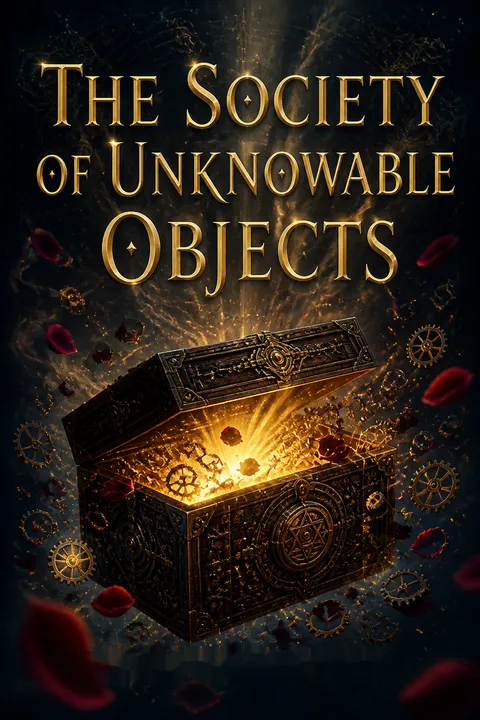


Plot Summary
Prologue
In 2015, Imelda Sparks follows a shifting map across the Nevada desert in search of a magical object. Near dusk, a strange man unsettles her; as she backs away, she steps over a ravine and falls to her death.
The man catches the crucifix she carried, an artefact capable of bringing the dead back, and keeps her bag and other finds. Imelda’s body remains dead for nearly two years, while the stranger keeps her belongings and studies them.
The opening gives the novel’s magic an immediate cost. Imelda’s curiosity and confidence carry her into danger, but her fall is an accident, not a neat punishment for seeking wonder. The stranger’s presence complicates the death before the reader can explain him: he is frightening, yet he tries to catch her, and later preserves what she leaves behind. The broken chain and the shifting map establish a world where objects have powers but no reliable moral instructions. Imelda’s absence also becomes an inheritance for Magda, first as grief, then as a mystery whose consequences reach into the present.
The Archive Wakes
Magda Sparks is a successful thriller writer whose closest family is the bookshop owner Frank Simpson, her mother’s old friend and the man who introduced her to the secret Society of Unknowable Objects. The Society is meant to protect magical everyday objects, though for years its meetings have amounted to little more than tea and routine checks.
Frank abruptly calls an extra meeting: James Wei, a Hong Kong art curator, believes he has found a magical ivory chess rook and knows of the Society through his late father’s friendship with Will Pinn’s father. Will refuses to travel, and Frank hesitates to send Magda. She insists on going herself, eager to find a real artefact and prove she is more than a passive member.
The summons turns Magda’s cherished secret world into an active responsibility. Her eagerness is not merely a taste for adventure: the Society gives structure to a life shaped by books, inherited wealth, and the early loss of her mother. Frank’s reluctance and Will’s refusal expose the group’s habitual avoidance before danger has even arrived. The rook matters because it makes the abstract premise concrete, but the breach of secrecy is equally consequential. Someone outside the Society knows its name, and the old arrangements can no longer guarantee safety. Magda’s decision to go is both a bid for agency and the first step beyond the protection of routine.
Noodles Before Gunfire
In Hong Kong, James meets Magda warmly, leads her to a crowded noodle shop, and explains how he found the rook among the assets of a dead banker. Their shared love of books and food makes the meeting feel almost like a date, but Magda notices a gaunt man watching her. At James’s office high above the harbour, she confirms that the rook feels unnaturally heavy and strange.
Before she can take it to safety, the watcher enters with a suppressed pistol and demands the artefact. James steps between him and Magda, and the gunman shoots him dead. Magda grabs the rook and escapes by leaping from the balcony, using her mother’s jade pendant to arrest her fall and fly away into the Hong Kong night.
The scene deliberately lets intimacy form before violence cuts it short. James’s openness gives Magda a glimpse of companionship beyond her familiar London circle, so his apparent death becomes a personal shock as well as a plot escalation. Her flight is the first visible proof that magic is not safely confined to the Society’s archive. It also marks a distinction between inherited knowledge and lived experience: Magda has carried the pendant for years, but only under mortal pressure does its power become a means of survival. The gunman’s methodical pursuit makes the artefact trade feel less like a quaint secret and more like a contest over who can wield power without restraint.
The Society's First Fracture
Back in London, Magda finds Henrietta Wiseman waiting in her house. Henrietta, long absent from Society meetings, has seen footage of Magda flying and returns with a warning: Frank’s account of the Society is false, and the grand Clockwork Cabinet contains no collection. She says the founders were not noble guardians but men who misused magic for their own advantage.
At their meeting in Regent’s Park, Frank barely responds to Magda’s account of the shooting and instead tests the rook. It lets him stop and direct people at a distance, a display that leaves Magda horrified. Frank admits the Cabinet is empty but will not yet explain why. Magda sees that loyalty to him has left her ignorant of the very institution she trusted.
Henrietta’s return breaks the comfort of Magda’s inherited version of events. Her claims are persuasive partly because she is not a simple enemy of Frank: she still cares about him, yet refuses the paternal terms on which he controls information. Frank’s demonstration makes his secrecy more understandable without making it innocent. The rook’s power is not an abstract threat; it turns ordinary parkgoers into instruments of another person’s will. Magda is caught between two forms of trust, the intimacy she feels toward Frank and the evidence Henrietta asks her to examine. The fracture is therefore epistemic as much as emotional: Magda must decide who gets to define what she knows.
The Box Beneath Bell Street
At a hastily arranged Society meeting, Will stays away and Henrietta does not attend. Frank shows Magda a concealed safe behind a basement bookcase and opens the Impossible Box, a small container that can hold objects of any size and release only what its user can name.
He says the Society’s artefacts are inside, not in the empty Cabinet, and begins to explain a mysterious book kept in his apartment’s so-called magic pantry. Before he can fetch it, Owen Maddox breaks in, injures Frank, and threatens Magda.
He steals the rook and the box, but James appears alive and strikes Owen with a book, driving him off. Henrietta has pulled Frank through a wall to safety. At the hospital, Frank tells Magda that the book matters more than the stolen collection.
The attack turns Frank’s withholding into a practical danger. He is finally preparing to share the truth, but the delay leaves the Society’s greatest asset exposed to a man who has already killed once. The Impossible Box offers an ingenious answer to the problem of protecting dangerous objects, yet it cannot protect people from the consequences of secrecy or hesitation. James’s survival revises Magda’s grief into relief, but his return also confirms that the world’s rules are less stable than she believed. Frank’s cryptic emphasis on the book gives the next conflict its scale: recovering a finite archive may matter less than preventing someone from acquiring the means to create limitless magic.
The Book in the Pantry
At Frank’s apartment, Magda finds a wrapped notebook and a letter hidden among the treats he once kept for her. Frank’s account dismantles the Society’s official origin: its earlier members exploited magical objects, and Frank later invented rules and a cleaner history to stop the abuses.
He explains that the notebook, the Book of Wonders, can create new artefacts from a person’s description. Imelda used it to make the Atlas of Lost Things, then travelled to recover lost objects, including the crucifix, coin, and blue flower.
Frank believes the Atlas led her to the stranger in Nevada, where she fell. James’s father, Dennis, had also entrusted James with a magical supply of pills that kept him healthy. Magda decides the stolen collection must be recovered.
Frank’s confession reframes protection as a response to inherited guilt, not a timeless virtue passed intact through generations. His fabricated history was meant to prevent repetition, but it also denied younger members the information needed to judge his choices. Imelda’s expedition complicates the boundary between responsible stewardship and risky curiosity: she used the book to solve the Society’s practical problem, then paid a terrible price. The Book of Wonders is more dangerous than any single artefact because it makes desire operational. The group’s challenge is no longer just to keep existing objects from bad hands. They must also decide who can be trusted with the power to imagine new ones.
The Killer's Borrowed Senses
Owen’s pursuit has its own history. In Cairo, while working as a government assassin, he killed a former politician who showed him a silver flask that never emptied. Drinking from it let Owen see people’s souls as coloured wings, and he made the experience part of his killing ritual. Years later, a strange man named Lukas came to Owen’s forest home, survived his bullets, and took both the flask and a map that led to magical objects.
Owen spent five years following that map. After stealing the rook and the Impossible Box from Frank’s basement, he tracks the flask to Alabama, where a flower-choked clearing surrounds an abandoned church. There he finds Lukas, immobilizes him with the rook, and reaches for the flask.
Owen’s past shows how a magical gift can intensify a pre-existing appetite rather than transform its owner into someone new. The flask gives him a vivid way to experience the lives he destroys, but he converts that heightened perception into another pleasure of domination. His disciplined language of planning masks a moral world in which other people are targets, not persons. Lukas’s earlier theft reverses that relationship: the hunter becomes dependent on a trail he does not control. This section also prepares the conflict’s unusual terms. Owen has physical skill and a powerful artefact, but his plan assumes that any opponent can be subdued if he has the right tool.
Alabama's Living Graveyard
When Owen tries to reclaim the flask, Lukas’s thoughts bring the assassin’s victims back into the clearing, among them Owen’s former handler and his abusive father. Owen uses the rook to freeze them and shoots them again, but the dead return in growing numbers. A monstrous tree seizes him and crushes him unconscious.
Lukas takes the flask, rook, and Impossible Box, while Henrietta searches underground and finds James alive in a pocket of earth. She ghosts them both to the surface and recovers the box. Owen later escapes the woods, but a resurrected victim shoots him; he kills her again and staggers away wounded. The map that once served Owen’s pursuit now leads Magda, Henrietta, and James toward the same Alabama town.
Lukas defeats Owen not by being more calculating but by making the assassin face the human consequences he has spent a lifetime converting into spectacle. The returned victims are not a moral tribunal with a tidy verdict; they are confused, endangered people dragged back into a violence they never chose. Owen responds by repeating the very act that created the crisis, showing the limits of his self-image as disciplined rather than cruel. Henrietta’s rescue of James offers a counterpoint: she uses her ability to cross barriers for care, not possession. Yet the box has changed hands, and the danger has not ended. The map’s guidance brings Magda toward a confrontation she cannot control.
The Daughter Sees Her Mother
At the edge of Masters, Magda recognizes the embroidered bag Lukas carries as her mother’s. He has Imelda’s last journal and says he found her after her fall. The crucifix brought her back, but Lukas repeatedly revived her when she tried to die, until her mind was damaged and he buried her with the coin’s power.
Owen returns in a car and strikes Lukas, James, and Henrietta; Lukas reappears, then splits the road and swallows James and Henrietta into the earth. He freezes Magda with the rook. Though pinned, she uses her pendant to lift Lukas into the air and dislodge the chess piece. When Imelda appears among the trees, Magda’s concentration breaks. Imelda attacks Lukas, then vines drag her away, leaving Magda to flee alone.
The reunion Magda might have wished for becomes an encounter with the violence of denying death. Lukas’s stated desire to restore Imelda cannot account for her suffering or her repeated attempts to escape him. His loneliness is real, but it does not make his actions harmless. Magda’s ability to use the pendant without holding it in her hand signals growth under pressure, yet the moment she sees her mother is also the moment she loses control. Love makes her vulnerable to the very magic she has been trying to master. The scene refuses a comforting distinction between wonder and horror: the same objects that restore, protect, or free someone can also prolong pain.
A Child Without Death
Magda reaches London after flying across the ocean, battered by wind and grief. Henrietta finds James alive underground and brings him back, taking the Impossible Box with her; the pair head for London. Meanwhile, Will examines the Book of Wonders and notices two pages have been cut out. Using the book, he restores them.
One shows a request for a child who would live, revealing that Magda’s grandfather Joseph Rudge had used the book to create Lukas. Frank confirms that Lukas is an artefact made to survive, not an ordinary man. Magda understands why bullets and the Impossible Box affect him differently, and why he senses magical objects. When the map shows the box moving in London, the scattered group realizes Lukas has followed them.
Will’s discovery matters because it comes through the very method he distrusts: he uses magic to solve a problem that ordinary inspection cannot resolve. His precision gives the revelation a different authority from Frank’s guarded explanations. Lukas’s origin also changes the moral frame without absolving him. He was made in response to someone’s longing, then abandoned to a life he could not understand; his dangerous conduct grows from a design imposed on him, not from a choice to be human. Magda now has to confront a creation that is both a person-like sufferer and an indestructible object. The map’s movement closes the distance between explanation and immediate threat.
Roses Over Bell Street
Lukas follows the stolen artefacts to London and uses a knife that controls the wind to travel. He reaches Bell Street Books before Magda can stop him, takes the Book of Wonders, and fills the surrounding streets with vast, thorned roses and twisting vines. Magda finds James and Henrietta in the storm, then reaches the wall of growth around the shop.
Henrietta passes through it and brings Will back out, but Frank refuses to leave his home. Lukas sits inside the rose-built enclosure with the golden book and Imelda’s bag. He can sense the magic in the book and the objects around him, but when he tries to create something new, nothing happens. Frank says Lukas cannot use the book because he is not human.
The London invasion makes private magical secrecy publicly consequential. The roses do not merely threaten the Society; they disrupt homes, traffic, and ordinary lives, turning the city into an extension of Lukas’s isolation. His power grows from a wish to replace a hostile human world with plants that cannot reject him, but the result traps everyone inside his grievance. Frank’s explanation gives the crisis a possible limit, although it does not yet offer a solution. The Book of Wonders represents authorship in its most literal form, and Lukas’s inability to use it exposes the gap between wanting a life and having the human capacity to shape one.
The Box Takes Lukas
Lukas demands that Magda use the book to make another person like him. He binds Frank and Henrietta with branches and uses the rook to control them, then draws James and Will back into the enclosure. Magda offers to create a companion if Lukas gives up the Impossible Box and Imelda’s belongings. He accepts her handshake, and she immediately pushes his arm into the box.
As he summons rats and other dead creatures with the crucifix, Will joins Magda, Henrietta frees herself, and James recovers her ring. Magda uses her pendant to lift Lukas, denying him leverage, and together they force him fully inside. The roses collapse. Frank, already frail and injured, dies as the magic recedes.
Magda wins by recognizing that Lukas’s need for companionship can be used against his appetite for possession, but the tactic demands a betrayal that she cannot pretend is clean. Her promise speaks to his genuine loneliness, then becomes the means of containment. The others’ cooperation turns the climax away from a solitary hero’s victory: Will, Henrietta, and James each contribute the particular strength that once seemed merely personal or inconvenient. Yet survival does not restore moral ease. The Impossible Box solves the immediate danger by making Lukas inaccessible, not by healing what made him dangerous. Frank’s death leaves Magda with authority, grief, and a burden he once kept entirely to himself.
After Frank, A New Society
Ten days after Frank’s death, Magda brings James, Henrietta, and Will together in his apartment and proposes that the Society continue under new leadership. She wants the group to protect the world from magical objects without repeating Frank’s secrecy or rule by one person. James agrees to join and considers moving from Hong Kong to London.
Henrietta will help but refuses to promise steady attendance, wary of authority. Will asks for time, still troubled by magic but no longer simply walking away. The group returns to the damaged basement, where James offers to repair the Clockwork Cabinet. Magda accepts the idea, choosing to preserve its history without pretending it was always what the Society claimed.
The resolution does not restore the old Society; it revises its structure. Magda inherits Frank’s responsibility while rejecting the isolation that made his leadership brittle. Her invitation to Will is especially important because his fear of magic is not treated as a defect to be overcome. It can serve as a needed check on the group’s excitement and power. Henrietta’s qualified participation preserves friction rather than smoothing the ensemble into easy agreement. James’s willingness to relocate makes the new Society a chosen family, not merely a hereditary obligation. Repairing the Cabinet becomes a modest act of historical honesty: the past is neither erased nor allowed to dictate the future.
Epilogue
Months later, Magda has renamed the bookshop Frank’s Books and shares its work and her home with James. She is slowly reading Imelda’s recovered final journal and plans to visit the tulip fields her mother had hoped to see with her. Henrietta sends a photograph from the Hong Kong noodle shop where Magda first met James.
Then an American customer named Cassie asks whether Magda has encountered unusual secondhand notebooks. When Cassie leaves, the open shop door reveals a bright summer landscape rather than the winter street outside. She steps through and vanishes. Her card identifies the Fox Library, leaving Magda with a new mystery and a promise of future contact.
The ending allows grief to remain present without making it the only possible future. Magda keeps Imelda’s journal and Frank’s name in the shop, but she also begins a life with James and returns to the ordinary, intimate pleasures that the crisis had interrupted. The tulip promise turns memory into a future action rather than a shrine. Cassie’s impossible doorway reopens the scale of the story: the Society’s local archive is only one part of a wider world of magical books and custodians. The epilogue therefore closes the emotional arc while deliberately leaving the larger magical geography unexplored. Magda’s curiosity survives, now balanced by experience and responsibility.
Analysis
The novel treats magic as power without built-in ethics. An artefact does not become benevolent because its owner has suffered, nor dangerous only when held by an obvious villain. The same crucifix can return a loved one and prolong that person’s agony; the same book can create medicine, flight, or a living being whose existence becomes a lifelong problem. Moral judgment must therefore attend to consequences, consent, and the limits of the user’s understanding.
The Society’s history makes institutional secrecy a central ethical problem. Frank’s false origin story is an attempt to interrupt a cycle of exploitation, but his unilateral control reproduces the very hierarchy he claims to correct. Henrietta’s skepticism exposes that contradiction, while Will’s fear supplies a useful counterpressure against the group’s fascination with extraordinary objects. Magda’s eventual leadership is not a simple triumph over Frank. It is an attempt to make protection accountable by sharing authority and admitting that inherited good intentions can conceal harm.
Lukas sharpens the book’s hardest question: how should people respond to a being made through someone else’s wish, then left alone with powers he cannot interpret? His loneliness invites compassion, but his repeated violations of Imelda’s will and his destruction of the city make compassion insufficient as a safety plan. Magda’s final bargain recognizes his need, yet her betrayal and the Impossible Box leave no painless resolution. The story refuses both sentimental absolution and easy punishment. Its more difficult lesson is that empathy may clarify why someone causes harm, while still requiring decisive limits to protect others.
Review Summary
The Society of Unknowable Objects is praised for its imaginative storytelling, magical elements, and engaging characters. Many reviewers compare it favorably to Brown's debut, "The Book of Doors," noting similar themes and world-building. The plot, centering on a secret society protecting magical artifacts, is described as fast-paced and thrilling. While some felt it didn't quite match the debut's impact, most found it a worthy follow-up. Readers appreciated the blend of mystery, adventure, and moral dilemmas. The book's ending hints at future installments, leaving fans excited for more.
People Also Read




Characters
Magda Sparks
The reluctant wonder-seekerMagda is a London novelist who writes thrillers under the name Miranda Hepworth. Raised by her artist mother, Imelda, she has found a second family in Frank’s bookshop and the Society of Unknowable Objects. Her imagination makes her quick to delight in mysteries, while her legal education gives her a habit of testing rules and arguments. She is warm, energetic, and sometimes impatient with caution, especially when caution feels like exclusion. Beneath her appetite for adventure is a strong loyalty to people who have cared for her. Magda’s central tension is between wonder and responsibility: she wants magic to mean possibility, but she must learn to reckon with what power can do to vulnerable people.
Frank Simpson
The guarded booksellerFrank owns the antiquarian bookshop that has been a refuge for Magda since childhood. He is her mentor and closest substitute for a father, a genial reader who remembers small kindnesses and keeps sweets for visiting children. His warmth coexists with a deep instinct to control information. Frank believes that magical objects can do catastrophic harm when mishandled, and he often treats secrecy as a form of care. That conviction makes him dependable in a crisis but difficult to challenge. His relationship with Magda is affectionate, shaped by shared books and years of trust, yet also marked by the imbalance between what he knows and what he allows her to know.
Henrietta Wiseman
The irreverent dissenterHenrietta, often called Henry by her friends, is a charismatic Society member who has spent years away from its meetings. She is stylish, funny, confident, and impatient with systems that demand obedience without explanation. Her appetite for freedom can make her reckless, but it also gives her a sharp eye for hypocrisy and a talent for acting when others are still deliberating. She cares about Magda and Frank even when she argues with them, and she refuses to confuse affection with agreement. Henrietta’s relationship to authority is complicated: she resists being managed, yet she is capable of loyalty and practical courage when people she loves are in danger.
Will Pinn
The wary watchmakerWill is a meticulous watchmaker whose workshop reflects his preference for order, clear mechanisms, and predictable outcomes. He is introverted and socially uneasy, often expressing anxiety as irritation or withdrawal. His inherited place in the Society sits badly with him because magic violates the rules by which he makes sense of the world. Will is not indifferent to other people; his concern tends to emerge quietly, through practical help and careful attention. His relationship with Magda is grounded in long familiarity, while his ties to his father and Frank carry unresolved questions about obligation, trust, and what a person owes to a family legacy.
James Wei
The generous art curatorJames is a Hong Kong art curator who handles valuable objects for a bank and takes pleasure in food, travel, books, and the details of other people’s lives. He is sociable without being shallow, and his easy charm rests on a serious awareness of how fortunate he has been. His father’s stories connect him to the Society, though James has not inherited its caution or its long history. He meets Magda with openness and quickly responds to her humour and imagination. His calm presence gives the group a counterweight to Henrietta’s impatience and Will’s apprehension, while his own relationship to risk is shaped by a life he has learned not to take for granted.
Owen Maddox
The methodical contract killerOwen is a former British soldier who became a professional assassin. He is patient, observant, and exacting about preparation, preferring to control the conditions of an encounter before he acts. His private discipline sits beside a profound moral emptiness: he can regard killing as craft and pleasure while dismissing the lives he takes. A childhood marked by abuse has left him fiercely self-reliant and contemptuous of vulnerability. Owen’s pursuit of magical objects is intensely personal, but he approaches them as instruments to regain power, not as wonders deserving care. His composure makes him dangerous, particularly because he rarely questions the aims he has chosen to serve.
Lukas
The unsettling wandererLukas is a solitary, unsettling man whose presence makes other people instinctively uneasy. He is drawn to magical objects and to the natural world, especially flowers and trees, which he can shape in extraordinary ways. His manner is childlike in its directness, yet his understanding of other people’s boundaries is limited. Lukas wants companionship and resents the rejection he has experienced, but he struggles to recognize that another person’s needs may differ from his own. The tension between his loneliness and his capacity to harm makes him difficult to categorize. He is not simply a calculating villain, nor does his suffering excuse the danger he creates.
Imelda Sparks
Magda's adventurous motherImelda is an artist, an affectionate mother, and a member of the Society who has never mistaken safety for a full life. She raised Magda with warmth and humour, determined to offer the attentive care she had lacked in her own childhood. Her inheritance gives her independence, but her defining quality is curiosity: she enjoys landscapes, travel, and the possibility that the world still contains undiscovered wonders. Imelda’s bond with Magda persists through letters, journals, jewellery, and remembered adventures. She is both a source of emotional security and a figure whose private choices reveal that even loving people can take risks whose consequences reach far beyond themselves.
Dennis Wei
James's devoted fatherDennis is a Hong Kong doctor and James’s father. He is an older parent whose devotion to his fragile son is bound up with his friendship with Ellery Pinn. In his final years, he passes on knowledge about the Society and impresses on James the importance of respecting the extraordinary help their family received.
Ellery Pinn
Will's reserved fatherEllery is Will’s father, a doctor who worked in Hong Kong and formed a close friendship with Dennis Wei. He is reserved and difficult for Will to understand, but his choices shape both his son’s inherited responsibilities and James’s connection to the Society.
Joseph Rudge
Imelda's troubled fatherJoseph is Imelda’s father and Magda’s maternal grandfather. He belongs to an earlier generation of Society members and leaves a difficult legacy that helps explain Imelda’s choice to distance herself from the Rudge name and raise Magda differently.
Waverly Weir
Owen's former handlerWeir is the government contact who recruits Owen for covert assassinations. A chain-smoking, watchful man, he treats their professional relationship with a familiarity Owen does not welcome. His role exposes the way institutions can recruit violence while keeping responsibility at arm’s length.
Cassie
The mysterious customerCassie is an American woman who visits Magda’s bookshop and asks about unusual notebooks. Warm and courteous, she seems to know more about strange books than she initially reveals. Her quiet confidence suggests a world beyond the Society’s familiar circle.
David Yan
The bank's late collectorDavid Yan is a senior bank partner whose death leaves his art and antiques to the bank. His possessions bring James into contact with the ivory rook and set the Hong Kong investigation in motion.
Annie
The Masters diner waitressAnnie works at the diner in Masters, Alabama. Her friendly service gives Magda, James, and Henrietta a brief moment of ordinary comfort while they search for the source of the map’s signal.
Dr. Sarah Penhaligon
The hospital doctorDr. Penhaligon treats Frank after the attack in the bookshop. Tired but compassionate, she gives Magda and her companions a moment of reassurance amid an otherwise chaotic emergency.
Plot Devices
The Book of Wonders
Turns wishes into artefactsThis small, heavy notebook contains descriptions and sketches of magical objects. A person who can use it describes an object and its power, and a new entry appears; the artefact then enters the world, often in an ordinary, easily overlooked way. The book can produce nearly limitless kinds of magic, making it more consequential than the objects it creates. Its history links the Society’s founders, Imelda’s search for lost objects, and Lukas’s existence. It also forces the characters to confront a dangerous question: who should have the authority to turn a private desire into a power that affects other people?
The Impossible Box
Hides an entire collectionA small wooden container that can hold objects of any size without changing its weight. The user can retrieve an item only by knowing what is inside and picturing the intended object, while looking directly into the box overwhelms the senses. Frank uses it as a discreet, secure replacement for the conspicuous Clockwork Cabinet. Its unusual capacity makes it the Society’s archive, a tempting prize for Owen and Lukas, and finally the means by which Magda contains an otherwise indestructible threat.
The Atlas of Lost Things
Tracks magical objectsImelda creates this shifting map to locate magical objects that the Society does not know about. A marked star moves as the sought object’s position changes, allowing Imelda to travel across continents in search of artefacts. Owen later uses the map to follow the silver flask, and Magda uses a map made through the Book of Wonders to track the Impossible Box. The Atlas’s limits matter: once a Society member knows an object exists, the map may no longer display it. Its guidance makes discovery possible, but it cannot explain what a found object will do or whether the search is safe.
The Unknowable Objects
Everyday things, impossible powersThe Society’s artefacts look like ordinary possessions but carry powers that defy physical rules. The rook controls people; Imelda’s pendant bends gravity and enables flight; a crucifix revives the dead; a coin moves earth and stone; a flower alters plant life; and Owen’s flask reveals souls through coloured wings. Other objects can store impossible amounts, manipulate wind, or provide an endless supply of medicine. Their variety prevents the characters from relying on one rule of magic. Most cannot be destroyed, which makes concealment and responsible use central problems rather than simple solutions.
The Society's Rules
A moral brake on powerThe Society’s stated principles require members to protect magical objects, conceal them from the world, avoid using them except to secure other objects, and make decisions collectively. Frank’s version of the rules is shaped by a history of abuse and by his fear that even trusted members might misuse the collection. Henrietta challenges their restrictive approach, while Magda must decide how to preserve their protective purpose without repeating Frank’s unilateral control. The rules function both as safeguards and as a source of conflict: they cannot settle every moral question, especially when immediate danger makes inaction dangerous too.
About the Author

Download PDF
Download EPUB
.epub digital book format is ideal for reading ebooks on phones, tablets, and e-readers.








