

Plot Summary
A Stranger Enters Marigold
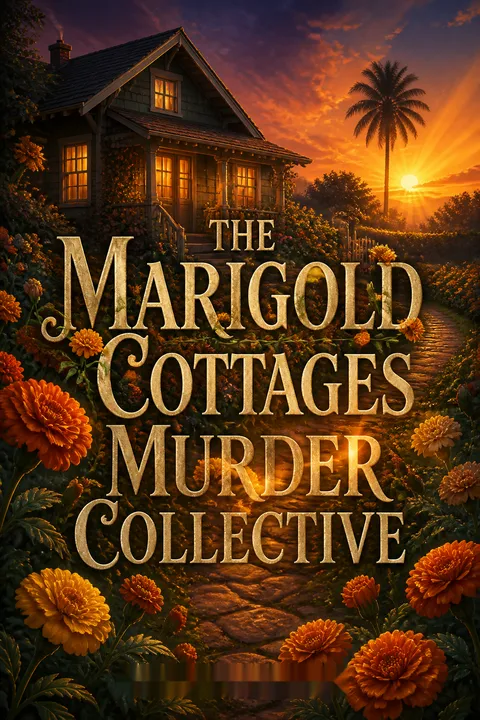
Golda Bakofsky, known to her tenants as Mrs. B, has spent decades turning six small Santa Barbara cottages into a refuge for people who do not quite fit elsewhere. Sophie Gilman, a young theatre worker still recovering from a college stalker, sees the danger before she sees the person when Mrs. B befriends Anthony Lambert, a hulking former prisoner she has met at a late-night bus stop.
Sophie intervenes, and Anthony disappears. Two months later, Mrs. B rents him the studio beside Ocean Mistral, an artist and single mother who worries about having an ex-con near her children. Lily-Ann Novak makes the neglected studio welcoming. Anthony moves in, while Sophie begins turning the residents’ odd habits into notes for a play.
The cottages begin as more than a picturesque setting: Mrs. B has made proximity into a form of care, though her tenants have not all agreed to be cared for. Sophie’s suspicion is shaped by genuine past danger, so the same vigilance that helps her notice Anthony also risks making every stranger look like a threat. Anthony’s arrival places that fear beside Mrs. B’s counter-instinct, her willingness to judge a person by small acts rather than appearance. Sophie’s play notes offer an early clue to her deeper need: she wants control over a world that once made her feel helpless.
Crows Reveal the Courtyard
After a night out she cannot fully remember, Sophie looks toward the hedge beside her cottage and sees a man lying among the leaves. A crow pecks at his head, making the stillness impossible to mistake for sleep. Lily-Ann checks the body and calls the police while Ocean comforts Sophie and alerts Mrs. B. The dead man is James Dedrick, a wealthy real-estate investor from Altadena.
Detective Sergeant Vernon Enible arrives already convinced that the killer is likely one of the residents. Anthony’s prison history, intimidating tattoos, and a bloodstain on his sleeve make him an easy target. Vernon detains him and searches his studio, treating appearance and past conviction as if they were proof.
The murder turns the courtyard, previously a shared domestic space, into a crime scene that every resident must look at differently. Sophie’s discovery reactivates her fear of being unsafe in her own home, while Lily-Ann responds by examining the body as a problem to be solved. Vernon’s rapid focus on Anthony shows how an investigation can confuse a plausible suspect with a proven one. The contrast is not simply between guilty and innocent people. It is between kinds of knowledge: forensic evidence still has to be gathered, while the detective’s confident social reading already risks narrowing what he can see.
The Neighbors Form a Collective
Mrs. B refuses to accept that Anthony killed Dedrick and gathers the residents at Hamilton’s cottage to investigate. Hamilton, a shut-in with an online gaming circle that includes a police officer, reports that Dedrick was a real-estate investor who arrived alone at the cottages. That suggests the killer was already on the property, but establishes no connection to Anthony.
Nicholas Perez, the city planner who keeps apart from his neighbors, admits privately that he recognized Dedrick from work and disliked his development ambitions. Sophie has also realized Anthony once worked as a bouncer at the Sidecar, the bar she repeatedly visits when she drinks too much. The group now has several leads, but no reliable account of the murder.
The collective forms because Mrs. B refuses to let the police’s first answer become the only answer. Its amateur methods are comic, but they also redistribute attention: Hamilton’s online friendships, Lily-Ann’s appetite for research, and Sophie’s note-taking become useful precisely because no one person sees the whole picture. Nicholas’s knowledge of Dedrick introduces a genuine reason for suspicion without establishing guilt. The group’s early mistake is to treat protecting Anthony and solving the murder as the same task. They are related goals, but the residents do not yet know what truth either one will require.
A Friend's Quiet Rescue
During a jail visit, Ocean asks Anthony whether he knew Dedrick. He denies knowing him and explains why he returned to the bus stop after their first meeting. When he worked the Sidecar’s door, he found Sophie unconscious in bushes after a night of drinking. He carried her home rather than leave her exposed, then failed to tell her because he feared the truth would worsen her recovery from stalking.
Mrs. B witnessed his care and quietly chose to trust him. Ocean now understands that Sophie’s blackout drinking is more dangerous than the neighbors knew, and that Anthony’s silence has been an attempt to protect her. The personal revelation softens Ocean’s stance, but it does not explain the murder.
Anthony’s account changes the emotional meaning of his earlier presence at the bus stop. What Sophie interpreted as recognition or menace was partly the aftermath of his effort to keep her safe, a kindness he did not use to claim intimacy or gratitude. Mrs. B’s trust rests on witnessing that act, not on a naïve belief that Anthony has never done harm. Ocean’s response holds two truths together: Anthony has a violent past, and he chose restraint when Sophie was vulnerable. The disclosure also complicates protection. Keeping Sophie uninformed spared her an immediate shock, but denied her the right to understand her own past.
A Shadow Named Hesse
Lily-Ann learns the name of Sophie’s college stalker, Neal Hesse, and suspects he may have followed Sophie to Santa Barbara. Hamilton searches public information and finds signs that Hesse now circles a college woman’s sorority and a café near Sophie’s theatre. Nicholas visits Hesse under the pretext of a zoning survey.
In Hesse’s garage, he spots hidden college pennants and a charm necklace, objects that suggest a fixation on a woman’s past. Ocean visits Hesse’s wife, who provides an alibi for the night Dedrick died but seems frightened. She slips a shelter leaflet under the door. The stalker investigation widens the danger around Sophie, while Mrs. B remains convinced Dedrick may have been mistaken for someone else.
Hesse’s reappearance forces the residents to take Sophie’s fear seriously without reducing her to it. His attention to women’s private spaces and college objects contrasts with the group’s awkward, visible care for one another. Nicholas’s improvised survey is a clumsy intrusion, but it yields a clue that official channels have not found. Ocean’s encounter with Hesse’s wife adds another ethical problem: gathering information may expose a frightened person to further risk. The mystery’s apparent boundaries keep expanding. The residents are not only asking who killed Dedrick, but who has been watching, and whose safety has been treated as a private inconvenience.
Anthony Becomes the Easy Suspect
After his first detention, Anthony is arrested again when his cellmate, Ian Talken, tells Vernon that Anthony described a fight with Dedrick. Police also claim doorbell footage shows Anthony breaking into Dedrick’s Altadena home after the murder. The evidence frightens the residents, especially Miles, who has grown close to Anthony, and Sophie, who remembers seeing a large figure leave the cottages that night.
Mrs. B refuses to let Anthony take the blame and turns herself in with her husband’s African walking club, claiming she struck Dedrick by mistake. Blood marks the club. The confession throws the investigation into confusion and places Mrs. B in jail, while Anthony remains behind bars.
The case against Anthony gains persuasive force through the accumulation of details that fit a ready-made story: his past violence, his size, a cellmate’s account, and a video that appears to confirm a burglary. Yet the group’s own experience of his reticence makes the alleged confession hard to accept. Mrs. B’s decision to confess is both protective and disruptive. She is willing to exchange her own freedom for Anthony’s, but her action also makes the danger of their assumptions concrete: loving someone does not guarantee that one has correctly understood what happened.
The Wrong Tattoo
Lily-Ann and Hamilton obtain the doorbell footage through Hamilton’s police-gaming contact and study the blurred intruder frame by frame. The throat tattoo resembles Anthony’s, but its feather pattern is different. Ocean follows the clue to Anthony’s former prison friend, known inside as TG and now called Perch, who admits he robbed Dedrick’s empty home after hearing about the death.
The burglary video no longer proves Anthony entered the house. Meanwhile, the residents give Vernon false alibis for Mrs. B, and Sophie visits the detective to insist the old woman never left home. Mrs. B is released, and the confession also weakens the case keeping Anthony in custody. Her return restores the group, but not its trust in one another.
The tattoo is a useful counterweight to the visual stereotype that first made Anthony look guilty. Lily-Ann’s attention to a tiny design difference dislodges a major piece of the police narrative, while Perch’s confession gives the image a mundane explanation. Yet the residents’ false alibis blur the line between loyalty and obstruction. They are trying to resist an unjust arrest, but they also make themselves vulnerable to prosecution and deepen their mistrust of Vernon. Mrs. B’s return is a relief, not a solution: Anthony’s freedom and the truth about Dedrick still depend on evidence the group has not yet uncovered.
The Heir Signs Away Home
Sophie discovers a contract in Nicholas’s kitchen and realizes he has agreed to transfer the cottages to Gregory Ybarra, the neighborhood developer. Nicholas says the deal would replace his expected inheritance with a larger housing project, but his hesitation signals that the decision is not simple.
He later tells Sophie that Leonard Bakofsky was his father, making Mrs. B his stepmother, though she does not know he knows. Ybarra has shown Nicholas a video of Dedrick’s murder and used the threat of Mrs. B dying in prison to pressure him into signing. The revelation turns Nicholas’s distance from Mrs. B into a tangled attempt to avoid obligation, and makes the property itself central to the danger.
Nicholas’s contract brings the novel’s private and civic conflicts into the same room. His argument for denser housing is not merely a cover: he works in planning and believes the city needs more homes. But Ybarra’s leverage converts a public policy question into coercion, exploiting Nicholas’s guilt and Mrs. B’s vulnerability. The hidden family tie sharpens the irony: Nicholas has been trying not to take anything from a woman who has already chosen to provide for him. His secrecy may be intended as restraint, but it leaves him isolated and makes a predatory bargain easier to impose.
Sophie Stops Shrinking
After Mrs. B returns and the case remains unsettled, Sophie drives to Hesse’s home and confronts the man who stalked her in college. She challenges his denial, recalls the ways he invaded her room and watched her, then knees him and shoves him down. The confrontation does not erase her fear, but it breaks her habit of dismissing what he did because he never physically touched her.
Anthony later admits he went to Hesse’s house and broke both his arms, an act of revenge that Sophie did not ask for. The experience leaves Sophie newly willing to occupy space and act, even as the neighbors must reckon with Anthony’s decision to use violence.
Sophie’s confrontation is a meaningful change in agency, but not a neat cure for trauma. She names the harm that she had minimized and acts from anger rather than waiting for someone else to certify that she was in danger. Anthony’s retaliation complicates the apparent victory: his protective impulse repeats the violence that once made him dangerous, even when directed at a person who caused real harm. The episode resists a simple equation between empowerment and force. Sophie gains ground by recognizing her own account as valid; Anthony’s choice shows how easily care can become permission to control another person’s conflict.
A Hammer Finds Lily-Ann
One night, Lily-Ann goes outside to free a twig caught against her window. A masked attacker emerges from the hedge and swings a hammer at her head. Sophie hears the scream, runs out holding a tequila bottle, and drives the attacker away with repeated swings. Lily-Ann recognizes the man but persuades Ocean not to call the police immediately.
She identifies him as her estranged husband, Piotr, who has money problems and stands to benefit from her estate. The attack suggests the killer of Dedrick has returned to finish a different job. Anthony stays with Lily-Ann, while the group now has to connect Piotr’s threat against her to the murder that first brought police to the cottages.
The attack transforms the murder investigation from a question about a past death into an immediate threat to a living neighbor. Sophie’s response is especially important because she acts before fear can convince her to stay inside. Lily-Ann’s refusal to involve police is not indifference to danger; she believes Piotr can manipulate the evidence and discredit her. Her decision exposes a painful tension between securing help and securing justice. The residents’ response is collective, but they cannot rely on solidarity alone. They need a credible account that can survive outside the courtyard.
The Putter Carries a Lie
Anthony overhears Ybarra telling Mrs. B he will take the murder evidence to police, then follows him. Ybarra ends up dead in the hedge, killed with a golf club. The residents uncover the truth that the first victim was not Anthony’s doing: Mrs. B struck Dedrick while trying to stop him from assaulting an unconscious Sophie, and Ybarra recorded it to blackmail her into surrendering the cottages.
Anthony killed Ybarra to stop that threat. Rather than expose Mrs. B and Anthony, the group tells Vernon that Piotr killed both men. They connect Piotr’s financial crisis, attempted attack on Lily-Ann, and golf equipment to the evidence. Vernon finds Piotr’s fingerprints on the club and pursues the case.
The solution is morally untidy by design. Mrs. B’s act began as an attempt to protect Sophie, but it ended in an accidental death she could not face openly. Anthony’s killing of Ybarra protects the community from blackmail while adding another concealed crime. The residents then choose a story that directs suspicion toward Piotr, whose violence and financial motives are real, but whose guilt for both deaths is not what they claim. Their collective care becomes a form of collusion. The book asks whether justice can be separated from loyalty when the formal system has already treated appearances as proof.
The Cottages Become Home
With Piotr’s fingerprints and financial troubles giving Vernon grounds to pursue him, the residents gather for a meal rather than another interrogation. Mrs. B is back among them, Anthony is free, and Miles and Riley treat the cottage courtyard as a place where their chosen family can look after one another.
Anthony and Lily-Ann move toward a relationship built on frankness, while Nicholas and Sophie begin to imagine one of their own. Sophie finishes a play drawn from the residents’ lives and reads its final scene to the group, giving their shared secrets a theatrical shape even though she cannot use the ending as written. Her story closes not with a perfectly clean case, but with neighbors still choosing one another.
The resolution shifts attention from legal certainty to the fragile work of belonging. Vernon has a case against Piotr, but the residents know that their account conceals the actions of two people they love. Their meal does not erase that compromise; it shows what they are trying to preserve. Sophie’s play gives her a new form of authorship, turning observation into creation rather than compulsive self-protection. The romantic pairings matter less as prizes than as evidence that these characters can risk intimacy without surrendering their independence. Mrs. B’s achievement is not making anyone whole. It is helping them remain together while unfinished.
Analysis
The mystery’s central misdirection is social before it is forensic. Anthony looks like the kind of man the police expect to have killed someone, while Mrs. B looks too old and gentle to have done it. The group’s discoveries repeatedly unsettle those shortcuts: Anthony’s past includes tenderness, Mrs. B’s protectiveness includes a fatal mistake, and the respectable figures pursuing development or wealth can exert more danger than the visibly threatening outsider. The novel treats evidence as something people interpret through prior belief, not as a self-speaking record.
Its community is built through concrete acts rather than perfect understanding. Residents bring food, fix rooms, share research, watch windows, and sit beside one another in moments of fear. They also conceal, interfere, judge, and sometimes hurt each other. Mrs. B’s instinct to protect can become paternalism; Ocean’s moral conviction can become anger; Lily-Ann’s order can become intrusion; Nicholas’s wish not to impose becomes isolation. Care is valuable precisely because it is not clean.
The ending refuses a simple victory. The residents create a case against Piotr while concealing Mrs. B’s accidental killing of Dedrick and Anthony’s killing of Ybarra. Their choice challenges the faith that legal procedure and moral truth always coincide, but it does not make their deception uncomplicated. They protect people they love by manipulating the investigation, risking the very justice they claim to seek.
Sophie’s emotional movement gives the ensemble its clearest line of change. She begins by watching life from the threshold and converting it into notes. Gradually, she acts inside the scene: she confronts Hesse and runs toward Lily-Ann. Writing remains a form of control, but it becomes more than retreat. By the end, Sophie can observe the group without disappearing from it. The cottages do not repair their residents; they give them company while they remain imperfect.
Review Summary
People Also Read







Characters
Golda Bakofsky, Mrs. B
The cottages' fierce caretakerGolda Bakofsky, called Mrs. B by nearly everyone around her, owns the Marigold Cottages and treats the tenants as an unruly extended family. Warm, theatrical, and strategically feeble when it suits her, she notices the needs people try to conceal and offers practical help before they ask. Her history of loss has not made her cautious; it has made her determined to build connections wherever she can. She trusts her own reading of character, sometimes more than the people she means to protect would like. Her home, flowers, library, food, and meddling all express the same impulse: to make a place where imperfect people can be useful to one another.
Sophie Gilman
The watchful young playwrightSophie works at a community theatre while privately longing to write and direct plays. A former college stalker left her anxious and self-conscious, and she often apologizes before anyone has accused her of anything. She also watches closely: the people outside her window, the patterns in the group chat, and the moments that might become scenes. Her drinking and memory gaps complicate her sense of safety, while the Marigold residents give her a community in which she can be both protected and protective. Sophie’s imagination is not an escape from reality so much as an attempt to arrange it, test it, and eventually claim a place within it.
Anthony Lambert
The guarded former prisonerAnthony is a large, tattooed man with a prison record and a quiet manner that invites other people to decide who he is before he speaks. He works in a bar kitchen after leaving the more volatile role of bouncer, and he values a life with less trouble in it. His restraint is not innocence or passivity; he has a history of violence and knows how quickly anger can become action. Yet he is also attentive to vulnerability, particularly when someone is too impaired or afraid to protect themselves. Anthony is uncomfortable receiving care, but the cottages gradually give him a place where small acts of kindness do not have to be repaid immediately.
Ocean Mistral
The artist and family anchorOcean is an artist and sculpture teacher raising Riley and Miles after her former wife moved abroad. Blunt, funny, politically alert, and fiercely protective, she has inherited much of Mrs. B’s habit of looking after people, though she is quicker to challenge the cost of that habit. Ocean is wary of police power and distrustful of easy explanations, but she can also act before she has thought through the consequences. Parenting has made her practical without diminishing her artistic eye or her anger at injustice. Her relationships with her children show both the tenderness and friction of care: she wants to keep them safe, while learning that they need room to make mistakes.
Lily-Ann Novak
The exacting problem-solverLily-Ann is a proposal coordinator who finds relief in lists, finished tasks, orderly rooms, and well-made things. Separated from her wealthy husband, she lives in a modest cottage and sometimes wonders whether her devotion to work is a defense against a less controllable emotional life. Her precision makes her an observant investigator, but she can initially treat human problems as puzzles whose loose ends should be tied. Beneath her cool presentation is a person capable of loyalty, attraction, and protectiveness, though she tends to discover those feelings through action before she can name them. Lily-Ann’s bluntness can be startling, yet it makes her unusually willing to ask questions other people avoid.
Nicholas Perez
The private city plannerNicholas works in Santa Barbara’s planning department and cares about the city’s architecture, neighborhoods, and future housing needs. He keeps a private entrance and avoids the cottages’ social life, telling himself that distance is a way to respect other people. His reserve conceals a more complicated mixture of guilt, affection, and uncertainty about what he owes the people who have helped him. He is not immune to connection; he simply fears that accepting it will make him exploitative or indebted. His interest in theatre and his work in urban planning reveal someone who wants to shape a world he has mostly experienced from its edges.
Lawrence Hamilton
The homebound fact-finderHamilton is an older, homebound tenant who prefers the safety of his cottage but enjoys company through games, messages, and online research. He scatters obscure facts through conversations and can miss the point while supplying information that proves useful. His anxiety does not prevent him from wanting to contribute; it changes the scale of what contribution feels possible. Hosting the neighbors and searching databases let him participate without pretending he is comfortable in the outside world.
Vernon Enible
The confident detectiveVernon is a detective sergeant who sees investigation primarily as the work of assembling evidence for prosecution. He is experienced, observant, and comfortable with conversational pressure, but his confidence can turn an early suspicion into a tunnel. He reads Anthony’s appearance and record as meaningful before the evidence supports that judgment. Vernon is neither a caricature nor a neutral instrument: he wants to solve the case and build a professional legacy, and those ambitions shape which uncertainties he is willing to tolerate.
Piotr Novak
Lily-Ann's polished husbandPiotr is a wealthy investor who presents himself with practiced charm and takes pride in money, appearance, and being taken seriously. He and Lily-Ann remain married while living apart, and their relationship is marked by competing ideas about work, intimacy, and what counts as care. Piotr likes to appear decisive and successful, but his investment habits expose a taste for risk. He can express concern for Lily-Ann, though his concern often carries an assumption that he knows what she needs better than she does.
Gregory Ybarra
The neighborhood developerGregory Ybarra owns nearby apartment buildings and sees Santa Barbara as a place where thoughtful development can create more housing. He presents himself as a civic-minded local, yet his interest in the Marigold Cottages is persistent and intensely practical. His genial manners make his pressure easier to disguise as concern. Ybarra understands that property is not only land but leverage, and he is prepared to use the language of planning and investment to advance his ambitions.
Neal Hesse
Sophie's former stalkerNeal Hesse is a man from Sophie’s college past whose stalking relied on intrusion, surveillance, and unsettling handmade objects rather than direct confrontation. He is frightening partly because his behavior can be minimized by people who expect danger to look more dramatic. His presence in Santa Barbara makes Sophie’s past feel less safely past and raises questions about how easily a person can resume a life after terrorizing someone.
Riley Mistral
Ocean's sharp-eyed teenagerRiley is Ocean’s teenage daughter, quick-witted, prickly, and alert to the ways adults misunderstand her. She can be cutting with her mother, but beneath the performance she is observant and morally serious. Her shifting moods and private experiments with independence create friction at home, while her affection for the people around her often appears through teasing rather than confession.
Miles Mistral
The tender-hearted younger childMiles is Ocean’s younger child, imaginative and unusually considerate of other people’s feelings. His gentleness can leave him vulnerable to worry, but it also gives him a direct way of reaching people who are used to being overlooked. He expresses affection through gifts, plans, and earnest efforts to help, often treating a small kindness as something that can change a person’s day.
James Dedrick
The visiting real-estate investorJames Dedrick is a wealthy investor from Altadena who comes to Santa Barbara to inspect property and consider development opportunities. His business manner is competitive, and people who have dealt with him remember his appetite for control. He arrives as an outsider with a financial interest in the neighborhood, though the residents initially know little about what brought him to their courtyard.
Perch, formerly TG
Anthony's prison friendPerch is a former prison friend of Anthony’s, known inside as TG. The two men share a history and matching, nearly identical tattoos, but Perch now lives under parole restrictions and keeps his distance from Anthony. He is more expressive and socially loose than his friend, with a strong attachment to the future he once imagined for himself.
Zoe
Ocean's former wifeZoe is Ocean’s former wife and the other parent of Riley and Miles. She left the family for a new relationship and now lives in Prague. Her absence shapes Ocean’s daily life as a parent, while the children continue to carry their own complicated feelings about the family they once had.
Plot Devices
The Marigold courtyard
A shared stage for suspicionThe cottages’ close arrangement makes privacy difficult and care almost unavoidable. Residents can watch the courtyard from their windows, hear activity across the way, and notice changes that a more scattered neighborhood might miss. That visibility helps Sophie spot unsettling figures, lets tenants check on one another, and eventually makes the property itself part of the crime scene. The courtyard also puts social difference in constant contact: the shut-in, the artist, the planner, the former prisoner, and the landlady cannot simply disappear from one another’s lives.
The Murder Collective
Neighbors pool imperfect knowledgeSophie’s group chat becomes the practical and comic infrastructure for the neighbors’ investigation. Mrs. B gives their efforts a purpose, Hamilton supplies online research, Lily-Ann organizes questions, Ocean pursues people directly, and Sophie records events for her play. The collective’s usefulness comes from combining partial observations rather than discovering a single brilliant detective. Its weaknesses matter too: members conceal information, make assumptions, and eventually lie to the police to protect one another.
Sophie’s play notes
Life becomes material and methodSophie records the cottages’ conflicts as potential scenes, partly because she wants to write a play and partly because staging events gives her a measure of control. Her notes preserve observations that others overlook and allow her to test which characters and motives make sense. The creative frame also changes as the case grows more serious: she begins by treating the murder as promising material, then has to distinguish theatrical invention from the pain and danger of her neighbors’ real lives.
The matching tattoos
Appearance turns into false evidenceAnthony’s distinctive throat tattoo initially helps police and neighbors imagine him as the intruder caught on a doorbell camera. Lily-Ann’s close attention to its feather pattern reveals a difference, and Ocean traces the near-match to Anthony’s former prison friend. The tattoo demonstrates how an identifying mark can both mislead and clarify: people assume resemblance proves identity until someone looks carefully enough to see what does not match.
The will and zoning deal
Property becomes family leverageThe cottages’ inheritance and the city’s push for denser housing give the murder investigation an economic dimension. Nicholas’s planning work makes redevelopment a legitimate public question, while Mrs. B’s will makes the property a private legacy. Ybarra exploits that overlap, using the threat of exposure and imprisonment to pressure Nicholas. The device forces the residents to ask whether preserving a cherished home is a matter of sentiment, economic security, civic policy, or all three.
Download PDF
Download EPUB
.epub digital book format is ideal for reading ebooks on phones, tablets, and e-readers.








