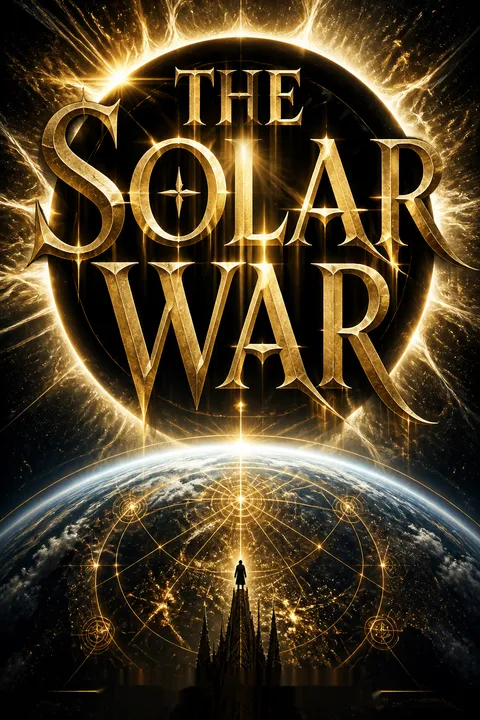


Plot Summary
Prologue
In a vision beyond time, the Emperor faces Horus in the shape of a wolf. Horus accuses his father of building an empire on lies and asks whether any truth survives beneath them. The Emperor rejects the creatures gathering in the dark and insists Horus will fail.
Yet the fire behind him falters as the wolf’s laughter presses closer. On Terra, sirens announce the first day of a new year, and people look up at unfamiliar lights. Horus has reached the Solar System.
The opening makes the invasion a struggle of belief as well as fleets. Horus’s accusation has force because the Emperor’s rule is coercive, even as the Emperor sees Chaos as a predatory power that offers no genuine freedom. Neither figure is presented as a simple moral answer. The wolf shape converts a political rebellion into an ancient fear of darkness approaching a failing fire. The sirens then bring that cosmic conflict down to ordinary life: the first sign of the war is not a revelation, but a sound that interrupts work, meals, and sleep.
The Solar System Ignites
At the edge of the Solar System, Sigismund commands the Imperial Fists fleet guarding the approaches to Pluto. The first traitor vessel bursts from the warp and dies in the mines and gunfire waiting there, but its destruction is only the opening stroke. Hundreds more ships force their way into reality, and the defenders attack them while their shields and formations are still unsettled.
The invaders keep coming faster than the guns can destroy them. On Terra, sirens carry the news to billions who cannot see the battle. Their planet has not yet been struck, but the system’s outer defenses are already burning, and the enemy has begun the long advance toward humanity’s home.
The invasion begins as a contest of rates: how quickly the defenders can kill, and how quickly Horus can replace what they destroy. Sigismund’s first victory is real but strategically temporary, which establishes the novel’s unsparing arithmetic of war. The sirens provide the civilian counterpoint to the fleet action. For those on Terra, the conflict arrives first as a rupture in routine, before it can be understood as a military event. By placing the opening battle and the alarm together, the story makes distance feel less like safety than delay.
The Gate at Uranus
At Terra’s command center, Admiral Niora Su-Kassen reads the enemy’s move toward Pluto and predicts that Uranus will be attacked next. Rogal Dorn refuses to reinforce the outer fleet: the defenders must make Horus spend ships and time at every line, rather than risk their strength in a battle they cannot win outright. Malcador explains that the warp has become too violent for reliable astropathic warnings.
At the Elysian Gate, Perturabo’s massive fire ships ram the defenses, and their explosions cripple sensors before Iron Warriors battleships arrive behind them. Halbract’s ships fight on, but the enormous space hulk Daughter of Woe gives the attackers a fortified foothold. Uranus is now under siege from a force still growing.
Dorn’s decision defines the defenders’ moral and strategic bind: saving each outlying population would scatter the force needed to protect Terra, but abandoning them makes the defense feel like a choice of whose lives count. Su-Kassen has to translate that abstraction into orders while watching the consequences accumulate. The Elysian assault shows why simple courage cannot repair an imbalance in numbers. Perturabo uses the attackers’ losses as a planned cost, then turns a converted transport into infrastructure for the next wave. The war is not just a clash of armies; it is a competition to decide which losses will make future resistance possible.
Abaddon's Hidden Spear
Aboard the captured Imperial Fists warship War Oath, Ezekyle Abaddon waits as the Word Bearer Zardu Layak completes a blood rite. Ahriman, the Thousand Sons chief librarian, projects his presence to confirm that the other ships are ready. The rite allows Horus’s armada to emerge far inside the Solar System, beyond the ordinary approach the defenders have prepared to meet.
Tens of thousands of vessels appear above the system’s orbital plane, paid for by the deaths of captives and soldiers used in the passage. Abaddon detests the sorcerous aid, but accepts the command Horus has given him. He orders the fleet toward the sun, concealing a second spearhead from the loyalists fighting at Pluto and Uranus.
Abaddon’s discomfort matters because it separates his loyalty from Layak’s faith. He accepts the supernatural mechanism as a means to his Warmaster’s end, but does not mistake obedience for worship. The fleet’s arrival also makes the defenders’ maps incomplete: their careful lines can be tactically sound and still fail to encompass the actual threat. The blood price is not incidental spectacle. It shows that Horus’s advantage depends on treating human lives as fuel, an approach that mirrors the loyalty he demands from his sons while hollowing out the human bonds those sons believe they serve.
The Prisoner Remembers
Mersadie Oliton, once a remembrancer among the Luna Wolves, has spent years imprisoned because she witnessed Horus’s betrayal. A dream visitor who appears to be her old friend Euphrati Keeler warns that Horus’s assault has a hidden purpose in the warp, and urges Mersadie to reach Dorn.
Before she can make sense of the message, the prison transport is attacked and its guards begin killing prisoners rather than let them escape. Mersadie finds a key medallion, releases Nilus Yeshar, a Navigator held in another cell, and follows him through the failing ship. They cross collapsing decks, evade an armed security machine, and reach a shuttle. Nilus pilots them out as the transport breaks apart behind them.
Mersadie’s defining resource is not military authority but the ability to preserve and connect memories. The prison has taken her recordings and restricted her world, yet it cannot fully control what she recalls or what those recollections may mean. Her escape is therefore both physical and interpretive: she has to act on a warning she cannot verify. Nilus offers expertise that her weakened body lacks, while the wrecked ship forces them into mutual dependence. The scene turns her former role as observer into a riskier one. To remember the war now means choosing to intervene in it.
A Refugee Ship Turns
As Uranus’s habitats and stations come under fire, merchant Cadmus Vek escapes the destruction of Cordelia aboard his freighter, the Antius. Sub-mistress Zadia Koln takes command when the captain is lost, and Vek forces the ship to cast off while people are still running toward its docks. His lifeward, Aksinya, has already helped save Vek’s children, Mori and Noon.
When the Antius later answers Mersadie and Nilus’s distress call, Koln wants no part of armed strangers, but Vek insists they be brought aboard. Mersadie asks for the Praetorian and refuses to explain her imprisonment, so Vek keeps her confined. He has saved her from the void, but has not yet decided whether to trust her.
Vek’s first choices are made under pressure, not from a settled heroic identity. He abandons people at the dock because keeping the ship alive may save his family, then accepts new passengers when he recognizes that survival cannot be reduced to protecting his own. His wealth and ownership give him power, but they do not make the decisions painless or erase the cost to those left behind. Koln’s resistance is also practical: every rescue adds mouths and danger to a ship built for freight, not mass flight. The Antius becomes a small version of the larger defense, where every act of mercy redistributes risk.
The Khan's Last Cut
Jaghatai Khan keeps the White Scars’ ships scattered around the Solar System instead of tying them to Terra’s defenses. Admiral Su-Kassen doubts whether Dorn’s attritional plan can protect the system’s people; the Khan encourages her to voice that doubt, even while agreeing that the plan may be necessary.
In the outer dark, Jubal Khan leads fast White Scars ships against Abaddon’s advancing armada. The White Scars repeatedly strike its edges, weakening ships before withdrawing.
Abaddon uses a damaged cruiser as bait, drawing Jubal’s flagship, the Lance of Heaven, close enough to board. Abaddon teleports onto the ship and kills Jubal in single combat. The White Scars lose their commander, but their repeated attacks have made the traitor fleet pay before it reaches the inner defenses.
The two Khans reveal different scales of responsibility. Jaghatai asks whether obedience to a plan has become a prison for Dorn and Su-Kassen, while Jubal turns a tactical doctrine into a personal gamble. His method depends on attrition rather than a single heroic strike, but Abaddon reads that method and exploits its appetite for a decisive kill. The result is not a clean triumph for either side: Jubal dies, while the armada carries damage into the system. The episode tests whether a warrior’s best qualities remain strengths when an opponent understands them. Skill can preserve a fleet, but it can also become a predictable invitation.
Pluto's Deadly Reversal
With Pluto’s defenses failing and enemy forces taking the fortress-moons, Sigismund gives the order to withdraw. The retreat is part of Dorn’s design. Before abandoning the moons, the Imperial Fists activate Vanth-Primus-Nul, a hidden program that spreads through their machine systems and turns stored weapons and reactors toward destruction.
Kerberos erupts first, killing ships and troops around it; Hydra and Charon follow. The explosions shatter the traitors’ formations and wreck the Khthonic Gate’s approach.
Sigismund’s fleet turns back into the debris field and attacks the ships caught in the blast’s confusion. The defenders have destroyed their own fortifications as well as the enemy’s foothold, trading territory and lives for time. The counterattack begins in the wreckage.
The trap works because the Imperial Fists accept that possession of a fortress is not the same as control of the battle. By making the moons unusable to both sides, Dorn denies Horus the clean bridgehead he expected. The cost is deliberately indiscriminate: the loyalists destroy their own military infrastructure and kill their own people alongside the attackers. This is not an ingenious escape from sacrifice, but a method for choosing when and where sacrifice happens. Sigismund’s reversal turns apparent defeat into a tactical blow, while the ruined moons make the victory impossible to confuse with rescue.
Sigismund's Oath of Life
During the counterattack, Horus Aximand leads Sons of Horus aboard Sigismund’s damaged frigate, the Lachrymae. Sigismund fights through the boarding assault, intent on reaching Aximand, while Fafnir Rann’s Imperial Fists force teleports in to rescue him.
Sigismund refuses to leave without Boreas, his lieutenant, and reaches him as Aximand prepares to strike. He cuts Aximand’s sword hand and wounds him before the Imperial Fists teleport away, leaving the Lachrymae behind. Boreas is mortally injured.
In the ship’s sanctuary, he tells Sigismund that dying cannot atone for the earlier oath Sigismund broke. Sigismund promises instead to live and continue fighting. His guilt has not disappeared, but it no longer gets to dictate that he must die.
Sigismund’s discipline has long served as both armor and punishment. He interprets survival as a debt owed to Dorn, and therefore sees death in battle as a possible form of repayment. Boreas refuses that logic at the moment when it would be easiest to endorse it. His counsel reframes loyalty as continued action rather than self-erasure. The rescue also exposes the limits of duty: Sigismund can choose to return for a brother, but he cannot control whether that brother lives. His new promise does not resolve his shame. It changes shame from an excuse for death into a reason to endure.
Uranus Is Abandoned
The defense of Uranus lasts for days, but Perturabo keeps feeding ships and troops through the Elysian Gate until the loyalists can no longer hold their positions. Lord Castellan Halbract pulls the surviving fleet from Oberon after one final volley and reports that Uranus has fallen.
He sends a reserve force ahead into the dark, where it can later strike the traitors unexpectedly. Across the outer system, the war reaches civilians through more than bombardment: nightmares drive people to suicide and riots, while cultists attack habitats and the Night Lords turn refugee ships into weapons against Saturn.
The planned defense has slowed Horus, but the cost is spreading through places the fleet cannot protect. The outer worlds are lost, and the next battle moves inward.
Halbract’s retreat is not evidence that the defense has failed on its own terms. He has preserved ships for a later encounter and made the enemy spend days taking ground. Yet the strategy’s measure, time, cannot capture what civilians experience as the loss of home, food, and reliable reality. The warp’s influence turns fear into an active weapon, so even populations far from the guns become part of the battlefield. This section widens the meaning of invasion: territory falls, but so do the everyday systems that allow people to trust sleep, shelter, and one another.
The Antius Under Siege
After the Antius is caught in a chain of explosions near Oberon, Mersadie persuades Vek to broadcast her name and the name Loken, hoping the loyalists will understand. The signal draws a traitor hunter. Later, an assault pod punches into the freighter, and crimson-armoured troops push toward Mersadie and Vek’s children.
Aksinya first takes Mori and Noon toward safety, then returns to cover Mersadie and gives her a pistol and the launch code. Vek is shot while trying to reach his children; Aksinya is badly wounded defending them. In the chaos, Koln becomes a monstrous attacker, and Mersadie shoots her down. The children survive, but the people who chose to shelter Mersadie have paid for it with their lives.
The attack makes the cost of Vek’s earlier decision unavoidable. He did not merely shelter a fugitive; he brought danger onto a ship carrying his children and hundreds of refugees. Yet the story does not make that choice retrospectively foolish. Vek and Aksinya act because a person in need remains a person, even when helping her is dangerous. Mersadie’s first response is survival, but the deaths around her transform the question from whether she can escape to whom she will abandon if she does. Her responsibility grows out of choices made by others as well as her own.
A Borrowed Crew
Mersadie refuses Nilus’s plan to take a shuttle and leave the damaged Antius behind. She wakes Mori, carries the still-unconscious Noon, and finds the surviving enginseer, Chi-32-Beta, concealed among the ship’s machinery.
Mersadie opens the cargo holds and asks the frightened refugees to help crew the vessel. A dock pilot and other workers answer, giving the Antius a chance to move. A hidden hunter ship pursues them through Jupiter’s debris field, but a warp-corrupted destroyer destroys the hunter instead.
At the Jovian defenses, Mersadie identifies herself over the vox. Garviel Loken answers and brings her, the children, and the other survivors aboard a grey ship. Her message has reached the person she needed, though the rescue comes with no promise of safety.
Mersadie’s development becomes visible in the difference between the shuttle she could take and the ship she chooses to save. Earlier, she escaped because she had no authority and little strength; now she persuades frightened strangers to supply both. The refugees are not converted by an inspiring speech so much as by a practical invitation to use what they know. That distinction keeps the scene grounded: agency arrives as shared labor. Loken’s rescue confirms that her message has traveled, but the war-corrupted ship that intervenes reminds them that survival is not equivalent to reaching a secure world.
A Ritual in the Comet
While the loyalist commanders argue over the enemy’s unexplained movements, Malcador and the primarchs recognize that the war has a second front in the warp. Ahriman and the Thousand Sons secretly travel to an old comet shrine, once a memorial to humanity’s dead, and bring a psychic device called a solatarium into its central chamber.
The device maps the Solar System alongside forces of belief and memory. Ahriman’s plan requires the planets to align through bloodshed, terror, and ritual sacrifice; thousands of captured psykers are prepared as part of the design.
The attacks on Pluto, Uranus, and the inner system have therefore served more than military purposes. The defenders can see the fleets, but not yet the full pattern their battles are completing.
The comet shrine joins memory to violence: a place built to honor the dead has been prepared to use the dead as instruments. Ahriman understands the scale of the atrocity and remains uneasy, but his desire to restore what his Legion lost pulls him toward complicity. The solatarium translates occult forces into an arrangement that resembles a strategic map, making metaphysics legible without making it controllable. The defenders’ uncertainty is therefore not a failure of intelligence alone. Their categories are too narrow for an enemy whose military actions are also ritual components.
Luna's Broken Ring
The Dark Mechanicum fleet attacks Mars, where Camba Diaz and the defenders meet machines designed to corrupt their systems and break their formations. At Luna, Abaddon drives the War Oath into the Ring, destroying a vast section of the moon’s defenses before teleporting his warriors into the Selenar’s hidden gene-fane.
The assault pushes through guardian machines and shifting energy barriers toward Heliosa-78, the last Selenar matriarch. She is preparing to poison the gene stores rather than let the traitors use them.
Abaddon stops her by offering survival in exchange for service. Heliosa yields, and Abaddon claims the gene-making complex for Horus. The attack has cost the loyalists a major defense and given the traitors the means to build new warriors.
Abaddon’s victory depends on recognizing that destruction would be a lesser prize than submission. Heliosa’s attempt to poison the gene stores is an act of refusal, but her hope that the institution can survive leaves room for coercion. Abaddon exploits that hope rather than defeating it outright. Meanwhile, the fall of the Ring shows that the loyalists’ defenses can be broken through an engineered sacrifice, not just a direct exchange of fire. The Selenar’s knowledge makes the moon strategically valuable beyond its position: whoever controls the means of creating warriors can extend the war past the battle now being fought.
The Sun Goes Dark
As the comet ritual reaches its alignment, a rift opens and releases Horus’s missing fleets into the inner system. Daemons invade the Phalanx, where Rogal Dorn fights Samus and Massak’s long-confined Librarians join the defense. Mersadie realizes the dream visitor was not the real Keeler: years earlier, Maloghurst’s sorcery had used her as a way to observe Loken, and Horus has repurposed that psychic link as a doorway.
The figures of Nilus and Keeler were masks worn by the same threat. In the warp, Mersadie rejects Samus’s control, strikes it with Loken’s sword, then throws herself into the Phalanx’s plasma junction. Her death closes the immediate path through her, and the daemon tide recedes, though the enemy fleet remains.
Mersadie’s memories have been both her vocation and the means by which she is manipulated. The revelation does not make her earlier warning meaningless: it shows how a real pattern of danger can be delivered through a false guide. Her agency comes when she stops treating memory as a trustworthy record and recognizes that it has been edited by an enemy. The final choice is not a victory over the whole warp or a reversal of the invasion. It is a local refusal to remain a usable instrument. Her death saves the Phalanx from being consumed through her, but cannot undo the larger strategy.
Terra's First Morning
With the daemons gone from the Phalanx, Dorn orders Su-Kassen to take command of the remaining fleet and continue fighting beyond Terra. He returns to the Throneworld with Sigismund and the battered defenders from Pluto. Loken carries Mori and Noon aboard his ship, unable to answer when they ask where Mersadie is.
Horus watches his forces spread toward Mars, Luna, and Terra, while the surviving loyalist ships converge on the capital. On the thirteenth day of Secundus, Dorn’s craft land inside the Palace defenses as orbital guns and surface batteries fire into the descending enemy. The battle has reached Terra itself. Horus’s fleet fills the sky, and the Siege begins before dawn.
The ending converts the vast system campaign into the immediate geography of a besieged world. Dorn’s return to Terra and Su-Kassen’s departure divide the defense between the ground that must be held and the fleet that must keep fighting elsewhere. Loken’s silence before the children gives the cost of Mersadie’s sacrifice a small, human shape, without pretending that the children can understand it. The final dawn is not a resolution but a threshold: the outer defenses have bought time, and Horus has used that time to arrive. The opening sirens have become the first sounds of a siege.
Epilogue
In the final vision, Horus meets the Emperor beside a dying fire. Horus sees his father as a tyrant who used noble purpose to excuse conquest and slaughter, and believes that he has finally uncovered the truth.
The Emperor remains silent as Horus lifts the last ember and leaves him with the promise of an approaching war. The fire gutters, but the Emperor does not answer with surrender. The armies are closing on Terra in the waking world; beyond it, the argument between father and son is still burning.
The closing vision refuses to let military events settle the moral conflict opened at the beginning. Horus’s critique of the Emperor is not empty, but his certainty that revelation makes him righteous is itself dangerous. The Emperor, meanwhile, offers no persuasive defense, only endurance. Their silence matters because neither can persuade the other through ordinary argument. The fire’s dwindling light links the psychic struggle to the siege’s material stakes, while the imminent arrival of Horus’s armies makes the vision more than a symbolic coda. It is a private confrontation whose consequences will be measured in worlds and lives.
Analysis
The Solar War is built around a conflict between what can be defended and what must be surrendered. Dorn’s strategy treats time as a resource: fleets retreat, fortresses are destroyed, and entire worlds are abandoned so that Horus cannot reach Terra quickly. The plan is rational, but the novel keeps its human cost in view through Vek, Aksinya, the refugees, and Su-Kassen’s difficulty accepting losses as data. Military necessity does not make those losses emotionally neutral.
The book’s parallel war in the warp complicates the defenders’ confidence in calculation. Horus and his allies use physical battles to create an occult pattern, so a tactical success can still contribute to a larger danger. The solatarium gives this idea a material form: planets, memories, and sacrifice become parts of one mechanism. Mersadie’s memories are crucial because they make the cosmic struggle legible through a person rather than through another map or prophecy. But memory is not secure. Her recollections have been altered and used, forcing her to distinguish the truth of a warning from the identity of the one delivering it.
That distinction gives Mersadie’s final choice its moral force. She cannot stop the invasion, restore the dead, or make the Emperor’s empire innocent. She can, however, refuse to let the enemy use her as its doorway. Her act is limited in scale and immense in consequence, much like the decisions made by ordinary people aboard the Antius. Across the novel, agency rarely means controlling events. It means deciding what one will protect when control has already been lost. The opening and closing visions sharpen this ambiguity. Horus sees the Emperor’s tyranny clearly but mistakes exposure of hypocrisy for proof that his own cause is just. The Emperor sees the threat but cannot offer a comforting answer. Their sons and subjects inherit a war in which conviction can motivate courage, excuse atrocity, or do both at once. The book ends not with victory, but with Terra still standing beneath a sky filled by the enemy.
Review Summary
The Solar War receives mostly positive reviews as an epic start to the Siege of Terra series. Readers praise French's prose, character development, and ability to convey the vast scale of the conflict. Many appreciate the connections to earlier Horus Heresy novels and the balance of action with introspection. Some criticize the pacing and perspective shifts, while others find it accessible even for newcomers. Overall, fans consider it a strong opening to the final chapter of the Horus Heresy, capturing the weight and inevitability of the impending siege.
People Also Read
Characters
Mersadie Oliton
The witness who remembersA former remembrancer who traveled with the Luna Wolves and saw Horus’s fall from close range. Mersadie is observant and emotionally perceptive, but imprisonment has narrowed her world and made memory both refuge and burden. She understands that recording events can protect truths that power would rather erase, yet she is not naturally a warrior or leader. Her instinct is to notice, interpret, and preserve. The invasion forces those habits into action: she must decide when to trust what she remembers, when to doubt it, and how to take responsibility for people who have come to depend on her.
Rogal Dorn
The fortress-minded PraetorianThe Emperor’s son charged with defending Terra, Dorn thinks in walls, supply lines, and the time required to move an enemy. His composure can look like certainty, but it is also a discipline that keeps grief and doubt from disrupting decisions others must carry out. He trusts preparation and accepts losses when he believes they preserve the larger defense. Those habits make him formidable, yet they also risk narrowing his attention to what can be measured on a battlefield map. His relationship with Su-Kassen and his brothers tests whether strategy can remain humane when every available choice carries a cost.
Horus
The Warmaster turned enemyOnce the Emperor’s favored son and commander of the Great Crusade, Horus now leads the rebellion toward Terra. His charisma and strategic brilliance remain central to his power, but he has allied himself with forces that reshape both his body and his understanding of the war. He regards himself as newly enlightened and his father as a deceiver, a conviction that lets him treat conquest as revelation rather than ambition. Horus’s immense reach makes him seem almost abstract to ordinary people, yet his conflict with the Emperor remains intensely personal: a son confronting the authority he once served.
Ezekyle Abaddon
Horus's chosen swordFirst Captain of the Sons of Horus, Abaddon is a precise commander who trusts loyalty to people more than loyalty to distant ideals. His bond with Horus is powerful, but he resents the sorcerous allies whose aid makes the invasion possible. A survivor shaped by violence and hard choices, he has little patience for hesitation once he sees a route to victory. His encounters with Layak expose a tension he would rather control: he condemns the priest’s transformation of brothers into servants while defending his own betrayals as necessary acts of loyalty.
Sigismund
The oath-bound swordsmanA First Captain of the Imperial Fists, Sigismund has built his identity around vows, endurance, and the precise use of violence. He is not emotionally untouched; instead, he treats feeling as something to bind and direct toward duty. His history with Dorn leaves him carrying a private wound, and he interprets loyalty as a demand to prove himself repeatedly. In battle he is decisive and frighteningly focused, while among his brothers he is less certain how to ask for forgiveness. His relationship with Boreas and Rann gives his severe code a human measure.
Jaghatai Khan
The restless WarhawkPrimarch of the White Scars, Jaghatai values movement, choice, and the freedom to act beyond a fixed plan. He understands why Dorn builds defenses, but recognizes how duty can become a cage when no one is permitted to question its price. His manner is lighter and more fluid than Dorn’s, though his insight is not casual: he watches people closely and knows that they need room to choose what they must do. He respects Su-Kassen’s judgment and encourages her to speak honestly to Dorn, even when the truth will not change the orders.
Niora Su-Kassen
The Solar fleet commanderA veteran void officer from the Jovian fleets, Su-Kassen directs the system’s layered defenses alongside Dorn. She relies on clear analysis and professional discipline, but does not mistake obedience for an absence of judgment. Her household details, including her tea, old pistol, and hawk, reveal a person who has cultivated a life beyond command even as war consumes her time. The Khan’s confidence in her gives her permission to express doubts she has been suppressing. Her central struggle is how to keep acting decisively while remaining aware of the human cost hidden inside the numbers.
Garviel Loken
The loyalist among wolvesA former Luna Wolves captain who refused to follow Horus into rebellion, Loken serves among Malcador’s Knight Errants. His loyalty is shaped by firsthand knowledge of the Legion he left, so he cannot reduce its betrayal to an enemy’s distant abstraction. He is courageous and persistent, but the past remains close enough to complicate his judgment. His connection to Mersadie began when she witnessed the Crusade and recorded the people within it. In the war’s confusion, he becomes one of the few figures capable of acting on her signal and bringing her message toward Dorn.
Malcador
The Regent's burdened counselorThe Emperor’s Regent, Malcador coordinates the Imperium’s response while bearing knowledge and powers few others can comprehend. His age and physical frailty contrast with the authority he can summon when challenged. He is willing to make brutal decisions in the name of preserving humanity, including orders that others find intolerable. That pragmatism does not make him free of sorrow. His relationship with Loken exposes the distance between a duty to protect the future and an individual’s demand that the present be treated justly.
Jubal Khan
The White Scars commanderA senior White Scars warrior and master of void combat, Jubal fights through speed, misdirection, and cumulative pressure rather than relying on a single overwhelming blow. He is reflective about the lives and loyalties war has altered, but does not let reflection prevent action. His mentorship of younger warriors treats combat as a sequence of choices whose consequences build toward a final opening. He understands that obeying an order’s purpose may differ from obeying its literal wording, a distinction that defines his approach to command.
Perturabo
The Iron Warriors architectPrimarch of the Iron Warriors, Perturabo directs the assault on the outer Solar System with an engineer’s attention to force, timing, and predictable outcomes. He trusts plans that can be measured and is unsettled when the defenders’ resistance fits his projections too neatly. His rivalry with Dorn is personal as well as strategic, because he sees his brother’s virtues as flaws disguised by praise. Perturabo’s control of the campaign makes him a formidable opponent, but his intelligence also lets him recognize that the battlefield may contain a purpose he has not yet identified.
Ahzek Ahriman
The Thousand Sons sorcererChief Librarian of the Thousand Sons, Ahriman brings formidable occult knowledge to Horus’s campaign. He approaches sorcery as a discipline of pattern, calculation, and controlled thought, and is troubled when the work demands sacrifices he cannot justify as mere technique. His longing for the lost home of his Legion leaves him vulnerable to arguments that make catastrophe sound like restoration. He remains distinct from the Word Bearers around him: power interests him, but blind faith does not.
Zardu Layak
The Crimson ApostleA Word Bearer priest who serves Horus’s cause through ritual and devotion, Layak regards faith as a force that can remake both people and reality. His relationship with Abaddon is tense because he sees a fellow betrayer beneath the captain’s contempt for religion. Layak can be theatrical and unsettling, but he is not merely a subordinate who obeys from fear. His own choices have remade him, and he interprets the bonds created by violence and rescue through a spiritual logic that Abaddon rejects.
Cadmus Vek
The endangered shipownerA Uranian merchant and father, Vek begins the crisis as a man accustomed to protecting his family through property, influence, and practical decisions. When Cordelia is destroyed, his choices become harder: he must abandon people at the dock, then decide whether to rescue strangers who may endanger his ship. He is neither a trained soldier nor naturally fearless. His relationship with his children and the memory of his wife’s faith give his decisions a moral center that survives even when certainty does not.
Aksinya
The family lifewardAksinya has protected Vek’s family across generations, combining the bearing of a household guardian with the speed and discipline of a trained fighter. Her loyalty is concrete: she watches threats, gets the children to safety, and expects little recognition. She initially distrusts Mersadie because she sees the danger her presence brings to everyone aboard the Antius. That suspicion does not prevent her from making practical choices when the children are threatened. Aksinya’s care is protective rather than sentimental, expressed through action and clear limits.
Nilus Yeshar
The imprisoned NavigatorA thin, unsettling Navigator whom Mersadie encounters in the prison transport, Nilus knows the architecture and risks of void travel. He is wary, sardonic, and eager to survive, qualities shaped by his experience of mutiny and imprisonment. His apparent expertise gives Mersadie a way out of the transport, and his presence becomes a source of both help and unease. He understands that the war has made every ship a possible trap, even when escape seems to offer a route to safety.
Euphrati Keeler
The remembrancer turned saintA former remembrancer and Mersadie’s friend, Keeler is associated with a new faith that challenges the Imperium’s official rejection of religion. She is remembered as a person who acts from conviction rather than institutional permission. Her relationship with Mersadie reaches back to their time among the Luna Wolves, when both women sought to witness the Great Crusade. The contrast between Keeler’s spiritual certainty and Mersadie’s skeptical attention gives their friendship lasting emotional weight, even when Mersadie cannot know what to believe.
Sanguinius
The Angel of BaalPrimarch of the Blood Angels, Sanguinius is a visible source of courage to the people and warriors around him, but he carries a grave awareness of what the coming war may demand. He can ease tension in a command room without denying the danger outside it. His relationship with Dorn is affectionate and candid, allowing him to name the emotional limits behind his brother’s discipline. His presence joins military leadership to the burden of being seen as a symbol.
Horus Aximand
The Sons of Horus tacticianA senior Sons of Horus commander, Aximand reads military movement quickly and trusts his ability to turn retreat into an opportunity for pursuit. His strategic confidence reflects the Warmaster’s own gift for war, while his command remains grounded in the practical choices of fleet deployment. His battle with Sigismund brings the conflict between the Legions into close personal range. He is a calculating officer, not simply a symbol of the treason he serves.
Heliosa-78
The last Selenar matriarchA surviving leader of the Selenar gene-cults, Heliosa guards the knowledge and facilities that helped create the Legions. She understands that control of the gene stores could determine who can build armies in the future. Her instinct is to deny that knowledge to an enemy, even at the cost of destroying her own institution. Yet she also hopes the Selenar might survive as a people, leaving her vulnerable to an offer framed around survival and service.
Massak
The silent LibrarianA former Imperial Fists Librarian, Massak has spent years confined with other psykers under strict silence and self-control. The restriction is not simple inactivity: it asks him to keep a dangerous faculty contained while the warp grows more violent around him. His loyalty to his Legion and his oath gives him a stable identity, but the invasion tests whether those restraints can hold when the Phalanx is attacked. Massak represents a form of strength based on disciplined cooperation rather than solitary power.
Samus
The stalking NeverbornA Neverborn presence that appears through voices, dreams, and shifting forms, Samus makes private fear feel physically close. It uses familiar images and memories to unsettle those it targets, turning the mind into an extension of the battlefield. Its repeated association with a figure standing beside the listener gives its threat an intimate quality: danger is not only somewhere in the dark, but may be attached to what a person believes they remember. Samus embodies the way the warp can exploit human perception.
Lord Castellan Halbract
The Uranus fleet defenderHalbract commands the Second Sphere and oversees Uranus’s defenses. He fights with the knowledge that the enemy can replace losses more easily than he can. His willingness to withdraw when the position is no longer sustainable reflects Dorn’s strategy of preserving time and ships, even when it means admitting that a world has fallen.
Plot Devices
The Solar System gates
Horus's outer-system footholdsThe Khthonic Gate near Pluto and the Elysian Gate near Uranus are stable passages between the warp and real space. Securing them allows Horus’s forces to enter the Solar System faster than an ordinary approach would permit. Dorn’s defenses are arranged in successive spheres around them, so each gate becomes a battle for both territory and time. Horus’s armada also finds a way to emerge deeper inside the system, showing that the gates are vital routes but not the only means of attack.
Vanth-Primus-Nul
A delayed fortress-killing programThe Imperial Fists secretly prepare a self-propagating data program in Pluto’s fortress-moons. When the loyalists withdraw, it moves through the moons’ machine systems, overriding controls and triggering stored munitions and reactor failures. Its purpose is not to preserve the fortresses, but to destroy them after the enemy has invested troops and ships in taking them. The resulting explosions damage the traitor fleet and create the opening for Sigismund’s counterattack.
The Solatarium
A ritual map of the heavensAhriman brings a psychic model of the Solar System to the old comet shrine. Its spheres represent not only planets and moons, but also intangible forces connected to memory, belief, and power. As the planets align, the device helps turn military battles, terror, and sacrifice into parts of a larger warp ritual. The defenders can observe the physical attacks without understanding that their consequences are also completing this occult configuration.
Mersadie's memories
A human link to the warpMersadie’s past as a remembrancer makes her a keeper of experiences tied to Horus and the Sons of Horus. Sorcery used during her time aboard the Vengeful Spirit establishes a link through which others can observe Loken. Horus later exploits that connection in a different way, using Mersadie’s presence and memories to help the warp reach into the Phalanx. The device binds the novel’s personal story to its cosmic danger, while making memory itself vulnerable to manipulation.
The warp rift
A hidden route into the coreThe comet shrine ritual tears open a breach between the warp and real space. It allows the traitor ships held beyond the ordinary routes to pour into the inner Solar System, bypassing much of the defense that has been fighting at Pluto and Uranus. The rift is produced through the convergence of planetary alignment, psychic sacrifice, and the violence of the campaign. Its opening transforms the war from a controlled sequence of defensive lines into a direct assault on Terra.
Download PDF
Download EPUB
.epub digital book format is ideal for reading ebooks on phones, tablets, and e-readers.








