

Key Takeaways
Read the book as a defense of Southern self-rule, not neutral history
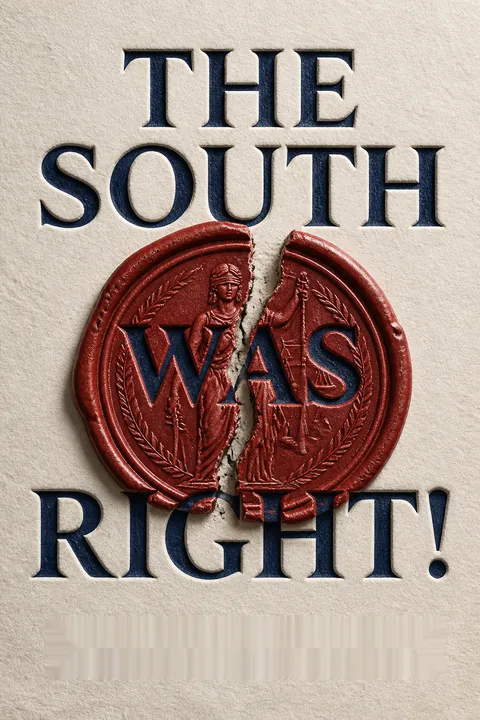
Its central claim. The Kennedys argue that the Southern states had a moral and constitutional right to leave the Union, and that Northern military victory replaced a voluntary federation with centralized rule. The book’s title states its conclusion plainly: the South was right to seek independence. Its chapters build that case through arguments about history, slavery, constitutional law, wartime conduct, and Southern identity.
A committed perspective. The authors identify as Southern nationalists and end by urging political action, including renewed independence if reform fails. That commitment gives the book its energy and its blind spots. Readers should treat it as a forceful political brief: a guide to how one Southern nationalist movement interprets the past, rather than a neutral survey of Civil War scholarship.
The book is most revealing when read as both history and an artifact of political memory. Its repeated appeal to self-government asks a durable question: when does a shared government lose the consent that makes it legitimate? At the same time, a declared conclusion can shape which evidence receives emphasis. A useful reading practice is to separate the authors’ factual claims, their interpretation of those claims, and the political program they build on top of them.
Separate criticism of Northern hypocrisy from any defense of slavery
The authors’ argument. The book points to Northern participation in slave trading, Northern laws restricting free Black residents, and the profits that Northern businesses drew from slave-grown goods. It uses these examples to challenge the picture of a uniformly antislavery North. It also notes that most Confederate soldiers did not own enslaved people, and argues that many fought for independence rather than personal property.
A revealing tension. The book’s own account includes the Confederate Constitution’s protection of slave property and its recognition of slavery in Confederate territories. Those provisions make slavery more than a Northern pretext in the political order the Confederacy sought to preserve. Exposing hypocrisy in the North does not erase the South’s defense of slavery or resolve how central slavery was to secession.
This distinction matters beyond the Civil War: showing that one side acted inconsistently does not establish the innocence of its opponent. The book is right to resist a morality play in which every Northerner opposed slavery and every Southerner had identical motives. Yet its strongest evidence also complicates its preferred conclusion. A careful account can hold several truths together: slavery shaped the political conflict, Northern interests were entangled with it, and individual soldiers could have fought for different reasons.
Treat secession as a constitutional argument, not a settled right
The compact theory. The authors contend that states created the federal government by delegating specific powers, while retaining the authority to reclaim them if the government became oppressive. They cite the Articles of Confederation, state ratification statements, the Kentucky and Virginia Resolutions, and William Rawle’s 1825 constitutional text, which discussed a state’s ability to withdraw from the Union. Their argument distinguishes a voluntary union from rule maintained by force.
The disputed conclusion. These sources establish that secession and state sovereignty were serious arguments in American political life. They do not, by themselves, prove that secession was an uncontested constitutional right in 1861. The book presents one interpretation of a long-running dispute, while giving less attention to opposing interpretations of the Constitution and the Union.
The distinction between consent and coercion is philosophically powerful, and the book makes it concrete through debates over delegated authority. But constitutional meaning is not settled by locating a historical writer who endorsed a position. It also depends on how institutions, states, and citizens understood and practiced the compact. Readers can learn from the authors’ constitutional case without mistaking evidence that the argument existed for proof that the argument prevailed.
Count civilian destruction among the war’s lasting costs
The human toll. The authors describe wartime suffering beyond the battlefield, including the destruction of homes and food supplies, the burning of Alexandria, Louisiana, and the removal of women and children from Georgia factory towns. They draw on official military records and state reports to document pillaging, abuse, and the displacement of civilians. Their larger point is that military defeat brought economic damage and personal loss that continued long after the fighting stopped.
Evidence and interpretation. The book uses these accounts to argue that Northern forces pursued a deliberate campaign against Southern society. The cited episodes support scrutiny of civilian harm, but the broader claim of a coordinated campaign requires more than a collection of individual orders and incidents. The distinction between documented acts and the authors’ explanation of them is essential.
Civilian experience is often crowded out by battle maps and leadership narratives, so the book’s attention to homes, food, and displacement widens the frame in a valuable way. Its examples also invite a disciplined question: what does a record prove about an event, and what further evidence is needed to establish policy or intent? Taking suffering seriously does not require adopting every causal claim made about it.
See Black Southerners as people with varied choices, not symbols
Many kinds of service. The book recounts Black Southerners who supported the Confederacy as laborers, body servants, nurses, and, in some cases, armed participants. It highlights Levy Carnine, who stayed with Confederate units and carried letters home, and cites Black veterans and former slaves who spoke warmly of particular white families. It also draws on federal interviews with former slaves, reporting that many described positive personal relationships with their former enslavers.
Limits of testimony. These stories show that Black people did not all respond to war in the same way. But the authors’ claim that most former slaves reported favorable experiences rests on interviews conducted decades after emancipation, selected and interpreted by the book’s authors. Such testimony matters, but it cannot by itself establish that slavery was benign or that enslaved people freely consented to their circumstances.
The strongest contribution here is the refusal to reduce Black people to a single expected role, whether grateful Confederate, eager Unionist, or passive victim. Individual stories restore complexity and agency. Their limits matter just as much: loyalty to a household could coexist with the coercion of enslavement, and an interview sample cannot stand in for every person’s experience. Respecting testimony means hearing it carefully without asking it to prove more than it can.
Test claims about historical memory against the sources behind them
The book’s memory argument. The Kennedys call the dominant national account the “Yankee myth of history,” meaning a version of the past that, in their view, casts the North as morally pure and the South as uniquely blameworthy. They cite Confederate leaders’ warnings about postwar history writing, Frank Owsley’s critique of Northern textbooks, and contrasts between older and newer Louisiana schoolbooks. The chapter argues that control of historical teaching shapes how later generations understand political defeat.
Apply the same test. The book also selects evidence to serve its own case, including partisan memoirs, sympathetic former Confederate accounts, and examples of Northern wrongdoing. Its warning about selective history therefore applies to its own pages. Readers should compare its quotations and statistics with the sources cited, and ask what evidence or perspectives have been left out.
History is never just a warehouse of facts. Choices about which events to teach, whose voices to quote, and what context to supply shape public memory. The book usefully makes those choices visible. Its own framing, however, can turn disagreement into proof of a hostile narrative, which makes independent checking especially important. A strong critique of one-sided history should invite more evidence, not simply replace one official story with another counter-story.
Ask who shared the South’s wealth before calling it prosperous
Culture and economics. Drawing on writers such as Frank Owsley and Grady McWhiney, the authors describe an Old South shaped by small farmers, local ties, and a less commercial ideal of life. They argue that standard accounts overstate the dominance of plantation society and understate the independence of many “plain folk.” The book also claims that the South had substantial economic strength before the war, then cites postwar losses, tenancy, and poverty as evidence of lasting damage.
The distribution question. Aggregate measures, such as the book’s claim that the South would have ranked among the largest economies of its day, do not show how wealth was distributed or how enslaved labor contributed to it. The authors’ account of regional culture is a useful challenge to caricature, but their economic comparisons need to be read alongside the unequal labor system they also describe.
A regional economy can be large while many residents remain poor, and a society’s cultural values can differ without being internally equal. That distinction helps clarify what the book’s economic figures can and cannot establish. Its focus on small farmers and local life pushes beyond the image of a South made only of planters and enslaved people. A fuller analysis still has to ask who produced wealth, who controlled it, and who bore its costs.
Treat the book’s voting tests as a warning, not a blueprint
A narrower franchise. The authors argue against universal voting rights and propose qualifications including literacy, basic civic knowledge, tax payment, and exclusion of people receiving public relief or benefiting from bankruptcy. They present these rules as a way to improve political judgment and limit voters’ ability to spend other people’s money. In their view, the state, rather than the federal government, should set voting qualifications.
The liberty problem. These proposals sit uneasily beside the book’s defense of government by consent. Literacy and tax requirements may sound neutral, but the power to define them can decide who counts as part of the political community. The authors do not adequately address how their tests might burden people with limited access to education or resources, or how excluded citizens could challenge those rules.
The tension is fundamental: a democracy needs informed participation, but qualifications intended to improve participation can also become instruments of exclusion. Political equality is not identical to equal expertise, and a vote is not simply a technical credential. The book is useful here as a case study in how defenses of local control can coexist with proposals that narrow the electorate. Any voting rule deserves scrutiny for both its stated purpose and its likely distribution of power.
Turn historical pride into local civic work, not nostalgia
The authors’ program. The book closes with a call to rebuild Southern pride through local history events, school presentations, memorial activities, and political organizing. It favors starting with local offices and organizations rather than relying on a single national candidate. Its stated goals range from greater local control and constitutional reform to a separate Southern nation if reform fails.
A consequential choice. This is not a neutral ending to a history book. It turns the historical argument into a modern political project. The authors’ call to preserve cultural memory can encourage civic participation, but their program also asks readers to accept a highly contested account of the past and a particular vision of Southern political identity. Historical pride is most constructive when it makes room for the region’s full range of experiences.
Local civic work is a more durable route to influence than waiting for a heroic leader to solve everything, and the book makes that practical point clearly. Its political aim also deserves direct examination: remembrance can build community, but it can also define who belongs and which histories matter. A constructive use of regional pride would preserve distinctive traditions while acknowledging slavery, racial exclusion, and disagreement within the South itself.
Analysis
The South Was Right! is a 146,000-word work of political history, constitutional argument, cultural criticism, and nationalist advocacy. Its structure moves from a challenge to accepted Civil War history, through arguments about slavery and wartime conduct, into a case for state sovereignty, and finally toward contemporary political action. That architecture is its main strength: readers can see how the authors connect historical memory to legitimacy, economic power, and identity. It is also the source of the book’s central analytical weakness. Evidence is repeatedly asked to perform two jobs: document a past event and establish a sweeping claim about Northern intent or Southern innocence.
The book’s use of primary materials is substantial. It quotes official military records, speeches, constitutional documents, former slaves’ interviews, and postwar accounts. But a primary source is not self-interpreting. A military order may establish that an order was given, while further evidence is needed to infer how broadly it was implemented or what policy it represented. Likewise, a late-life recollection is valuable evidence of memory and attachment, but it cannot represent every enslaved person’s experience. The authors often move quickly from examples to general conclusions, while giving less space to competing readings of the same material.
Its most important internal tension is between the universal language of consent and the particular social order it defends. The book condemns coercive government and invokes liberty, yet the Confederate Constitution it reproduces protects slavery, and its own voting proposals would restrict participation. These contradictions do not make every argument about federal power irrelevant. They do show that political principles are often applied selectively, and that liberty for one community can coexist with exclusion inside it.
The adaptation therefore preserves the book’s strongest questions while marking its conclusions as contested. Readers gain the most by separating three layers: the historical evidence, the authors’ interpretation, and their modern political prescription. That approach neither dismisses regional memory nor grants it immunity from scrutiny. It makes the book useful as a case study in how defeat, grievance, and constitutional theory can be combined into a living political identity.
People Also Read








Glossary
Yankee myth of history
Claimed victor-written narrativeThe authors’ label for what they see as a Northern-dominated account of the Civil War and the South. They argue that this narrative presents Northern actions as morally justified, casts the South as uniquely culpable, and discourages challenges to federal authority. The term expresses the book’s interpretation of historical memory, not a neutral scholarly category.
Southern Apologia
Southern defense literatureThe book’s name for postwar Southern writing that defended the Confederacy’s motives, constitutional arguments, and conduct. The authors point to former Confederate leaders and writers who tried to preserve their account of the war for later generations. In their telling, this literature answered Northern histories they viewed as distorted or hostile.
New Unreconstructed Southerner
Active Southern nationalistThe authors’ term for a modern Southerner who rejects the idea that Southern defeat settled every political question and who actively promotes regional identity and self-government. The book distinguishes this person from someone privately proud of Confederate ancestry but politically inactive. Its proposed activities include local historical education, organizing, and political campaigning.
cultural genocide
Destruction of cultural identityThe book uses this term for what it considers a sustained effort to weaken Southern identity through military conquest, postwar political control, education, and restrictions on public symbols. The authors extend the term to later portrayals of Southern history and culture. This is their polemical interpretation of cultural change, not an uncontested description of the period.
Download PDF
Download EPUB
.epub digital book format is ideal for reading ebooks on phones, tablets, and e-readers.








