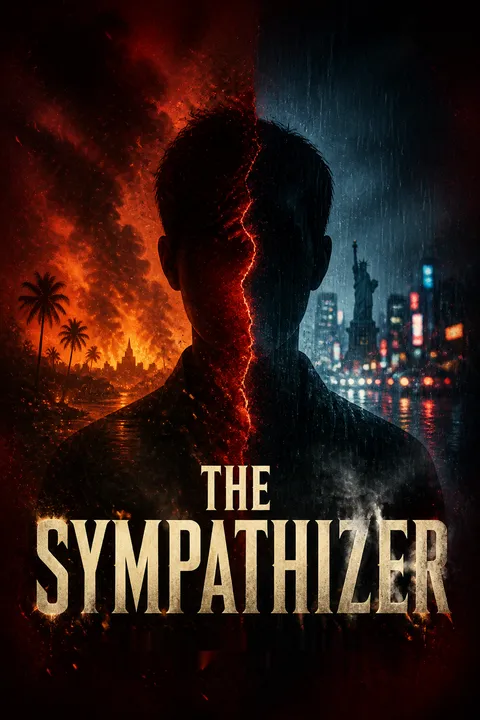


Plot Summary
The Last Flight from Saigon
In April 1975, as North Vietnamese forces close on Saigon, the Captain serves as aide to a South Vietnamese general while secretly spying for the communists. His handler, Man, orders him to leave with the General and report on the exiles’ plans. The Captain organizes seats on a covert American flight, choosing a handful of officers and saving places for his blood brother Bon, Bon’s wife Linh, and their young son, Duc.
He also arranges bribes and visas, then guides the General’s party through the curfew-bound city. Before boarding, the three childhood friends part with a promise to return. The Captain carries a hidden camera and a book that doubles as a cipher, while the war’s outcome and his divided loyalties travel with him.
The evacuation makes the Captain’s double life practical rather than abstract: the same skills that serve the General also help a communist network. His duty to choose who escapes forces him to turn political collapse into arithmetic, and his decision to include Bon’s family reveals the private loyalties that ideology cannot erase. Saigon is not merely a homeland being lost; it is the place where every allegiance was formed and concealed. The opening establishes the novel’s central pressure: the Captain can understand opposing sides, but that understanding does not let him stand outside their consequences.
The Runway Takes Its Price
The first evacuation plane is struck on the runway, forcing the passengers into the open as rockets and gunfire tear through the airfield. A second transport arrives, and the crowd surges toward it while the General and the Captain push their families forward. Bon’s wife, Linh, and their little boy, Duc, are hit before they can board.
The Captain lifts Linh’s body and runs for the plane; Bon carries his dead child behind him. The General catches Linh at the ramp, and the crew hauls Bon and the Captain aboard as the aircraft races away. On Guam, Bon collapses into grief. At the burial, he throws himself into the grave, and the Captain climbs down to pull him out before they cover Linh and Duc with earth.
The escape succeeds in the narrowest military sense and fails as a human rescue. The Captain’s split identity cannot shield him from the sight of Bon losing the family that gave his life meaning. Bon’s grief also changes the friendship’s balance: the Captain is no longer simply a fellow conspirator but the person who must keep his brother alive. The uncertain source of the fatal bullet deepens the wound, because violence has made even the distinction between friend and enemy impossible to settle. From here, the refugees carry the war inside their relationships.
Refugees Without a Country
On Guam, the General tries to raise morale among civilians and is beaten with shoes, canes, and umbrellas by women demanding to know why their husbands and sons are not with him. The refugees move on to Camp Pendleton, where the Captain finds Professor Hammer and secures work at his former college.
He also helps Bon find sponsorship and a job, while Bon spends his nights drinking and cleaning a church, unable to escape memories of Linh and Duc. Through coded letters to Man’s aunt in Paris, the Captain reports that the exiles are scattered across America and struggling to start again. The General and Madame eventually settle in Los Angeles, where the General remains unemployed and furious at his reduced life.
The refugees’ arrival exposes a gap between military rank and moral authority. The General expects his uniform to command respect, but the women see only the absent families and failed defense it represents. In America, the Captain and Bon survive through work and sponsorship, yet material safety does not restore their former selves. The letters to Paris keep the Captain connected to the revolution, while his outward life depends on American institutions. Exile therefore becomes another double existence: a new home built from aid and labor, and a lost home preserved through memory and clandestine reporting.
A False Spy Is Chosen
By 1976, the General has opened a liquor store and gathered former officers around him, but he is already planning a counterrevolution. At the store’s opening, he tells the Captain and CIA officer Claude that an informer may be hiding among the exiles. The Captain names a fat, good-natured former intelligence major, hoping to deflect suspicion from himself.
The General accepts the accusation and orders the Captain to correct his mistake by arranging the man’s death with Bon. Bon, who has spent a year numbed by loss, welcomes the task because it gives him a purpose. The Captain watches the major at work, learns his routine, and prepares a staged robbery. He cannot persuade himself that the man is guilty, but obeys anyway.
The major’s selection shows how a lie can become an institution once authority adopts it. The Captain invents a suspect to protect himself, then discovers that his improvisation has created a real death sentence. Bon’s readiness is not simple bloodlust; it is an attempt to recover a role after grief stripped away husband, father, and soldier. The General’s resistance project likewise turns personal humiliation into political momentum. In this section, the novel asks how people make violence feel necessary: by naming it correction, duty, or the restoration of a purpose.
The Major’s Third Eye
The Captain and Bon follow the major’s Sunday routine for weeks, then steal license plates and buy fireworks to disguise a killing near the Fourth of July. Bon waits in the carport while the Captain approaches the major with a gift bag of oranges and firecrackers. When Bon steps out, he cannot shoot the man in the back. The major turns toward him, and Bon fires once, killing him.
They escape, discard the evidence, and drink through the night. The Captain later attends the funeral, where the General praises the dead man as a dutiful officer and gives money to his widow. The Captain visits the widow as well, offering support, but the major’s face continues to appear in his thoughts as an accusing witness.
The killing turns the Captain’s abstract complicity into a physical fact. Bon’s refusal to shoot from behind grants the victim a final moment of recognition, but it cannot make the act just. The oranges and celebratory fireworks turn an American holiday into cover for a political execution, collapsing the distance between public ritual and private violence. The General’s funeral speech repairs his own network while the Captain’s conscience refuses that repair. The dead major’s imagined third eye becomes a figure for knowledge that cannot be buried: the Captain now sees himself as the man who arranged the murder.
Sonny Writes Back
At the major’s funeral and a refugee wedding, the Captain meets Sonny Do, an old college acquaintance who now edits a Vietnamese-language newspaper. Sonny reports on the exiles and questions whether the war should continue, irritating the General, who wants the community organized for a return to Vietnam.
The Captain also sees the General’s daughter Lan, now calling herself Lana and singing in nightclubs against her parents’ wishes. At a lunch with Congressman Ned, the General learns that a Hollywood director is making a Vietnam War film and agrees to have the Captain review its script.
The General hopes to build support through veterans’ groups and political allies; Sonny’s reporting, by contrast, offers the refugees a public space to question the cause.
Sonny’s newspaper makes representation a direct political contest. The General needs a shared story of unfinished struggle, while Sonny’s reporting gives the community permission to imagine life beyond military return. The Captain’s position between them is especially dangerous because he understands the usefulness of both approaches. Lana’s public singing offers a different kind of refusal: she challenges family authority through performance rather than political organization. The section gathers three competing claims to voice, the General’s command, Sonny’s journalism, and Lana’s art, while the Captain is recruited to mediate another struggle over who gets to portray Vietnam.
Hollywood Borrows Vietnam
The Captain reads the screenplay for The Hamlet and finds a war story in which Vietnamese characters scarcely speak, while American soldiers dominate every scene. When he confronts the director, the Auteur dismisses his objections, but later hires him as a consultant in the Philippines. There, the Captain recruits Vietnamese refugees from a camp at Bataan to appear as extras.
The film gives a few Vietnamese characters speaking roles, yet casts them as victims, traitors, or villains whose deaths serve the American plot. The extras accept low wages because they need the money. The Captain argues for better pay and more credible details, but each improvement makes him more useful to the production without changing who controls the story.
The film set transforms the Captain’s political dilemma into a labor problem. He can negotiate wages, costumes, and dialogue, but he does not control the story’s structure or its moral center. His consultation matters to the people he hires, yet it also lends credibility to a narrative that makes Vietnamese lives support an American hero’s development. The distinction between being included and being represented becomes painfully concrete: the refugees appear on screen, but the film decides what their presence means. The Captain’s participation is neither pure betrayal nor effective resistance, which is precisely why it troubles him.
The Cemetery Explodes
During production, the Captain watches James Yoon endure a grueling torture scene as Binh, a Vietnamese ally in the film. The real refugees hired as guerrilla extras supply the scene’s insults and violence with uncomfortable conviction.
Later, the Auteur orders the film’s cemetery set destroyed, including the fake grave where the Captain placed his dead mother’s photograph. While he kneels there, explosives detonate. The Captain is thrown, burned, and knocked unconscious.
In a Manila hospital, he wakes unable to speak and suspects the blast was no accident, especially after his bitter clash with the Auteur. The studio pays his medical costs and settles with him for ten thousand dollars, while he realizes that part of his memory is missing.
The cemetery is a fragile memorial made for a camera, yet its destruction wounds the Captain as if the grave were real. The production’s appetite for spectacle consumes the one place where he had tried to give his mother dignity. His injury also converts the film’s violence from representation into bodily risk, blurring the line the production depends on between staged danger and actual harm. The settlement gives him money but no certainty about what happened. His missing memory becomes another form of dispossession, an absence he can feel but cannot yet name.
Sofia Chooses Sonny
Back in Los Angeles, the Captain visits Sofia Mori, his former lover, and finds her with Sonny. He challenges Sonny for remaining in America despite his revolutionary convictions, but Sonny admits his fear and divided loyalties rather than pretending to be fearless.
Sofia sides with him, explaining that immigrant life and political work have become her home. The Captain recognizes that he has lost her, though he had never fully accepted the rules of their open relationship.
Meanwhile, the General’s Benevolent Fraternity raises money for veterans while secretly supporting a force training for a return to Vietnam. Bon volunteers for a dangerous reconnaissance mission. The General tells the Captain that he may join only after proving himself through an undisclosed act.
The encounter with Sofia and Sonny punctures the Captain’s assumption that ideological courage belongs only to those who return to fight. Sonny has stayed in America out of fear, but he also recognizes the work of building community there. Sofia’s choice is not a prize awarded to either man; it reflects her own political and emotional commitments. At the same time, Bon’s enlistment shows how grief can be converted into a military mission. The Captain is pulled between intimate loss, his friend’s likely danger, and the General’s demand for action.
The Captain Kills Sonny
The Captain understands that the General’s test is Sonny’s assassination. Bon helps him rehearse a plan, but when the Captain enters Sonny’s apartment, their conversation becomes unexpectedly intimate. Sonny describes his love for Sofia and his new desire to think beyond himself. The Captain reveals that he is a communist agent, hoping the truth will make Sonny understand, but Sonny assumes it is a trap.
When Sonny moves to leave, the Captain shoots him several times. He checks Sonny’s eye as Bon taught him, sees it move, and fires again. Disguised as a white man, he leaves the building and vomits beside his car. The killing earns the Captain the right to join Bon’s mission, but it leaves him carrying two murders and a fresh betrayal.
The Captain’s confession is an attempt to make recognition possible at the moment when recognition has become dangerous. Sonny cannot believe him because the Captain has arrived as an apparent threat, and the truth comes too late to undo that context. The disguise that helps the killer escape also reveals the racial order he can exploit: he is treated as invisible when he looks white. His violence now serves both factions, the General’s anticommunist campaign and his own communist allegiance, without belonging cleanly to either. The scene marks a point of no return in his personal life as well as his politics.
The Movie Opens Abroad
Two days after Sonny’s murder, the Captain leaves California with Bon and two veteran officers for Thailand. In Bangkok, Claude takes the exhausted group to see The Hamlet. The audience cheers the film’s American victories, while its only extended quiet comes during Mai’s rape by guerrillas.
The Captain recognizes how the production turns Vietnamese suffering into fuel for an American rescue story, despite the speaking roles and details he helped secure.
At the airport, the General has already condemned the Captain’s pursuit of Lana and reminded him that her family sees him as socially unworthy. The men travel onward to a forest camp, where a guerrilla force waits under an admiral who resembles Ho Chi Minh and believes their return can still be organized.
The screening forces the Captain to encounter his work from the position of an audience member rather than a consultant. The cheers make the film’s politics measurable: spectators are not simply watching violence but learning which deaths deserve excitement and which pain requires silence. His contribution has improved the surface while leaving the machinery of the story intact. The General’s rejection of his relationship with Lana repeats the Captain’s lifelong exclusion as a bastard, even as the General depends on his service. Thailand offers a new battlefield, but the Captain arrives already compromised by the stories he has helped shape.
The Mekong Crossing Fails
The twelve-man team crosses into Laos with a Lao farmer and a Hmong scout guiding them toward the Mekong. A landmine kills the affectless lieutenant, and the Captain must carry the severed leg until the group can bury him.
At the river, a rocket destroys the bamboo raft as the team begins crossing. The grizzled captain is killed, the darker marine is mortally wounded, and gunfire separates the survivors. Bon and the Captain are captured with the philosophical medic, the dark marine, and the scout.
The Lao farmer later disappears during an escape attempt, while other members of the force die in captivity. Bon’s plan to fight his way home ends in a prison camp, and the Captain’s attempt to protect him has brought them both into communist hands.
The mission strips military purpose down to bodily tasks: carrying a leg, hiding a grave, crossing a river under fire. The Captain’s education and strategic imagination cannot make the terrain obey him. Bon’s earlier declaration that he wants to kill communists brings him directly into the power of the people he hates, while the Captain’s effort to save his friend has again produced a situation he cannot control. The river, a practical boundary on the map, becomes a threshold between the exile army’s imagined future and the revolution’s actual prisons.
Man Behind the Mask
After a year of isolation, the Captain is summoned to meet the camp’s commissar and discovers that the scarred, faceless official is Man, his childhood friend and revolutionary handler. Man had arranged to become commissar so he could protect both the Captain and Bon from execution or a deadly labor detail.
He has studied the Captain’s confession, but says its polished, ironic style will not satisfy the commandant, who expects a clear account of ideological error. Man explains that the Captain must undergo a final examination if he is to leave. The revelation changes the meaning of the camp: Man has not simply abandoned his friend, but his protection also requires him to become an interrogator.
Man’s appearance makes friendship inseparable from institutional power. The Captain sees the schoolmate who recruited him and the official who has kept him confined in the same person, with neither identity canceling the other. Man’s protection is real, but it operates through the machinery of coercion he is trying to manage. The confession’s style becomes a political problem because irony refuses the single, obedient meaning demanded by the commandant. The Captain’s gift for holding contradictions has kept him alive in espionage, yet it now threatens to make him unintelligible to the revolution he served.
The Answer Is Nothing
Man’s final examination uses light, isolation, interrupted sleep, and a harmless electric stimulus, techniques drawn from the Captain’s own interrogation training. Under the pressure, the Captain remembers the communist agent he watched being raped and tortured in Saigon. He had objected, but when the policemen continued, he did nothing to stop them; after liberation, Man’s network rescued her.
He also admits that he once wished his priest father dead, and Man’s agent acted on that wish. The commandant’s question about what outranks independence and freedom finally yields the answer nothing. The word carries both the slogan’s claim that freedom is supreme and the bitter possibility that the revolution has made it worthless.
The revelation is not that the Captain personally inflicted the worst violence, but that he watched while others did it and later disguised omission as helplessness. His father’s death adds a second form of complicity: private desire can travel outward through a political network and return as an irreversible act. The word nothing resolves the interrogation without resolving the history. It holds a revolutionary ideal and its negation in the same sound, exposing how slogans can preserve their authority even after institutions betray their meaning. The Captain’s divided mind becomes a tool for seeing that betrayal, not an escape from responsibility.
A Boat Toward Uncertainty
After the Captain breaks down, Man arranges for him and Bon to leave the camp and escape Vietnam. He bribes officials with money taken from desperate families and gives the Captain his old rucksack, cipher book, and completed manuscript. Bon is battered and limping, but the friends reunite and travel to Saigon, where a cousin organizes a sea passage for a large family group.
Yellow music is banned, so even the city’s silence confirms that the revolution has narrowed the life it promised to free. The Captain and Bon prepare to board a crowded fishing boat with the manuscript wrapped against the water. They do not know whether they will reach safety. Their final certainty is only that, despite everything, they intend to live.
The escape does not restore the Captain to a country or deliver a clean political conclusion. Man purchases freedom through the same informal money economy the revolution claims to have overcome, and his choice costs him the possibility of leaving with his friends. Bon and the Captain become refugees again, now fleeing a victorious revolution rather than a defeated republic. Their manuscript is both testimony and contraband, an effort to keep their own account from being erased. The ending’s hope is deliberately modest: not victory, return, or innocence, but the decision to continue living and to keep speaking.
Analysis
The Sympathizer follows a man whose ability to see both sides begins as an intelligence asset and becomes a moral liability. The Captain’s Vietnamese and French parentage, American education, South Vietnamese service, and communist allegiance place him inside several political worlds without granting him secure membership in any. His divided perspective does not make him neutral. It makes him responsible for understanding consequences that others can dismiss as necessary, accidental, or invisible.
The novel repeatedly tests the difference between action and complicity. The Captain can object to the torture of a prisoner, negotiate a film’s treatment of Vietnamese extras, and recognize the humanity of people called enemies. Yet at crucial moments he also watches, obeys, or pulls a trigger. His confession finally identifies omission as a form of guilt: he failed to save the communist agent from sexual violence, then carried that failure forward under the language of helplessness. The book refuses the comfort of treating moral awareness as moral innocence.
Its political critique works through mirrored institutions. American intelligence techniques enter South Vietnamese police practice; Hollywood turns Vietnamese suffering into spectacle; the victorious revolution adopts coercive methods and makes its own ideals difficult to speak honestly. These parallels do not claim that every regime or action is identical. They show how power borrows tools and rhetoric while insisting that its own purpose is exceptional. The Captain’s position lets him expose those repetitions, but it also implicates him in them.
The novel’s form makes that problem unavoidable. The Captain writes a confession for authorities who demand ideological clarity, while his own language keeps opening into contradiction, memory, and irony. His eventual answer, nothing, is both affirmation and indictment. Freedom may be the highest value, yet a state can invoke it while depriving people of it. By ending with the Captain and Bon preparing to flee again, the novel refuses a clean reconciliation. Their hope is not a return to innocence or certainty, but the insistence that they will keep living and keep trying to tell what happened.
Review Summary
The Sympathizer received mixed reviews, with many praising its unique perspective on the Vietnam War and its aftermath from a Vietnamese point of view. Readers appreciated the novel's dark humor, complex themes, and insightful commentary on identity and cultural representation. Some found the writing style challenging or overly intellectual, while others were captivated by the narrator's dual nature and the book's exploration of loyalty and betrayal. Critics generally agreed that the novel offers a fresh and important contribution to literature about the Vietnam War and its impact on refugees.
People Also Read








Characters
The Captain
The divided spyAn unnamed Vietnamese-French officer, the Captain serves in the South Vietnamese security apparatus while secretly working for the communists. Raised by a poor Vietnamese mother and an absent French priest father, he is accustomed to being treated as neither wholly one thing nor another. His fluency in English and skill at reading opposing viewpoints help him survive as an aide, spy, and cultural intermediary. Yet his intelligence does not protect him from self-deception: he often understands the moral cost of an action only after helping to carry it out. His wit, appetite for books, alcohol, and romance make him vivid and evasive in equal measure. He wants recognition without surrendering the complexity that makes him difficult to accept.
Man
The revolutionary handlerThe Captain’s closest childhood friend and communist handler, Man is a careful reader, disciplined organizer, and gifted teacher of revolutionary thought. He and the Captain share a blood oath with Bon, though Man’s political life is more deeply embedded in clandestine committees. His intellectual confidence is matched by a capacity for secrecy, and he often understands what the Captain is feeling before the Captain can name it. Man believes that personal sacrifice can serve collective liberation, but his faith does not make him untouched by pain or doubt. His relationship with the Captain is founded on genuine affection and a shared history, yet their political roles repeatedly place them on opposite sides of danger.
Bon
The wounded soldierBon is the Captain’s other blood brother, a loyal paratrooper and committed South Vietnamese patriot. His hatred of communism grows from the killing of his father, but his life is not reducible to revenge. He loves his wife and child with a depth that unsettles his former certainty about what makes a man. Direct, physically courageous, and sparing with words, Bon expresses emotion most clearly through action. He has little patience for the Captain’s elaborate arguments, though he trusts him more than almost anyone. His sense of self is tied to protecting comrades and family, which makes exile especially painful: without a unit or home, he struggles to recognize what remains of the soldier he was.
The General
The exiled commanderThe South Vietnamese General employs the Captain as aide and intelligence officer, trusting his competence and command of American culture. A veteran who values discipline, food, family, and status, he once believes deeply in the American alliance. Defeat strips away his rank and livelihood, but not his appetite for command. He seeks to restore his army and national cause, using veteran networks, public organizations, political allies, and secret funding. His dignity is sincere, though it can harden into suspicion and control. He relies on the Captain as a capable subordinate and surrogate son while remaining shaped by class prejudice and a rigid sense of who belongs in his family.
Claude
The CIA mentorAn American CIA officer who has known the Captain since childhood, Claude combines physical confidence with a working knowledge of Vietnamese politics and American institutions. He helped the Captain reach college in the United States and later trained South Vietnamese officers in intelligence and interrogation. He sees himself as pragmatic, affectionate, and experienced, but his professional fluency often obscures the damage caused by the policies he serves. Claude’s friendship with the Captain is real, even when it cannot make their unequal positions disappear.
Sofia Mori
The uncompromising loverSofia, the Captain’s colleague at the college, is a Japanese American woman who resists the expectation that her identity must be defined by inherited culture. She is frank about racism, sex, and the limits of liberal acceptance, and she chooses a life of free relationships rather than conventional marriage. Her connection with the Captain is tender but deliberately unpossessive. As a listener and political thinker, she recognizes how both of them perform agreeable roles for white institutions. Sofia wants intimacy without surrendering her independence, and she refuses to be treated as an accessory in the Captain’s emotional or political life.
Sonny Do
The dissident journalistSonny is a former college acquaintance who remains in America after Saigon falls and starts a Vietnamese-language newspaper for the refugee community. He is principled, articulate, and willing to challenge the General’s military ambitions, though his convictions coexist with fear about returning to Vietnam. His relationship with Sofia gives him a more intimate life than the Captain expects, and it also forces him to reconsider how political commitment can take shape in exile. Sonny’s journalism aims to make public debate possible among people who have lost their country, but his independence makes him vulnerable to those who want a single community line.
Lana
The rebellious singerThe General’s daughter, formerly known as Lan, studies art history in California and becomes a nightclub singer. Her parents expect a respectable path toward marriage, but she claims space through performance, independent living, and outspoken political views. Lana is neither the obedient schoolgirl the Captain remembers nor merely the glamorous figure he desires. She is socially progressive, artistically ambitious, and alert to the way men project fantasies onto her. Her attraction to the Captain is complicated by family expectations and his own uncertain attachments.
Madame
The General’s determined wifeThe General’s wife is a formidable organizer who manages family and household life through upheaval. In exile, she takes on work and domestic responsibilities that were once handled by staff, then helps build the General’s community organizations and supports his political plans. She is protective of her children and wary of American permissiveness, especially when it threatens the future she imagined for Lana. Beneath her cultivated manner is a practical intelligence, and her choices often carry the family through crises that the General cannot solve with rank.
Linh
Bon’s devoted wifeLinh is Bon’s wife and the mother of their young son, Duc. She leaves Saigon with her family during the evacuation, carrying the practical and emotional burdens of protecting a child in flight. Her presence gives Bon a life beyond military duty and anchors the Captain’s sense of responsibility to his blood brother.
Duc
The brothers’ godsonDuc is Bon and Linh’s young son and the Captain’s godson. Still a small child when Saigon falls, he experiences the upheaval through the adults who carry and protect him. His place in the brothers’ chosen family makes him a symbol of the future they hope to preserve.
The former major
The false suspectA former Special Branch officer, this jovial, food-loving major is better known for his expertise in Chinese language and cuisine than for covert intrigue. He struggles to support his family in America and treats the Captain as a friend, unaware of the suspicion surrounding him. His ordinary kindness complicates the General’s appetite for conspiracies and gives the Captain an unsettling measure of how easily an accusation can become a death sentence.
Professor Hammer
The generous academicA former professor and mentor, Avery Wright Hammer first helped the Captain obtain a scholarship in America and later sponsors him after the fall of Saigon. He offers practical aid without demanding that the Captain perform gratitude in any particular way. His own political evolution from youthful communism to renewed faith in American power reflects the intellectual compromises that surround the Captain.
The Auteur
The Hollywood directorThe celebrated director of The Hamlet is ambitious, talented, and impatient with criticism. He regards filmmaking as art, even when his production turns Vietnamese suffering into material for an American-centered war story. He hires the Captain for authenticity but resists challenges to the story’s assumptions. His confidence in his own imagination exposes the power imbalance between those who control a film and those whose lives it depicts.
The Commandant
The ideological examinerThe commandant oversees the reeducation camp and evaluates the Captain’s written confession. He believes discipline and ideological clarity are necessary to rebuild the country, and he regards the Captain’s irony and Western learning as signs of unresolved contamination. His manner can be patient, but his authority rests on confinement and coercion. He represents a system that can acknowledge suffering while still demanding that individuals describe it in approved terms.
The Admiral
The jungle resistance leaderAn exiled naval commander, the Admiral leads a small force near the Thai border and insists that the struggle against communism can continue for years. His resemblance to Ho Chi Minh unsettles the Captain and the other newcomers, while his sparse camp and religious language give his movement the atmosphere of a revolutionary outpost. He offers the veterans a cause, though the people he hopes to liberate may not share his certainty.
The Watchman
The captured bomb-makerA former watchmaker and communist operative, the Watchman is captured and interrogated by the South Vietnamese Special Branch. Educated, proud, and deeply committed to the revolution, he refuses to make himself easy to categorize. His exchanges with the Captain reveal how political conviction and personal vulnerability can become weapons in an interrogation room.
Plot Devices
The written confession
A life put on trialThe novel is presented as the Captain’s account, written while he is held in a reeducation camp and addressed to the commandant. This frame gives the narrative the shape of testimony while allowing the authorities to judge not only what the Captain did but how he describes it. His digressions, jokes, and conflicting memories are part of the evidence, not decoration. The form also makes the reader a witness to the pressure exerted by political institutions on personal memory and language. The confession’s final revisions extend the plot into the act of narration itself.
Invisible ink and ciphers
A hidden channel homeThe Captain sends reports to Man through letters addressed to Man’s aunt in Paris. Ordinary remarks about weather and family health signal whether the letter contains a message; rice water and iodine reveal invisible writing, while a book provides a page-and-word cipher. This device keeps the Captain’s communist allegiance concealed from the General and from possible censors. It also turns routine domestic correspondence into a second narrative, one in which the same letter can offer harmless news on its surface and military intelligence beneath it.
The false-bottom rucksack
A portable secret compartmentClaude gives the Captain a leather rucksack with a false bottom, which the Captain uses to conceal his miniature camera and later the book that serves as a cipher. The bag carries his clothing and personal keepsakes alongside the tools of espionage, making secrecy part of ordinary survival. It moves with him from Saigon to America and onward toward Southeast Asia, preserving continuity between his former missions and his later flight. Its hidden space also reflects the Captain’s habit of presenting one usable surface while protecting another identity beneath it.
The Hamlet
A war story inside warThe Hollywood production gives the Captain a second arena in which to confront who has the power to describe Vietnam. He improves details, argues for Vietnamese dialogue, and secures better wages for refugees, but the film remains centered on American soldiers and turns Vietnamese characters into victims, villains, or background figures. The movie’s production and later screening echo the larger political conflict: a people can be visible in an image while being denied control over what that image means. This device also links the Captain’s intelligence work to the economics of entertainment.
Independence and freedom
A slogan with two meaningsThe revolutionary maxim about independence and freedom appears throughout the Captain’s political life, first as a principle worth sacrifice and later as a question his reeducation cannot settle. The word nothing can affirm that no value surpasses freedom, yet it can also expose how a victorious revolution has emptied freedom of practical meaning. Its double sense suits the Captain’s divided perspective: the same phrase can serve liberation and conceal domination. The slogan’s transformation becomes the key to his final understanding of how revolutions can reproduce the power they once opposed.
FAQ
Synopsis & Basic Details
What is The Sympathizer about?
- A Spy's Conflicted Journey: The Sympathizer is a story about a half-French, half-Vietnamese man working as a double agent during the Vietnam War, navigating his loyalties to both the communist cause and the South Vietnamese army.
- Exile and Identity: The novel explores his experiences as a refugee in America, his involvement in a Hollywood film, and his participation in a counter-revolutionary movement, all while grappling with his complex identity.
- Themes of Betrayal and Loyalty: It delves into themes of betrayal, loyalty, and the search for belonging, as the Protagonist struggles to reconcile his divided allegiances and his place in a world shaped by war and ideology.
Why should I read The Sympathizer?
- Unique Perspective on War: The novel offers a rare and insightful perspective on the Vietnam War from the viewpoint of a conflicted double agent, challenging traditional narratives and exploring the complexities of the conflict.
- Intricate Character Study: It presents a compelling and nuanced character study of a man grappling with his dual identity, torn between his loyalties and his own moral compass, making him a fascinating and complex protagonist.
- Exploration of Cultural Identity: The book delves into the challenges of cultural identity, displacement, and the search for belonging, making it a relevant and thought-provoking read for anyone interested in these themes.
What is the background of The Sympathizer?
- Historical Context of the Vietnam War: The novel is set against the backdrop of the Vietnam War and its aftermath, exploring the political and social turmoil of the era, including the fall of Saigon and the refugee crisis.
- Cultural and Political Tensions: It delves into the cultural and political tensions between the East and the West, examining the impact of colonialism, communism, and American intervention on Vietnamese society.
- Personal and National Identity: The story explores the complexities of personal and national identity, as the Protagonist grapples with his mixed heritage and his place in a world shaped by war and ideology.
What are the most memorable quotes in The Sympathizer?
- "I am a spy, a sleeper, a spook, a man of two faces. Perhaps not surprisingly, I am also a man of two minds.": This opening line encapsulates the Protagonist's conflicted nature and sets the stage for the novel's exploration of dualities.
- "Nothing, the General muttered, is ever so expensive as what is offered for free.": This quote highlights the novel's critique of American intervention and the complex relationship between the US and Vietnam.
- "We were not a people who charged into war at the beck and call of bugle or trumpet. No, we fought to the tunes of love songs, for we were the Italians of Asia.": This quote reveals the cultural nuances of the Vietnamese people, contrasting their romantic nature with the brutality of war.
What writing style, narrative choices, and literary techniques does Viet Thanh Nguyen use?
- First-Person Confessional Narrative: Nguyen employs a first-person, confessional narrative style, allowing readers direct access to the Protagonist's thoughts, feelings, and internal conflicts, creating a sense of intimacy and immediacy.
- Satirical and Ironic Tone: The novel is characterized by a satirical and ironic tone, using dark humor and sharp wit to critique both American and Vietnamese societies, as well as the absurdities of war and politics.
- Interweaving of Genres: Nguyen masterfully interweaves elements of espionage thriller, war novel, historical fiction, and satire, creating a unique and compelling narrative that defies easy categorization.
Hidden Details & Subtle Connections
What are some minor details that add significant meaning?
- The Monogrammed Rucksack: The rucksack given to the Protagonist by Claude, with its false bottom and monogrammed initials, symbolizes his dual identity and the hidden aspects of his life as a spy. It also represents the complex relationship between the Protagonist and Claude.
- The Photograph of the Communist Agent: The Protagonist keeps a photograph of the communist agent he helped capture, a constant reminder of his failure to save her and the moral compromises he has made. This detail underscores his internal conflict and guilt.
- The General's Damaged Finger: The General's damaged finger, a result of a past war injury, serves as a subtle reminder of the physical and emotional toll of war, and his inability to escape its consequences.
What are some subtle foreshadowing and callbacks?
- The "Blood in Your Eye" Toast: The toast "Here's blood in your eye," learned by the Protagonist in America, foreshadows the violence and bloodshed that will follow, and also serves as a callback to his American experience.
- The Recurring Image of the Tamarind Tree: The tamarind tree at the General's villa, with its "long, knuckled pods of its sour fruit dangling like the fingers of dead men," foreshadows the death and decay that will engulf Saigon and the characters' lives.
- The Mention of the "Three Musketeers": The Protagonist, Bon, and Man's self-identification as the "Three Musketeers" foreshadows their eventual separation and the betrayal of their youthful ideals, highlighting the tragic consequences of war.
What are some unexpected character connections?
- The Protagonist and the Crapulent Major: The Protagonist's friendship with the crapulent major, a seemingly minor character, leads to the major's death, highlighting the Protagonist's unintended consequences and the complex web of relationships in the novel.
- The Protagonist and the Lieutenant at the Airport Gate: The Protagonist's encounter with the lieutenant at the airport gate, whom he bribes to allow the evacuation, reveals the shared humanity and moral compromises of individuals on both sides of the conflict.
- The Protagonist and the Call Girls: The Protagonist's interactions with the call girls at the refugee camp, while seemingly peripheral, reveal his capacity for empathy and his understanding of the human condition, even in the most unlikely of circumstances.
Who are the most significant supporting characters?
- Claude: Claude, the CIA operative, serves as a mentor and a foil to the Protagonist, representing the complexities of American involvement in Vietnam and the moral ambiguities of espionage.
- The Commissar (Man): Man, the Protagonist's childhood friend and fellow revolutionary, becomes a powerful figure in the communist regime, challenging the Protagonist's beliefs and forcing him to confront his own complicity.
- The Auteur: The Auteur, the Hollywood director, embodies the power of narrative and the limitations of representation, highlighting the struggle for control over the story of the Vietnam War.
Psychological, Emotional, & Relational Analysis
What are some unspoken motivations of the characters?
- The General's Fear of Irrelevance: The General's relentless pursuit of a counter-revolution is driven by his fear of becoming irrelevant in exile, a desire to reclaim his former power and status.
- The Protagonist's Yearning for Belonging: The Protagonist's actions are often motivated by his deep-seated yearning for belonging, a desire to find his place in a world that has always seen him as an outsider.
- Bon's Desire for Meaning: Bon's willingness to participate in dangerous missions stems from his desire to find meaning and purpose in a life marked by loss and trauma, a need to reclaim his identity as a soldier.
What psychological complexities do the characters exhibit?
- The Protagonist's Internal Conflict: The Protagonist's internal conflict is a central aspect of his character, as he grapples with his divided loyalties, his moral compromises, and his own sense of self.
- The General's Obsessive Nature: The General's obsessive nature, his unwavering belief in his own righteousness, and his inability to accept defeat reveal the psychological toll of war and the dangers of unchecked ambition.
- Bon's Trauma and Grief: Bon's trauma and grief over the loss of his family manifest in his reckless behavior and his desire for revenge, highlighting the psychological scars of war and the struggle to find meaning in the face of loss.
What are the major emotional turning points?
- The Fall of Saigon: The fall of Saigon is a major emotional turning point, marking the end of the characters' former lives and forcing them to confront the harsh realities of displacement and loss.
- The Death of Linh and Duc: The death of Bon's wife and child is a devastating emotional turning point, highlighting the senseless violence of war and the profound impact of loss on the characters' lives.
- The Protagonist's Confrontation with Man: The Protagonist's confrontation with Man, his childhood friend turned interrogator, forces him to confront the complexities of his own identity and the moral compromises he has made.
How do relationship dynamics evolve?
- The Protagonist and Claude: The relationship between the Protagonist and Claude evolves from one of mentorship to one of mutual respect and understanding, as they navigate the complexities of their shared history and their differing perspectives on the war.
- The Protagonist and Bon: The relationship between the Protagonist and Bon, initially based on shared loyalty and brotherhood, is tested by the trauma of war and the conflicting paths they choose, highlighting the fragility of even the strongest bonds.
- The Protagonist and Lana: The Protagonist's relationship with Lana, a singer and fellow exile, offers a glimpse of hope and connection, but also reveals the challenges of navigating love and desire in a world shaped by war and displacement.
Interpretation & Debate
Which parts of the story remain ambiguous or open-ended?
- The Protagonist's True Loyalties: The Protagonist's true loyalties remain ambiguous throughout the novel, leaving readers to question whether he is ultimately a communist, a nationalist, or simply a survivor.
- The Nature of Truth and Representation: The novel leaves open the question of whether truth can ever be fully represented, particularly in the context of war and propaganda, challenging readers to consider the limitations of narrative and perspective.
- The Possibility of Redemption: The ending of the novel leaves the possibility of redemption open-ended, as the Protagonist embarks on a new journey, uncertain of his future and the path he will choose.
What are some debatable, controversial scenes or moments in The Sympathizer?
- The Portrayal of Violence: The novel's graphic depiction of violence, particularly the torture and rape scenes, has sparked debate about the author's intent and the ethical implications of representing such acts.
- The Protagonist's Moral Ambiguity: The Protagonist's moral ambiguity, his willingness to compromise his values and engage in morally questionable actions, has led to debate about his character and the novel's overall message.
- The Critique of American Intervention: The novel's sharp critique of American intervention in Vietnam has been both praised and criticized, sparking debate about the responsibility of the US in the conflict and its aftermath.
The Sympathizer Ending Explained: How It Ends & What It Means
- The Protagonist's Departure: The Protagonist's departure from the reeducation camp and his journey back to Vietnam with Bon represent a complex ending, leaving his future uncertain and his loyalties still divided.
- The Ambiguity of Redemption: The ending does not offer a clear resolution or redemption for the Protagonist, highlighting the enduring impact of war and the complexities of moral choices.
- The Cycle of Violence and Betrayal: The ending suggests that the cycle of violence and betrayal may continue, as the Protagonist returns to a world still shaped by conflict and ideological struggle, leaving readers to ponder the possibility of lasting peace and reconciliation.
The Sympathizer Series

Download PDF
Download EPUB
.epub digital book format is ideal for reading ebooks on phones, tablets, and e-readers.








