

Plot Summary
A Garden Against the Randalls
Cora's grandmother Ajarry was stolen from West Africa and sold repeatedly before settling on the Randall plantation, where a three-yard garden became the one claim she could defend. After Ajarry died, her daughter Mabel tended the plot, then vanished into the swamp, leaving Cora a child without protection.
Cora fought neighbors who wanted her patch, was moved into Hob, and grew guarded as plantation gossip and violence isolated her. At Jockey's birthday feast, Caesar, a literate woodcarver recently bought by James Randall, asks Cora to flee north with him. She refuses. Her grandmother's hard-earned caution seems more reliable than Caesar's hope, and Mabel's disappearance has left Cora with no proof that escape leads anywhere but loss.
The garden is more than a token of ownership. It gives Cora a small, defensible territory in a world that treats people as transferable property. Ajarry's survival strategy has become Cora's inheritance, but so has its limit: protecting a patch of earth cannot protect her from the plantation. Her refusal of Caesar is not simple timidity. It is a reasoned response to a system that has made risk look indistinguishable from suicide.
The Cane Falls Twice
Years earlier, Cora took a hatchet to Blake's doghouse after he built it over her garden, forcing him to recognize that taking her land would cost him. That defiance later became plantation gossip used to keep her socially isolated.
At Jockey's feast, Terrance Randall beats the boy Chester for spilling wine, and Cora throws herself over him. Terrance's cane opens a scar across her face; overseer Connelly then whips both Cora and Chester for several mornings.
When James dies, Terrance takes control of both plantation halves and burns Big Anthony alive for trying to escape. Cora understands that the new regime will be worse. She seeks Caesar, accepts his plan, and learns that a shopkeeper named Fletcher can lead them to the underground railroad.
Cora's defense of Chester repeats the instinct that made her challenge Blake, but this time the cost is paid in her own body. The scene turns private resistance into a decision about leaving. Terrance's public violence is not merely punishment; it teaches the plantation that no boundary, even a moment of compassion, belongs to the enslaved. Cora accepts Caesar's plan because staying has become an active danger, not a neutral alternative.
Three Runaways, One Capture
Cora and Caesar slip through the cotton and enter the swamp, using Caesar's knowledge of its islands to move north. Lovey, Cora's friend, discovers them and refuses to return, so the three continue together. After a day and night of mud, hunger, and insects, they leave the swamp and skirt farms toward Fletcher's house. Hog hunters ambush them on a trail.
Cora kills the youngest hunter with a rock while Caesar escapes the bearded man who seized him. The other hunters drag Lovey away. Caesar pulls Cora onward, and they reach Fletcher's cottage without their friend or their food. Jeer, Lovey's mother, had already raised the alarm, so the posse is searching the county and the fugitives have lost their head start.
Lovey's choice makes the escape a shared act rather than Caesar and Cora's private plan, but it also multiplies the danger. Cora's killing of the boy is an act of self-defense with an irreversible consequence, not a triumph she can celebrate. Losing Lovey gives freedom its first human cost. The fugitives move forward, yet every mile now carries the knowledge that survival may require violence and leave someone else behind.
Rails Beneath Georgia
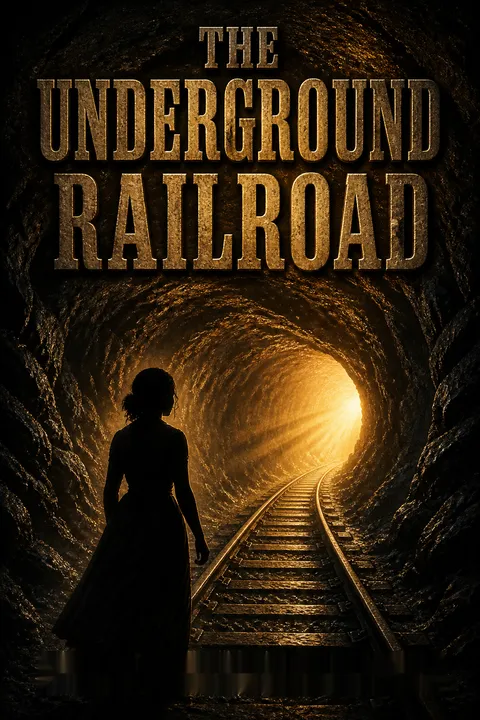
Fletcher hides Cora and Caesar beneath a blanket in his cart, then delivers them to Lumbly, a station agent whose barn contains a tunnel and steel tracks. Cora sees rows of shackles before the underground train arrives, a grim reminder of the world the railroad opposes.
She and Caesar board a battered boxcar and travel in darkness. In South Carolina, station agent Sam gives them false identities as Bessie Carpenter and Christian Markson, clean clothes, food, and directions to a placement office.
The state appears to offer a startling alternative: housing, paid work, schools, medical care, and freedom of movement. Caesar finds factory work, while Cora becomes a domestic servant. For the first time, they sleep in beds and begin to imagine staying.
The literal railroad makes escape a material achievement, built by hidden labor rather than granted by benevolent law. Its tunnels also refuse to promise a simple destination: Cora and Caesar must trust a route whose stations they cannot see. South Carolina's comfort feels persuasive precisely because it answers real injuries, hunger, illiteracy, and exhaustion. The novel's danger is that relief can be mistaken for justice when it arrives with better furniture.
Freedom With a Scalpel
Cora learns to read at the colored school and takes a museum job, where she performs staged versions of African, shipboard, and plantation life for white visitors. The displays distort the violence she knows firsthand.
At the new hospital, Dr. Stevens proposes sterilization, presenting it as an opportunity for women to control their futures; Cora learns that the state mandates it for women it labels unfit. Sam then tells Cora and Caesar that doctors are secretly withholding treatment from colored patients with syphilis to study the disease.
The dormitory system separates women deemed mentally ill, and Gertrude, one of its residents, disappears into hospital care. Cora recognizes that South Carolina's promises conceal another machinery of control. Before she can organize a warning, Ridgeway arrives in town.
South Carolina's coercion wears the language of public health, education, and uplift, which makes it harder to resist than the Randall plantation's open brutality. Cora's museum work sharpens her ability to see how institutions edit experience for white consumption. The hospital's sterilization scheme extends that editing into the future, deciding whose children may exist. Her disillusionment does not mean the material gains were false; it means that comfort without consent can reproduce domination in respectable form.
The Burning Station
Sam learns that Ridgeway, the celebrated slave catcher, has identified Cora and Caesar as fugitives wanted for a white boy's death. He sends Cora to the station beneath his house while he tries to reach Caesar. A posse searches the home, then sets it ablaze. Cora remains below, unable to know whether Sam or Caesar has escaped. The next train is late.
When its engine finally passes the station, Cora cries out, and the young engineer backs up for her. Georgia's line has been closed, so he carries her north on a freight platform to a North Carolina stop. There she discovers that the station is abandoned and blocked by a cave-in. A nervous agent, Martin Wells, gets her out through the mine and hides her in his home.
The underground refuge does not shield Cora from every consequence; its safety depends on human agents who can be discovered, displaced, or killed. Her wait beneath Sam's burning house turns the railroad's promise of movement into a test of endurance. The train's unscheduled return offers rescue without certainty. Each state is a new political arrangement, not a simple step closer to freedom, and Cora survives by adapting before she can understand where she has arrived.
North Carolina's Hanging Park
Martin and his wife Ethel conceal Cora in a cramped attic nook, where she watches a town park through a hole in the wall. North Carolina has expelled its Black population and replaced enslaved labor with immigrant workers under contract; Black people found inside the state are hunted by night riders. Each Friday, residents gather for a festival that ends in a public lynching.
Cora hears Martin explain the laws and sees the town celebrate Louisa's execution. The household searches and growing suspicion make concealment precarious. Their maid Fiona informs the riders, who find Cora under a bed during a festival. Martin and Ethel are seized as well. Ridgeway claims Cora under the Fugitive Slave Law and chains her for the journey south.
North Carolina's spectacle turns racial violence into civic entertainment, allowing ordinary residents to rehearse their innocence while participating in murder. Cora's attic is a refuge only because Martin and Ethel accept danger on her behalf, and even their protection is compromised by fear. The state has not abolished racial hierarchy; it has redesigned it around exclusion and terror. Fiona's betrayal shows how a system recruits the vulnerable by making survival seem like competition.
The Catcher's Black Road
Ridgeway takes Cora west through Tennessee, where wildfire has blackened miles of farms, towns, and forest. He travels with Boseman, his brutal associate, and Homer, a free Black boy who chooses to remain at the slave catcher's side. Cora learns that Caesar was seized in South Carolina and killed by a mob after Ridgeway's men captured him.
They also pick up Jasper, a runaway who sings hymns despite Ridgeway's threats. When Jasper refuses food, Ridgeway shoots him rather than carry a prisoner he considers unprofitable. Cora remains chained and repeatedly tests chances to flee, but each attempt fails. In a fever-struck town, the young Black man Royal notices her in the wagon and begins arranging a rescue with two companions.
Ridgeway makes violence sound like accounting: Caesar, Jasper, and Cora become costs, risks, or property on a ledger. Homer complicates the easy division between captor and captive because his freedom papers have not given him a world in which he feels secure. Cora's failed escape attempts do not signal surrender; they show how captivity trains the body to calculate danger even when the mind still seeks an opening.
Guns in the Dark
Royal, Red, and Justin confront Ridgeway's camp at night and invite Cora to leave with them. Ridgeway's attempt to seize control of the fight falters when Red shoots Boseman. Cora loops her wrist chains around Ridgeway's neck and pulls him down long enough for Royal to regain the advantage. The rescuers chain Ridgeway and Boseman to the wagon; Cora kicks Ridgeway before leaving.
Homer is absent, and his fate remains uncertain to her. Royal explains that the underground railroad has sent him and Red into Tennessee to retrieve Justin, but the mission changed when they found Cora. They take both fugitives to a concealed station, where a polished passenger train carries them north to Indiana and the Valentine farm.
Cora's chains, previously instruments of control, become the means by which she helps stop Ridgeway. The reversal does not erase the power imbalance; she succeeds because Royal's group brings weapons and solidarity, and because the captor is briefly vulnerable. Her kicks are not a neat moral reckoning for the dead. They are a bodily answer to the man who has treated her survival as his business.
Valentine's Bright Risk
At John Valentine's Indiana farm, Cora finds Black families farming, studying, raising children, and building homes without masters. She tries the washhouse, milk house, and fieldwork before settling into the community's routines.
Molly, a reserved child, begins seeking Cora's company, while conductor Royal grows close to her. Sam arrives after escaping South Carolina and reports that Terrance Randall has died, though Ridgeway's whereabouts are unknown.
The farm's growth brings a difficult political question: Mingo wants to stop sheltering fugitives to protect the settlement, while the visiting speaker Elijah Lander argues that no one should be abandoned. Cora has begun to belong here, but she understands that the farm's prosperity and its support for the railroad make it a target.
Valentine offers more than escape from a particular master: it gives people the chance to turn labor into shared life, education, and care for children. Yet safety is not private property. The settlement's debate asks whether survival requires closing its doors or risking what it has built for others. Cora's growing attachment to Royal and Molly makes the argument intimate: belonging is no longer an abstraction she can surrender without grief.
The Farm Is Fired
At the farm's decisive meeting, Valentine admits that the community's future is uncertain. Mingo urges restraint, while Lander argues that the residents must keep faith with one another despite the danger. White attackers open fire before the debate can settle anything.
Lander is shot, Royal is mortally wounded as he reaches him, and the buildings burn. Cora cradles Royal until other residents pull her toward safety, but Ridgeway seizes her amid the chaos. Homer has returned to Ridgeway's side.
The catcher forces Cora to guide him to the hidden station beneath the abandoned house in the woods. She gives directions because he threatens her at gunpoint, knowing that the railroad's secret may be the only remaining thing she can still choose how to use.
The massacre answers the farm's debate with force: white power does not wait for Black people to reach consensus before destroying their achievement. Lander's vision of collective identity and Royal's intimate bond with Cora are both cut short in the same attack. Her return to Ridgeway is a reversal of the rescue, but not a return to passivity. Even while coerced, she is deciding how close to bring him to the railroad's hidden machinery.
Mabel's Lost Return
The story turns back to Mabel's night of escape, revealing what Cora could never know. Mabel had spent years preparing to flee Randall land, taking vegetables, a machete, flint, and stolen shoes into the swamp. She left Cora behind because she believed the child had not yet endured the worst of the plantation and would slow her down.
After reaching a clearing, Mabel experienced a brief sense of freedom, then turned back toward her daughter. A cottonmouth bit her as she crossed the swamp. She traveled on until the venom and exhaustion overcame her, dying before she could return. Her empty garden had seemed to Cora like proof of abandonment; it was also the trace of a mother who tried, too late, to come home.
This revelation does not excuse Mabel's choice or give Cora the comfort of a reunion. It replaces a settled accusation with a more painful uncertainty: Mabel loved her daughter, yet her attempt to survive required leaving her. The swamp grants Mabel a moment of freedom and then kills her on the return. Her story exposes how slavery can make even maternal care a choice between impossible harms.
A Tunnel Without Maps
In the house's cellar, Cora and Homer uncover the trapdoor beneath the old station. Ridgeway makes her descend ahead of him, eager to expose the railroad's hidden routes. On the stairs, Cora turns and locks herself around him; they tumble to the platform, where Ridgeway's legs are broken and he is left alive with Homer.
Cora finds the handcar, works its stiff lever, and drives into a tunnel whose destination is unknown. After miles underground, she reaches a forest and follows a trail until a westbound wagon train appears.
Its Black driver, Ollie, shares food and offers her a place on the journey toward St. Louis and California. Cora gives her name and accepts the ride. Her next destination is uncertain, but the movement is now hers to choose.
Cora does not defeat the system by discovering a guaranteed sanctuary; she escapes into uncertainty. The final tunnel has no map, so survival depends on the judgment she has developed across every failed refuge. Her attack on Ridgeway transforms the stairs into a point of no return, while the westbound wagon offers practical help without promising an ending. Cora's freedom begins as self-direction, not arrival.
Analysis
The novel makes escape a sequence of places that offer different versions of the same question: who has the authority to decide what a Black person may become? South Carolina grants wages and schooling while doctors study patients without honest consent. North Carolina removes Black people from its borders, then turns their deaths into civic theater. Indiana builds a genuine refuge, but its safety depends on whether the community will continue to shelter people like Cora. These are not interchangeable evils. Their differences show how domination can adjust its methods while preserving its central claim over Black life.
Cora's journey is also an education in institutions. She begins with the plantation's explicit rules, then learns to distrust the museum's curated history, the hospital's paternal language, and the legal arrangements that leave fugitives vulnerable to recapture. Reading becomes part of that education: words can expose a contradiction, but they can also disguise one. Ridgeway's account of national destiny and the advertisements that price fugitives use language to make theft sound orderly. Cora's answer is less a counter-theory than a sustained refusal to accept those descriptions as truth.
The book's literal railroad binds private courage to collective labor. Cora cannot escape alone, yet no network can remove the choices she must make or the costs she must bear. She loses friends, harms a pursuer in self-defense, and repeatedly discovers that refuge is temporary. The Valentine community offers the clearest image of a different social order because its members turn work into shared provision rather than profit extracted by force. Its destruction does not disprove that possibility. The closing journey leaves Cora without a map, but with the practiced judgment to choose movement for herself. Freedom remains unfinished, something built in company and defended without guarantees.
Review Summary
The Underground Railroad receives mostly positive reviews for its powerful portrayal of slavery and creative reimagining of history. Readers praise Whitehead's writing style, research, and ability to convey the horrors of slavery. However, some criticize the lack of character development and emotional depth. The book is noted for its brutal honesty and importance in educating readers about American history. While divisive, many consider it a significant work deserving of its accolades, including the Pulitzer Prize and National Book Award.
People Also Read



Characters
Cora
The guarded fugitiveBorn enslaved on the Randall plantation, Cora is watchful, physically capable, and slow to trust. She protects the small garden inherited from her grandmother because it gives her a rare claim over her own labor. Abuse and isolation make her wary of intimacy, but her instincts for defense and survival remain acute. As she travels through different versions of America, she learns to read not only letters but the motives concealed inside benevolent institutions. Cora's resistance is practical rather than rhetorical: she measures danger, preserves what she can, and acts when a person beside her is threatened. Her private struggle is to imagine a future without surrendering the hard knowledge that has kept her alive.
Caesar
The hopeful woodcarverCaesar is a skilled woodcarver and unusually literate field hand who believes that a person can prepare for freedom by learning, making, and planning. His childhood on Mrs. Garner's Virginia farm gave him a sheltered sense of possibility, which was shattered when her estate sold him and separated his family. On Randall, he quietly builds a route through the underground railroad with the help of Fletcher. His steadiness complements Cora's suspicion, though he sometimes mistakes hope for certainty. Caesar's plan is not an abstract dream: it depends on his trade, his reading, his knowledge of the land, and his willingness to ask another person to risk the journey with him.
Ridgeway
The relentless slave catcherRidgeway is a towering professional slave catcher who treats pursuit as both a livelihood and a philosophy. His father, a blacksmith, taught him to value useful work, but Ridgeway turns that lesson into a belief that possession proves a person's right to rule. He studies escape routes, informants, laws, and human fear with the same concentration another man might give a craft. His calm manner makes his violence more frightening, because he can describe cruelty as procedure and theft as national destiny. Ridgeway resents any escape that exposes a weakness in the system he enforces. He is especially fixated on Cora's family and on the underground railroad that makes his work less absolute.
Mabel
Cora's absent motherMabel is Cora's mother and the daughter of Ajarry. Quiet, stubborn, and difficult for others to read, she carries a private history of grief, labor, and thwarted attachment. She tends the family garden and teaches Cora what she can about survival, though she offers little emotional explanation for her silences. Her disappearance shapes Cora's understanding of abandonment and turns the question of what happened to her into a lasting wound. Mabel's choices reflect the brutal limits placed on enslaved parents, whose love cannot guarantee safety or even keep a family together. She remains central to Cora's inner life even when absent from the plantation.
Royal
The railroad conductorRoyal is a freeborn Black man who works for the underground railroad and moves through danger with practiced confidence. Raised in Connecticut, he learned the trades and later became an organizer, messenger, and conductor for fugitives. His ease in freedom contrasts with Cora's lifelong suspicion of white authority, but he does not demand that she trust him quickly. Royal sees the railroad as a collective undertaking, not a heroic possession belonging to its operators. He is patient with Cora's guardedness and offers affection without treating it as a debt she must repay. His life connects the personal work of helping one fugitive with the wider effort to build Black institutions.
Ajarry
The keeper of the gardenCora's grandmother, Ajarry was kidnapped from West Africa and sold repeatedly before being purchased by the Randalls. She learned to read the shifting prices and risks of enslavement as a means of staying alive. On the plantation, she defended a tiny garden plot and raised children under conditions designed to make family ties temporary. Her history gives Cora both a practical inheritance and a deep awareness of how little ownership enslaved people are permitted.
Lovey
Cora's closest friendLovey is sociable where Cora is guarded, finding joy in dances, celebrations, and the small companionship available on Randall. She is Cora's friend and often tries to draw her into the life of the quarter. Her closeness to her mother and her willingness to act on the chance of escape make her more than a cheerful companion. Lovey embodies the desire for freedom that many enslaved people keep alive even when they rarely speak of it.
Sam
The South Carolina agentSam is a sociable South Carolina station agent who helps fugitives enter the state's new system of jobs and housing. He also works in a saloon, where casual conversation brings him information unavailable through official channels. His genial manner can make danger seem manageable, but he does not confuse good intentions with reliable protection. Sam's willingness to help Cora and Caesar grows from conviction and from a practical understanding of how the railroad depends on local trust.
Martin Wells
The nervous station keeperMartin inherits his father's secret work on the underground railroad and becomes a reluctant helper in North Carolina. He is cautious, anxious, and less suited to danger than his father, but he still accepts Cora into his home. His fear shapes the limits of what he can offer. Martin's struggle is not between simple goodness and cowardice, but between compassion and the knowledge that helping a fugitive can endanger everyone under his roof.
Ethel
Martin's wary wifeEthel is Martin's wife, raised amid the assumptions of a slaveholding household. She has long imagined herself as a Christian guide to people she considers lesser, a mixture of sincere religious feeling and inherited superiority. Cora's presence unsettles that self-image and forces Ethel to confront the risk her husband has brought into their home. Her fear is genuine, but so is her capacity for care when Cora becomes ill. Ethel's conflicted response reveals how benevolence can coexist with prejudice.
John Valentine
The farm's founderJohn Valentine is a prosperous farmer who uses his land and resources to create a refuge for Black families and fugitives in Indiana. He is generous but not idealized; he worries over debt, danger, and the strain of maintaining a community under hostile scrutiny. Valentine wants the people who live on his land to shape its future rather than simply obey his judgment. His farm turns his private resources into a larger experiment in collective life.
Elijah Lander
The eloquent abolitionistLander is a celebrated Black speaker and writer whose mixed parentage and education have allowed him unusual access to white institutions. He uses that access to argue for Black dignity and collective advancement, though his speeches do not always provide easy practical answers. His presence gives the Valentine community a voice beyond its fields, cabins, and immediate dangers. Lander's polished public manner sits alongside a private reserve that makes him difficult to know.
Mingo
The cautious community leaderMingo is a former enslaved man who bought freedom for his family through years of hired labor. At Valentine, he argues that the community should limit its risks and stop sheltering fugitives before white neighbors destroy what has been built. His caution is rooted in hard-earned survival, but it can turn into a judgment that some people are beyond help. Mingo represents a real disagreement about whether security can be preserved without sacrificing solidarity.
Terrance Randall
The brutal plantation masterTerrance inherits the southern half of the Randall plantation and later takes control of both halves. He is vain, impulsive, and devoted to extracting more labor and profit from the people he owns. Unlike his brother James, he makes his desires visible through public punishments and personal violations. Terrance treats fear as an instrument of management, and his rule gives Cora a clear reason to seek escape.
Homer
Ridgeway's young clerkHomer is a small, highly observant Black boy who keeps Ridgeway's accounts and records the slave catcher's pronouncements. Ridgeway bought him as a child and later arranged legal freedom, but Homer remains beside him, convinced that the wider world offers him little security. His neat clothes and formal habits conceal a childhood shaped by dependence. Homer complicates the meaning of freedom by showing how a legal status can fail to provide a believable future.
Red
Royal's armed allyRed is a North Carolina fugitive who joins Royal's work after losing his family to the state's racial terror. He is resourceful, angry, and increasingly committed to armed resistance. His willingness to use force puts him at odds with the railroad's more cautious methods.
Fiona
The household informantFiona is a young Irish maid working for Martin and Ethel. She notices the food disappearing and the odd patterns of the household, then uses that knowledge to pursue a reward. Her precarious position among white residents shapes her calculation of whose safety matters.
Dr. Stevens
The hospital physicianDr. Stevens is a South Carolina physician involved in the state's medical programs for Black residents. He presents sterilization as modern health care and speaks with a reassuring manner, while the program's coercive purposes remain obscured. His professional confidence allows him to treat control over patients' bodies as benevolent expertise.
Plot Devices
The literal underground railroad
Escape made physicalThe railroad is a network of hidden stations, tunnels, conductors, trains, and improvised routes. Its machinery turns a metaphor for organized escape into a literal means of transport. Each station has its own character and risks, and passengers often travel without knowing where they will emerge. The railroad depends on people whose labor and secrecy sustain it, making every successful journey a collective achievement rather than a miracle bestowed from above.
The changing states
A nation in variationsEach state Cora enters presents a distinct arrangement of racial power: South Carolina offers material advancement alongside medical control, North Carolina enforces Black exclusion through public terror, Tennessee exposes everyone to disaster, and Indiana sustains a vulnerable Black community. These altered landscapes make the country feel like a series of political experiments. The device prevents escape from being treated as a simple movement from bad South to good North.
Cora's garden plot
A claim over laborThe small plot passed from Ajarry to Mabel to Cora gives the women a tangible place to tend and defend. It is never secure in the legal sense, but maintaining it lets Cora practice a form of ownership denied everywhere else. The garden also links generations through food, labor, and memory. Its meaning changes as Cora travels: a fragile home, an inheritance, and a reminder that possession under slavery can be withdrawn at any moment.
The living history museum
History staged for whitesIn South Carolina, Cora performs invented scenes of African life, the slave ship, and plantation labor behind glass. The museum makes her body part of a public story that erases or softens the violence she knows. Its scenes echo the novel's larger question about who gets to author the nation's history. Cora's knowledge of the plantation lets her recognize the lies in the displays and prepares her to distrust other institutions that advertise themselves as humane.
Runaway advertisements
People priced as propertyPrinted notices describe fugitives by their bodies, skills, scars, and supposed habits, turning intimate lives into searchable property records. The notices connect distant places through the market for capture and remind readers that the hunt is systematic, not merely personal. Their repeated appearance frames freedom as a struggle against paperwork, bounty, and public recognition as much as against physical chains. The language of ownership persists even where the law briefly claims to protect Black people.
FAQ
Synopsis & Basic Details
What is The Underground Railroad about?
- Fictionalized escape network: The novel reimagines the Underground Railroad as a literal railway system, transporting enslaved people to different states, each representing a unique facet of American society and racial dynamics.
- Cora's journey to freedom: The story follows Cora, a runaway slave, as she travels through this fantastical railroad, encountering various forms of oppression and resistance, and grappling with her own identity and desires.
- Exploration of American history: The narrative uses Cora's journey to explore the complex history of slavery, racism, and the struggle for freedom in the United States, blending historical elements with speculative fiction.
Why should I read The Underground Railroad?
- Unique narrative perspective: The novel offers a fresh and imaginative take on the history of slavery, using a blend of historical fiction and magical realism to create a compelling and thought-provoking narrative.
- Exploration of complex themes: It delves into profound themes of identity, freedom, and the legacy of slavery, prompting readers to confront the dark aspects of American history and their ongoing impact.
- Powerful emotional impact: The story is emotionally resonant, portraying the brutal realities of slavery while also highlighting the resilience and strength of the human spirit in the face of oppression.
What is the background of The Underground Railroad?
- Historical context of slavery: The novel is set against the backdrop of slavery in the antebellum South, drawing on the historical realities of plantations, slave auctions, and the brutal treatment of enslaved people.
- Fictionalized Underground Railroad: It reimagines the Underground Railroad as a literal railway system, a fantastical element that allows the author to explore different aspects of American society and racial dynamics.
- Exploration of racial dynamics: The story examines the complex and often contradictory attitudes towards race and freedom in different parts of the United States, from the brutal South to the seemingly progressive North.
What are the most memorable quotes in The Underground Railroad?
- "If you want to see what this nation is all about, I always say, you have to ride the rails. Look outside as you speed through, and you'll find the true face of America.": This quote, spoken by Lumbly, encapsulates the novel's central metaphor of the Underground Railroad as a means to understand the multifaceted nature of America.
- "We are not one people but many different people.": Lander's words highlight the diversity within the black community and the complexity of their shared history and struggle, challenging the notion of a monolithic identity.
- "If niggers were supposed to have their freedom, they wouldn't be in chains.": Ridgeway's chilling statement embodies the twisted logic of slavery and the dehumanization of black people, revealing the core of his ideology.
What writing style, narrative choices, and literary techniques does Colson Whitehead use?
- Blend of realism and fantasy: Whitehead seamlessly blends historical realism with elements of magical realism, creating a unique and unsettling narrative that blurs the lines between fact and fiction.
- Non-linear storytelling: The narrative jumps between different time periods and perspectives, creating a fragmented and disorienting effect that mirrors the chaotic and traumatic experiences of slavery.
- Use of symbolism and metaphor: The novel is rich in symbolism, with the Underground Railroad, the various states, and the characters themselves serving as metaphors for broader themes of oppression, resistance, and the search for identity.
Hidden Details & Subtle Connections
What are some minor details that add significant meaning?
- The recurring motif of chains: Chains appear in various forms throughout the novel, from the literal shackles of slavery to the metaphorical chains of societal oppression, highlighting the pervasive nature of bondage.
- The significance of names: Characters' names often carry symbolic weight, reflecting their roles or destinies, such as Ajarry's name, which means "born on the road," foreshadowing her life of displacement.
- The use of blue: The color blue appears repeatedly, often associated with hope, freedom, and the sky, contrasting with the darkness and oppression of slavery.
What are some subtle foreshadowing and callbacks?
- Ajarry's stories: Ajarry's tales of her past, initially presented as background, foreshadow the brutal realities that Cora will face on her journey, creating a sense of cyclical trauma.
- The recurring image of the doghouse: The doghouse that Blake builds and Cora destroys foreshadows the violence and dispossession she will experience, and the lengths she will go to protect her own space.
- The mention of the City of Pennsylvania: Ajarry's dream of her cousins living as free people in the City of Pennsylvania foreshadows Cora's own journey and the possibility of a better life, even if it is not in the way Ajarry imagined.
What are some unexpected character connections?
- The parallel between Cora and Ridgeway: Despite being on opposite sides of the conflict, Cora and Ridgeway share a similar determination and a sense of being shaped by their pasts, highlighting the complex nature of their relationship.
- The connection between Mabel and Cora: Though separated by time and circumstance, Mabel's escape and Cora's journey are linked by a shared desire for freedom and a legacy of resistance, creating a sense of intergenerational trauma and resilience.
- The unexpected bond between Cora and Homer: Despite their different backgrounds and roles, Cora and Homer share a connection through their shared experiences of violence and their complex relationship with Ridgeway, highlighting the unexpected alliances that can form in the face of oppression.
Who are the most significant supporting characters?
- Lumbly: As a station agent, Lumbly represents the hidden network of the Underground Railroad, providing a glimpse into the complex and dangerous world of those who aided runaway slaves.
- Sam: Sam's character embodies the complexities of white allies in the abolitionist movement, highlighting both their genuine commitment and their limitations in understanding the black experience.
- Ethel and Martin Wells: This couple represents the internal conflicts and moral dilemmas faced by those who are caught between their own fears and their sense of justice, highlighting the risks and sacrifices involved in aiding runaway slaves.
Psychological, Emotional, & Relational Analysis
What are some unspoken motivations of the characters?
- Ridgeway's obsession with Mabel: Beyond his role as a slave catcher, Ridgeway's relentless pursuit of Cora is driven by a deep-seated obsession with her mother, Mabel, and a desire to prove his own power and control.
- Cora's internal conflict: Cora's journey is marked by an internal struggle between her desire for freedom and her fear of the unknown, as well as her complex feelings towards her mother for abandoning her.
- Caesar's need for purpose: Caesar's desire to escape is not just about freedom but also about finding a sense of purpose and agency in a world that has denied him both.
What psychological complexities do the characters exhibit?
- Cora's trauma and resilience: Cora's experiences with slavery and violence have left her deeply traumatized, but she also displays remarkable resilience and a fierce determination to survive and find freedom.
- Ridgeway's twisted ideology: Ridgeway's belief in the American imperative and his obsession with property reveal a deeply flawed and dehumanizing worldview, highlighting the psychological impact of slavery on both the enslaved and the enslavers.
- Martin's internal conflict: Martin's fear and guilt over his involvement in the Underground Railroad highlight the psychological toll of living in a society that is deeply divided by race and oppression.
What are the major emotional turning points?
- Cora's decision to leave Randall: Cora's decision to join Caesar's escape plan marks a turning point in her life, as she chooses to take control of her destiny and pursue freedom, despite the risks.
- The discovery of South Carolina's true nature: The revelation of the government experiments in South Carolina shatters Cora's hope for a better life, forcing her to confront the insidious nature of oppression.
- The destruction of Valentine Farm: The violent attack on Valentine Farm is a devastating emotional blow for Cora, as she witnesses the loss of her community and the death of those she cares for, forcing her to confront the fragility of freedom.
How do relationship dynamics evolve?
- Cora and Caesar's bond: Their relationship evolves from a shared desire for freedom to a deep bond of mutual dependence and affection, highlighting the power of human connection in the face of adversity.
- Cora and Ridgeway's complex dynamic: Their relationship is marked by a mix of hatred, fear, and a strange sense of recognition, highlighting the complex and often contradictory nature of power dynamics in a system of oppression.
- Cora and Royal's connection: Their relationship is marked by a shared understanding of the struggle for freedom and a deep emotional connection, offering a glimpse of hope and love amidst the darkness of their world.
Interpretation & Debate
Which parts of the story remain ambiguous or open-ended?
- The true nature of the Underground Railroad: The novel leaves the true nature of the Underground Railroad ambiguous, blurring the lines between reality and fantasy, and prompting readers to question the limits of human agency and resistance.
- The fate of Mabel: Mabel's ultimate fate remains unknown, leaving readers to speculate about her life after her escape and the possibility of a reunion with Cora.
- The meaning of freedom: The novel does not offer a clear definition of freedom, instead presenting it as a complex and ever-evolving concept, shaped by individual experiences and societal forces.
What are some debatable, controversial scenes or moments in The Underground Railroad?
- The violence and brutality: The novel's graphic depictions of violence and brutality, particularly against black bodies, have sparked debate about the limits of representation and the potential for desensitization.
- The portrayal of white characters: The novel's portrayal of white characters, particularly those who are sympathetic to the abolitionist cause, has been debated, with some arguing that it reinforces a white-savior narrative.
- The ending's ambiguity: The novel's open-ended conclusion has been interpreted in various ways, with some finding it hopeful and others finding it bleak, highlighting the complex and often contradictory nature of the struggle for freedom.
The Underground Railroad Ending Explained: How It Ends & What It Means
- Cora's escape into the unknown: The novel ends with Cora escaping into a tunnel, leaving her fate uncertain and open to interpretation, suggesting that the journey to freedom is ongoing and never truly complete.
- The cyclical nature of oppression: The ending highlights the cyclical nature of oppression, as Cora's escape is followed by the destruction of Valentine Farm, suggesting that the struggle for freedom is a continuous and never-ending process.
- The power of individual agency: Despite the bleakness of the ending, Cora's final act of resistance underscores the power of individual agency and the enduring hope for a better future, even in the face of overwhelming odds.
About the Author
Other books by Colson Whitehead

Download PDF
Download EPUB
.epub digital book format is ideal for reading ebooks on phones, tablets, and e-readers.








