


Key Takeaways
Turn overwhelming data into a decision by filtering against explicit criteria
Start with the decision. Faced with 15,000 prospective graduate students, the author first clarified what made someone a suitable recruit. Applicants who did not prioritize the program or could not graduate in time were removed. Further filters included GPA, distance from campus, and the rigor of previous study. The remaining shortlist was shaped to improve diversity in the program. A daunting spreadsheet became a manageable selection task in under half an hour.
Criteria make complexity usable. The point is not to copy those particular filters, but to decide what matters before drowning in information. Separate essential requirements from preferences, then ask whether the final choices serve the actual purpose. A filter is useful only when it reflects a defensible goal.
This example captures a powerful decision-design move: reduce complexity by clarifying the decision, rather than trying to inspect every data point equally. It also makes criteria visible, so others can question or improve them. Yet a spreadsheet cannot make a judgment fair merely by making it systematic. GPA, school reputation, and geography may act as imperfect proxies for ability or access. The method is strongest when criteria are both explicit and revisited for bias, relevance, and unintended exclusion.
Use intuition for speed, analysis for consequences, and both for important choices
Different choices need different tools. The book distinguishes intuitive thinking, which relies on feelings and rapid judgments, from analytical thinking, which examines information through logic. Choosing between two shirts may be low-stakes enough for a quick preference. Comparing cars or investments calls for research into needs, reliability, costs, and risk. The author’s car purchase combined practical requirements, such as space and dependability, with confidence in the manufacturer’s reputation.
Neither mode is a universal winner. Instinct can speed a decision, but emotion can also make a scam seem irresistible. Analysis can expose consequences, but endless comparison can turn a minor choice into paralysis. The practical skill is to notice what is at stake and use evidence and personal judgment in proportion.
The useful distinction is not between a rational mind and an irrational heart. Feelings can signal priorities, discomfort, or attachment that a spreadsheet does not capture; they can also be shaped by urgency, fear, or salesmanship. Treating intuition as input rather than final authority preserves its speed while leaving room for scrutiny. The book’s suggestion that romantic choices are mainly intuitive is less convincing as a general rule: values, patterns of behavior, and compatibility can also be examined without reducing a relationship to a score.
Define the problem before spending effort on its solution
A solution needs a target. The book presents problem-solving as five linked stages: formulate the problem, find alternatives, analyze those alternatives, select one, and implement it. Formulation matters because a poorly framed question can produce an efficient answer to the wrong problem. Someone unhappy at work, for instance, might be reacting to a manager’s behavior, a mismatch with the field, or something else entirely. Those explanations point toward different remedies.
Keep the stages distinct. First state the problem clearly. Then generate viable options, compare their likely costs and contributions, choose an approach, and plan its implementation. A promising idea can still fail through poor communication or organizational friction. The process is a guide, not a guarantee: implementation must be checked against what actually happens.
This sequence helps prevent a familiar organizational mistake: treating the first proposed fix as if it were already the problem definition. It also separates diagnosis from commitment, which makes it easier to revise a theory when new information appears. In practice, the stages often loop. Implementing a change may reveal that the original problem was framed too narrowly, so a good process includes permission to return to the beginning rather than defend a failing plan.
Ask what evidence could disprove your explanation before collecting more
Investigate before assuming. The book recommends identifying root causes by asking “why” repeatedly and using questions such as who, what, where, and how. Once plausible explanations are written down, they guide what information to gather. Qualitative evidence gives narrative detail about experience and context; quantitative evidence uses numbers to show scale or frequency. A question about why children respond to divorce may need accounts of their experiences, while a question about how many cars required repairs calls for counts.
Check the source, too. The text describes Andrew Wakefield’s claims linking the MMR vaccine to autism, noting that others could not reproduce his findings and that he had altered results. Its lesson is to check methods, credibility, and corroboration, not to accept a claim because it appears in a journal or online. Research should clarify a question, not merely confirm a favored answer.
This advice points toward a disciplined form of intellectual humility: distinguish what is known, what is missing, and what would change the conclusion. Pairing qualitative and quantitative evidence can expose different parts of a problem, since a count can show prevalence while a narrative can reveal how a process unfolds. The challenge is that research itself can be steered by the questions asked and the evidence excluded. A useful safeguard is to specify in advance what findings would weaken the working explanation.
Break systems apart, then reconnect the patterns their parts reveal
Parts are not the whole. Analytical thinking separates components so they can be examined. Synthetic thinking looks for relationships and recurring similarities among them. The book’s systemic thinking combines these moves: list relevant elements, group related ones, and identify themes linking the groups. A law-enforcement problem, for example, can be examined across ranks and interactions, rather than attributed to one role in isolation.
Use structure to see connections. Herbert Simon’s decomposable matrix approach breaks a complex hierarchy into subsystems and considers how strongly they interact. The book also describes a Goal, Problem, or Solution (GPS) model: state a goal, identify the problem affecting it, and develop a solution for each relevant component. In a furniture business, examining sales goals across roles can reveal shared obstacles such as delivery costs or delays.
This is a useful antidote to two opposite errors: treating a complex issue as an undifferentiated tangle, or explaining it through one isolated cause. Mapping relationships can reveal that a local fix shifts pressure elsewhere in the system. The map, however, is still a model built from selected components. Leaving out customers, incentives, or informal workarounds can make a tidy diagram misleading. The value comes not from drawing a complete picture, but from making assumptions and consequential connections easier to inspect.
Let creativity multiply options before analysis chooses what can work
First expand, then narrow. Creative thinking is divergent: it generates many possibilities, including ideas that initially seem unrelated. Analytical thinking is convergent: it compares options and reduces them to a workable choice. The book illustrates practical creativity with temporary tattoos carrying a parent’s contact details for young children on a family trip. The idea addressed a specific risk in a way that ordinary planning might overlook.
Do not confuse novelty with usefulness. After generating options, examine their costs, benefits, and likely consequences. The author also describes the GPS model as a way to turn goals, problems, and possible solutions into a structured search for patterns. Collaboration can broaden the ideas available, while analysis helps determine which ideas are feasible and appropriate to the problem.
The sequence matters because evaluation too early can silence ideas before they have been fully formed, while unfiltered brainstorming can leave a team with a pile of attractive but impractical suggestions. Separating generation from evaluation gives each mode room to work. Creativity also depends on constraints: the child-identification idea is imaginative precisely because it responds to a concrete safety concern. Novelty alone is not evidence of effectiveness, so even clever solutions need testing against the circumstances they are meant to address.
Treat analogies as clues, not proof, and inspect the argument beneath them
A resemblance suggests a question. Analogical reasoning uses similarities between two things to propose that they may share another feature. The book describes a pharmacologist noticing that Demerol resembled morphine in one effect, then testing whether it also relieved pain. The similarity generated a hypothesis; further testing established whether the inference held.
Check the leap. An analogy is stronger when its similarities are relevant to the conclusion and when important differences are considered. The book contrasts this with reasoning errors such as an ad hominem attack, which targets a speaker instead of the argument, and bandwagon appeals, which treat popularity as proof. It also warns against unsupported generalizations and weak samples. Ask what the comparison actually supports, and what remains untested.
Analogies are valuable because they let people reason beyond information already in hand. They can make an unfamiliar mechanism easier to imagine or suggest a promising test. Their danger is that a vivid comparison can feel like evidence even when the shared features are superficial. The Demerol example works as a model because the analogy leads to investigation rather than ending it. In argument, the key question is not simply whether two cases resemble each other, but whether the resemblance bears on the specific conclusion being claimed.
Summarize data, test relationships, and forecast with different statistical tools
Match the tool to the question. Descriptive statistics summarize observed data, using measures such as averages or medians. Inferential statistics test whether a pattern in a sample may reflect a wider relationship. Predictive statistics use current and historical data to estimate what may happen next. A pajama company might summarize orders, compare sales during an advertising campaign with a previous period, then use past product launches to guide new designs.
Evidence has limits. The book’s chicken-farm example compares monthly egg production for younger and older hens, with averages of 65 and 55 eggs. A statistical test can assess whether that difference is unlikely to be random, but it cannot make the conclusion certain. Sampling, measurement, and other causes still matter. Statistics can narrow uncertainty; they do not remove it.
Separating description, inference, and prediction is essential because each answers a different question. A summary tells what happened in the observed data; an inference assesses whether a pattern could be due to chance; a forecast projects beyond observations. Those tasks are easy to blur when a result is attractive. Statistical significance alone does not establish causation or practical importance, and comparisons across different periods may have competing explanations. Good analysis makes the assumptions and limits as visible as the numbers.
Judge policies by results, side effects, fairness, and practical implementation
Evaluate more than the promise. The book’s policy framework examines six dimensions: effectiveness, unintended effects, equity, cost, feasibility, and acceptability. A request for more work-from-home days, for example, might reduce office distractions but create new distractions at home, affect coworkers differently, and depend on whether the job can be done remotely.
Compare alternatives before committing. The Five-E method adds efficiency, ethical considerations, evaluation of alternatives, and recommendations for change to the assessment of effectiveness. A policy may sound beneficial yet be too costly, unfairly distributed, or difficult to carry out. Examining these dimensions helps decision-makers consider not only whether a plan could work, but who bears its costs and whether the organization can put it into practice.
This framework is useful because it treats implementation and distribution as part of a policy’s design, not as afterthoughts. A policy can improve an average outcome while imposing burdens on a particular group, and a technically sound plan can fail if relevant people do not accept it. The dimensions also make disagreement more precise: stakeholders may differ over effectiveness, fairness, or cost rather than simply being for or against change. The framework organizes questions, but its answers still depend on evidence and explicit value judgments.
Analysis
The book’s strongest contribution is practical rather than theoretical: it gives readers a repeatable way to move from a vague concern to a considered decision. The recruiting spreadsheet offers a compact demonstration. The decisive act is not processing more data, but defining what the decision is for and selecting filters that serve that purpose. The book then broadens that move into a toolkit: problem formulation, research, competing explanations, analysis of alternatives, implementation, and review.
Its most useful conceptual tension is between breaking problems into parts and restoring their relationships. Analysis makes components legible; synthesis and systemic thinking help prevent those components from being mistaken for independent causes. Creative thinking adds possibilities, while critical thinking scrutinizes claims. These are better understood as complementary habits than as separate personality types. The book occasionally draws boundaries too sharply, especially when it implies that some personal decisions belong mainly to intuition. Feelings may matter deeply, but they can still be examined alongside evidence about behavior, values, and consequences.
The book’s breadth is also its main limitation. It introduces many tools, including matrices, policy tests, analogies, and statistics, but gives uneven guidance on when one tool is preferable or how to combine them. Some statistical explanations are simplified enough to invite overconfidence. A result below a conventional significance threshold does not by itself establish causation, practical importance, or a reliable relationship in every setting. Likewise, a structured checklist cannot repair poor measurement or biased selection criteria.
The most durable lesson is therefore methodological modesty. Structure helps people notice assumptions and organize evidence; it does not guarantee objectivity. Criteria require justification, data require scrutiny, and conclusions remain open to revision. Used that way, analytical thinking is neither cold calculation nor endless doubt. It is a practiced discipline for making reasoning visible before acting.
Review Summary
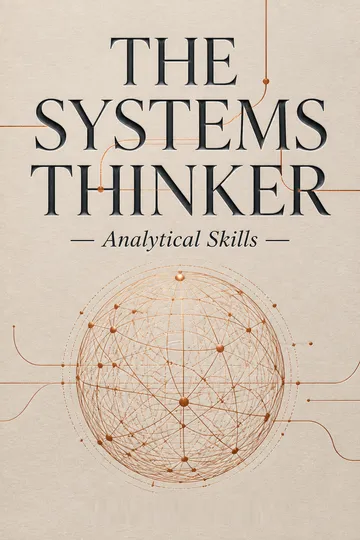
The Systems Thinker - Analytical Skills receives mixed reviews, with an average rating of 3.44 out of 5. Some readers praise its concise, easy-to-read format and valuable insights into systems thinking. Others appreciate the book's overview of analytical skills and tools, though some note its lack of depth. Positive reviews highlight the book's effectiveness in explaining complex concepts, while critical reviews mention its brevity and limited practical implementation guidance. Overall, readers find it a quick read with useful reminders and frameworks, albeit not groundbreaking.
People Also Read








Glossary
Analytical thinking
Evidence-guided problem solvingA way of using logic to gather and examine information, clarify a problem, compare possible explanations or solutions, and choose an action supported by the available evidence. The book presents it as a learnable skill used in ordinary personal choices as well as professional decisions.
Systemic thinking
Finding patterns across componentsA method for considering multiple parts of a situation together rather than handling each in isolation. The book describes listing relevant components, grouping those with shared features, and identifying broader themes. It combines analysis of parts with synthesis of their relationships.
GPS model
Connect goals, problems, solutionsA structured model that develops a goal statement, a problem statement, and a solution statement for each relevant part of a situation. Comparing the resulting components can reveal recurring patterns. The book illustrates its use with a furniture business seeking to improve sales across different employee roles.
Decomposable matrix
Map subsystem relationshipsAn analytical tool associated with Herbert Simon’s account of complex hierarchies. It represents major subsystems and the issues or relationships that affect them, allowing the analyst to examine components separately and rate their interactions. The aim is to identify which connections matter most to the problem.
Dimensional analysis
Clarify a problem’s scopeA method for examining a problem across five dimensions: substantive, spatial, temporal, quantitative, and qualitative. It prompts questions about what the problem is, where and when it occurs, how much it affects, and how serious it is. The book presents it as an exploratory checklist.
Organized Random Search
Generate ideas through categoriesA technique attributed in the book to Frank Williams. Rather than searching indiscriminately for ideas, the problem solver divides the issue into possible subdivisions or categories, then uses those categories to prompt further ideas. The text illustrates this with organizing the recall of countries geographically.
Relevance systems
Map connected problem elementsA way of organizing elements of a problem into a hierarchy of relationships. Analysts can begin with the central issue and work downward toward contributing elements, or start with details and build upward. A binary relevance system connects two related systems to expose shared influences and constraints.
SWOT analysis
Assess strengths and risksA planning tool that sorts relevant factors into strengths, weaknesses, opportunities, and threats. The book presents it as one way to organize positive and negative considerations when evaluating a problem or plan. It is useful as a prompt for analysis, though the judgments entered into each category can be subjective.
Five-E method
Evaluate and recommend policyA policy-analysis model organized around effectiveness, efficiency, ethical considerations, evaluation of alternatives, and establishment of recommendations for positive change. It asks whether a policy works, whether its costs are justified, whether it is ethically acceptable, how it compares with other options, and what can realistically be implemented.
Descriptive statistics
Summarize observed dataStatistical measures used to describe data already collected. Examples include totals, means, medians, modes, and measures of spread. In the book’s business example, descriptive statistics summarize retail orders so a company can see typical and unusually large or small purchases.
Inferential statistics
Assess patterns beyond a sampleStatistical methods used to assess whether patterns in collected data may indicate a wider relationship rather than random variation. The book’s examples include comparing average egg production across groups of hens and testing advertising results. Such analyses inform conclusions but do not make them certain.
Predictive statistics
Estimate future outcomesMethods that use current and historical data to estimate future events or results. The book describes using prior product sales to guide choices about new designs and colors. Predictions can inform planning, but their accuracy depends on the quality and relevance of the data and the assumptions behind the model.
The Systems Thinker Series
About the Author
Other books by Albert Rutherford



Download PDF
Download EPUB
.epub digital book format is ideal for reading ebooks on phones, tablets, and e-readers.








