

Key Takeaways
Treat confident beliefs as hypotheses, then inspect how you reached them.
Notice your thinking. Metacognition means reflecting on how your mind forms judgments. The book argues that critical thinking is not simply collecting facts: it is examining how those facts support a belief, and whether assumptions, emotions, or wishful thinking have steered the conclusion. Someone partial to corgis, for instance, might search for evidence that corgis suit a family while asking only about the drawbacks of other dogs. The research appears balanced, but the questions were tilted from the start.
Slow the first answer. The book also describes a study in which brain activity predicted some choices before participants consciously reported making them. This suggests that conscious reasoning may arrive after unconscious processes have begun. Keeping notes on how a judgment was formed can make those hidden steps easier to review.
What's useful here is the shift from asking whether a belief feels right to asking how it was built. That move resembles debugging: the aim is not to shame the person who reached a conclusion, but to find the step where the process went wrong. Still, introspection is not a transparent window into the mind. A journal or decision record helps because it preserves what was considered before the outcome is known, reducing the temptation to rewrite one's own reasoning afterward.
Treat your senses as interpreters, not as cameras recording reality.
Attention leaves gaps. The brain filters sensory information and combines it into a coherent experience, but that construction can omit or alter details. In the invisible gorilla experiment, people concentrating on basketball passes often failed to notice a person in a gorilla suit crossing the scene. The McGurk effect shows a different limitation: conflicting lip movements and audio can produce the experience of a third sound that was not present in either signal alone.
Focus has a cost. The book also cautions that what seems like multitasking is often attention switching between tasks. Its discussion uses Paul MacLean's triune brain model, which describes brain systems associated with survival, emotion, and complex thought. The model is presented as a way to think about competing influences, not as a literal account of three independent brains.
The practical lesson is not that perception is useless, but that confidence in a perception should depend on the conditions under which it was formed. A witness watching a fast, frightening event is not equivalent to a camera recording it. The triune brain model can make the contrast between quick reactions and deliberation memorable, but contemporary neuroscience does not divide the brain into three neat evolutionary layers. The broader point, that perception is selective and constructed, does not depend on that simplified map.
Record important evidence before memory quietly revises the story.
Memory reconstructs. Memories are not exact recordings; details can fade, blend, or be filled in to fit a person's expectations. The book reports Richard Wiseman's Total Recall experiment: participants remembered an average of 65 percent of 10,000 images, and 98 percent of a smaller set of 612. Yet strong recall does not guarantee accuracy. In a study of students' memories of the Challenger explosion, a quarter scored zero on a seven-point accuracy scale two and a half years later, while half scored two or lower.
Confidence can mislead. A flashbulb memory is a vivid recollection of an emotionally charged event. Source amnesia occurs when a person remembers information but forgets where it came from. The illusory truth effect describes how repetition can make a claim feel true simply because it feels familiar. Open-ended questions and contemporaneous records help limit these distortions.
This account separates vividness from accuracy, a distinction with consequences for family disputes, journalism, and legal testimony. Recording details near the time of an event creates an external reference point that memory alone cannot provide. The reported image experiment shows impressive recognition, but its results should not be mistaken for proof that every kind of information is remembered equally well. Memory performance depends on what is tested, how it is tested, and whether recognition is confused with precise recollection.
Build arguments from premises you can inspect, not conclusions you already favor.
Trace the reasoning. An argument uses premises, meaning its starting claims, to support a conclusion. Deductive logic draws a conclusion that follows from stated premises; inductive logic generalizes from observations and remains open to revision. An argument is valid when its conclusion follows logically from its premises. It is sound when it is valid and its premises are true. A conclusion can happen to be true even when the reasoning offered for it is faulty.
Name the failure. A non sequitur reaches a conclusion that does not follow from its premises. Post hoc reasoning assumes that one event caused another because it came first. An ad hominem attack targets the person rather than the argument, while a strawman misrepresents an opponent's position to make it easier to dismiss. Identifying the faulty step is more productive than treating disagreement as a contest to win.
The distinction between validity and soundness is a compact tool for separating logical structure from factual accuracy. It also helps locate disagreement: two people may reason consistently from premises that do not match. A useful extension is to ask what evidence would change each person's mind. If no possible observation could count against a claim, the problem is not merely a weak argument; the belief has been insulated from evaluation. That question turns logic into a practical test of intellectual openness.
Check a claim's source before repetition makes it feel true.
Follow the evidence. Online claims often travel farther than their supporting facts. The book describes a false story about a mass wedding in Gaza that used photographs from a real event but misrepresented the children pictured as the brides. Emotional wording, no reliable source, images without context, and a lack of coverage by major news outlets were all reasons to investigate before sharing it.
Look beyond familiarity. The illusory truth effect helps explain why a repeated claim can seem credible even when its original source is weak or its accuracy has been challenged. Check whether several reputable outlets report independently, find the earliest source available, and look for evidence from reliable sources with different perspectives. A dozen websites repeating one article are not a dozen independent confirmations.
The key distinction is between corroboration and duplication. Digital abundance can create the appearance of consensus when many pages trace back to one unverified post. Looking for independent reporting is therefore more informative than counting search results. There is a limit, however: reputable outlets can share blind spots, and a new or local event may not yet have broad coverage. Source checks should guide confidence, not replace examination of the underlying evidence.
Notice when marketing turns a shortcut in your thinking into a purchase.
Prices steer perception. The book describes the left-digit effect: a price just below a round number can feel substantially cheaper because attention lands on its first digit. Anchoring works similarly: an initial price or comparison point influences how later prices are judged. The book reports that impulse buying accounts for about 80 percent of luxury purchases and 60 percent of food purchases, illustrating how often shopping decisions happen without extended deliberation.
Fear can be sold. A security advertisement placed alongside true-crime entertainment can make a rare danger feel close and urgent, then present a product as the solution. Multi-level marketing schemes add social pressure: sellers recruit others, often buying inventory themselves, and the book reports that around 95 percent of participants fail to recover their investment. Ask who benefits, what independent evidence supports the claims, and what the full cost is.
These examples connect cognitive bias to commercial design: the choice architecture around a decision can matter as much as the product itself. A pause, a comparison with the actual price history, or a written budget can restore deliberation where urgency has been manufactured. The book's percentages are useful warnings, not universal rates for every product or seller. More broadly, persuasive design is not automatically fraudulent; the important question is whether it informs a choice or exploits a predictable blind spot.
Treat coincidences as prompts to test causes, not proof of plots.
Conspiracies answer emotional needs. A conspiracy theory can offer a sense of control, belonging, and special insight when events feel random or overwhelming. The book's example of the author's grandfather shows how suspicion can expand: watching a German neighbor for signs of hidden wrongdoing made ordinary encounters appear connected, until the whole neighborhood seemed unsafe. Grand conspiracy theories often cast powerful plotters, uniquely perceptive investigators, and a supposedly oblivious public.
Keep the possibility open. Some secret wrongdoing is real. The book cites CIA mind-control experiments under MK-ULTRA, FBI surveillance of activists through COINTELPRO, and tobacco companies' knowledge of smoking risks. The difference is evidence. A closed belief system absorbs counterevidence as further proof, shifts the burden to critics, or keeps widening the alleged plot. An anomaly deserves investigation, not automatic belief.
This is a valuable distinction between skepticism and reflexive dismissal. Institutions have concealed wrongdoing, so accepting every official account is not a sound standard; neither is treating every unexplained detail as evidence of coordination. The strongest inquiry specifies what evidence would support or weaken the allegation and considers the number of people and organizations that would need to cooperate. The larger a proposed plot becomes, the more opportunities there are for reliable records, independent witnesses, and conflicting interests to test it.
Make beliefs answerable to evidence, including evidence that could prove them wrong.
Use a repeatable method. The book's practical advice is to combine knowledge with critical thinking rather than relying on either alone. Before accepting an online claim, check who produced it, whether the source has relevant expertise or a clear stake, and whether independent, reputable sources agree. For a contested issue, investigate credible opposing accounts rather than only searching for confirmation.
Stay willing to update. Scientific skepticism means questioning claims by examining evidence and how it was gathered, not rejecting every unfamiliar idea. Scientific conclusions can change when stronger evidence appears. The book argues that critical thinking can be practiced through journaling, deliberate review of assumptions, and discussion with people who can spot errors. The aim is not to be permanently certain. It is to make conclusions proportionate to the evidence and revise them when that evidence changes.
This method treats belief as a provisional map rather than a personal possession. That stance supports both intellectual humility and accountability: a person can explain why a conclusion seems warranted while naming what might change it. It also guards against the mistaken idea that open-mindedness means giving every claim equal weight. Evidence quality matters, and so do expertise, incentives, and replication. The method is most useful when applied consistently, including to claims that flatter a person's identity or political loyalties.
Analysis
The book's most durable contribution is epistemic rather than neurological: it asks readers to inspect the route from evidence to belief. That question unifies its discussions of perception, memory, argument, advertising, and conspiracy. A missed visual detail and a misleading political narrative are not the same kind of error, but both show how a mind can mistake a useful interpretation for an objective record. The book's practical response is to externalize reasoning, inspect premises, seek independent evidence, and remain open to revision.
Its scientific framing needs more care than its central advice. MacLean's triune brain model is historically influential but is an oversimplified account of brain evolution, not a literal three-part control system. The familiar estimate of roughly seven items in short-term memory is not a universal capacity limit, and early brain-activity signals before conscious reports do not by themselves settle questions of agency or free will. These claims can make the narrative vivid, but readers should not confuse a memorable model with a settled explanation.
A further limitation is that critical thinking can sound like a private discipline, as if careful individuals alone can defeat misinformation. Yet reliable judgment also depends on public institutions, transparent records, skilled journalism, and access to trustworthy expertise. The book gestures toward source quality and consensus, but these are social achievements, not merely personal habits. Nor should skepticism be treated as a virtue in isolation: persistent doubt without standards for evidence can become another route to credulity.
The strongest synthesis is therefore modest and demanding. Human judgment is fallible, but not hopeless. Better thinking means matching confidence to evidence, noticing incentives and assumptions, and allowing credible criticism to alter a view. That practice does not promise certainty. It makes error easier to detect, explain, and correct.
Review Summary
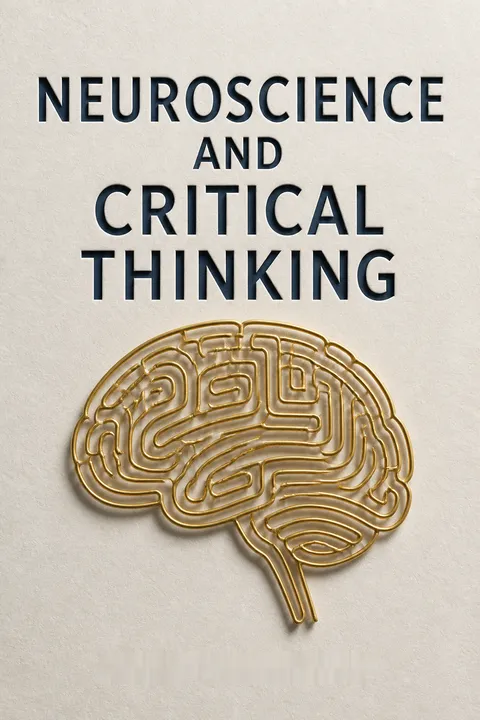
Neuroscience and Critical Thinking receives mixed reviews, with an average rating of 3.51. Readers appreciate its simplicity and accessibility, particularly for high school students or adults seeking a basic understanding. Some find it informative and well-researched, praising its concise approach to critical thinking and neuroscience. However, others criticize its shallow treatment of neuroscientific aspects and oversimplification. The book is commended for discussing logical fallacies and decision-making processes, but some reviewers note factual errors and a lack of depth in certain areas.
People Also Read










Glossary
Metacognition
Thinking about thinkingMetacognition is awareness of how one's thoughts and judgments are formed. In the book, it is the starting point for critical thinking: a person examines the assumptions, emotions, and reasoning behind a belief instead of accepting the belief simply because it feels familiar or convincing.
Triune brain model
Three-part brain modelA model associated with neuroscientist Paul MacLean that describes the brain in terms of three evolutionary layers: a system linked to basic survival, one linked to emotion and social behavior, and the neocortex linked to more complex thought. The book uses it to illustrate competing influences on judgment. It is a simplified historical model, not a literal map of three separate brains.
Long-term potentiation
Strengthened neural connectionsLong-term potentiation refers to a lasting increase in the strength of communication between connected neurons. The book uses it to explain how learning can change neural connections, supporting the formation and retention of long-term memories. Repeated activation is described as strengthening those connections.
Flashbulb memory
Vivid emotional recollectionA flashbulb memory is a vivid recollection of the circumstances surrounding an emotionally intense, unexpected event. People may remember where they were and what they were doing when they heard major news. The book emphasizes that vividness and confidence do not guarantee that the remembered details remain accurate.
Source amnesia
Forgetting where information came fromSource amnesia occurs when a person remembers a piece of information but cannot recall where, when, or from whom it was learned. It matters when judging credibility: a claim can feel like established knowledge even when its origin was unreliable, forgotten, or misunderstood.
Illusory truth effect
Repetition creates familiarityThe illusory truth effect is the tendency for repeated statements to seem more credible because they feel familiar. A person may remember encountering a claim but forget that it was false, disputed, or presented by an unreliable source. The effect helps explain how rumors and misinformation can gain apparent credibility through repetition.
Memory contamination
Distortion of remembered detailsMemory contamination is the alteration of a recollection by later information, existing beliefs, expectations, or details drawn from other experiences. The book describes memory as partly reconstructed, so a person's confident account may combine original observations with added or changed details. Leading questions and coaching can further shape what a witness recalls.
Deductive logic
Conclusion from stated premisesDeductive logic derives a conclusion from premises. If the premises are true and the reasoning is valid, the conclusion follows necessarily. The book distinguishes the structure of a deduction from the truth of its starting claims: a deduction can be logically valid even when one of its premises is false.
Inductive logic
Generalization from observationsInductive logic uses observations to support a broader conclusion or theory. Unlike a valid deduction from true premises, an inductive conclusion is not guaranteed by the observations alone and remains open to revision as new evidence appears. The book connects this process to the development and testing of scientific claims.
Reality testing
Checking whether a pattern is plausibleReality testing is the process of assessing whether a perceived pattern or explanation fits available evidence and the broader context. In the book's discussion of conspiracy theories, it helps distinguish a plausible interpretation from one that depends on selective evidence, unsupported connections, or assumptions that cannot be tested.
Ideomotor effect
Unconscious movementThe ideomotor effect refers to movement produced by unconscious mental processes rather than deliberate, conscious instruction. The book uses ordinary actions carried out without close attention to illustrate how the brain can guide muscles automatically. Such movements may feel mysterious, but the book presents them as a natural feature of subconscious motor control.
FAQ
1. What is "Neuroscience and Critical Thinking" by Albert Rutherford about?
- Explores the intersection: The book examines how neuroscience and critical thinking intersect, focusing on how our brains shape thought patterns, memory, decision-making, and susceptibility to errors.
- Practical application: It provides readers with tools to improve memory, make rational decisions, reduce emotional reactions, and set realistic expectations.
- Addresses modern challenges: The book discusses how to navigate misinformation, marketing tactics, and conspiracy theories in today’s information-rich world.
- Focus on self-awareness: Emphasizes the importance of metacognition—thinking about your own thinking—to develop stronger critical thinking skills.
2. Why should I read "Neuroscience and Critical Thinking" by Albert Rutherford?
- Understand your brain: The book helps readers understand the neurological basis of their beliefs, perceptions, and decision-making processes.
- Combat cognitive errors: It offers strategies to recognize and overcome common thinking errors, biases, and logical fallacies.
- Navigate information overload: Provides practical advice for evaluating information in an era of constant media, marketing, and online misinformation.
- Personal and societal benefits: Learning these skills can improve personal decision-making and contribute to more rational, evidence-based discussions in society.
3. What are the key takeaways from "Neuroscience and Critical Thinking"?
- Critical thinking is learned: Critical thinking is not innate; it requires conscious effort, self-awareness, and practice.
- Biases are natural but manageable: Our brains are wired for certain biases and emotional responses, but understanding them allows us to mitigate their effects.
- Memory is unreliable: Human memory is constructed, malleable, and often inaccurate, so relying solely on memory can lead to errors.
- Logical reasoning matters: Recognizing and avoiding logical fallacies is essential for sound decision-making and argumentation.
- Skepticism is healthy: Scientific skepticism and evidence-based reasoning are crucial tools for discerning truth from misinformation.
4. How does Albert Rutherford define and explain critical thinking in the book?
- Metacognition at the core: Critical thinking is described as metacognition—being aware of and analyzing your own thought processes.
- Beyond memorization: It’s not about knowing facts, but about understanding how you know things and evaluating the reasoning behind beliefs.
- Skills involved: Includes deconstructing arguments, identifying logical flaws, constructing step-by-step solutions, and being open to revising beliefs.
- Not just criticism: Critical thinking is about engaging in calm, reasoned debate, not simply being critical or argumentative.
5. What does "Neuroscience and Critical Thinking" say about how the brain influences our beliefs and perceptions?
- Triune brain model: The book explains the "triune brain" (reptilian, primate, and human/neocortex) and how each part influences emotions, instincts, and rational thought.
- Emotional bias: Emotional responses, rooted in older brain structures, often guide beliefs and can override rational analysis.
- Need for control and meaning: Human brains seek control, meaning, and simple explanations, which can lead to superstitions, confirmation bias, and oversimplification.
- Social and moral instincts: Our need for social belonging and moral codes also shapes our perceptions and can introduce critical thinking errors.
6. How does the book describe the relationship between memory and critical thinking?
- Memory is constructed: Memories are not perfect recordings; they are reconstructed and influenced by biases, emotions, and new information.
- Types of memory: Differentiates between short-term, long-term, emotional, and detail memory, each with its own strengths and weaknesses.
- Memory errors: Discusses phenomena like source amnesia, truth amnesia, and the illusory truth effect, which can lead to false beliefs.
- Critical thinking as a corrective: Emphasizes the need to corroborate memories with evidence and logical reasoning, especially in high-stakes situations.
7. What are the main logical fallacies and cognitive errors discussed in "Neuroscience and Critical Thinking"?
- Common fallacies covered: Includes arguments from authority, post hoc ergo propter hoc, ad hoc reasoning, ad hominem, argumentum ad ignorantiam, false dichotomy, moving the goalpost, and strawman fallacy.
- Why they occur: Many fallacies arise from natural cognitive tendencies, such as the desire for simplicity, validation, or group belonging.
- Impact on reasoning: These errors can undermine arguments, lead to poor decisions, and make individuals susceptible to manipulation.
- How to avoid them: The book provides strategies for identifying and countering these fallacies in everyday thinking and debate.
8. How does "Neuroscience and Critical Thinking" address the influence of marketing, media, and misinformation?
- Manipulation tactics: Explains how marketers exploit cognitive biases (e.g., left-digit effect, impulse buying, anchoring) to influence consumer behavior.
- Media literacy: Stresses the importance of evaluating sources, recognizing emotional or biased language, and seeking consensus among reputable experts.
- Misinformation examples: Analyzes urban legends, spam emails, and viral hoaxes to illustrate how misinformation spreads and how to critically assess such claims.
- MLMs and scams: Details how multi-level marketing schemes and scams use psychological manipulation and social proof to deceive people.
9. What does Albert Rutherford recommend for improving critical thinking skills in daily life?
- Practice metacognition: Regularly reflect on your own thought processes, biases, and the sources of your beliefs.
- Seek diverse perspectives: Engage in discussions with others, especially those who challenge your views, to uncover blind spots.
- Use evidence-based reasoning: Prioritize objective evidence over gut feelings, anecdotes, or wishful thinking.
- Be open to change: Cultivate self-awareness and a willingness to revise beliefs when presented with well-reasoned arguments or new data.
10. How does "Neuroscience and Critical Thinking" explain the appeal and dangers of conspiracy theories?
- Psychological needs: Conspiracy theories fulfill needs for control, certainty, and belonging, especially in uncertain times.
- Pattern recognition gone awry: Humans are wired to see patterns, which can lead to seeing connections where none exist.
- Cognitive traps: Confirmation bias, fundamental attribution error, and closed belief systems make conspiracy theories resistant to evidence.
- Societal impact: While some conspiracy theories have uncovered real issues, most undermine trust, promote misinformation, and discourage healthy skepticism.
11. What practical methods does the book suggest for evaluating information and sources?
- Check multiple sources: Always verify information across independent, reputable, and fact-checked outlets.
- Assess source quality: Look for professional management, lack of emotional or sales-driven language, and transparency about biases.
- Consensus matters: Give more weight to information supported by a consensus among experts in the field.
- Investigate opposing views: Research arguments from different perspectives to better understand the landscape and avoid echo chambers.
12. What are the best quotes from "Neuroscience and Critical Thinking" by Albert Rutherford and what do they mean?
- "The brain is an amazing organ. Not only can it think, it can also think about how it thinks."
- Highlights the concept of metacognition, which is central to developing critical thinking skills.
- "Critical thinkers focus more on how they know than what they know."
- Emphasizes the importance of process and reasoning over mere accumulation of facts.
- "Wishful thinking can be especially harmful to our critical thinking because it guides us to the conclusions we want instead of the correct ones."
- Warns against letting emotions and desires override objective analysis.
- "Critical thinking cannot happen in a vacuum. Other people can offer perspectives that you have never even considered, and they can find holes in your logic that you missed completely."
- Stresses the value of dialogue and openness to feedback in refining one’s thinking.
- "Healthy skepticism is the most important tool you can use when dealing with conspiracy theories; it is excellent at filtering out what is false or implausible from what is true."
- Advocates for a balanced, evidence-based approach to evaluating extraordinary claims.
About the Author
Other books by Albert Rutherford

Download PDF
Download EPUB
.epub digital book format is ideal for reading ebooks on phones, tablets, and e-readers.








