


Plot Summary
Charlene’s Vanishing Map
Four months after receiving a message from Charlene Billings,3 the narrator1 learns from her colleague Frank Sims10 that she has disappeared, leaving behind a sketch of an Appalachian valley and the narrator’s1 name. He recognizes the location and goes there, uneasy that his own understanding of the spiritual Insights has begun to falter.
In town, he meets David Lone Eagle,4 a Native American descendant searching the valley for the unwritten Tenth Insight. David4 says he saw Charlene3 enter the forest and suspects she is near Sipsey Canyon, where people report openings into another dimension. He also warns that Forest Service officers are counting hikers, the eastern wilderness is closed, and an unexplained hum has begun to trouble the area.
The search begins with a double failure of attention: the narrator ignored Charlene’s earlier message, and now he must act without knowing whether she is safe. His guilt is practical rather than abstract, because his delay has cost him the chance to understand why she came to the valley. David’s history adds another pressure: the landscape is not simply wilderness to explore but ancestral ground threatened by outside ownership. The opening makes intuition a form of responsibility. Following a hunch may be uncertain, but refusing to follow it has consequences too.
The Falls in His Mind
The narrator1 slips past the rangers and follows the stream east, where a low hum and vivid encounters with crows, a hawk, and the valley’s heightened colors sharpen his attention. He holds an image of a hidden pool and waterfall in mind rather than dismissing it as fantasy. After an unmarked jeep searches the meadow, he follows the hawk across rocky hills and finds the falls exactly as imagined.
There he senses a familiar warmth and sees Wil,2 the companion who vanished during the earlier journey in Peru. Wil2 confirms that sustained mental images can guide a person toward a possible future and its synchronistic meeting. The narrator’s1 willingness to keep faith with the image brings him to the first person who can explain the new mystery.
The narrator’s progress depends less on receiving a perfect prediction than on remaining attentive long enough to act on an incomplete one. The crow, hawk, and imagined waterfall all become prompts to notice what ordinary skepticism would dismiss. That practice carries a risk: the same confidence can be mistaken for forcing events into existence. Wil’s distinction between guidance and arbitrary will matters because the narrator has already experienced how quickly intuition can feel unreliable. The falls turn the abstract question of spiritual awareness into a test of conduct: he must keep observing, moving, and revising without demanding certainty first.
Williams’s Afterlife Review
Wil2 explains that the Tenth Insight has not been written on Earth; people are only beginning to grasp it through experiences in the Afterlife. Together, he and the narrator1 enter that dimension while concentrating on Charlene.3
They witness a newly dead physicist, John Donald Williams,9 struggle to accept his death, then watch a life review expose his lifelong pursuit of recognition and his disregard for the risks of advanced technology. The review carries him back to a nineteenth-century military camp, where he stayed silent while a peace proposal from Maya5 was rejected.
Williams9 remembers that he and others were meant to form a group of seven to confront the Fear driving dangerous control of the future. A rising hum disrupts the vision and throws the narrator1 back toward Earth.
Williams’s review binds private regret to public harm. His failure was not simply an unkind temperament or a career pursued too hard; the same hunger for status that shaped his work also made him overlook the moral consequences of technology. The review treats missed chances as cumulative, because silence in one life can help recreate the conditions for silence in another. This mechanism changes the narrator’s understanding of intuition: a missed image may represent more than personal disappointment. The group of seven offers a counterweight to isolated expertise, but the danger surrounding the experiment suggests that insight without collective action remains insufficient.
The Fear Joel Names
Back in the forest, the narrator1 meets journalist Joel Lipscomb,8 who has encountered Charlene3 and says she warned him to leave. Joel8 lays out his expectation that economic inequality, failing institutions, environmental damage, and religious extremism will combine into civilizational collapse.
He dismisses spiritual purpose as wishful thinking, yet his detailed account gives the narrator1 a human voice for the Fear Williams9 warned about. As an unmarked jeep passes, the narrator1 heads toward the stream, torn between continuing the search and seeking help.
He falls among tumbling rocks, but a pale shape seems to divert them. He then sprains his ankle and meets Maya Ponder,5 a physician who connects the injury to his fear and hesitation about whether to act.
Joel’s bleakness is persuasive because it draws on recognizable failures rather than supernatural menace. The narrator cannot refute him with a slogan, so the encounter forces the spiritual framework to face material insecurity and institutional distrust. His accident makes that conflict bodily: he is frightened, divided, and momentarily unable to move forward. Maya’s approach does not deny the injury or replace ordinary care; she asks him to examine what his fear is doing to his choices. The section therefore links social pessimism with personal paralysis without equating them. A person may be right to identify danger and still become immobilized by the expectation that nothing can change.
Maya’s Healing Practice
Maya5 treats the narrator’s1 ankle while explaining her view that fear and stress can affect health and that patients must participate in healing alongside conventional medicine. She guides him to focus on the pain, identify its precise location, and imagine energy moving through the injured area.
As he does, the pain changes, and he recalls faking injuries as a child to escape pressure. Maya5 describes how her mother’s chronic illness and her father’s research into the immune system shaped her work at a clinic combining alternative methods with medical resources.
She believes healing requires recovering a meaningful direction in life, not merely removing symptoms. After leaving to fetch supplies, Maya5 returns in his thoughts as a woman from Williams’s9 past-life vision, though she resists the larger mission he sees for her.
Maya’s healing method gives the novel’s spiritual claims an unusually concrete setting: pain, attention, memory, and a patient’s own interpretation. The narrator’s childhood recollection does not prove that every accident is self-created, but it reveals a learned strategy of retreat that still shapes his response to danger. Maya’s professional identity also carries a tension between care and certainty. Her emphasis on patient agency can restore dignity, yet it risks assigning too much responsibility to someone who is ill. Her insistence on working alongside conventional medicine keeps that tension visible rather than allowing spiritual belief to become a simple substitute for treatment.
Curtis Knows the Hum
After Maya5 leaves, the narrator1 tries to explain the danger but she refuses to join him, so he continues east alone. He finds Curtis Webber,6 a former technology researcher who recognizes the valley’s hum as the sound of linked energy generators.
Curtis6 says he helped develop the technology at a fictitious corporation and learned that increasing its output can destabilize space and affect other dimensions. He believes the current operators are trying to amplify the device by focusing it on the valley’s energy openings.
At Codder’s Knoll, Curtis6 and the narrator1 hear the hum intensify; the ground splits, trees fall, and Curtis6 nearly slides into a fissure before an inexplicable cushioning force saves him. Curtis,6 angry and guilty about his past work, decides explosives may be the only way to stop the experiment.
Curtis gives the supernatural threat a technical history and a morally compromised human source. He is not an uninformed alarmist: his knowledge makes the danger more credible, while his past participation makes it personal. Yet experience alone does not make his proposed response wise. The fissure demonstrates the experiment’s destructive reach, but it also exposes how quickly fear can narrow Curtis’s options to sabotage and force. The plot’s central conflict is now more than belief versus disbelief. It is a dispute over whether people can use dangerous knowledge without reproducing the same controlling logic that produced the danger.
The Narrator’s Lost Lives
The narrator1 climbs to a limestone overhang and uses its energy to rejoin Wil2 in the Afterlife. A welcoming soul group triggers memories of a thirteenth-century life as a monk who copied the Nine Insights and tried to circulate them before the church was ready.
He was arrested after faking an ankle injury to delay punishment. He also remembers a later life as a mountain man who abandoned Maya5 and Charlene3 during a failed attempt to prevent a war against Native Americans.
These memories reveal the same pattern: he sees what may be right, then retreats when action carries risk. Wil2 helps him understand that this recognition is a life review he can use while alive. The narrator1 then witnesses a sweeping vision of human history as an uneven movement toward spiritual awareness.
The narrator’s memories turn repetition into a psychological structure rather than a sequence of unrelated past lives. His false injury, his retreat from the Native American conflict, and his present hesitation all express the same defense: withdrawal protects him from immediate danger but leaves others to bear the consequences. The present-day life review makes self-knowledge actionable. Regret need not wait until death, but noticing a pattern does not erase responsibility for changing it. The historical panorama enlarges that individual problem, presenting cultural progress as fragile and repeatedly distorted by fear, domination, and premature attempts to impose a perfect future.
The Town of Fear
As the narrator’s1 historical vision ends, Wil2 identifies their gray surroundings as Hell. The narrator1 is pulled into a nineteenth-century town where a dead military commander,11 unable to accept his death, reenacts paranoia and violence.
The narrator1 escapes into an opium den, an office, and a sexual gathering, each occupied by people trapped in familiar routines that keep them from facing fear and isolation. A young man manages to leave, but the commander11 and his pursuers return to repeat their conflict.
Wil2 explains that these are mental constructions formed by souls who remain caught in compulsive control dramas, not proof of an external demonic conspiracy. When the narrator1 stops surrendering to their panic and reconnects with his own inner calm, the illusion releases him.
The town makes evil psychologically legible without making it harmless. The commander’s violence and the other souls’ compulsions injure and imprison, yet Wil traces them to fear, habitual defenses, and refusal of responsibility rather than to a separate supernatural force. This account challenges the comfort of labeling harmful people as monsters beyond understanding. It also risks overexplaining suffering through an individual’s psychology, but the narrative preserves an important distinction: understanding a cause does not absolve its consequences. The narrator escapes only after recognizing that he has mistaken intensity for truth and dependence for rescue.
Feyman’s Buried Purpose
The experiment’s renewed blasts shake the Afterlife, and the narrator1 and Wil2 follow an image of a vast energy plant. The vision shows Feyman,7 the man David4 had seen with Forest Service officers, saving a failing facility before converting it into smaller, decentralized generators.
A memory of his earlier life reveals that Feyman7 once opposed a commander’s11 abuse of technology, but his political ambitions and resentment eventually bent him toward control. His Birth Vision shows that he came to help make new energy safe and widely available, and that he expected to join six others in the valley.
The narrator1 recognizes that the group must recover shared memories and combine its members’ purposes. As another blast tears him from the Afterlife, he briefly sees Charlene,3 confirming that she too can cross between dimensions.
Feyman’s vision complicates the antagonist role by separating original intention from present conduct. His technological ambition began with a potentially useful goal, but fear and the desire for control have distorted it. The vision does not excuse that distortion; it identifies a point at which he might still choose differently. The group of seven is therefore not merely a mystical credential. It is a model of distributed responsibility, joining technical knowledge, medical practice, journalism, mediation, and other forms of understanding. Charlene’s appearance also makes the personal search and the larger crisis converge: the person the narrator came to find is already involved in the same struggle.
Charlene’s Hidden Captivity
Back in the valley, the narrator1 finds Curtis6 after Curtis6 has blown up the experiment’s outdoor antenna. They hide in a cave as armed vehicles search the area, and Maya5 arrives after failing to reach the sheriff’s department.
Her memories now link her to an earlier attempt to stop the Native American war, and she and Curtis6 begin to recognize the resentment between them. Nearby, Curtis6 attacks a guard and frees Charlene,3 whom Feyman7 had been escorting under armed watch. Charlene3 explains that she taught Feyman7 about the Insights, believing he wanted clean energy, while he secretly used her sensitivity to locate the valley’s dimensional openings.
The group shares its past-life memories and names the old anger, guilt, and distrust that would prevent them from working together. Charlene3 identifies mutual uplift and honest emotional clearing as necessary before they can act.
Charlene’s account reveals a betrayal grounded in misdirected trust, not simple gullibility. Her knowledge made her useful to Feyman, and his promise of public benefit gave her a reason to cooperate until she recognized the danger. Meanwhile, the group’s personal history becomes operational: unresolved resentment is not presented as private baggage but as a force that can sabotage collective work. Maya’s method of naming feelings offers a practical alternative to both denial and blame. The scene also revises the narrator’s earlier guilt. His delayed response mattered, but repair now depends on what the group does with the information and relationships it has in front of it.
The Failed Vision
The five companions leave the cave and approach Feyman’s7 underground bunker, but armed guards capture them before they can reach it. Feyman7 orders them held until his experiment is complete.
Under the strain of the hum, they try to raise their energy and picture a future that defeats his plan, but their vision still treats Feyman7 as an enemy to push away. The ground fractures, Maya5 panics and runs, and Charlene3 slips away separately. Curtis6 and the narrator1 escape during the chaos, find Maya,5 then reunite with Charlene3 near the falls.
David4 joins them there and admits he has recovered his own past-life memories. When a screech owl guides Maya5 to the group, David4 explains that animals can serve as signs of qualities people need to recover. The group prepares to try again without turning fear into hostility.
The first collective attempt fails for a precise reason: the group has energy and a compelling image, but still organizes that image around defeating an enemy. Their fear makes the act of resistance resemble the control they oppose. Maya’s flight and the group’s separation show how quickly conviction can collapse when danger becomes immediate. David’s arrival does not solve the problem by adding another believer; he brings a changed understanding of his own anger and a way to read the animals as prompts for attention. The failed attempt is useful because it reveals that the group must include its opponents in its vision, not merely outlast them.
The Vision Reaches Feyman
At the falls, the five companions reconnect with their soul groups and recover the larger vision of human history and a possible future beyond its fearful polarization. When the experiment starts again, they first fail by imagining Feyman7 pushed back.
David4 stops Curtis6 from escalating and urges the group to include Feyman7 and his men as souls capable of remembering their purpose. They focus on Feyman’s7 original wish to make energy safe and accessible, and the generator’s dissonance fades. Feyman7 briefly recognizes that intention, then panics and flees rather than surrendering his ambition.
The local experiment ends, and Forest Service officers, federal agents, and the sheriff’s department arrive to investigate. Joel,8 now committed to helping, appears at the site. At dawn, Wil2 meets the narrator1 and Charlene,3 more clearly visible after the valley’s shift, and points them toward the next stage of their journey.
The climax turns on a change in the group’s target. They do not excuse Feyman or make him harmless; they stop treating him as a fixed embodiment of evil and address the purpose he has abandoned. His moment of recognition is real but incomplete, which keeps the resolution honest: the experiment is halted in this valley, while the wider conflict remains. The arrival of public authorities shifts the danger from a purely spiritual confrontation toward accountability in the ordinary world. Wil’s clearer presence offers a visible consequence of the group’s work, but the unfinished vision and his invitation onward prevent the ending from claiming that one successful intervention has settled humanity’s larger struggle.
Analysis
The novel builds its spiritual argument through a chain of concrete failures and repairs. The narrator1 ignored Charlene’s3 message, Williams9 stayed silent when peace was possible, Curtis6 turns first toward explosives, and the group’s initial attempt to stop Feyman7 fails because it imagines him only as an enemy. In each case, the central problem is not lack of information alone. People possess knowledge but become unable to use it when fear narrows their sense of responsibility.
The Afterlife framework gives that problem a long historical reach. Personal habits recur across lives, while societies repeatedly transform intentions toward democracy, science, religion, and technology into systems of domination. The book’s account of history is deliberately teleological: it treats human development as movement toward greater cooperation and spiritual awareness. That vision lends significance to individual action, though it also risks presenting complex historical harms as stages in a single planned process. The valley’s history of Native dispossession keeps that risk visible, since spiritual reconciliation cannot undo the material injustice David4 names.
The group’s eventual success depends on joining distinct kinds of knowledge. Maya5 contributes healing and emotional insight, Curtis6 understands technology and commerce, Charlene3 brings research and communication, David4 carries Indigenous memory and mediation, and the narrator1 connects their experiences into a shared account. Their method does not erase disagreement; it makes resentment discussable and redirects attention from defeat toward recovery of purpose. Feyman’s7 brief recognition is therefore an opening, not a conversion, and the authorities’ arrival matters because spiritual intention must still meet practical accountability.
The novel’s most distinctive claim is that expectation functions like prayer: a vision of collapse can help produce withdrawal and control, while a vision of awakening can motivate cooperation. This is less a promise that optimism guarantees success than an ethical demand to examine what one’s expectations permit. The ending leaves the wider struggle unresolved, placing its burden on continued attention, intervention, and the refusal to dehumanize those who are causing harm.
Review Summary
The Tenth Insight received mixed reviews. Some readers found it powerful and insightful, expanding on the concepts from The Celestine Prophecy. They appreciated the spiritual exploration and ideas about life purpose. Others felt it was too fantastical or difficult to grasp, lacking the appeal of the first book. Critics noted the weak plot and characters, viewing it as a vehicle for spiritual concepts rather than a compelling story. Overall, readers who enjoyed the first book and were open to spiritual themes tended to rate it more favorably.
People Also Read





Characters
The narrator
Reluctant spiritual seekerThe unnamed narrator is a returning explorer of the Insights who begins this journey uncertain whether his intuitions still lead anywhere. His concern for Charlene3 draws him into the valley, where he must balance physical danger, spiritual experience, and skepticism. He is observant and capable of unusual openness, but a recurring instinct to withdraw when responsibility becomes frightening complicates his self-image as a seeker. His relationships with Wil2, Charlene3, and the others challenge him to turn insight into action rather than treating it as private knowledge. The narrator’s central psychological conflict is between caution that protects him and avoidance that leaves others unsupported.
Wil
Guide across dimensionsWil is the narrator’s1 trusted companion from the earlier journey in Peru, now able to move through the Afterlife dimension. He is curious, affectionate, and willing to explain what he has learned, while remaining candid about what he does not yet understand. His own experience shows that spiritual ability can become a form of control when separated from humility and inner guidance. Wil helps the narrator1 interpret intuition, soul groups, and life reviews, but he does not simply provide answers or solve the physical crisis for him. His role is to widen the narrator’s1 perspective while leaving the work of choosing and acting with those still on Earth.
Charlene Billings
Researcher of human purposeCharlene is the missing friend whose research work and interest in the Insights lead her into the valley. She is intellectually inquisitive and willing to explore unfamiliar ideas, yet her trust in Feyman’s7 promise of useful energy technology leaves her vulnerable to manipulation. Her professional curiosity reflects a deeper interest in understanding how people and institutions work, not merely collecting facts. She shares a powerful history with the narrator1 and others in the group, and her attention to unspoken emotions helps them work together. Charlene combines investigative discipline with spiritual receptivity, making her a bridge between evidence, intuition, and collective memory.
David Lone Eagle
Valley’s ancestral mediatorDavid is a descendant of the Native people who lived in the valley and a seeker of the Tenth Insight. His attachment to the land is inseparable from the history of its dispossession, and he carries a fierce anger toward those who threaten it. He believes the valley contains sacred places that can guide people toward wider understanding, but he must also confront how resentment can narrow his own vision. David is perceptive about intuition, animal signs, and the importance of mediation. His connection to the group’s past makes him both a bearer of historical memory and a voice for including Native wisdom in any future shaped by technology.
Maya Ponder
Physician of inner healingMaya is a physician who combines conventional medical resources with alternative approaches and a strong belief in patient participation. Her mother’s illness and her father’s biological research shaped her interest in how fear, commitment, and purpose affect health. She is compassionate and perceptive, but initially resists being drawn into a larger spiritual conflict that threatens the life she has deliberately built. Maya’s medical practice reflects her conviction that healing involves more than fixing symptoms: people also need to recover agency and a reason to move forward. Her attentiveness to group dynamics gives the others a way to name difficult feelings rather than burying them.
Curtis Webber
Engineer facing his pastCurtis is a former researcher who understands the energy technology being tested in the valley because he once helped develop it. His technical intelligence is matched by guilt about what his work may have enabled, and he is determined to prevent the device from harming the landscape. Under pressure, he favors decisive force, including explosives, because he fears that delay will make the danger irreversible. His conflict with Maya5 and his difficult connection to the narrator1 reveal how old grievances can shape present judgment. Curtis represents the possibility of redirecting technical expertise toward public benefit, but he must learn to distinguish urgent action from fearful retaliation.
Feyman
Engineer seeking controlFeyman is an engineer associated with the secret energy project and a former colleague of Curtis6. He is intelligent, ambitious, and convinced that centralized control is necessary to introduce a new energy source without destabilizing society. His confidence masks a deep investment in recognition and influence, making it difficult for him to accept limits or criticism. Feyman’s connection to the valley’s technology gives him both the knowledge and the power to endanger it. He is not presented as a simple outsider to the group’s ideals; his stated belief in innovation and his professional history make the conflict over how technology should serve people especially sharp.
Joel Lipscomb
Reporter of social collapseJoel is a journalist who voices a detailed, deeply pessimistic account of social and economic decline. He distrusts spiritual explanations and believes institutions are failing under inequality, environmental damage, and political self-interest. His skepticism is not casual cynicism; it grows from his close attention to the worst incentives in his profession and society. Joel’s presence forces the narrator1 to encounter the Fear as an argument with real-world evidence behind it, rather than as a vague spiritual obstacle. His role as a reporter also connects him to the question of whether public information can expose harm or merely intensify alarm.
John Donald Williams
Physicist confronting consequencesWilliams is a physicist whose death brings him into the narrator’s1 first extended encounter with the Afterlife. His career in advanced research and energy technology gives the group a direct link between scientific innovation and moral responsibility. In the life review, his early drive for achievement and recognition becomes inseparable from choices he made when others needed him to speak. Williams’s story establishes the importance of examining not only what a person intended, but what their silence and professional ambition made possible.
Frank Sims
Charlene’s worried colleagueFrank works with Charlene3 at a research firm and becomes alarmed when she misses important appointments and stops communicating. He finds her sketch and the narrator’s1 old letter, then contacts him for help. His practical concern turns a private disappearance into the story’s inciting search.
The military commander
Voice of coercive powerThe commander appears in memories of the nineteenth-century conflict and in the narrator’s1 encounter with a trapped soul’s mental construction. He is suspicious of reconciliation and committed to using force to secure political and economic aims. His presence shows how power can defend itself by treating peace proposals as threats.
Sharon
A soul trapped in escapeSharon is a young woman the narrator1 remembers from school, where she struggled with depression and drug use. He encounters her again within a mental construction in the Afterlife, still surrounded by people and habits that keep her from confronting what has happened. Her brief appearance gives the narrator1 a personal connection to the souls caught in repetitive fear.
Plot Devices
Maintained intuition
Images guide actionIntuition appears as fleeting impressions, animal encounters, dreams, or clear images of a possible event. The narrator1 learns to keep these impressions in mind long enough to test them through action. His image of a pool and waterfall leads him to Wil2, while later images help him locate the people and places connected to the valley’s crisis. The device distinguishes guided action from simply willing an outcome into existence. It also creates a recurring tension: a person must act without certainty, while remaining alert to the possibility that fear or desire has distorted the signal.
Afterlife and soul groups
Memory beyond one lifeThe Afterlife is a dimension in which souls can observe life on Earth, revisit their choices, and retain knowledge through groups of related souls. These groups support those living on Earth, but they cannot replace a person’s own connection to spiritual guidance. The narrator1 and Wil2 encounter soul groups through visions, dreams, and life reviews. The device expands the characters’ private histories into shared purposes and helps explain why people may feel immediate affection or resentment. It also makes the physical world consequential: souls on Earth must make choices in a slower, more stable reality.
Life reviews
Choices shown in consequenceA life review allows a soul to see a life’s decisions in a wider context, including opportunities ignored and effects on other people. Williams’s9 review links professional ambition to the dangerous use of technology and an earlier failure to support peace. The narrator1 later experiences a review while still alive, recognizing that his recurring retreat from responsibility has shaped more than one life. This device turns regret into usable information: characters can understand a pattern before it becomes permanent. It also resists a purely self-congratulatory view of intention by asking what a person actually did when a consequential moment arrived.
Animal messengers
Nature signals needed qualitiesAnimals appear at moments when the characters are preparing to make a choice or need to recover a particular quality. Crows and hawks sharpen the narrator’s1 attention, a bobcat accompanies his encounter with Maya5, and a screech owl guides Maya5 and the others through the darkness. David4 interprets these appearances as invitations to reconnect with capacities carried through life’s evolution, rather than as decorative coincidences. The animal signs bind spiritual perception to the valley’s ecology and reinforce the importance of protecting its living systems. Their meaning depends on attention and context, not on a fixed rule that every sighting predicts a specific event.
Dimensional energy generator
Technology threatens the valleyA concealed generator links smaller energy units and is being amplified through the valley’s dimensional openings. Curtis6 recognizes its hum from his earlier research and warns that increasing its output destabilizes the surrounding space. The device makes the spiritual conflict materially dangerous: fissures split the ground, trees fall, and the landscape itself becomes vulnerable. Its promise of inexpensive energy is not inherently destructive, but Feyman’s7 attempt to centralize and control the technology puts the valley at risk. The generator therefore tests whether technical discovery can be directed toward broad human benefit without repeating the same fearful pursuit of power.
FAQ
0. Synopsis & Basic Details
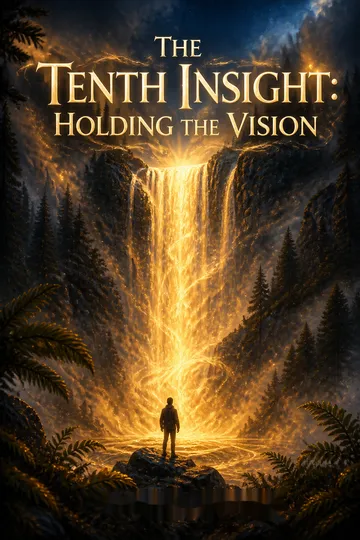
What is The Tenth Insight: Holding the Vision about?
- A Spiritual Quest: The Tenth Insight: Holding the Vision follows an unnamed narrator on a journey into the Appalachian wilderness to find his missing friend, Charlene, who is deeply involved in researching a new spiritual understanding. His search quickly evolves into a quest for the elusive Tenth Insight, a higher truth that promises to unify humanity's spiritual evolution.
- Unveiling Hidden Realities: Guided by intuition and a series of profound encounters, the narrator delves into the nature of synchronicity, past lives, the afterlife, and the concept of "soul groups." He learns that humanity is at a critical juncture, facing a "polarization of Fear" that threatens to derail its spiritual awakening.
- Collective Transformation: The core of the story centers on the formation of a destined "group of seven" individuals, each with a unique spiritual purpose, who must overcome personal and historical resentments to collectively remember and "hold" a "World Vision"—a blueprint for humanity's utopian future—to avert a looming technological and societal crisis.
Why should I read The Tenth Insight: Holding the Vision?
- Deepen Spiritual Understanding: Readers seeking to expand their perception of intuition, synchronicity, and the afterlife will find a rich, experiential narrative that offers a unique framework for understanding personal and collective spiritual growth. The book provides a practical guide to living a more purposeful life.
- Explore Humanity's Destiny: It offers a compelling, optimistic vision of human history and future, reinterpreting traditional concepts of evil and apocalypse as opportunities for conscious evolution and unity. This perspective can inspire hope and agency in a world grappling with division and uncertainty.
- Engage with Transformative Ideas: The novel blends adventure with philosophical inquiry, presenting complex spiritual concepts through an accessible story. It encourages readers to reflect on their own life purpose, relationships, and the power of their intentions to shape reality, making it a thought-provoking read for those interested in self-improvement and global change.
What is the background of The Tenth Insight: Holding the Vision?
- Sequel to a Phenomenon: The Tenth Insight: Holding the Vision is the direct sequel to James Redfield's bestselling novel, The Celestine Prophecy, continuing the exploration of nine spiritual insights that describe humanity's evolving consciousness. It builds upon the foundation of energy dynamics, intuition, and the search for a higher purpose established in the first book.
- Appalachian Mysticism: The story is set in a specific, unnamed Appalachian valley, which is depicted as a sacred site, a "midway between the upper world and the middle world here on Earth," drawing on Native American spiritual traditions of vision quests and connection to nature. This geographical setting grounds the metaphysical journey in a tangible, ancient landscape.
- Contemporary Societal Fears: The narrative is deeply rooted in contemporary anxieties of the mid-1990s, addressing concerns about economic collapse, environmental degradation, political polarization, and the ethical implications of rapidly advancing technology. It frames these challenges as manifestations of a collective "Fear" that humanity must overcome through spiritual awakening.
What are the most memorable quotes in The Tenth Insight: Holding the Vision?
- "We either fear that human culture is falling apart, or we can hold the Vision that we are awakening. Either way, our expectation is a prayer that goes out as a force that tends to bring about the end we envision. Each of us must consciously choose between these two futures.": This quote, delivered by Wil, encapsulates the core message of the Tenth Insight, emphasizing the power of collective intention and the critical choice humanity faces between fear-driven decline and love-driven evolution. It highlights the active role individuals play in shaping reality.
- "In reality, there are no enemies; we're all souls in growth, waking up. We have to project the World Vision toward them as though they are just like us.": David Lone Eagle's profound realization during the climax redefines conflict, urging empathy and inclusion even for those perceived as adversaries. This quote is pivotal in shifting the group's strategy from opposition to transformative love, reflecting a central theme of universal spiritual connection.
- "True prayer is the method, the visualization, that God expects us to use in discerning his will and implementing it in the physical dimension. His kingdom come, his will be done, on Earth, as it is in heaven.": David's explanation of prayer elevates it beyond mere supplication to an active, co-creative process. This quote empowers individuals by linking their focused intention and visualization directly to divine will, making them active participants in manifesting a higher reality on Earth.
What writing style, narrative choices, and literary techniques does James Redfield use?
- Didactic Narrative Blend: Redfield employs a unique blend of first-person adventure narrative and explicit spiritual instruction. The story progresses through the narrator's experiences, but significant portions are dedicated to characters explaining the "Insights" and their implications, often feeling like a spiritual seminar embedded within a thriller.
- Holographic Visions & Deja Vu: A key technique is the use of vivid, often holographic visions and recurring sensations of déjà vu to convey past-life memories, birth intentions, and the "World Vision". This blurs the line between subjective experience and objective reality, making the spiritual concepts feel tangible and immediate to the reader.
- Symbolic Archetypes & Unnamed Protagonist: Characters often serve as archetypes representing different facets of human experience (e.g., the healer, the technologist, the cynic, the mediator). The unnamed narrator enhances reader identification, allowing them to project themselves into the universal spiritual journey, while the symbolic animal encounters further enrich the narrative's mystical layer.
1. Hidden Details & Subtle Connections
What are some minor details that add significant meaning?
- Feyman's Persistent Limp: Feyman's slight limp, initially a throwaway detail, is later revealed to be a physical manifestation of his past-life role as the "ultimate yes-man" aide who "limped slightly" and failed to act during the Native American wars. This subtle callback highlights how unresolved past-life patterns can manifest physically and psychologically in current incarnations, influencing character motivations and actions.
- The Narrator's Ankle Injury: The narrator's sprained ankle, seemingly a random accident, is directly linked to his past life as a monk who "faked a severe ankle injury" to avoid a summons and responsibility. This detail, revealed during Maya's healing session, underscores the book's theme that physical ailments often stem from deep-seated, unconscious fears or unresolved patterns from past lives, serving as a "beacon" for self-awareness.
- David Lone Eagle's Facial Scar: David's "thin scar on his face that ran from the edge of his left eyebrow all the way to his chin" is a physical reminder of a past-life fight fueled by his "anger burning within" him over historical injustices. This scar symbolizes the deep, unresolved trauma and resentment that he, and by extension his soul group, must confront and forgive to move forward in their collective mission.
What are some subtle foreshadowing and callbacks?
- Recurring Animal Encounters: The narrator's early encounters with a rabbit, crows, and a hawk are not random; David later explains that these animals are "coincidences of the highest order," each carrying a specific "medicine" or message for the narrator's journey. The rabbit foreshadows the need to face fear and find abundance, while the hawk signals the arrival of a messenger (Wil), subtly guiding the narrator's path before he consciously understands their meaning.
- The Dissonant Hum's Evolution: The "low, dissonant hum" from Feyman's experiment initially causes fear and discomfort, but as the group begins to "hold the Vision," the hum becomes "almost harmonious." This subtle shift foreshadows the group's ability to influence the experiment's energy field through their collective consciousness, demonstrating that their spiritual work directly impacts the physical world and the experiment's calibration.
- The "White Form" of Protection: The "wispy white form" that saves the narrator from falling rocks and the "strange streak of light" that deflects bullets from Maya are early, unexplained instances of divine intervention. Wil later clarifies these as "angels" who "respond to our faith and vision and make miracles," serving as a callback that reveals the unseen spiritual support available when individuals align with their higher purpose.
What are some unexpected character connections?
- The Narrator's Past as a Monk and Mountain Man: The narrator discovers he was a monk in 13th-century France, martyred for trying to disseminate the Insights, and later a mountain man in the 19th-century Appalachian wars, who "ran away" from conflict. These past lives reveal a deep-seated pattern of both courageous spiritual pursuit and a fear of commitment, directly influencing his current struggles with aloofness and intervention in the valley's crisis.
- Maya and Curtis as Past-Life Allies: Maya (the healer) and Curtis (the technologist) were killed together in a past life during the Native American wars, where Maya, as a missionary's daughter, tried to broker peace and Curtis, as a congressional aide, was an observer. This shared traumatic past explains Curtis's initial anger and distrust towards Maya, and their eventual reconciliation is crucial for the group's ability to overcome historical resentments and unite.
- Feyman and Joel's Intertwined Destinies: Feyman (the antagonist) and Joel (the cynical journalist) were connected in a past life: Feyman as a military aide who was scapegoated, and Joel as a journalist who failed to expose the truth due to bribes. Joel's post-death dedication to "waking up Feyman" highlights the profound, karmic connections within soul groups, where individuals are destined to help each other resolve past failures and awaken to their true intentions.
Who are the most significant supporting characters?
- The Soul Groups as Collective Guides: Beyond individual characters, the "soul groups" themselves are significant supporting entities. They act as "reservoirs for our memories," holding the "Birth Visions" and sending "extra energy" to individuals on Earth, subtly guiding their intuitions and dreams. Their collective wisdom and support are essential for the group of seven to remember the World Vision and overcome the polarization of fear.
- The Animals as Symbolic Messengers: The various animals encountered by the narrator (rabbit, crows, hawk, bobcat, eagle, wolf, owl) are not mere background elements but active, symbolic messengers. As David explains, each animal represents an "aspects of ourselves that we developed when we were those animals during the course of evolution," offering specific guidance and "medicine" to help the characters navigate their challenges and awaken their latent qualities.
- Wil as the Afterlife Bridge: Wil, the narrator's spiritual mentor, serves as a crucial bridge between the physical and Afterlife dimensions. His ability to traverse these realms and communicate with soul groups provides the foundational knowledge for understanding life reviews, birth visions, and the true nature of spiritual evolution. His unwavering optimism and guidance are instrumental in helping the narrator and the group grasp the Tenth Insight.
2. Psychological, Emotional, & Relational Analysis
What are some unspoken motivations of the characters?
- Narrator's Fear of Commitment and Aloofness: The narrator's initial reluctance to call Charlene back, his "telling myself that I would call later," and his past-life pattern of "not stick[ing] my neck out for anyone" reveal an unspoken fear of deep involvement and responsibility. This motivation stems from a past-life trauma as a monk who was martyred for his convictions, leading to a subconscious desire to avoid similar risks in his current life.
- Feyman's Deep-Seated Need for Recognition and Control: Feyman's ambition to centralize the energy technology and be "known for having done this" is driven by an unconscious need to overcome past-life humiliation and a distorted sense of mission. His past as a scapegoated military aide and failed assassin fuels a desperate desire to control outcomes and gain validation, masking a profound insecurity and fear of powerlessness.
- David's Penance of Forgiveness: David Lone Eagle's intense anger and resentment over the historical injustices against his people, coupled with his self-described "penance of forgiveness," reveal an unspoken motivation to heal collective trauma. His past-life role as an "angry chief" who rejected peace underscores his current mission to mediate and integrate diverse cultures, transforming his personal rage into a force for reconciliation.
What psychological complexities do the characters exhibit?
- The Narrator's Internal Conflict with Responsibility: The narrator grapples with the psychological complexity of his "aloofness" and "reluctance to act or to take a stand," which he recognizes as a pattern from past lives. His journey involves confronting this ingrained habit, moving from a detached observer to an active participant, and integrating his intellectual understanding of the Insights with courageous, heartfelt action.
- Maya's Struggle with Naiveté and Practicality: Maya, the healer, exhibits the complexity of balancing idealistic vision with practical reality. Her past-life "naively" pursuing peace without sufficient understanding led to her death, making her initially resistant to the group's mission. Her current life as a physician, grounded in scientific understanding, reflects her soul's attempt to integrate spiritual faith with a cautious, effective approach to healing and intervention.
- Curtis's Guilt and Desire for Redemption: Curtis, the technologist, is psychologically complex due to his profound guilt over his past involvement in dangerous technology and his failure to act in a past life. His initial impulse to use violence to stop Feyman stems from this unresolved guilt and a desperate need for redemption, which he must transform into a more conscious, non-violent approach to fulfilling his "Birth Vision" of ethical technological evolution.
What are the major emotional turning points?
- The Narrator's Life Review in the Afterlife: Witnessing Williams's Life Review and then experiencing his own "Life Review now" (remembering his past lives as a monk and mountain man) is a major emotional turning point for the narrator. This direct confrontation with his "missed opportunities" and "regrets" ignites a powerful determination to "wake up earlier" and consciously align with his true purpose, overcoming his ingrained aloofness.
- Maya's Remembrance of Past-Life Trauma: Maya's emotional breakthrough occurs when she remembers her past life as the missionary's daughter, killed while trying to stop the Native American wars. This memory, coupled with Curtis's anger, forces her to confront the "fear block" associated with her past failure, allowing her to fully embrace her role as a healer who can "heal this" by understanding and transforming collective trauma.
- The Group's Collective Forgiveness and Energy Amplification: The process of "clearing residual emotions" through honest sharing and forgiveness among the group members (especially between Curtis, Maya, and the narrator) is a critical emotional turning point. This act of collective vulnerability and acceptance allows their "soul groups" to merge, amplifying their energy exponentially and enabling them to access the "World Vision", demonstrating that unity through love is essential for spiritual power.
How do relationship dynamics evolve?
- From Skepticism to Trust: The relationship between the narrator and Joel Lipscomb evolves from initial skepticism and cynicism on Joel's part to a grudging acceptance and eventual participation. Joel, initially a "voice of Fear," is drawn into the group through his own disturbing dream and the realization that the narrator's friends are actively addressing the crisis, signifying the possibility of awakening even the most disillusioned.
- Healing Past-Life Resentments: The dynamics within the core group (the narrator, Charlene, David, Wil, Maya, Curtis) are profoundly shaped by their past-life connections. Initial friction, like Curtis's anger towards Maya or Charlene's resentment towards the narrator's detachment, are "residual emotions" that must be consciously acknowledged and forgiven. This process transforms their relationships from unconscious conflict to conscious, loving collaboration, essential for their collective mission.
- Soul Group Interconnectedness: The concept of "soul groups" fundamentally redefines relationship dynamics, revealing that individuals are part of larger spiritual families who incarnate together across lifetimes. This understanding fosters a deeper sense of interconnectedness and purpose, as characters realize their earthly relationships are often destined opportunities to support each other's growth and fulfill a shared "World Vision."
4. Interpretation & Debate
Which parts of the story remain ambiguous or open-ended?
- The Nature and Role of Angels: While Wil explicitly states that the "wisps of white light" are "angels" who "respond to our faith and vision and make miracles," their exact nature, origin, and the mechanics of their intervention remain largely ambiguous. The story suggests they are a mystery even to those in the Afterlife, leaving their full understanding open for future insights or personal interpretation.
- The Specifics of the "New Heaven": The "World Vision" reveals humanity's intention to create "not merely a New Earth, but a New Heaven as well," where soul groups in the Afterlife "rapture toward the physical." While the concept of dimensions closing and energy transferring is presented, the precise nature of this "New Heaven"
0. Synopsis & Basic Details
What is The Tenth Insight: Holding the Vision about?
- A Spiritual Quest: The Tenth Insight: Holding the Vision follows an unnamed narrator on a journey into the Appalachian wilderness to find his missing friend, Charlene, who is deeply involved in researching a new spiritual understanding. His search quickly evolves into a quest for the elusive Tenth Insight, a higher truth that promises to unify humanity's spiritual evolution.
- Unveiling Hidden Realities: Guided by intuition and a series of profound encounters, the narrator delves into the nature of synchronicity, past lives, the afterlife, and the concept of "soul groups." He learns that humanity is at a critical juncture, facing a "polarization of Fear" that threatens to derail its spiritual awakening.
- Collective Transformation: The core of the story centers on the formation of a destined "group of seven" individuals, each with a unique spiritual purpose, who must overcome personal and historical resentments to collectively remember and "hold" a "World Vision"—a blueprint for humanity's utopian future—to avert a looming technological and societal crisis.
Why should I read The Tenth Insight: Holding the Vision?
- Deepen Spiritual Understanding: Readers seeking to expand their perception of intuition, synchronicity, and the afterlife will find a rich, experiential narrative that offers a unique framework for understanding personal and collective spiritual growth. The book provides a practical guide to living a more purposeful life.
- Explore Humanity's Destiny: It offers a compelling, optimistic vision of human history and future, reinterpreting traditional concepts of evil and apocalypse as opportunities for conscious evolution and unity. This perspective can inspire hope and agency in a world grappling with division and uncertainty.
- Engage with Transformative Ideas: The novel blends adventure with philosophical inquiry, presenting complex spiritual concepts through an accessible story. It encourages readers to reflect on their own life purpose, relationships, and the power of their intentions to shape reality, making it a thought-provoking read for those interested in self-improvement and global change.
What is the background of The Tenth Insight: Holding the Vision?
- Sequel to a Phenomenon: The Tenth Insight: Holding the Vision is the direct sequel to James Redfield's bestselling novel, The Celestine Prophecy, continuing the exploration of nine spiritual insights that describe humanity's evolving consciousness. It builds upon the foundation of energy dynamics, intuition, and the search for a higher purpose established in the first book.
- Appalachian Mysticism: The story is set in a specific, unnamed Appalachian valley, which is depicted as a sacred site, a "midway between the upper world and the middle world here on Earth," drawing on Native American spiritual traditions of vision quests and connection to nature. This geographical setting grounds the metaphysical journey in a tangible, ancient landscape.
- Contemporary Societal Fears: The narrative is deeply rooted in contemporary anxieties of the mid-1990s, addressing concerns about economic collapse, environmental degradation, political polarization, and the ethical implications of rapidly advancing technology. It frames these challenges as manifestations of a collective "Fear" that humanity must overcome through spiritual awakening.
What are the most memorable quotes in The Tenth Insight: Holding the Vision?
- "We either fear that human culture is falling apart, or we can hold the Vision that we are awakening. Either way, our expectation is a prayer that goes out as a force that tends to bring about the end we envision. Each of us must consciously choose between these two futures.": This quote, delivered by Wil, encapsulates the core message of the Tenth Insight, emphasizing the power of collective intention and the critical choice humanity faces between fear-driven decline and love-driven evolution. It highlights the active role individuals play in shaping reality.
- "In reality, there are no enemies; we're all souls in growth, waking up. We have to project the World Vision toward them as though they are just like us.": David Lone Eagle's profound realization during the climax redefines conflict, urging empathy and inclusion even for those perceived as adversaries. This quote is pivotal in shifting the group's strategy from opposition to transformative love, reflecting a central theme of universal spiritual connection.
- "True prayer is the method, the visualization, that God expects us to use in discerning his will and implementing it in the physical dimension. His kingdom come, his will be done, on Earth, as it is in heaven.": David's explanation of prayer elevates it beyond mere supplication to an active, co-creative process. This quote empowers individuals by linking their focused intention and visualization directly to divine will, making them active participants in manifesting a higher reality on Earth.
What writing style, narrative choices, and literary techniques does James Redfield use?
- **
Celestine Prophecy Series
About the Author


Download PDF
Download EPUB
.epub digital book format is ideal for reading ebooks on phones, tablets, and e-readers.








