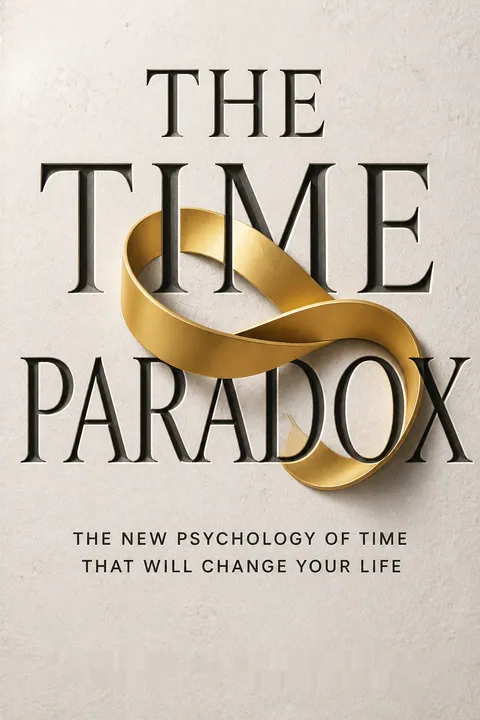


Key Takeaways
Treat time perspective as a lens you can adjust, not a personality sentence.
Your time lens. A time perspective is the often-unconscious way people sort experience into past, present, and future, shaping what they notice, feel, and do. Zimbardo and Boyd describe six dimensions: past-positive, past-negative, present-hedonistic, present-fatalistic, future, and transcendental-future, which concerns existence after death. Their inventory research, involving thousands of people, suggests that these dimensions can coexist rather than define fixed personality types. A person can plan carefully and also enjoy spontaneity.
Different strengths, different costs. Future orientation is associated with planning and preventive health, while present-hedonism brings energy and pleasure but can accompany impulsive risk. Fatalism can weaken a sense of agency; a negative past can feed regret. The goal is not to live in one time zone, but to recognize which one is steering.
The framework is useful because it replaces a vague question, such as whether someone is disciplined, with a more precise one: which horizon is controlling this decision? That distinction invites adjustment rather than self-condemnation. It also resembles cognitive flexibility, the capacity to shift mental strategies when circumstances change. The inventory is best treated as a reflective map, not a diagnosis. Scores describe patterns and associations; they do not establish that a time perspective caused a behavior or capture every cultural way of experiencing time.
Change the meaning of painful memories without pretending the events were harmless.
Memory is reconstructed. Zimbardo recalls spending five months as a sick child in a hospital where other children died. He later understood the experience not only as terror, but as a place where he learned to read, invent games, and endure. His account illustrates how present interpretation can shape the emotional meaning of the past. In Elizabeth Loftus's car-crash experiment, people asked how fast cars were going when they “smashed” reported higher speeds than those asked when cars “contacted”; some also remembered broken glass that was never shown.
Reframe without erasing. The authors suggest naming lessons gained from difficult events and deliberately recalling things worth appreciating. They do not argue that painful events were good or that every injury can be reframed away. The distinction is between changing what happened and changing how a person carries it now.
This approach sits between two unhelpful extremes: treating memory as a perfect recording, and treating painful history as irrelevant because memory is fallible. Psychological research on memory supports the idea that recall is reconstructive, while trauma research also makes clear that reframing is not a substitute for safety, support, or treatment. Gratitude can broaden attention toward overlooked positives, but it should not be prescribed as a demand to feel thankful for suffering. The strongest application is agency over interpretation, not denial of harm.
Notice when time pressure shrinks your attention before judging your character.
Urgency changes behavior. In the Good Samaritan experiment by John Darley and Dan Batson, seminary students preparing a speech passed a person who appeared ill and needed help. Among students told they were late, 90 percent did not stop, even though they noticed the person. Students who believed they had time were more likely to help. The researchers changed the students' time pressure, not their stated values.
Time has cultural rules. The book calls schedules organized around when events feel ready “event time,” in contrast to clock time, which assigns fixed hours. A dance performance in Bali, for example, might begin when the dancers and audience were ready, not at a printed time. These systems can clash: what one person sees as flexible, another experiences as disrespectful.
The experiment is a sharp reminder that good intentions are vulnerable to attention limits. In behavioral science, this is often understood as a bandwidth problem: urgent demands consume the mental capacity needed to notice and respond to other people. That makes compassion partly a matter of scheduling and institutional design, not merely virtue. The study does not show that time pressure excuses every failure to help, nor that all cultures fit neatly into event-time and clock-time categories. It does show why context deserves scrutiny before character is condemned.
Use future planning to build a life, not postpone living one.
Planning creates options. Future-oriented people tend to set goals, meet deadlines, and take preventive health steps. The authors point to a study in which four-year-olds who waited for a second treat later showed stronger self-regulation and scored higher on average on the SAT than children who took the immediate treat. They also describe mental rehearsal research: imagining the steps needed to reach a goal proved more useful than picturing only the successful outcome.
The future has a cost. Extreme planning can turn every hour into preparation for another hour. Zimbardo describes a successful academic career that left little room for friends, family, or leisure. His eventual adjustment was to use planning not just for work, but to protect time for pleasure. A plan should make life more available, not keep it perpetually deferred.
Future thinking works best when it converts intention into manageable action. That is why rehearsing steps can outperform merely visualizing a finish line: it links aspiration to choices available now. The marshmallow findings are memorable, but they should not be read as proof that a child's wait time alone determines adult success. A child's trust that a promised reward will arrive, and the stability of the surrounding environment, matter to how waiting makes sense. Self-control is a capacity, but it is also shaped by circumstance.
Take beliefs about an afterlife seriously as motives for choices made today.
The future can extend beyond life. The authors define the transcendental-future time perspective as beliefs about what follows bodily death, including judgment, reunion with loved ones, reincarnation, or eternal life. They argue that such beliefs can influence present conduct just as expectations about career or family can. In their discussion of suicide terrorism, they describe recruits who saw death as a route to an eternal reward, rather than as simple hopelessness or mental illness. The book presents this as one psychological lens, not a complete explanation.
Secular versions exist. The Iroquois Great Law asks decision-makers to consider consequences for seven generations. Here, the far future matters not because of personal salvation, but because descendants will inherit today's choices. Beliefs that reach beyond one lifetime can support comfort, restraint, or dangerous sacrifice.
Understanding a belief's motivational force does not require endorsing its truth or its consequences. This distinction is valuable in the study of religion and political violence: actions that look irrational from outside may follow a coherent inner model of reward, duty, and time. Still, the framework risks making an immensely complex act seem too explainable by one belief. Political grievance, group belonging, recruitment, and local conditions also shape action. A careful account takes the believer's worldview seriously without mistaking explanation for justification.
Build a flexible mix of good memories, present pleasure, and future plans.
Balance is a profile. The authors' ideal combines a strong positive view of the past, moderately strong future planning, and moderately strong present-hedonism, with low past-negativity and present-fatalism. A positive past can offer continuity and belonging. Present pleasure brings vitality and sensory attention. Future thinking supports preparation and persistence. None should dominate every situation.
Shift with the moment. Work that needs completion calls for future focus; time with loved ones can call for attention to the present; family rituals can draw on positive memories. The point is not to calculate a perfect score, but to practice changing gears. The authors describe this as a learned capacity, influenced by family, school, work, and community rather than fixed at birth.
This is the book's central practical idea: psychological health depends less on choosing one correct relationship with time than on having access to several. The proposal resonates with flexible coping, where a strategy is selected for the demands of a situation instead of applied mechanically. Yet the ideal profile reflects research developed largely in Western contexts, and what counts as healthy balance may differ across cultures and circumstances. It is most useful as a compass, not a universal prescription or a reason to fault people whose environments limit their choices.
Protect your health by respecting biological rhythms and limiting chronic stress.
The body keeps time. The suprachiasmatic nucleus, a small cluster of brain cells, helps regulate circadian rhythms, the roughly daily cycles governing sleep, mood, and other bodily processes. Light resets this internal clock. Researchers cited by the authors measured its natural cycle at about 24 hours and 11 minutes. Disruption can bring fatigue and impaired attention; the book notes that traffic accidents rise after the spring clock change. Short naps can also improve alertness, particularly for people doing safety-critical work.
Stress can become chronic. Immediate danger activates a short burst of bodily stress. Modern worries can keep that system active for much longer. The authors connect persistent stress and rumination with health and mental-health problems, including depression. They recommend attention to sleep, routine, and control over stressors, rather than treating every problem as a matter of attitude.
This section usefully joins psychology to chronobiology: a person's experience of time is not only a belief, but also a body synchronized to light, sleep, and daily demands. It cautions against moralizing fatigue as laziness when biological timing is disrupted. The book's broad stress comparison is illuminating, though people cannot always control work schedules, caregiving, or exposure to danger. Individual habits matter, but public health also depends on work design and access to recovery. Better rhythms are partly personal practice and partly a social responsibility.
Invest time like money, and count what each yes displaces.
Time has opportunity costs. Unlike money, time cannot be saved for later or replenished. Accepting an invitation, task, or meeting means losing the chance to spend that hour elsewhere. The authors contrast turning down a questionable request for money with accepting an unwanted dinner invitation, even when the latter consumes a more precious resource. Their question is practical: what is this hour buying, and what does it crowd out?
Choose returns beyond cash. The book argues that people often gain more lasting satisfaction from experiences and close relationships than from material purchases. It also links financial habits to time perspective: regular saving and starting early favor long horizons, while impulse spending can make pleasure costly. A deliberate calendar, like a deliberate budget, should reflect what a person values.
Opportunity cost makes the invisible price of a crowded calendar easier to see. It is a useful bridge between economics and personal life because it turns an abstract scarcity into a concrete comparison: this commitment, instead of what? The book's preference for experiences and relationships over possessions is persuasive as a prompt, not a rule that fits every income or stage of life. Financial advice also depends on conditions that change over time. The durable insight is to assess the purpose of an expenditure, whether the currency is money or attention.
Make room for love and happiness before urgency fills the calendar.
Relationships need shared time. New love can make the present feel complete, but durable relationships also require memories and a jointly imagined future. Partners with different time perspectives may clash over spending, punctuality, work, or spontaneity without realizing that they are approaching time differently. The authors recommend meeting in the present: clarify what the other person means, then discuss what each can do next, rather than prosecuting old mistakes.
Happiness adapts. The book describes research in which lottery winners did not remain happier than ordinary people over time. A major gain can become familiar, while everyday pleasures and relationships still need attention. Happiness can come from remembering good experiences, enjoying the present, or anticipating a goal, but it is felt in the present. The authors therefore urge readers to make time for connection and enjoyment, not just work that seems urgent.
The relationship advice is strongest when it treats disagreement as a translation problem rather than evidence of indifference. A future-focused partner may be expressing care through preparation, while a present-focused partner may express it through spontaneity and attention. Neither language is sufficient alone. The emphasis on adaptation also challenges the assumption that one dramatic achievement will permanently settle well-being. Still, happiness is not simply a scheduling problem; illness, loss, and economic strain can constrain it. Protecting joyful time helps, but it cannot make every circumstance fair.
Reject quarterly incentives when your business depends on decades.
Short horizons can corrupt judgment. Enron's executives initially built a successful company, but pressure to satisfy quarterly earnings helped narrow attention to the next report. The company reported inflated figures, collapsed into bankruptcy in 2001, and lost almost all its share value. Vice president Sherron Watkins warned that accounting scandals could destroy the firm, but leaders failed to act on the longer-term danger. The case illustrates how a group's time perspective can become short-sighted even when its members are intelligent.
Rules shape attention. Industrial clocks and factory schedules made time measurable and sellable; modern institutions also reward punctuality, deadlines, and near-term results. Those arrangements can create coordination, but they may punish people whose lives or cultures operate differently. The authors argue that public programs designed around long-term planning can also fail people focused on immediate needs.
The Enron story shows why organizational ethics cannot be reduced to individual character. Incentives define what gets noticed, rewarded, and postponed; a culture organized around quarterly wins can make long-term risk feel abstract. Governance must therefore preserve independent scrutiny and extend the time horizon of evaluation. The social argument needs equal care: labeling disadvantaged people as present-oriented can obscure the instability that makes long-term planning difficult. Institutions should adapt their supports to people's actual constraints, rather than treating one schedule as proof of virtue.
Give today's time a purpose chosen by you, not by the calendar.
Waiting is still a choice. In Samuel Beckett's play Waiting for Godot, two men spend their days expecting someone who never arrives. They announce that they should leave, yet remain where they are. The book uses their stillness to make a simple point: time passes whether or not a person feels progress. The question is what deserves the time that is passing.
Make the principle usable. The authors call their closing rule the “Golden Rule of Time”: use time in the way one would want others to use theirs. That can mean doing meaningful work, making room for pleasure, and giving attention to people who matter. Purpose is personal, but it becomes real through present actions, not through endlessly waiting for a perfect moment.
The ending turns an existential question into an everyday test: does this use of time support a life that the person respects? That connects with self-determination theory, which emphasizes autonomy, competence, and relatedness as foundations of well-being. It also resists the idea that purpose must be grand; attention, service, craft, or companionship can give ordinary hours direction. The limit is that purpose cannot be chosen in a vacuum. Poverty, illness, and obligation constrain available time. Personal agency matters, but meaningful change also requires conditions that make choices possible.
Analysis
The book's enduring contribution is to make time perspective visible as an influence between situation and action. It is not merely a matter of punctuality or scheduling. A person's orientation toward past, present, or future shapes which consequences feel real, which memories become self-defining, and which obligations receive attention. The central prescription, flexibility across time perspectives, is more convincing than an argument for becoming uniformly future-oriented. The hurried seminarians demonstrate why: the same moral identity can produce different behavior when the immediate frame changes.
The framework is also strongest when it connects individual psychology to social conditions. Clock-based workplaces, educational routines, family stability, and economic uncertainty help teach people how far ahead it feels safe to plan. This prevents the theory from becoming only a character test. Yet the book sometimes risks turning broad correlations into neat personality portraits. A score associated with risky behavior does not establish cause, and the inventory's Western origins limit claims of universal fit. The categories can clarify tendencies, but they cannot substitute for examining institutions, resources, or the pressures acting on a particular person.
The account of memory adds another important caution: the past that guides action is partly reconstructed in the present. This allows growth, but it also demands ethical restraint. Reinterpretation can loosen needless shame; it should not be used to overwrite evidence, excuse perpetrators, or pressure survivors into optimism. Likewise, understanding the motivational role of afterlife beliefs can illuminate behavior without making one psychological explanation adequate for political violence.
Taken together, the book is best read as a guide to temporal range. Learn from experience without becoming captive to it, take pleasure without surrendering judgment, and plan without making life a permanent rehearsal. Its practical test is whether a person's habits and institutions keep all three horizons available when the situation calls for them.
Review Summary
The Time Paradox received mixed reviews, with ratings ranging from 1 to 5 stars. Many readers found the book's ideas on time perspectives fascinating and potentially life-changing, praising its scientific approach and insights into human behavior. However, some criticized it for being too long, repetitive, or resembling a self-help book. Several reviewers appreciated the book's analysis of how different time orientations affect decision-making and life outcomes, while others felt the concepts were oversimplified or lacked practical application.
People Also Read







Glossary
Time perspective
Personal orientation toward timeThe often-unconscious attitude through which a person organizes the flow of experience into past, present, and future categories. It influences what receives attention, how events are interpreted, and which outcomes guide decisions. The authors argue that time perspectives are learned and can be adjusted, rather than being fixed traits.
Six time perspectives
Six recurring time orientationsThe authors' framework identifies past-positive, past-negative, present-hedonistic, present-fatalistic, future, and transcendental-future perspectives. Each describes a different relationship to time, and an individual can score high or low on several dimensions at once. The framework is intended to describe patterns, not to divide people into six fixed personality types.
Zimbardo Time Perspective Inventory
Measure of time orientationsA questionnaire developed by Philip Zimbardo and John Boyd to assess five time-perspective dimensions: past-positive, past-negative, present-hedonistic, present-fatalistic, and future. A separate Transcendental-future Time Perspective Inventory measures beliefs about existence after death. The inventories produce profiles across dimensions rather than a single overall score.
Event time
Time organized around eventsA way of organizing activity by environmental or social events rather than by fixed clock readings. A performance might begin when the performers and audience are ready, or a meal when circumstances suit the group. The book contrasts event time with clock time and describes conflicts that arise when people assume their own system is universal.
Clock time
Time measured by clocksA standardized system that assigns fixed numerical times to activities and coordinates schedules across people and institutions. The book traces its growing importance through industrial work, transportation, and modern daily life. Clock time enables coordination, but its rules can conflict with event-based cultural practices and make punctuality a social judgment.
Transcendental-future time perspective
Orientation beyond bodily deathA person's beliefs and expectations about what may happen after physical death, such as divine judgment, reunion with the dead, eternal life, or reincarnation. The authors treat these expectations as a psychological future that can motivate conduct in the present, regardless of whether the beliefs can be empirically verified.
Balanced time perspective
Flexible use of time orientationsThe authors' proposed profile combines a strong positive attitude toward the past with moderately strong future planning and present-hedonism, while keeping past-negativity and present-fatalism low. More broadly, it means being able to shift attention among time horizons according to the situation instead of relying rigidly on one perspective.
Golden Rule of Time
Use time as others shouldThe authors' closing principle asks people to use their time as they would want others to use theirs. It applies not only to how people treat one another, but also to how they spend time alone: through meaningful work, enjoyment, rest, and attention to relationships. It is offered as a practical prompt for choosing how to live.
FAQ
What's The Time Paradox about?
- Exploration of Time Perspectives: The Time Paradox by Philip G. Zimbardo and John Boyd examines how our attitudes toward time—past, present, and future—affect our lives. It identifies six major time perspectives that influence behavior and decision-making.
- Impact on Life Choices: The book highlights that understanding and adjusting our time perspectives can improve health, relationships, and success. It aims to help readers reclaim their past, enjoy the present, and master their future.
- Psychological Insights: Drawing on decades of research, the authors provide insights into how time affects happiness and success, offering practical exercises to help readers shift their time perspectives.
Why should I read The Time Paradox?
- Transformative Insights: The book offers a unique perspective on the influence of time on our lives, providing tools to enhance well-being and encouraging a deeper understanding of time attitudes.
- Practical Applications: Zimbardo and Boyd provide actionable advice and exercises for improving time management and life satisfaction, making the book both theoretical and practical.
- Broad Relevance: The concepts are applicable to various aspects of everyday living, whether you are a student, professional, or someone looking to improve your quality of life.
What are the key takeaways of The Time Paradox?
- Understanding Time Perspectives: The book identifies six time perspectives—past-negative, past-positive, present-fatalistic, present-hedonistic, future, and transcendental-future—that shape experiences and behaviors.
- Balance is Essential: A balanced time perspective, allowing flexible shifts between past, present, and future, is crucial for mental health and well-being. Extreme focus on one perspective can lead to dissatisfaction.
- Reclaiming Your Time: Emphasizes the importance of reclaiming your past, enjoying the present, and mastering your future through conscious choices and reflections for a meaningful life.
What are the best quotes from The Time Paradox and what do they mean?
- “What you are, they once were. What they are, you will be.”: Reflects the inevitability of death and the importance of living meaningfully in the present, reminding us to appreciate life.
- “The mind is its own place, and in itself can make a heaven of hell, a hell of heaven.”: Highlights the power of perceptions and attitudes toward time, suggesting that mental framing can alter experiences.
- “Time is our most valuable possession.”: Emphasizes the finite nature of time, encouraging readers to prioritize how they spend it in pursuit of happiness and fulfillment.
How do the authors define time perspectives in The Time Paradox?
- Time Perspectives Explained: Defined as nonconscious personal attitudes toward time, these perspectives categorize experiences and give order and meaning to our lives.
- Six Major Perspectives: The authors identify six perspectives: past-negative, past-positive, present-fatalistic, present-hedonistic, future, and transcendental-future, each influencing thoughts, feelings, and behaviors.
- Psychological Impact: Discusses how these perspectives can lead to various psychological outcomes, such as happiness, anxiety, and success, helping individuals make informed life choices.
What exercises does The Time Paradox suggest for changing time perspectives?
- Self-Reflection Exercises: Includes the "Who Was I?" test, encouraging reflection on past identities and experiences to identify dominant time perspectives and areas for growth.
- Gratitude Lists: Suggests keeping a daily gratitude list to foster a positive attitude toward the past, enhancing well-being and shifting focus from negative to positive experiences.
- Mental Rehearsal: Encourages mental rehearsal of future goals to improve performance and motivation, solidifying a future-oriented mindset.
How does The Time Paradox relate time perspectives to health and well-being?
- Health Outcomes: Argues that a balanced time perspective leads to better health outcomes, with individuals more likely to engage in preventive health behaviors and maintain healthier lifestyles.
- Psychological Resilience: A positive attitude toward the past is linked to greater resilience and lower anxiety and depression levels, impacting mental health significantly.
- Social Connections: Highlights that time perspectives influence social relationships, with past-positive individuals often having stronger family ties and support networks, crucial for well-being.
What is the Zimbardo Time Perspective Inventory (ZTPI)?
- Measurement Tool: The ZTPI is a psychological tool developed to assess individual differences in time perspective, categorizing responses into past-positive, past-negative, present-hedonistic, present-fatalistic, and future orientations.
- Understanding Behavior: Helps individuals understand how their time perspective influences behavior and decision-making, revealing patterns that may affect mental health or personal growth.
- Research Applications: Used in studies to explore the relationship between time perspective and factors like risk-taking, substance use, and well-being, forming a foundation for the book's arguments.
How can I identify my own time perspective using The Time Paradox?
- Zimbardo Time Perspective Inventory (ZTPI): Provides a questionnaire to assess time perspectives, revealing dominant attitudes toward past, present, and future.
- Self-Assessment: Reflect on personal experiences and their relation to time, considering how often you dwell on the past, focus on the present, or plan for the future.
- Comparative Analysis: Compare ZTPI scores with others to understand your unique time perspective profile, gaining insights into how time influences thoughts and behaviors.
What is the significance of the transcendental future perspective in The Time Paradox?
- Belief in Afterlife: Encompasses beliefs about life after death and how these influence present behavior, suggesting actions may differ based on expectations of the afterlife.
- Motivational Power: Provides a sense of purpose and motivation, influencing present actions and emphasizing goals beyond this life.
- Cultural Variations: Different religions and cultures have varying beliefs about the transcendental future, shaping societal behaviors and values, highlighting the importance of understanding cultural context.
How does The Time Paradox address the concept of time in business and politics?
- Impact on Decision-Making: Explores how time perspectives influence business strategies and political decisions, with a focus on short-term gains potentially leading to unethical practices.
- Cultural Time Orientation: Discusses how different cultures prioritize time, affecting business practices and political engagement, improving international relations and negotiations.
- Long-Term Vision: Advocates for a balanced time perspective in business and politics, emphasizing long-term planning and ethical considerations for sustainable success and societal well-being.
About the Author
Other books by Philip G. Zimbardo
Download PDF
Download EPUB
.epub digital book format is ideal for reading ebooks on phones, tablets, and e-readers.








