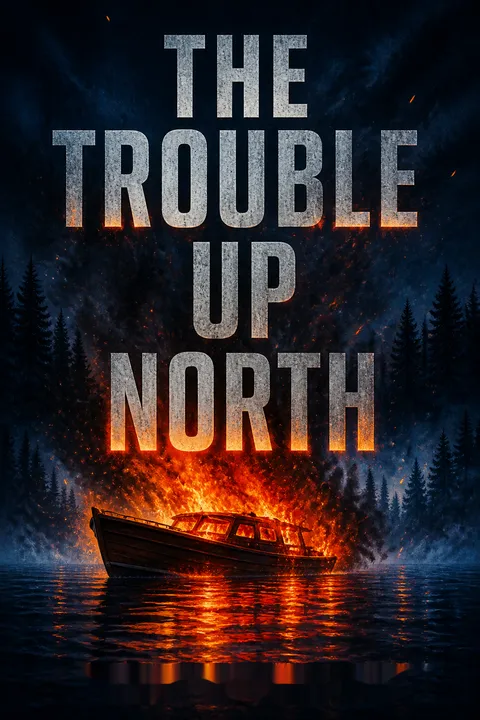


Plot Summary
The Fire Before Breakfast
At the Sawbrook farmhouse in northern Michigan, sixty-year-old Rhoda tells her ailing husband, Edward, that their daughter Jewell plans to burn a wealthy resorter's boat that night. Van Hargraves has paid her a thousand dollars up front and promised nine thousand more. Rhoda intends to check the riverbank for witnesses, though Edward warns her not to get involved.
The family already has too little money: Edward's lung cancer has forced Rhoda to borrow against their vast river property. She resents Lucy for placing her own parcel in a conservation trust, and distrusts Buckner's claim to sobriety. Harbor North's development presses closer, while Rhoda's conviction that the Sawbrooks must defend their land shapes every choice she makes.
The opening makes a criminal plot feel less like a sudden lurch than the latest expression of a family system. Rhoda's practical help for Jewell grows from debt, loyalty, and a belief that land is a relationship rather than a commodity. That conviction gives her courage, but also narrows the range of choices she can imagine. Her resentment toward Lucy is especially revealing: Lucy's conservation strategy may preserve the acreage, yet it threatens Rhoda's authority over how preservation should happen. Edward's illness sharpens the conflict. The family is not merely defending property; it is trying to keep its shared life intact while time and money contract around it.
Poker Money, Van's Boat
Jewell has made money at Van's private poker games, where her talent and Sawbrook family stories entertain resorters as they lose to her. After losing her entire twenty-thousand-dollar land buyout in a Las Vegas tournament, she accepts Van's offer to stage an insurance fire, partly because he promises to restart the games.
Her best friend Connie approves, noting that a Christian band's concert will pull sheriff's deputies away from the river. Across town, Lucy hosts a celebration for Buckner's six months sober, but neither sibling attends.
Lucy hides her disappointment while using the gathering to solicit donations for Friends of the Crow, a group she built to protect the river. Her siblings' absences expose how far the family has drifted from one another.
Jewell's wager is not simply greed. Poker offers her a language in which instinct, confidence, and nerve can plausibly repair losses that ordinary work cannot. That makes the Vegas failure especially painful: the money was meant to relieve her parents' debt and restore her place in the family, but her private gamble makes both aims harder. Lucy's party supplies a parallel image of repair. She tries to create a public community around Buckner's recovery, yet the family members whose presence would make the celebration meaningful stay away. The contrast shows how each sibling pursues care in a different currency: risk, organization, or abstinence, with none yet able to reach the others.
Buckner Drinks Again
Before the fire, Buckner is sober and trying to learn why his girlfriend Sky has stopped answering him. Her mother says Sky needs space, and Delray Harper, the owner of the Boogie Down Barn where she works, confirms that a customer hurt her but refuses to give details. Buckner understands that Sky wants him kept out of it, but his fear for her turns into anger.
He takes a bottle of whiskey from the bar and drinks. Later, at Lucy's campground, he gets into a drunken standoff with Ray Tomshaw over Ray's truck keys and demands information about Sky. When Buckner charges at Lucy's deputy, Lucy tases him twice to stop him, then once more after he is down. Buckner steals the park's four-wheeler and vanishes into a blackout.
Buckner's relapse has a trigger, but the narrative refuses to let the trigger become an excuse. He wants to protect Sky, yet he treats her silence as a wound to his own importance and answers it by drinking. His behavior at the campground turns that private collapse into danger for others, forcing Lucy to act as ranger and sister at once. The third Taser strike complicates her authority: she stops an immediate threat, then admits that anger shaped the extra blow. Buckner's blackout makes the consequences harder to measure, not less real. The scene establishes a central pressure in the family: love often arrives as an impulse to intervene, even when intervention can become harm.
The River Takes Both Sisters
Jewell follows the river through Crooked Tree Park, pours gasoline over Van's boat, and throws a burning torch onto its deck before escaping into the water. From a dinner in town, Lucy sees the blaze and races to evacuate the park's campers. After completing the sweep, she spots a camouflaged figure near the back gate and pursues her through the trees.
Jewell leaps into the Crow to evade capture; Lucy, recognizing her sister, follows. The sisters struggle downstream, and the current carries them over the falls. Jewell is battered and loses her rucksack, while Lucy strikes the rocks and lies unconscious with a deep cut across her cheek. Jewell drags her sister to shore, then calls Rhoda for help.
The river makes the sisters' conflict physical before either can explain herself. Lucy's chase begins as duty, but her decision to enter the water reveals how family loyalty can overpower professional judgment. Jewell knows the river well enough to use it as an escape route, yet her confidence cannot control the current or the weight of the evidence on her back. The falls turn pursuit into shared injury: neither sister can remain the simple pursuer or fugitive. Their survival depends on Jewell's choice to rescue Lucy, even though Lucy may expose her. In this moment, the river is neither a refuge nor an enemy. It is a force that strips both women of control.
A Note Beside the Body
Rhoda and Jewell carry the unconscious Lucy to a workshop and Rhoda stitches the gash in her cheek without medical help. The next morning, Jewell finds a typed apology delivered by a local boy on Van's behalf. Soon afterward, Connie reports that investigators found human remains aboard the burned boat and suspect they are Van's. Jewell fears she killed him.
Edward reads the apology and reasons that Van may have died before the fire, staging his death so insurance will pay his husband, Franklin. The family has no proof, and the authorities may still treat the fire as murder. When Lucy wakes, she reveals that Buckner was drunk at the park and that she left him tied up there, widening the danger to all three siblings.
The apology changes the emotional meaning of the fire without settling its legal meaning. Edward's inference gives Jewell a possible way to understand herself as manipulated rather than murderous, but that interpretation rests on a few typed words and a body too damaged to identify with certainty. The family therefore lives in a gap between what may have happened and what can be proved. Rhoda's improvised surgery embodies the same unstable logic: care is urgent, but the methods are risky and secret. Lucy's return to consciousness adds another liability rather than closure. The incident has converted a private family scheme into a chain of evidence, injury, and conflicting accounts.
The Stolen Ranger ATV
Buckner wakes in his bathtub with no memory of the night and discovers the stolen four-wheeler in his living room. Rhoda finds him hungover in his basement beside his dog, Harold, and explains that police may connect the vehicle and his drunken campground fight to the fire. She decides they must destroy it rather than risk Lucy being implicated.
Buckner agrees, then races toward the quarry while resort teenagers chase him in an SUV. He jumps clear as the four-wheeler sails into the pit and explodes. Rhoda collects him and Harold, then conceals them in her car as she passes a police checkpoint. The vehicle is gone, but Buckner's relapse and Lucy's involvement remain risks the family cannot erase.
The four-wheeler is both evidence and a measure of how quickly Buckner's good intentions become dangerous improvisation. He accepts Rhoda's plan because he wants to protect Lucy, yet his method of disposal nearly costs him his life. Rhoda's insistence on destroying the vehicle shows the protective instinct that governs her family: she acts first, then asks her children to accept the logic afterward. Buckner's concern for Harold softens him without excusing him. The dog is a dependent who cannot judge his keeper's choices, just as Buckner often hopes his family will shelter him from theirs. Passing the checkpoint buys time, not safety.
The Cave Keeps Them
Rhoda sends Lucy and Jewell toward an old family cabin while she searches for a boat. The sisters hide in a childhood cave when they hear a helicopter, and Buckner finds them there. As they hike onward, Lucy apologizes for using the Taser after Buckner was already down. He accepts the apology, then admits he is in love with Sky and her young son, Frog.
Jewell reveals that she sold her land to Lucy and lost the buyout gambling in Vegas, despite hoping to win it back. Lucy explains that the trust cannot simply be reversed. Their arguments expose old resentments, but they also begin to speak more honestly. At the cabin, the siblings eat together and share the history of Buckner's new family.
The cave offers the siblings a rare pause in which their childhood can be remembered without being mistaken for innocence. Their teasing about the cave's imagined occupant gives way to adult disclosures: Lucy owns her excess, Jewell owns her financial gamble, and Buckner names a future he wants rather than another crisis he has caused. The land trust sharpens their differences, since Lucy sees protection through legal structure while Jewell imagines money as a way to reverse any loss. Their tenderness is real but not neat; an apology does not resolve the trust, and affection does not eliminate mistrust. What changes is their ability to remain together while disagreeing.
A Hand in Harvard's Minefield
After another blast from the land mines Grandpa Harvard planted around the family bunker, Harold returns to the cabin clearing carrying a woman's severed arm. Rhoda, Jewell, Lucy, and Buckner search the area and find the dead woman's bag, marked with mushroom patches. Rhoda retrieves it from the dangerous ground and finds identification showing that the victim was thirty-five.
The family realizes that a mushroom hunter has trespassed into the minefield and died. Lucy challenges Rhoda over the land mines and the stuffed cormorant in the workshop, seeing both as proof that the Sawbrooks' claim to protect nature is compromised by possession and violence. Rhoda answers that they need more information before deciding what to do.
The minefield turns inherited history into immediate bodily consequence. What the family has treated as a boundary and a warning system has become lethal to a stranger whose only apparent offense was entering the woods to forage. Lucy's anger at the cormorant and the mines is not abstract environmentalism; the severed arm has made the costs of the family's self-protection impossible to keep at a distance. Rhoda's response, by contrast, begins from the claim that context matters. Neither position cancels the victim's death. The scene forces the siblings to see that loving a place does not guarantee that one's actions toward it, or toward visitors, are defensible.
Sky Steals the Gospel Van
Rhoda goes to Delray for a boat and meets Sky, who reveals that a singer from the Christian band attacked her at the Barn, choking her during a private dance. Delray's employee Bernard failed to resolve the matter, so Sky has devised a more public response. Rhoda helps her get the band's van key from their motel room, using a jar of the Sawbrooks' potent family liquor to persuade the desk clerk to hand over a room key.
They drive the van to the Barn, where the dancers pose around it and post images online, turning the band's vehicle into an embarrassing spectacle. Delray, impressed and needing to keep his employees' trust, agrees to provide Rhoda with a boat. Sky's confidence earns Rhoda's respect.
Sky's subplot echoes the main story's conflict over who gets to define justice. Delray initially treats the assault as a business problem, while Sky rejects the idea that a beating would solve it or protect the dancers. She chooses humiliation and public visibility instead, converting the band's own religious branding into a tool against them. Rhoda recognizes the intelligence of this response because it avoids making the attackers martyrs. Their partnership also revises Rhoda's expectations of Buckner's girlfriend: Sky is not merely someone he wants to rescue, but a person who can plan and act for herself. The boat is secured through reciprocal respect, not force.
Not for the Deer
With the family's dead mushroom hunter and the land trust between them, Rhoda and Lucy argue about whether protecting the property has become more important than protecting people.
Rhoda tells Lucy that her father killed many cormorants after their numbers devastated local fisheries and ruined livelihoods; the act was illegal, but the small community had believed it necessary. She does not offer the story as a clean defense. Instead, it shows Lucy the history behind the family's instinct to act outside the law.
Rhoda also recalls Lucy's childhood question about whether a dead deer was a good omen, and her father's answer that it was not good for the deer. The shared memory softens the argument, while Rhoda begins preparing to take responsibility herself.
The cormorant story resists both easy vindication and easy condemnation. Rhoda's father broke conservation law in response to a genuine economic crisis, but his motives do not erase the scale of the killing. Lucy's moral framework remains necessary precisely because family tradition can rename harm as protection. The deer memory offers a smaller, sharper counterweight: even a beautiful omen for the observer can mean catastrophe for the animal. Rhoda's willingness to tell Lucy the history rather than simply demand loyalty marks a rare opening between them. It does not make them agree. It allows Lucy to recognize the pressures that shaped Rhoda without surrendering her own judgment.
The Porch Holds Its Ground
Rhoda learns that Coast Guard boats have blocked Buckner and Jewell as they try to reach Canada. At home, she tells Edward she has called deputy Rick Pico and led him to suspect she was involved in the boat fire, hoping to turn the investigation away from their children. She leaves Jewell's rucksack where evidence can be found and prepares for the police to come.
Edward, weakened by cancer, refuses to stay behind. They sit together on the porch as sirens and a helicopter approach, each holding a weapon. When officers order them to surrender, Rhoda and Edward stand with their guns raised and do not fire. Police shoot them. Their children survive, but the parents' attempt to take the blame has become the family's final, irreversible cost.
The climax gives Rhoda's protectiveness its most consequential form. She cannot secure a clean escape for Jewell, so she tries to redirect suspicion toward herself, using the same strategic intelligence that once served the family in its illicit work. Edward's decision to stand with her is not a sudden heroic conversion; it is the culmination of a marriage in which he has repeatedly accepted the Sawbrook life on its own terms. Their refusal to shoot keeps the scene from becoming a victory through violence, but it cannot save them. The porch, a place of shared mornings and family memory, becomes the boundary where their loyalty meets the state's force.
The Land Outlives the Fire
After their parents' deaths, Jewell and Buckner give investigators accounts that keep the focus from settling into a clear case against them; Lucy supports the story that she entered the river trying to rescue a dog. The siblings remain out of prison.
Buckner seeks the ten thousand dollars Van promised from Franklin, who confirms that Van had wanted the insurance money and had sent his apology before the fire. Buckner marries Sky, brings her and Frog to live on the property, and places his parcel in Lucy's trust.
Jewell returns to poker and moves into the main house, while Lucy leaves town and returns to Mabel's house. She finds Germain's compass flask left for her. The siblings begin rebuilding their lives together on the land their parents fought to keep.
The ending refuses to equate survival with innocence or healing with forgetting. The siblings inherit a property and a compromised family story, but they also inherit the possibility of choosing different methods. Buckner's land trust shows that Lucy's approach can be accepted without making her the sole authority; Jewell's return to the main house gives her a place within the family after her gamble. The flask's compass condenses the novel's central tension: inheritance can orient a person, but it can also keep them circling the past. The siblings do not recover their parents or erase the deaths around them. They begin again by living together and making new decisions.
Analysis
The Trouble Up North treats family loyalty as both a refuge and a mechanism for repeating harm. The Sawbrooks protect one another through practical skill, shared memory, and a readiness to break rules, but those habits can also make secrecy feel virtuous and possession feel like stewardship. Rhoda's central belief is that land and family are inseparable. Lucy challenges the belief not because she loves the place less, but because she sees the legal trust as a way to preserve it without pretending that ownership is morally innocent. Their conflict is therefore not a simple contest between tradition and progress. It asks whether care for a place can survive the relinquishing of control.
The novel also gives each sibling a different strategy for coping with vulnerability. Jewell uses poker to turn uncertainty into a game whose risks she believes she can read. Buckner tries to become sober and useful, but his urge to defend people can slide into impulsive violence. Lucy organizes, fundraises, and relies on evidence, yet her certainty can become another form of control. Rhoda converts love into intervention, often deciding what others need before asking them. These strategies are imperfect, but the siblings' growing ability to name their failures and remain together suggests a more durable kind of loyalty than blind agreement.
The river and the family property make these conflicts tangible. A boat fire, a flooded chase, a minefield, and a conservation trust are not symbols floating above the plot; each changes who is endangered, who has authority, and what choices remain. The dead mushroom hunter forces the family to confront the cost of treating private land as a complete moral boundary. The cormorant story complicates the verdict without erasing the harm. By the end, the children inherit neither a clean legacy nor their parents' certainty. They inherit a place, a set of stories, and the task of deciding which parts of that inheritance deserve to continue.
Review Summary
People Also Read


Characters
Rhoda Sawbrook
The land's fierce guardianRhoda is the sixty-year-old matriarch of a northern Michigan family whose history is bound to the Crow River and thousands of acres threatened by development and debt. She is resourceful, physically capable, funny, and intensely loyal, but her loyalty often takes the form of control. Rhoda trusts action more than institutions, a habit formed by generations of family survival outside the law. She loves her children fiercely, yet her judgment of them can be harsher than her protection is gentle. Edward's illness makes her especially unwilling to accept loss, while her attachment to the land gives her a sense of identity that is difficult to separate from ownership. Her bluntness hides a deep fear of helplessness.
Edward Clark
Rhoda's steady-hearted husbandEdward is Rhoda's husband and the father of Lucy, Buckner, and Jewell. A former Vietnam veteran who once joined Rhoda on smuggling runs across the Great Lakes, he is now living with lung cancer and increasingly limited strength. His temperament balances Rhoda's certainty: he is patient, wry, and alert to the emotional costs of her decisions, even when he does not try to overrule her. Edward has made a life inside the Sawbrook family without needing to bear its name, and he understands both its appeal and its danger. His humor is not denial so much as a way to keep tenderness present when illness threatens to make every conversation about decline.
Jewell Sawbrook
The river's risk-taking playerJewell is Rhoda and Edward's youngest child, a gifted poker player whose confidence and charm can make risk feel like a form of competence. At Van's games, she uses stories about her family to entertain wealthy opponents and unsettle them at the table. She loves the river and the family history she has inherited, but she also wants to solve financial trouble through sudden, improbable wins. Jewell is quick, athletic, and loyal to her friend Connie and her siblings, yet she sometimes mistakes conviction for evidence that a plan will work. Her relationship with Lucy is marked by admiration and defensiveness, while Rhoda's approval matters to her more than she readily admits.
Lucy Sawbrook
The family's conservationistLucy, the eldest Sawbrook sibling, is a park ranger and the founder of Friends of the Crow, a conservation group working to protect the river and its habitat. She is educated, capable, and comfortable with institutions in ways her mother distrusts. Lucy's strongest instinct is to make a problem legible and manageable through rules, fundraising, and long-term planning. That instinct can become self-righteousness, especially when she believes her family is repeating destructive choices. She cares deeply for Buckner and Jewell, though her concern often arrives wrapped in criticism. Her estrangement from Rhoda reflects a genuine dispute about what preservation requires, not a lack of love for the land or her family.
Buckner Sawbrook
The tender, troubled brotherBuckner is the only son of Rhoda and Edward, a large, warmhearted man whose alcoholism repeatedly disrupts his efforts to build a stable life. He has managed periods of sobriety and is trying to understand the habits beneath his drinking, but he remains vulnerable to impulsive anger and blackouts. Buckner is often less calculating than his sisters and mother, yet he notices emotional truths they may overlook. His affection for animals and children reveals how naturally he can care for those who depend on him. He wants to be useful to his family and to create a home with Sky, but his need to protect people can become another excuse to act before he thinks.
Sky
A dancer who acts for herselfSky works as a dancer at Delray's Boogie Down Barn and is Buckner's girlfriend. She is a mother to a young son and is trying to make a life under difficult economic conditions. Sky is perceptive about Buckner's strengths and his volatility, and she sets boundaries when his desire to help risks becoming another burden. Her response to harm is practical and inventive: she wants accountability without turning an attacker into a public martyr. Sky's independence matters to her, but so does connection. She is not waiting to be rescued, even when she accepts care from people she trusts.
Van Hargraves
The resort's reckless hostVan is a wealthy resort resident, a heavy drinker, and the former host of private poker games where Jewell became a local attraction. His husband Franklin has tried to support him through repeated struggles with alcohol. Van enjoys attention and treats the boundary between respectable wealth and unlawful schemes as flexible. He can be generous when generosity suits him, but his charm does not make him trustworthy. Through Jewell's work at the bar and his connection to the resort, he embodies the uneasy mixture of local entertainment, privilege, and economic pressure along the Crow.
Franklin
Van's patient, polished husbandFranklin is Van's husband, a small, mild-mannered resorter whom Lucy meets through her recovery-group and conservation networks. He is socially gracious and willing to support environmental work, even when its organizers resent needing his money. His relationship with Van is shaped by affection, frustration, and repeated disappointment. Franklin's privilege gives him resources unavailable to the Sawbrooks, but it does not protect him from the emotional exhaustion of loving someone whose drinking dominates their shared life. His warmth toward Lucy and Buckner suggests a genuine desire for connection beyond the resort's social circle.
Connie Becker
Jewell's lifelong confidanteConnie has been Jewell's closest friend since childhood. She lives with her mother and three young daughters on a parcel of river land affected by the resort's development. Practical, funny, and unsentimental, Connie understands the limited choices available to local women and gives Jewell advice without pretending the risks are small. Her own romantic history has left her wary of wealthy outsiders who promise a different life. Connie's friendship gives Jewell a place to test her plans and admit when confidence is covering fear.
Delray Harper
The Barn's stubborn ownerDelray owns the Boogie Down Barn, a rough strip club that has adapted to the influx of wealthy resort customers without changing its shabby appearance. He is a showman with a strong sense of business and a self-image grander than his surroundings warrant. Delray can be evasive and self-serving, but he also understands that the dancers' safety is essential to his club's survival. His relationship with Sky and his decision to help Rhoda reveal the limits of his swagger: when his staff lose trust, he has to respond.
Harold
Buckner's watchful dogHarold is Buckner's black pound dog, likely a mix of hound and pit bull. Quiet and attentive, he gives Buckner a dependable bond that does not depend on explanations or promises. Buckner sees him as anxious and unusually perceptive, while the rest of the family gradually comes to treat him as one of their own. Harold's loyalty is a source of comfort, but it also reflects Buckner's wish to be someone another living creature can safely depend on.
Frog (Dashiell)
Sky's watchful young sonFrog is the nickname Buckner gives Sky's young son, whose given name is Dashiell. The child is still a toddler, and his presence makes Buckner imagine a future built around ordinary acts of care. His absent resorter father is a source of uncertainty, but Buckner does not treat the boy as a burden. Frog matters less as an independent actor than as a measure of the family life Buckner hopes he can help create.
Rick Pico
A county deputy with accessRick is a sheriff's deputy and Connie's former partner, as well as the father of one of her daughters. He moves between the family and local law enforcement, making him a familiar face at roadblocks and crime scenes. Rhoda distrusts the county's policing culture, but Rick can also show compassion when he recognizes another person's hardship. His position makes him useful to the investigation and difficult for the Sawbrooks to predict.
D-Rod
Lucy's inexperienced deputyD-Rod is Lucy's part-time park assistant, whose title sounds more authoritative than his training or resources. He helps with campground evacuations and becomes caught in Buckner's drunken confrontation. His anxious questions contrast with Lucy's confidence, but he remains willing to follow her lead during a dangerous situation.
Ray Tomshaw
A hostile campground regularRay is a bouncer at the Boogie Down Barn who lives at Lucy's campground with his girlfriend, Tammy. He is combative and poorly regarded by Lucy, yet he is one of the witnesses to Buckner's behavior on the night of the fire. His truck becomes the focus of Buckner's drunken standoff.
Tammy Sharp
Ray's blunt girlfriendTammy is Ray's girlfriend and a campground resident who has a contentious relationship with both Ray and Buckner. She gives Lucy information during the standoff and is unwilling to apologize simply to make the conflict disappear. Her bluntness makes her a difficult witness to dismiss or manage.
Bernard
Delray's hired muscleBernard is a large, newly hired enforcer at the Boogie Down Barn. Delray presents him as someone who can handle trouble outside the club, but Bernard's first major assignment goes astray. His bright tracksuit and imposing build make him memorable before his actual usefulness is clear.
Nathan Shipley
The messenger from the riverNathan is a local boy who brings Jewell an anonymous typed apology after the boat fire. His errand is brief, but the message he carries changes how the Sawbrooks interpret Van's apparent death.
Grandpa Harvard
The family's dangerous elderGrandpa Harvard, named by combining family names rather than after the university, served in a war and returned with lasting psychological wounds. He built a bunker and planted land mines around it, leaving the family a dangerous inheritance. Rhoda also treats the blasts as warnings tied to major family events.
Alfred Sawbrook
The first river patriarchAlfred arrived in northern Michigan in the nineteenth century as a trapper and acquired land for his family. His life established the Sawbrook association between the river, self-reliance, and a willingness to operate outside conventional rules.
Mabel Sawbrook
The outlaw ancestorMabel, Alfred's daughter, became part of the family's outlaw mythology after killing a man who attacked her and remaining on Sawbrook land. The family home still bears her name, making her a presence in the siblings' understanding of inheritance.
Wanda Sawbrook
Rhoda's troubled sisterWanda was Rhoda's older sister, a warm and book-loving girl whose life was shadowed by depression and alcoholism. Rhoda remembers her most vividly as a child in the woods, before grief and addiction overwhelmed her.
Billy Sawbrook
Rhoda's lost brotherBilly was Rhoda's brother and the favored child in their family. He left for military service and died in a helicopter crash, becoming one of the losses that shaped Rhoda's fierce attachment to family and home.
Plot Devices
The Crow River land
Inheritance under pressureThe Sawbrook property is both a family home and a barrier to Harbor North's expansion. Rising taxes and Edward's medical bills make ownership increasingly difficult, while Lucy's conservation trust offers a legal way to protect land without keeping it entirely under family control. Rhoda experiences that solution as a surrender of authority; Lucy sees it as a practical defense against development. Jewell's sale and lost buyout make the disagreement personal. The land therefore drives the family's arguments and decisions, while the river and forest provide the setting in which their history remains physically present.
The boat insurance scheme
A paid fire with hidden stakesVan offers Jewell money to burn his boat and make the destruction appear accidental, giving her an apparently simple job with a clear payment. The scheme is linked to his need for money and Franklin's financial security, but Jewell is not told everything that matters about the boat. The fire transforms a planned insurance fraud into a criminal investigation and forces the family to distinguish what they believe happened from what they can prove. It also makes the river, normally a place of family memory, the site of danger and evidence.
Grandpa Harvard's mines
A boundary that becomes lethalGrandpa Harvard planted land mines around a bunker on the family's property and Rhoda's father marked the area off with fencing. The mines embody the family's assumption that danger can be managed by drawing a hard boundary and letting trespassers bear the risk. Their periodic explosions have become part of Rhoda's personal mythology, which gives them symbolic as well as physical force. When a mushroom hunter enters the area, the old defenses produce a death that the family cannot treat as folklore or private property business.
The land conservation trust
A legal route to preservationLucy creates a trust through Friends of the Crow that can hold family parcels beyond the reach of development. She offers her siblings money in exchange for placing their land into it, presenting the arrangement as a way to protect the river while relieving financial strain. Rhoda fears that the trust removes the land from the family's control, while Lucy argues that legal structure is the only durable protection. Jewell's decision to sell and her attempt to win the money back reveal how differently the siblings understand what a promise can secure.
Germain's compass flask
A family map in metalThe silver flask associated with the Sawbrook bootlegger Germain bears animal engravings and contains a working compass. It first appears as a prized family heirloom and a source of comfort for Edward. Its compass turns it into more than an object passed down: it suggests that inheritance can orient the next generation, even when the family history is morally mixed. The flask's meaning shifts as Lucy comes to understand that a family legacy can be held without simply repeating its old rules.
Download PDF
Download EPUB
.epub digital book format is ideal for reading ebooks on phones, tablets, and e-readers.








