

Key Takeaways
Treat diversity as no substitute for a fairer distribution of wealth
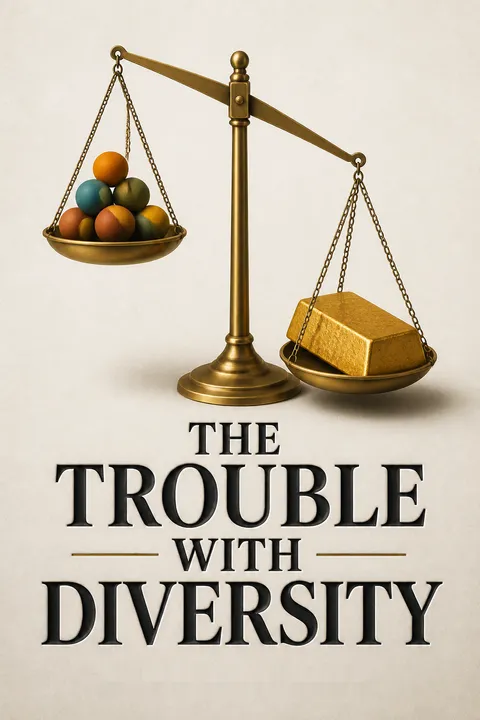
The central substitution. Michaels argues that American politics has learned to celebrate differences of race, sexuality, and heritage while evading differences in money. Identity frames difference as plural and valuable; poverty makes unequal resources a problem that demands explanation or change. The book's central claim is that identity became an appealing subject partly because it displaces class. As inequality widened, recognition and inclusion often took the place of demands to redistribute wealth.
Recognition is not enough. This is not an argument against civil-rights protections. It is an argument against treating inclusion as sufficient justice. A diverse boardroom can still pay low wages, and a poor person can be respected while lacking housing, health care, or choices. Michaels asks readers to judge diversity initiatives by what they change materially, not only by who is represented.
The distinction between representation and distribution gives the book its sharpest diagnostic tool. It is possible to widen access to institutions while leaving their power and rewards concentrated, a distinction obscured by headcounts alone. Yet the two goals are not necessarily rivals: representation can expose exclusion, while economic policy can address the unequal conditions beneath it. The useful question is not whether diversity matters, but whether a diversity initiative changes access, resources, decision-making power, or only the institution's public image.
Race can organize lives without being a biological division
Classification without biology. Michaels contrasts Homer Plessy, whose one-eighth Black ancestry led Louisiana authorities to classify him as Black in 1896, with Susie Phipps, a light-skinned woman classified as Black on her birth certificate decades later. Their cases show that racial labels have depended on social rules, not a reliable visible boundary. The one-drop rule made ancestry decisive even when appearance did not.
Genes do not settle it. The book cites genetic research finding more variation within supposed racial populations than between them. Sickle-cell risk tracks ancestry from malaria-prone regions, not a uniform Black race; Tay-Sachs risk is associated with some Jewish populations and also with French Canadians. Michaels argues that race can remain socially consequential even when it fails as a biological taxonomy.
The distinction between biological categories and social classifications is essential: a category need not be genetically coherent to shape treatment, opportunity, or self-understanding. That distinction is especially useful in medicine, where ancestry may sometimes inform risk but broad racial labels can be poor substitutes for individual evidence. Michaels presses beyond this point toward abandoning racial identity altogether. The caution is that dismantling a category in theory does not automatically undo institutions that have organized resources and discrimination through it.
Question heritage claims that turn learned culture into inherited destiny
Culture is learned. Michaels argues that cultural identity cannot neatly replace biological race. People learn languages, music, and traditions; they do not inherit them through genes. In his classroom example, students who have never read Emerson or Frederick Douglass are still told that one author represents one group's heritage and the other represents another's. That assignment rests on identity, not on what the students have actually learned or experienced.
Belonging can be assigned. The same problem appears in claims that particular books or practices belong naturally to a racial group. A person can learn any language or enjoy any music without changing ancestry. Michaels calls attention to the gap between real inheritance, such as genes, and cultural inheritance, which requires teaching and practice. He questions whether culture can provide a stable definition of racial identity once biology has failed.
This critique catches a real conceptual slippage: ancestry, cultural practice, and personal identity are related, but they are not interchangeable. Treating a canon or art form as the natural property of a group can narrow who is permitted to claim it. Still, the absence of a fixed cultural essence does not make shared histories or institutions inconsequential. Practices can be learned while communities retain collective memories and face patterned treatment. The stronger lesson is to avoid turning cultural affiliation into a test of authenticity.
Do not let antiracism substitute for confronting poverty
The preferred victim. Michaels argues that public debate often focuses on people harmed by prejudice because discrimination is widely condemned, while poverty prompts harder questions about wages, ownership, and public policy. His account of Leo Frank, a Jewish factory superintendent lynched in Georgia, shows how a conflict over class could be retold mainly as a story of anti-Semitism. Frank earned far more than the young worker Mary Phagan, whose death sparked the case, but the class disparity became secondary in later memory.
Katrina's harder question. Michaels applies the same distinction to New Orleans: racial discrimination may shape who is poor, but people without money or transport would have been left vulnerable even in a society without racial prejudice. He argues that condemning racism does not, by itself, address the economic conditions that leave people exposed.
The distinction between discrimination and economic deprivation helps reveal why a society can make moral progress on prejudice without reducing material hardship. It also clarifies why one dramatic case can dominate public memory while routine exploitation remains less visible. The danger is treating these explanations as competing accounts. Racial discrimination can shape who is poor, where poverty is concentrated, and which communities receive protection. A rigorous diagnosis should ask both how bias operates and how economic arrangements create vulnerability.
Diverse elite campuses can make inherited advantage look earned
Representation can reassure. Michaels argues that a racially diverse university may appear meritocratic while remaining economically exclusive. In the book's 2016 afterword, more than half of Harvard students came from families earning over $125,000, while only 4 percent came from the bottom income quintile. The campus could become more diverse by race without becoming representative of the country's economic distribution.
The missing comparison. The point is not that racial representation has no value. It is that it can distract from the advantages that help students reach elite schools in the first place: family wealth, strong schools, tutoring, and other preparation. Michaels argues that visible diversity can reassure affluent students that admissions are fair, while the deeper role of inherited resources remains largely unexamined.
The example exposes a measurement problem: institutions often report demographic variety more readily than the economic composition of their students. Those measures answer different questions, and success on one can conceal failure on the other. The book's critique is most persuasive when directed at claims that representation proves fairness. It is less persuasive if read as a reason to abandon race-conscious remedies, since those may address barriers that class measures alone miss. A fuller audit would track race, income, access, and outcomes together.
Make equal opportunity real before declaring winners deserving
Opportunity starts early. Michaels argues that people cannot fairly be judged by effort or ability when family resources shape their chances from childhood. A wealthy family can buy access to better schools, private tutoring, and college preparation; local property taxes can also make school quality depend on neighborhood wealth. The advantage begins well before university admissions.
Change the starting conditions. A serious commitment to equal opportunity, he argues, would require more than scholarships or admissions preferences. It would mean funding schools more equally and confronting ways wealth passes advantages to children, including inheritance. Michaels points out that many people endorse hard work as the basis of success while also opposing taxes on inherited wealth. That tension matters because inheritance can preserve advantage without requiring the next generation to earn it.
Equal opportunity sounds modest, but the book shows how demanding it becomes once opportunity is traced back to childhood conditions. The argument shifts attention from individual choices to the institutions that distribute preparation and access. Its force depends on asking what counts as a fair starting point, a question that cannot be settled by test scores alone. Michaels's proposals, such as abolishing private schools, are deliberately sweeping; the broader principle is to judge merit only after examining how much inherited advantage helped produce it.
Use reparations to restore stolen wealth, not to promise equality
Restitution has a distinct aim. Michaels separates reparations from general poverty reduction. Reparations seek to compensate for past injustice and its continuing consequences; they do not necessarily reduce inequality across society. He compares the claim to returning property taken from Holocaust victims: present-day recipients need not have committed the original crime for restitution to be owed.
A useful thought experiment. Michaels imagines racial disparities in wealth being erased while the overall gap between rich and poor remains unchanged. The result would reduce racial inequality, but it would not make society economically equal. He does not say that this makes reparations worthless. Rather, he argues that restitution and a broader commitment to equal opportunity are separate principles, and neither should be mistaken for the other.
This distinction prevents a familiar confusion: repairing a specific injustice is not the same project as designing a fair distribution for everyone. A remedy can be justified even if it does not solve every inequality, and its limits do not invalidate its purpose. Michaels's thought experiment usefully asks what reparations are meant to accomplish. Its abstraction can understate how historical injustice shapes present institutions and resources, however. The strongest reading treats restitution as one obligation among several, not as a substitute for universal economic policy.
Protect languages without confusing cultural survival with social justice
Language is not a hierarchy. Michaels argues that languages are equally capable of serving their speakers, so the disappearance of one language is not automatically a question of justice. He describes Patrick Nudjulu, among the last speakers of Mati Ke, an Australian Aboriginal language. His grandchildren do not speak it, and his sister, the other remaining speaker, is someone he is culturally forbidden to speak with after puberty. The example shows that a culture can contain both a language and practices outsiders may judge harmful.
Identity is not a blank cheque. Michaels extends the question to deafness: if a cochlear implant reduces the need for sign language, is that loss of culture or a remedy for a disability? He challenges the idea that preserving identity is always preferable to changing conditions that cause hardship.
The passage forces a valuable distinction between protecting people from coercive assimilation and treating every inherited practice as beyond criticism. It also warns against measuring social justice by the survival of identities alone. But language loss can involve more than a neutral switch between equally useful tools: communities may lose control over education, public life, and transmission when a dominant language is imposed. The key question is whether people have meaningful freedom to maintain, change, or pass on a language, rather than whether a culture remains unchanged.
Debate religious beliefs as claims, not as identity badges
Belief invites disagreement. Michaels distinguishes religion from cultural identity. Cultural differences are often treated as equally valid expressions of who people are; religious beliefs make claims about what is true and how people should act. Christians who believe abortion is murder, for example, disagree with people who reject that claim. Calling the disagreement prejudice can obscure the actual dispute.
Public arguments need reasons. Michaels accepts that religious convictions belong in political debate, but argues that citing scripture will not persuade people who do not accept its authority. Debates about abortion or same-sex marriage require arguments that can be considered beyond one faith's revelation. The point is not to silence religious people, but to recognize that political decisions involve claims about truth and policy, not merely expressions of identity.
This distinction is a strong defense of open disagreement: respect for people does not require treating every proposition as equally true. It also makes religious debate more intelligible by separating protection from persuasion. Yet beliefs are often bound up with communities and histories, so describing them only as propositions can miss how political exclusion works. The useful standard is twofold: protect people from unequal treatment because of their faith, while allowing public arguments, religious or secular, to be challenged on their reasoning and consequences.
Build worker bargaining power, not just a more diverse executive class
Who gets the gains? In the 2016 afterword, Michaels turns from representation to workplace power. He notes that worker productivity and pay rose together for decades, then diverged after 1973: productivity kept increasing while typical pay flattened. He argues that the gains went increasingly to owners and executives rather than to the workers whose labor produced them.
Organize for leverage. The book contrasts diversity policies, which employers may readily accept, with union bargaining, which can raise labor costs. Michaels reports that in 2014 union members had a weekly median salary of $970, compared with $763 for nonunion workers. At his university, lecturers' pay rose from $30,000 to $37,500 after unionizing and negotiating a contract. He calls the gap between workers' contribution and compensation exploitation.
This ending supplies a concrete alternative to asking only who occupies prestigious positions: increase workers' capacity to negotiate over pay and conditions. It also explains why organizations may endorse diversity initiatives while resisting labor demands. The wage comparison is consistent with the book's argument, though a simple comparison cannot by itself isolate the effect of union membership from other differences between workers. The larger point remains: representation changes who can reach the top; bargaining power can change how much of the value created at work reaches everyone else.
Analysis
Michaels's most durable contribution is a test of political priorities: does a proposed remedy alter the distribution of money, security, and power, or mainly change who is recognized within existing institutions? That question exposes a real limit of symbolic inclusion. A company can celebrate employee identities while keeping wages low, and a university can diversify its student body while drawing overwhelmingly from families with substantial resources. The distinction helps explain why a politics can sound egalitarian yet leave economic hierarchy largely untouched.
The argument becomes less convincing when it treats identity and class as nearly interchangeable political choices. Race can be socially constructed and still shape access to jobs, housing, safety, and public resources. Its social reality is not disproved by the absence of a biological essence. Nor does the need for redistribution make recognition or antidiscrimination secondary in every setting. A worker may face exploitation and racial exclusion at once; remedies aimed at only one can leave the other intact.
The book is strongest as a critique of substitution, not as a case for replacing identity politics with class politics wholesale. Its own examples show that classifications can affect material outcomes, even as it warns that recognition can obscure them. The more complete standard is to assess justice on several levels: who is represented, who has access, who controls decisions, and who receives the gains from work and public investment. Michaels's challenge remains useful because it demands evidence of material change, not just affirmations of good intentions. Its limitation is that economic equality cannot be pursued well by ignoring the social categories through which inequality is often organized.
Review Summary
The Trouble with Diversity receives mixed reviews, with ratings ranging from 1 to 5 stars. Many readers appreciate Michaels' critique of diversity initiatives and his focus on economic inequality as the root cause of social injustice. Some praise his writing style and thought-provoking arguments. However, critics argue that he oversimplifies complex issues, dismisses the importance of racial discrimination, and lacks nuance in his analysis. Several reviewers note that while they agree with some of Michaels' points, they find his approach problematic or his solutions unrealistic.
People Also Read



Glossary
Neoliberalism
Market-centered account of fairnessMichaels uses neoliberalism for a political outlook that treats the market as the central mechanism for distributing rewards and tends to regard market-produced inequality as legitimate when formal discrimination is absent. In his account, antidiscrimination can fit comfortably within this outlook if it changes who competes without changing the economic structure that determines who gains.
Classism
Bias against poorer peopleIn the book, classism means prejudice, condescension, or disrespect directed at people because they are poor or working class. Michaels distinguishes it from poverty itself: ending classist behavior may improve how poor people are treated, but it does not give them more income, security, or access to resources.
Cultural identity
Belonging framed through cultureCultural identity is the idea that a person belongs to a group through shared practices, traditions, language, or heritage. Michaels questions whether it can provide a stable replacement for biological race, because culture is learned, changes over time, and does not belong exclusively to people assigned to a particular ancestry.
Indigenism
Politics of indigenous identityIndigenism is a political movement and framework centered on the identity, rights, and cultural survival of Indigenous peoples. Michaels contrasts it with socialism: one may seek to protect ancestral practices and distinct identity, while the other advances an economic program. The two can overlap, but cultural continuity is not itself equivalent to challenging market inequality.
Equality of opportunity
Fair access to life chancesEquality of opportunity is the principle that people should have a fair chance to develop their abilities and pursue success, regardless of the family advantages or disadvantages into which they are born. Michaels argues that taking this principle seriously would require confronting unequal schools and inherited wealth, not simply declaring that competition is open to everyone.
Exploitation
Work underpaid relative to valueIn the afterword, Michaels uses exploitation to describe a situation in which workers are paid less than the value their labor generates, with the difference accruing to owners or executives. He distinguishes this from discrimination: removing race or gender barriers can broaden access to jobs without changing the unequal division of the gains those jobs produce.
FAQ
What's The Trouble with Diversity about?
- Critique of Diversity Focus: Walter Benn Michaels argues that the American focus on diversity overshadows the more pressing issue of economic inequality. He suggests that society prefers celebrating cultural differences over confronting class disparities.
- Race vs. Class: The book emphasizes that discussions about race and identity distract from the real problem of economic inequality. Michaels posits that focusing on racial identity allows people to ignore the growing wealth gap.
- Historical Context: Michaels traces the evolution of diversity, linking it to the struggle against racism, and argues that it has become a way to avoid addressing class issues. The Supreme Court's ruling in Bakke v. Board of Regents is highlighted as pivotal in this shift.
Why should I read The Trouble with Diversity?
- Challenging Conventional Wisdom: The book challenges widely accepted beliefs about race and diversity, making it a thought-provoking read for those interested in social justice. It encourages readers to rethink their understanding of identity politics.
- Insightful Analysis: Michaels provides a critical analysis of how the focus on diversity has become a substitute for addressing economic inequality. His arguments are supported by historical examples and current events.
- Relevance to Current Issues: The themes are highly relevant today, as discussions about race, identity, and economic disparity continue to dominate public discourse. The book offers a deeper understanding of these complex issues.
What are the key takeaways of The Trouble with Diversity?
- Diversity as Distraction: The book argues that celebrating diversity often distracts from the more significant issue of economic inequality. Michaels asserts that focusing on identity politics allows society to ignore the growing wealth gap.
- Racial Identity vs. Economic Reality: Michaels emphasizes that racial identity is often treated as more significant than economic status, leading to a misunderstanding of social dynamics. He suggests that real societal divisions are economic rather than racial.
- Call for Economic Equality: The author advocates for shifting focus from cultural diversity to economic equality, arguing that true social justice requires addressing wealth disparities.
What are the best quotes from The Trouble with Diversity and what do they mean?
- “We love race, and we love the identities to which it has given birth.”: This quote highlights the paradox of American society's fascination with racial identity while ignoring underlying economic issues. It suggests that celebrating diversity can be superficial.
- “Celebrating the diversity of American life has become the American left’s way of accepting their poverty.”: Michaels critiques the left's focus on identity politics as a way to sidestep economic inequality. This underscores the idea that acknowledging cultural differences does not address poverty's root causes.
- “The commitment to diversity has redefined the opposition to discrimination as the appreciation of difference.”: This reflects Michaels' argument that the focus on diversity has shifted the conversation from addressing inequality to merely celebrating differences.
How does The Trouble with Diversity address the concept of race?
- Race as a Social Construct: Michaels argues that race is not a biological fact but a social construct used to categorize people. He emphasizes that the scientific basis for racial categories has been discredited.
- One-Drop Rule: The book discusses the historical context of the one-drop rule, illustrating how arbitrary and socially constructed racial categories can be.
- Racial Identity vs. Economic Class: Michaels posits that discussions about race often overshadow the more critical issue of economic class, allowing society to ignore economic inequality realities.
What is Walter Benn Michaels' stance on affirmative action in The Trouble with Diversity?
- Affirmative Action Critique: Michaels critiques affirmative action as prioritizing racial diversity over addressing economic inequality. He argues it often benefits those already privileged rather than the truly disadvantaged.
- Diversity vs. Equality: The author suggests that affirmative action reinforces the idea that racial identity is more important than economic status, potentially perpetuating inequality.
- Cultural Capital: Michaels discusses how affirmative action can lead to a superficial understanding of diversity, where institutions celebrate cultural differences without addressing underlying economic disparities.
How does The Trouble with Diversity relate to contemporary social issues?
- Relevance to Current Discourse: The book's themes are highly relevant to ongoing discussions about race, identity, and economic inequality in America. Michaels' critique of diversity resonates with current debates about social justice.
- Economic Inequality: As the wealth gap continues to widen, Michaels' arguments about the need to address economic disparities become increasingly important.
- Identity Politics: The rise of identity politics makes Michaels' critique of the focus on diversity particularly timely. His call for a return to discussions about class and economic equality challenges readers to rethink their perspectives.
What are the implications of The Trouble with Diversity for social justice movements?
- Shift in Focus: Michaels argues that social justice movements should prioritize economic equality over cultural diversity. This shift could lead to more effective strategies for addressing poverty and inequality.
- Unity Among Classes: By emphasizing class over race, the book suggests that social movements could unite people across different backgrounds in the fight against economic injustice.
- Critique of Liberalism: The book critiques contemporary liberalism for its focus on identity politics, suggesting it has become a way to avoid addressing deeper economic issues.
How does The Trouble with Diversity redefine the conversation around identity?
- Identity as a Distraction: Michaels argues that the focus on identity often distracts from the more significant issue of economic inequality. Discussions about identity should not overshadow the need for economic justice.
- Cultural vs. Economic Identity: The book emphasizes that cultural identity is often celebrated while economic identity is ignored, highlighting the need to address economic disparities in identity discussions.
- Rethinking Identity Politics: Michaels calls for a rethinking of identity politics, advocating for a focus on class and economic equality instead.
What solutions does The Trouble with Diversity propose for addressing inequality?
- Focus on Economic Equality: Michaels advocates for shifting focus from cultural diversity to economic equality as the primary goal of social justice movements.
- Policy Changes: The book suggests policies should prioritize economic equality, such as equitable funding for education and healthcare.
- Collective Action: Michaels emphasizes the importance of collective action in addressing economic inequality, uniting across racial and cultural lines.
How does The Trouble with Diversity address the concept of economic inequality?
- Focus on Class Disparities: Michaels emphasizes that economic inequality is a more pressing issue than identity politics, often overshadowed by discussions about race and gender.
- Critique of Meritocracy: The book challenges the notion of meritocracy, suggesting it often ignores systemic barriers faced by the poor.
- Call for Structural Change: Michaels advocates for structural changes in society to address economic inequality, such as equitable education funding and wealth redistribution.
How does The Trouble with Diversity challenge the idea of multiculturalism?
- Multiculturalism as a Distraction: Michaels argues that multiculturalism can distract from addressing economic inequality, suggesting that celebrating cultural diversity does not necessarily lead to social justice.
- Critique of Cultural Identity: The book challenges the notion that cultural identity should be prioritized over economic issues, suggesting that focusing on cultural differences can obscure class disparity.
- Call for Economic Justice: Michaels advocates for shifting focus from multiculturalism to economic justice, believing that addressing economic inequality is essential for achieving true social equity.
Download PDF
Download EPUB
.epub digital book format is ideal for reading ebooks on phones, tablets, and e-readers.








