

Key Takeaways
Treat great-power rivalry as a long contest between peace and war
The dangerous middle. Brands uses “long-term competition” for an open-ended contest among powerful states that falls between peace and all-out war. Rivals may cooperate on shared problems while competing for influence, and their choices interact: each side tries to steer the other toward costs and risks it can better bear. The contest spans military power, economics, diplomacy, intelligence, and political ideas, all under limited resources.
Patience under pressure. The Cold War shows why the work is slow and uncertain. Washington had to contain Soviet expansion without triggering nuclear war, sustain commitments without exhausting itself, and strengthen its own society as well as its position abroad. History offers lessons, Brands argues, not a ready-made script: today’s rivalries differ, but the strategic dilemmas are recognizable.
What's useful is the refusal to treat peace and war as the only two settings of international life. Competition can intensify without becoming combat, which makes routine choices about trade, alliances, and information strategically consequential. The framing also discourages the comforting fiction that a crisis is an isolated episode. Its limitation is that a broad definition can make almost any disagreement look like rivalry. Distinguishing sustained contests over power from ordinary friction remains essential, or the concept itself can encourage overreaction.
Keep strategy clear in direction, flexible in application
Containment was assembled. Containment, the strategy of checking Soviet expansion while avoiding a direct war, did not begin as a complete blueprint. George Kennan argued that Moscow could be deterred, that Soviet rule contained serious internal weaknesses, and that a prosperous, cohesive noncommunist world mattered more than matching the USSR everywhere. Truman's early policies reflected that selectivity, emphasizing recovery in Western Europe and Japan.
Events forced adaptation. The strategy changed as crises accumulated. The Soviet blockade of Berlin, the Communist victory in China, the Soviet atomic test, and North Korea's invasion of the South helped shift containment toward a global, militarized policy under NSC-68. Kennan disliked the transformation, but a strategy that could change while retaining its basic aim survived across presidencies. Its gradual pace looked indecisive in the moment, yet avoided both appeasement and a disastrous showdown.
This is a strong model of strategy as a durable hypothesis, not a frozen checklist. In complex systems, rules that preserve a goal while permitting local adjustment can survive shocks better than detailed plans built for one forecast. The story also shows why apparent inconsistency is not always failure: commitments may shift because adversaries, allies, or technology change the problem. The hard question is what must remain constant. Without clear priorities, flexibility becomes improvisation with a strategic label.
Make allies stronger, even when the balance sheet looks worse
Strength through reconstruction. A milieu strategy means shaping the wider international environment so an opponent has fewer opportunities and less leverage. The United States used this approach to build a stronger noncommunist community. The Marshall Plan provided about $13 billion in aid, while U.S. policy helped revive Japan, support European integration, and establish institutions for trade and finance. Washington even accepted measures that benefited allies more immediately than itself, including lower U.S. tariffs.
Security joined prosperity. NATO and other alliances reassured vulnerable states, deterred Soviet pressure, and helped former rivals such as France and West Germany cooperate. Economic recovery, security guarantees, and democratic institutions reinforced one another. The coalition remained full of disputes and resentment, but U.S. leaders generally treated compromise and consultation as the price of keeping it together. The competitive payoff was a more capable group of allies, not simply a larger American share of wealth or power.
The coalition strategy resembles risk pooling: members accept uneven short-term costs because a more resilient group is better able to absorb shocks. It also challenges the idea that leadership means extracting the largest immediate concession. Institutions and recurring consultation made U.S. power more acceptable by giving allies ways to shape decisions. Yet the arrangement was not automatically benevolent. It depended on Washington's judgment about whose interests counted and sometimes imposed unequal burdens. Durable leadership requires both a shared purpose and room for partners to disagree.
Exploit asymmetry, but never confuse military leverage with safety
Different strengths, different risks. The United States and Soviet Union had unlike advantages. America had greater industrial and technological capacity, while Moscow's position in Eurasia gave it powerful local advantages. Early U.S. policy leaned on its atomic monopoly; later, Truman expanded conventional forces, and Eisenhower's New Look relied heavily on nuclear deterrence to keep defense affordable. Each approach gained leverage but left vulnerabilities.
The balance kept shifting. Mutual assured destruction, or MAD, described a situation in which each superpower could inflict devastating damage after being attacked. It reduced incentives for nuclear war, but it also made threats to use nuclear weapons less credible in limited conflicts. In the 1970s, Soviet arms growth seemed to narrow U.S. options. U.S. planners responded by steering competition toward precision weapons, sensors, and other technologies that exploited American advantages. Greater leverage, however, could also make an anxious opponent feel less secure.
The chapter's central tension resembles a control problem: a threat must be credible enough to deter, yet restrained enough not to trigger the catastrophe it is meant to prevent. That is not a puzzle with a clean technical solution, because leaders interpret signals through fear, doctrine, and imperfect information. Asymmetric competition can reduce costs, but it may also move danger into less visible domains or provoke countermeasures. The useful question is not simply which side has more power, but what each side believes it can safely do with it.
Pace the contest; peripheral overreach can drain power everywhere
Vietnam exposed the cost curve. U.S. leaders feared that losing in Vietnam would damage American credibility elsewhere, then escalated a war whose political foundations in South Vietnam remained weak. More than 500,000 U.S. troops served there. The intervention failed to reform the Saigon government, break North Vietnam's will, or end the conflict at an acceptable cost. One estimate put U.S. spending at $9.60 for every dollar of damage inflicted on North Vietnam.
Recovery required restraint. The war consumed resources, divided the country, and weakened U.S. influence elsewhere. In the 1970s, post-Vietnam caution sometimes swung too far toward inaction. Later policy sought to limit direct U.S. exposure, use regional partners, and support insurgencies against Soviet overextension without repeating a mass deployment. The broader lesson is to distinguish a rival's challenge from a vital interest, and to avoid treating every setback as a test that must be answered at any price.
Vietnam illustrates a familiar decision trap: once leaders define an outcome as a test of credibility, the costs of continuing can seem smaller than the reputational cost of stopping. That logic can make sunk costs masquerade as strategy. A more useful test asks whether a commitment is producing the political result it was meant to secure, not whether more effort might redeem earlier effort. Still, restraint is not costless. Pulling back can unsettle allies, so pacing requires prioritization and credible alternatives, not merely fewer commitments.
Attack authoritarian weaknesses without promising rescue you cannot deliver
Political warfare works in many forms. Brands uses “political warfare” for actions short of war that pursue national aims through diplomacy, economic pressure, propaganda, covert support, or help for resistance movements. U.S. efforts included Radio Free Europe, support for independent-minded Yugoslavia, and attempts to exploit tensions between China and the Soviet Union. The opening to China, after years of estrangement, turned their rivalry into a major strategic advantage for Washington.
Encouragement has consequences. Early efforts to spark armed resistance behind the Iron Curtain failed. In 1956, broadcasts around the Hungarian uprising encouraged hopes of Western help that never came; Soviet forces crushed the revolt. Later, support for Poland's Solidarity movement helped preserve opposition under martial law. Engagement also mattered: trade, travel, and the Helsinki human-rights process exposed communist failures and created openings for dissent. These tools could weaken adversaries, but they could also provoke repression, alienate allies, or endanger people who expected rescue.
The distinction between support and rescue is ethically and strategically crucial. External actors can amplify local opposition, but they rarely control its timing, goals, or vulnerability to repression. That asymmetry makes promises especially dangerous: a broadcast or covert signal may be interpreted as a guarantee even when policymakers intend only encouragement. The section also suggests that influence can accumulate through ordinary channels, not just dramatic operations. Political pressure is most defensible when local agency remains central and the sponsor is honest about the limits of its commitment.
Negotiate to shape competition, not to pretend it has disappeared
Cooperation had a strategic purpose. Cold War leaders used diplomacy to reduce the risk of nuclear catastrophe, resolve crises, and address shared problems. After the Cuban Missile Crisis, Washington and Moscow established a hotline and pursued arms agreements; they also cooperated on smallpox eradication and nuclear nonproliferation. Such steps did not erase the rivalry, but they reduced some of its dangers.
A settlement needs leverage and an exit. Détente, the 1970s effort to ease U.S.-Soviet tensions, brought agreements and more contact, but its promise of restraint could not overcome incompatible goals. Reagan's later approach combined pressure with reassurance. George H. W. Bush similarly backed German reunification in NATO while giving Moscow a role in negotiations and room to accept the outcome. The Cold War ended on favorable terms for the United States, but the Soviet leadership needed a way to retreat without appearing simply humiliated.
Negotiation is not the opposite of competition; it is one way to manage its risks and convert power into durable agreements. The endgame underscores a bargaining insight: an opponent that sees only surrender or escalation may choose escalation, even when badly positioned. Face-saving language can therefore serve a hard strategic purpose without changing the underlying balance. But reassurance can be misread as weakness, and concessions can reward aggression. Effective diplomacy depends on making both the costs of refusal and the benefits of restraint credible.
Build intelligence through technology, expertise, debate, and repeated contact
Secrecy demanded substitutes. Early U.S. intelligence had few reliable sources inside the Soviet Union and often lacked basic facts about its forces. Washington compensated with signals intelligence and aerial reconnaissance. U-2 flights helped disprove the supposed Soviet bomber gap; satellite imagery later improved estimates of Soviet missiles. These tools reduced the risk that a show of Soviet strength or a mistaken estimate would dictate U.S. policy.
Knowledge came from a wider ecosystem. Government analysts, universities, think tanks, defectors, and allied services all contributed to Sovietology, the multidisciplinary study of Soviet society and politics. The community made serious errors, including misjudging the size of the Soviet economy and sometimes underestimating Moscow's ambitions. Its value lay not in perfect prediction but in gathering evidence over time, debating interpretations, and correcting some mistakes. No single report could explain the rival; cumulative knowledge made better decisions possible.
The intelligence story is a lesson in triangulation. Technical sensors can count objects, while historians, economists, linguists, and diplomats help explain what those objects mean. Independent analysts are valuable not because they guarantee truth, but because they expose hidden assumptions and make correction possible. The repeated errors also warn against confusing precision with understanding: a reliable missile count cannot reveal a leader's intentions. Good intelligence should make decisions more informed, not create the illusion that uncertainty has been eliminated.
Organize for competition without giving government unchecked command
A state built over time. The National Security Act of 1947 created the basic postwar framework, including the National Security Council, CIA, and a reorganized Defense Department. The arrangement remained awkward, with agencies and military services competing for influence. Small offices such as the State Department's Policy Planning Staff and the Pentagon's Office of Net Assessment helped inject long-range thinking into a bureaucracy often consumed by immediate crises.
Pluralism had strategic value. The United States also built institutions for public diplomacy and coordination, including the United States Information Agency and the Active Measures Working Group, which helped expose Soviet disinformation. These bodies were imperfect and sometimes ineffective, but debate and oversight could challenge bad assumptions and preserve public consent. Presidential power grew sharply during the Cold War, yet Congress periodically pushed back, especially after Vietnam. Organization was not a one-time design; it required repeated adjustment.
The account treats institutional friction as both a cost and a safeguard. In organizational terms, overlapping authorities can slow action, but they can also create independent checks on a single office's assumptions. That benefit depends on institutions sharing information and resolving disputes before a crisis. The danger runs in both directions: unchecked executive action can damage democratic legitimacy, while oversight designed in reaction to one abuse can disable useful capabilities. The practical aim is not maximum centralization, but coordination that remains answerable to elected citizens.
Strengthen your own society, because rivalry exposes domestic failure
The home front was part of the contest. The Cold War threatened to turn the United States into a militarized garrison state. McCarthyism showed how fear of internal enemies could damage civil liberties and public debate. Yet the rivalry also intensified pressure to confront racial segregation, which undermined America's claims to represent freedom. Federal civil-rights measures gained force partly because discrimination damaged U.S. credibility abroad.
Investment created lasting capacity. Cold War funding helped expand universities, scientific research, and industries that supported both defense and civilian innovation. The United States maintained a largely open society while building substantial military power, though not without costs or contradictions. Brands' broader point is that domestic vitality is not separate from national strength. A system that cannot acknowledge its failures, educate its people, or sustain public consent may weaken itself more effectively than an adversary can.
This is the book's most consequential systems argument: internal reform can function as foreign policy because legitimacy, innovation, and social cohesion affect a country's ability to compete. External pressure sometimes made neglected domestic contradictions harder to ignore. That does not mean geopolitical rivalry reliably produces progressive reform; it can equally license scapegoating and repression. The difference depends on political choices and institutions capable of turning exposure into correction. Competition tests a society, but the test itself does not determine whether the society improves.
Analysis
Brands' central achievement is to replace a victory myth with a history of adaptation. Containment appears not as Kennan's finished design but as a contested strategy revised by shocks, domestic politics, allied demands, and changing technology. This matters because it makes the Cold War useful as a repertoire of dilemmas rather than a template to copy. The narrative's strongest thread is the interaction between external competition and internal capacity: rebuilding allies, funding research, confronting racial injustice, and learning about the Soviet system all altered the strategic balance.
The book also resists simple explanations of victory. Military pressure mattered, but so did the free world's economic appeal, the Soviet system's structural weakness, local resistance, and Gorbachev's decisions. Its account of the endgame is especially instructive: American leverage made Soviet retreat consequential, while tact and diplomatic respect made retreat possible. This combination complicates both triumphalist claims that pressure alone won and accounts that credit diplomacy alone.
A useful caution follows from the same history. The Soviet collapse was not a controlled policy outcome. U.S. leaders did not foresee the speed or exact form of the breakup, and a collapse of a nuclear-armed state could have produced risks quite different from the peaceful European transition. Strategic pressure can expose an adversary's weaknesses, but it cannot guarantee that the resulting change will be orderly or favorable. Nor does a Cold War analogy settle how to treat rivals whose economies and societies are deeply connected to America's.
The book's most transferable advice is therefore procedural: define a theory of success, build coalitions, study opponents, preserve domestic legitimacy, and adjust when evidence changes. Its most important warning is against confusing commitment with stubbornness. A democratic strategy must be forceful enough to compete, restrained enough to endure, and flexible enough to recognize when the costs of a policy are defeating its purpose.
Review Summary
The Twilight Struggle receives mixed reviews, with an average rating of 4.03 out of 5. Positive reviews praise its insightful analysis of Cold War strategies and their relevance to current geopolitical challenges. Critics appreciate Brands' thorough research and application of historical lessons to modern conflicts with China and Russia. However, some readers find the writing style dry and academic, with occasional pacing issues. Overall, reviewers consider it a valuable resource for understanding great power competition, despite its demanding content.
People Also Read




Glossary
Long-term competition
Open-ended great-power rivalryAn ongoing contest for influence between powerful states that occupies the uncertain space between peace and war. It can include limited conflict, cooperation on shared problems, and competition across military, economic, diplomatic, informational, and ideological domains. Because resources are finite and each side reacts to the other, it requires prioritization, adaptation, and sustained effort.
Containment
Check expansion without general warThe U.S. strategy of resisting Soviet expansion while avoiding a direct, all-out war. George Kennan's original conception emphasized selective counterpressure, rebuilding a healthy noncommunist world, and exploiting the Soviet system's internal weaknesses. In practice, containment changed substantially as events altered perceived risks, becoming more global and militarized while retaining its basic aim.
Milieu strategy
Shape the wider competitive settingA strategy that changes the broader international environment rather than focusing only on direct action against a rival. During the Cold War, the United States strengthened the noncommunist world through economic recovery, security arrangements, and political cooperation. The resulting prosperity and cohesion constrained Soviet opportunities and made the opposing system less attractive by comparison.
New Look
Economical deterrence through nuclear powerThe Eisenhower administration's Cold War defense strategy, designed to sustain competition without the expense of permanently enlarged conventional forces. It relied on allied forces, a smaller U.S. military, and the threat of powerful nuclear retaliation to deter major aggression. The strategy avoided some costly interventions but left difficult questions about credibility, escalation, and the protection of exposed allies.
Flexible Response
Offer graduated military choicesA strategy associated with the Kennedy and Johnson administrations that sought more military options than the New Look's reliance on nuclear retaliation. It aimed to strengthen conventional defenses, respond to limited conflicts, and create intermediate choices before nuclear escalation. Its central difficulty was whether leaders could actually control escalation once nuclear weapons entered a conflict.
Mutual assured destruction (MAD)
Mutual vulnerability deters nuclear warA condition in which both superpowers possess the ability to inflict catastrophic destruction on the other, even after suffering a first strike. The expectation of unacceptable retaliation was intended to deter nuclear attack. In Brands' account, this logic could lower the risk of all-out nuclear war while weakening the credibility of threats intended to defend allies against limited aggression.
Political warfare
Influence efforts short of warThe use of national instruments short of open war to advance political aims. The book includes diplomacy, economic measures, propaganda, covert operations, and support for opposition movements. Such efforts could exploit authoritarian repression, fracture rival alliances, or raise the costs of expansion. They could also provoke retaliation, harm local populations, and create expectations of support the sponsor would not fulfill.
Détente
Managed easing of superpower tensionsThe 1970s effort to reduce U.S.-Soviet tensions through arms-control agreements, expanded economic and diplomatic contact, and attempts to moderate competition. Détente helped manage risks and gave the United States room to recover, but it did not reconcile the superpowers' incompatible aims. Its limits became clear as rivalry continued in military competition and the developing world.
Sovietology
Multidisciplinary study of Soviet societyThe U.S. academic and policy field devoted to understanding Soviet politics, economics, history, society, and ideology. It linked universities, government agencies, think tanks, foundations, and specialists with relevant language skills or personal experience. Its practitioners made substantial errors, but the field expanded expertise, supplied competing interpretations, and helped policymakers assess long-term Soviet strengths and weaknesses.
FAQ
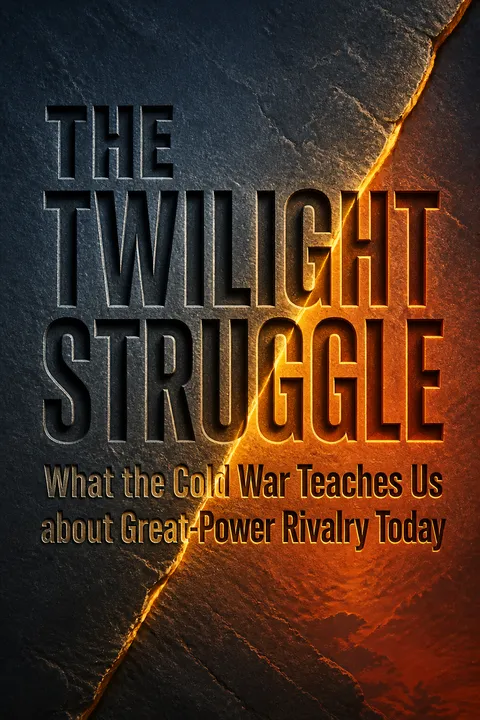
What is The Twilight Struggle: What the Cold War Teaches Us about Great-Power Rivalry Today by Hal Brands about?
- Comprehensive Cold War analysis: The book examines the Cold War as a prolonged, multifaceted rivalry between the United States and the Soviet Union, covering military, economic, ideological, and intelligence dimensions.
- Lessons for modern competition: Hal Brands draws direct parallels between the Cold War and current U.S. competition with China and Russia, arguing that great-power rivalry is a recurring feature of world politics.
- Strategic and institutional focus: The narrative highlights how the U.S. built alliances, developed new institutions, and adapted its strategies to manage long-term competition.
- Enduring relevance: Brands uses the Cold War as a lens to offer practical lessons for today’s policymakers, emphasizing the importance of learning from history to navigate contemporary challenges.
Why should I read The Twilight Struggle by Hal Brands?
- Insight into great-power rivalry: The book provides a deep understanding of how the U.S. managed a decades-long competition, offering context for today’s geopolitical challenges.
- Balanced perspective: Brands explores the tension between maintaining democratic values and waging effective competition, showing how the U.S. avoided becoming a garrison state.
- Actionable lessons: The book distills Cold War experiences into practical guidance for current policy, especially regarding alliances, escalation management, and strategic focus.
- Rich historical narrative: Drawing on extensive research, the book goes beyond clichés, making it essential for students, scholars, and practitioners of international relations.
What are the key takeaways from The Twilight Struggle by Hal Brands?
- Containment as a model: The Cold War strategy of containment combined clarity with flexibility, showing that gradual, steady policies can yield transformative results.
- Importance of alliances: Building and managing a coalition of free nations was central to U.S. success, amplifying American strength and legitimacy.
- Asymmetric competition: The U.S. leveraged technological, economic, and political advantages to impose costs on the Soviet Union, especially in military and Third World arenas.
- Values as assets: Promoting democracy and human rights was both a moral imperative and a strategic weapon that exposed Soviet weaknesses.
How does Hal Brands define "long-term competition" in The Twilight Struggle?
- Ongoing, open-ended rivalry: Long-term competition is a sustained contest for influence between great powers, existing in a twilight between peace and war.
- Multidimensional and interactive: It involves military, economic, ideological, and political dimensions, requiring strategic choices about resource allocation.
- Incremental and patient: Success comes from patience, flexibility, and exploiting opportunities over decades, rather than seeking quick victories.
- Systems contest: The rivalry is as much about the strength of political, social, and economic systems as about statecraft and military power.
What is the Cold War strategy of containment according to Hal Brands?
- Flexible and evolving: Containment was not a rigid blueprint but an adaptable strategy to prevent Soviet expansion without provoking all-out war.
- Strategic virtues: It combined incremental methods with transformative goals, focusing on rebuilding the West and exploiting Soviet weaknesses.
- Political legitimacy: The Truman administration fused geopolitics and ideology to legitimize containment, emphasizing the defense of freedom.
- Bipartisan support and criticism: While bipartisan backing was crucial, the strategy faced significant controversy and debate.
How did the United States build "situations of strength" during the Cold War, as described by Hal Brands?
- Coalition-building: The U.S. created a cohesive Western community anchored in economic prosperity, security alliances, and democratic values.
- Economic and security integration: Initiatives like the Marshall Plan and NATO revived and protected key regions, fostering cooperation and reducing conflict risk.
- Asymmetric concessions: The U.S. made strategic concessions to allies to strengthen the entire bloc and maintain unity.
- Democracy as strategy: Promoting democracy was both a moral and strategic advantage, making allies more reliable and peaceful.
What were the main challenges and strategies of competing in the nuclear shadow, according to The Twilight Struggle?
- Nuclear paradox: The destructive power of nuclear weapons made direct war unthinkable, complicating deterrence and strategy.
- Evolving military doctrine: U.S. strategy shifted from atomic monopoly to flexible response and military buildup, adapting to changing realities.
- Balancing stability and advantage: The U.S. had to manage the tension between avoiding nuclear war and seeking strategic advantage.
- Exploiting Soviet weaknesses: Ultimately, the U.S. won by leveraging economic and technological superiority over the Soviet Union.
How did the United States contest the Third World periphery during the Cold War, according to Hal Brands?
- Complex battlegrounds: The most intense Cold War struggles occurred in developing regions marked by instability and decolonization.
- Moral and strategic dilemmas: The U.S. often faced tough choices between supporting self-determination and containing communism, sometimes backing authoritarian regimes.
- Costly commitments: Interventions like Vietnam highlighted the difficulties and failures of U.S. strategy in the periphery.
- Strategic recovery: By the 1980s, the U.S. adapted by limiting liabilities, promoting democracy, and using proxies to impose costs on the Soviet Union.
What role did political warfare play in the Cold War, according to The Twilight Struggle by Hal Brands?
- Broad definition: Political warfare included propaganda, covert support for dissidents, economic measures, and efforts to divide the Communist bloc.
- Targeting internal weaknesses: The U.S. exploited Soviet vulnerabilities and bloc tensions, especially after the Sino-Soviet split.
- Moral and strategic dilemmas: Political warfare involved risks of escalation, working with unsavory allies, and managing alliance politics.
- Significant impact: Despite setbacks, political warfare contributed to the eventual weakening of Soviet power.
How did the U.S. intelligence community contribute to Cold War strategy in The Twilight Struggle?
- Decentralized and pluralistic: The U.S. intelligence community fostered debate and honest analysis, integrating multiple agency perspectives.
- Technological superiority: Advances in signals intelligence, satellite reconnaissance, and codebreaking provided critical insights into Soviet capabilities.
- Intellectual ecosystem: Academic and think-tank research on the Soviet Union complemented classified intelligence and informed policy.
- Learning and adaptation: The community learned from interaction and self-corrected after errors, maintaining analytical integrity.
How did the U.S. organize its government and institutions for Cold War competition, according to Hal Brands?
- National security state creation: The National Security Act of 1947 established key institutions like the Department of Defense, CIA, and NSC for coordinated action.
- Balancing centralization and pluralism: The system encouraged debate and prevented overcentralization, fitting American political culture.
- Strengthening executive authority: Presidential power expanded for crisis management, while Congress maintained oversight.
- Specialized agencies: Institutions like the USIA and Peace Corps addressed specific aspects of the rivalry, from propaganda to development aid.
What was the role of ideology and values in the Cold War, according to The Twilight Struggle by Hal Brands?
- Central to the contest: The Cold War was fundamentally a battle between democracy and totalitarianism, with U.S. leaders emphasizing moral superiority.
- Democracy’s resilience: The U.S. avoided becoming a garrison state, using the rivalry to drive reforms in civil rights, education, and economic growth.
- Civil rights and global image: Addressing racial injustice was partly motivated by the need to maintain credibility in the Third World.
- Values as strategic assets: Promoting democracy and human rights strengthened the free world and exposed Soviet weaknesses.
About the Author
Other books by Hal Brands
Download PDF
Download EPUB
.epub digital book format is ideal for reading ebooks on phones, tablets, and e-readers.








