

Key Takeaways
Call a policy rational only when credible theory meets open deliberation.
Two conditions. Mearsheimer and Rosato define strategic rationality as a policy grounded in a credible explanation of how international politics works and produced through deliberation among key policymakers. A credible theory guides leaders through an uncertain situation; deliberation lets decision makers compare options and settle on a policy. Either condition alone is insufficient: an evidence-based idea imposed without debate, or an open debate ending in a baseless strategy, fails their test.
A disputed application. The authors argue that Russia’s 2022 invasion of Ukraine met both conditions. They interpret the Kremlin’s reasoning as a balance-of-power response to Western ties with Ukraine, and they argue that key Russian officials shared the security concern and participated in the decision process. This is their assessment of the reasoning and process, not a claim that the invasion was justified or successful.
The definition makes a useful distinction between judging how a decision is reached and judging what it does. That separation helps prevent a bad result from automatically becoming evidence of foolish thought. But the Russia example also shows how much turns on contested judgments: what counts as a credible theory, and how much evidence establishes real deliberation inside an authoritarian government? The label can clarify analysis only if its criteria are applied symmetrically to allies and adversaries, and if claims about private decision processes remain appropriately cautious.
When probabilities are unknowable, reason with theories, not pretend precision.
Risk is not uncertainty. In a risk situation, the possible outcomes are unclear but their odds can be calculated, as with a fair die or an insurer’s large body of data. In international politics, leaders often lack reliable information about another state’s intentions, military performance, or willingness to fight. The authors call this uncertainty: decision makers cannot objectively calculate the probabilities required by expected utility maximization, a method that compares options by assigning values and odds to possible outcomes.
Use explanations instead. The authors argue that policymakers must still choose, so credible theories provide a better guide than invented precision. After the Cold War, for example, U.S. leaders faced uncertain futures for China, Russia, and Japan, and debated engagement, containment, or withdrawal without knowing how each choice would play out.
The distinction resembles a basic lesson in decision science: a precise number is not necessarily a more informative judgment. Forecasting can still help when estimates are calibrated and updated, but its value depends on how much the evidence supports the probabilities. The book’s emphasis on theory adds a way to identify which facts matter and how they might connect. Its danger is the mirror image of false precision: leaders can become so attached to a theory that they reinterpret contrary evidence as an exception instead of a warning.
Test each theory's assumptions, causal logic, and evidence before trusting it.
Three credibility tests. A theory is a simplified explanation of how some part of the world works. The authors judge it credible when its assumptions reasonably describe reality, its causal logic explains how one factor produces another without major contradictions, and substantial evidence supports its claims. A theory need not explain every case: simplification is useful precisely because it leaves some details out, though those omissions can matter in a particular situation.
More than one can qualify. Balance-of-threat theory, which expects states to respond to powerful rivals they perceive as dangerous, and democratic peace theory, which argues that democracies rarely fight one another, are examples the authors treat as credible. They stress that historical evidence is often ambiguous, so international relations can contain several credible, competing explanations rather than one final formula.
This standard treats theories as more than slogans: it asks whether their starting points, mechanisms, and evidence cohere. That is a strong defense against policies built on appealing but unsupported stories. It also demands intellectual humility. Historical cases are not controlled experiments, and scholars can disagree about what the evidence shows, as the book’s own debates over major wars demonstrate. A practical safeguard is to ask what evidence would change a theory’s application, not merely what evidence can be made to fit it.
Make room for real dissent, then give someone authority to decide.
Debate plus decision. State rationality concerns how policymakers’ views become government policy. The authors require robust, uninhibited debate in which decision makers can challenge one another without coercion, deception, or suppressed information. They also require a final choice by an ultimate decider. Debate without a decision leaves the state without a policy; a decision made by silencing dissent is not deliberative.
Cuba as an example. During the 1962 Cuban Missile Crisis, President Kennedy’s advisers debated military attacks and a coercive naval blockade. The group remained divided, even as members gathered information and argued over Soviet proposals. Kennedy eventually chose a settlement that included a U.S. promise not to invade Cuba and a less public agreement to remove U.S. missiles from Turkey. For the authors, a leader breaking a deadlock after debate can count as rational collective decision-making.
This account avoids a common mistake: treating agreement as proof of groupthink or disagreement as proof of dysfunction. A group can reason carefully and still reach no consensus, especially when its members assess uncertain threats differently. The framework also makes the quality of participation central, not the mere presence of meetings. One limitation is that the authors focus on debate among a small circle of senior officials. A process can be open within that room while excluding affected publics, junior experts, or information that never reaches the room.
Do not infer irrationality from defeat or rationality from victory.
Process is not outcome. A state can base its policy on a credible theory and debate it thoroughly yet fail because its information was wrong, the theory left out a decisive factor, or events changed unexpectedly. Conversely, a state can achieve its aim through luck or overwhelming strength despite weak reasoning. Success and failure therefore cannot, by themselves, establish whether a decision was rational.
A hard historical claim. The authors examine ten grand-strategy and crisis decisions often described as irrational, including Germany’s decisions before and during the First World War and Japan’s attack on Pearl Harbor. They judge nine of the ten cases to have failed to achieve their intended goals, with the Cuban Missile Crisis settlement as the exception, yet classify the decisions as rational because they met their process-based criteria. Rationality, in their account, raises the chance of success; it does not guarantee it.
The distinction protects historical analysis from hindsight bias: once the outcome is known, a failed policy can seem obviously foolish, while a successful one can look inevitable. Decision theory faces the same challenge when evaluating choices under uncertainty: a sound wager can lose, and a poor wager can pay off. Still, separating process from outcome should not make outcomes irrelevant. Repeated failure can expose a theory’s weak assumptions or a group’s inability to learn. Results are not a verdict on rationality, but they are evidence worth feeding back into the next decision.
Spot nonrational policy where weak theories meet silenced debate.
Two ways to fail. A policy is nonrational in the authors’ framework if it rests on a noncredible theory, emerges from a nondeliberative process, or both. Germany’s pre-First World War naval buildup illustrates the danger of a weak theory: Admiral Tirpitz expected a German fleet to deter Britain, despite the established logic that Britain would counter a threat to its naval advantage. He also kept opponents from meaningfully challenging his plan.
Iraq combined both failures. Before the 2003 invasion, U.S. leaders expected that removing Saddam Hussein would enable democracy in Iraq and encourage democratic change across the region. The authors consider forcible democracy promotion and domino theory poorly supported. They also describe senior officials ignoring warnings, suppressing dissent, and failing to plan adequately for postwar Iraq. A flawed theory and a closed process reinforced each other.
The cases suggest that nonrationality is not simply a matter of leaders being unintelligent. It can arise when an appealing strategic story is insulated from correction and authority is used to make dissent costly. Organizational research likewise treats information flow as a design problem: decision makers cannot learn from evidence they never receive or are punished for presenting. Yet identifying a bad theory is easier with hindsight than in real time. Institutions need protected channels for challenge, but also standards for distinguishing informed criticism from reflexive obstruction.
Rank state survival above ideology, prosperity, and institutional promises.
The goal hierarchy. Strategic rationality concerns how a state pursues its objectives; goal rationality concerns whether its objectives are ranked coherently. The authors argue that a state must put survival first because it cannot pursue prosperity, influence, or an ideology if it ceases to exist. Survival means preserving its territory, population, and control over its political institutions. States can rank their other goals in different ways, but none can rationally outrank survival.
Security can override principle. During the Second World War, Britain set aside its deep anti-communism to seek cooperation with the Soviet Union after France fell and British survival appeared threatened. The authors also point to states that violated the Nuclear Non-Proliferation Treaty when their leaders believed nuclear weapons were needed for security. Such choices do not prove that states always survive; they show that governments generally treat survival as the condition for pursuing other aims.
The survival imperative offers a powerful baseline for interpreting policy shifts: values and institutions may shape choices, yet a perceived existential threat can reorder priorities quickly. The concept also needs careful handling. The state, its current regime, and the people living within its borders do not always have identical interests. Leaders may describe regime preservation as national survival, even when their policies endanger citizens. Analysis should therefore ask whose survival is being protected, and whether the claimed threat concerns the state’s existence or the rulers’ hold on power.
Never confuse strategic rationality with moral legitimacy or peaceful intent.
Reasoning is not virtue. The authors reject the assumption that rationality automatically produces peace or moral conduct. Their definition asks whether policymakers use a credible theory and deliberate, not whether their goals are just. A state can rationally choose coercion, violence, or war if its leaders believe those methods serve their objectives.
The First World War warning. German leaders in 1914 feared that Russia’s growing strength would leave Germany less secure in the future. They therefore considered preventive war, a conflict intended to avoid a worse balance of power later. The authors classify the decision as rational because they see it as theory-driven and deliberative, despite its disastrous consequences. This classification explains the logic they attribute to German leaders; it does not make the decision morally acceptable or its threat assessment correct.
Keeping strategic analysis separate from ethical judgment is valuable because a policy can be internally coherent and still be unjust. It also prevents the word rational from quietly becoming praise. But the separation should be treated as a beginning, not an endpoint: public debate needs distinct questions about whether leaders reasoned competently, whether their goals were legitimate, and who bore the costs. The book’s framework is strongest as an account of policymaking process. It cannot, by itself, tell citizens whether a war should be fought.
Analysis
The book’s central achievement is to turn a loose insult, irrational, into a testable claim about policymaking. Its two-part standard, credible theory plus deliberation, makes room for a distinction that political argument often erases: a policy can be competently reasoned, strategically mistaken, disastrous, or immoral, without those categories being interchangeable. The emphasis on uncertainty is also a meaningful challenge to models that treat foreign policy as if leaders can assign reliable probabilities to every possible future.
The framework’s strengths create its main vulnerabilities. Credibility depends on evaluating assumptions, causal mechanisms, and historical evidence, but each of those judgments can be contested. Since international relations lacks controlled experiments and historical records are incomplete, analysts may disagree about whether a theory was credible at the time or appears credible only after scholars reconstruct it. The criterion of uninhibited debate is similarly difficult to verify, especially in secretive regimes. A meeting record may show discussion without revealing intimidation, excluded voices, or information withheld before the meeting.
The empirical strategy concentrates on prominent cases already labeled irrational, then argues that many meet the authors’ criteria. This is a useful test of conventional accounts, but it cannot by itself establish that states are rational most of the time. The selection of famous cases, the availability of archival evidence, and the interpretation of what counts as a credible theory all shape the result. The authors’ insistence on process over outcome is analytically disciplined, although repeated failure should still be treated as evidence that a theory or decision system may need revision.
The sharpest practical implication is not that leaders are reliably wise. It is that they need theories they can revise, debate that cannot be safely staged, and decision-makers who remain accountable for the choice. Rationality is a condition for intelligible policy, not a guarantee of sound judgment, justice, or peace. That distinction makes the book useful both as a defense of strategic analysis and as a warning against using rationality as a moral endorsement.
Review Summary
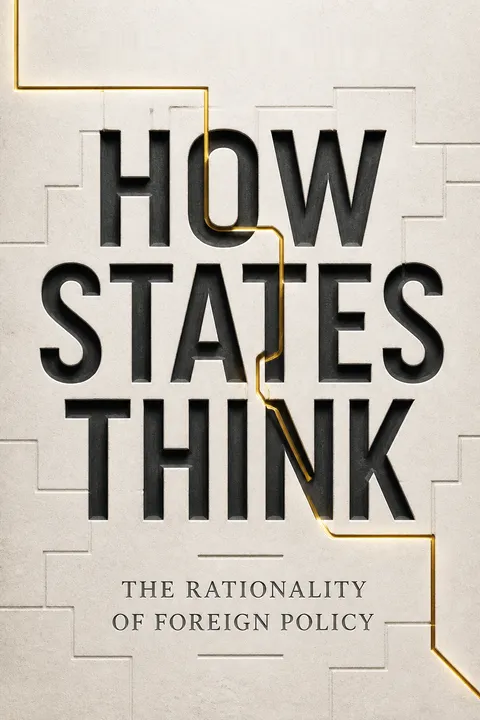
Reviews for How States Think are mixed, averaging 3.68/5. Many readers appreciate the book's central argument — that states behave more rationally than commonly assumed — but criticize its excessive repetition and overly academic tone. A frequent complaint is that the book should have remained a journal article. The theoretical first half is considered dry, while the historical case studies in the second half are more engaging. Some question the authors' broad definition of rationality and perceived bias toward realist theory.
People Also Read

Glossary
Strategic rationality
Theory-guided, deliberative policyThe book’s standard for assessing how a state forms foreign policy. A policy is strategically rational when it is based on a credible explanation of how international politics works and results from robust debate among key policymakers followed by a final decision. The term describes the reasoning process, not whether a policy succeeds or is morally justified.
Credible theory
Evidence-supported causal explanationA simplified explanation of how some part of international politics works. To count as credible in the book, a theory must rest on reasonably realistic assumptions, offer a logically coherent account of how causes produce effects, and receive substantial support from historical evidence. A credible theory can still fail in a particular case because it omits relevant factors or circumstances change.
Deliberation
Open debate followed by choiceThe collective process through which a state’s key policymakers consider and compare policy options. Deliberation requires robust, uninhibited debate, without coercion, deception, suppression of relevant information, or silencing of participants. It also requires a mechanism for choosing a policy, whether the group reaches agreement or an ultimate decision-maker resolves a deadlock.
Expected utility maximization
Choosing the highest expected payoffA decision method that identifies possible outcomes, ranks them by preference, assigns values and probabilities, calculates the expected value of each available action, and selects the action with the highest result. The authors argue that this approach fits situations where reliable probabilities can be calculated, but not foreign policy decisions characterized by scarce and unreliable information.
Uncertainty
Unknown, unmeasurable future outcomesA condition in which decision makers cannot obtain enough dependable information to calculate the likelihood of possible outcomes. The book distinguishes uncertainty from risk, where probabilities can be estimated from logical calculation or ample data. International policymakers face uncertainty about other states’ capabilities, intentions, resolve, and future choices.
Goal rationality
Coherent ranking of state goalsThe rationality of the objectives a state pursues, distinct from the strategy it uses to pursue them. The authors argue that a rational state must rank its own survival first because all other goals depend on its continued existence. Prosperity, ideological influence, and other aims may follow in whatever order the state chooses.
homo theoreticus
Policymaker who reasons through theoryThe book’s label for a policymaker who uses explanatory theories to understand international politics and choose a strategy. Such a decision-maker relies on causal reasoning and evidence to interpret a situation, while remaining open to changing views when important new information appears. The term contrasts with decision-making based mainly on mental shortcuts or formulaic calculations.
Risk theory
Fleet intended to deter BritainAdmiral Alfred von Tirpitz’s rationale for building a large German battleship fleet before the First World War. He expected the threat of a costly naval battle to deter Britain and give Germany leverage. The authors judge the theory noncredible because it underestimated Britain’s incentive and ability to counter a challenge to its naval advantage.
About the Author
Download PDF
Download EPUB
.epub digital book format is ideal for reading ebooks on phones, tablets, and e-readers.








