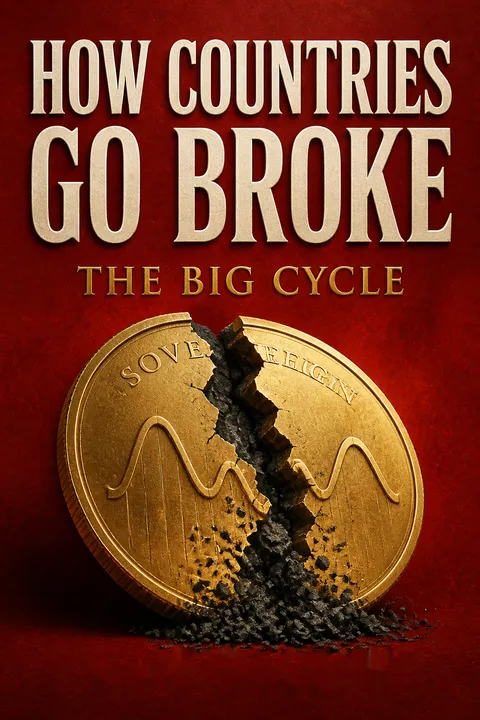


Key Takeaways
Treat debt as a cycle, not a permanent source of free spending
Borrowing moves spending through time. Credit lets a household, company, or government spend before earning the money. That boosts demand now, but repayment later means spending less. Since one person’s spending is another’s income, borrowing can first lift incomes and asset prices, then weaken them when debts come due. This is why credit tends to move the economy in waves rather than deliver a lasting boost.
Small cycles accumulate. Dalio describes short-term debt cycles averaging about six years, with large cycles averaging roughly 80 years, give or take 25. Repeated borrowing can leave each boom and bust with more debt than the last. Eventually, claims on future money grow too large relative to incomes and the real goods and services they are meant to buy.
What's useful here is the distinction between debt as a timing tool and debt as a substitute for income. Borrowing is not inherently reckless: financing a productive investment can create the earnings needed for repayment. The danger emerges when rising asset values are mistaken for rising capacity to pay. This resembles economist Hyman Minsky's account of financial instability, in which success encourages more risk-taking until the system becomes fragile. The roughly lifetime-long cycle is a useful historical lens, not a clock. Its timing can vary, and a recurring pattern does not by itself prove that a crisis is imminent.
Track who is buying, not just how much debt exists
Prices emerge from transactions. Dalio frames a market price as total spending divided by the quantity sold. If buyers spend more while sellers offer the same amount, prices rise. If spending falls, prices can fall even when the goods available have not changed. To anticipate a move, he asks what major buyers and sellers intend to do, and what would change their behavior.
Capacity changes the result. When businesses can expand production, extra credit and spending can support more output with less inflation. When they cannot, the same spending increase is more likely to push prices up. Dalio developed this approach while studying agricultural markets in the 1970s, then applied it to financial assets and whole economies. He argues that market movements often reflect the changing flow of spending, not a simple return to a fixed equilibrium price.
The framework directs attention toward participants, incentives, and market capacity, a useful corrective to treating supply and demand as abstractions. It also resembles flow-based analysis in operations research: bottlenecks determine whether added demand becomes more production or higher prices. But spending divided by quantity is an accounting identity, not a forecasting model by itself. Predictive power depends on estimating the behavior of buyers and sellers, and that can be difficult when expectations shift or new information arrives. The strongest use is diagnostic: identify whose decisions move the market, then test whether their ability or willingness to keep buying is durable.
Watch debt service and refinancing, not debt-to-GDP alone
Measure repayment capacity. Dalio’s debt dashboard focuses on four relationships: debt to income, debt service to income, interest rates relative to income growth and inflation, and debt obligations relative to liquid savings. For a government, revenue is more directly relevant than GDP because revenue is what can be used to pay bills. A rising share of borrowing used to cover existing debt costs is a warning that the balance is deteriorating.
Maturity matters, too. A rate increase may not immediately affect fixed-rate bonds, but costs rise as old debt matures and must be refinanced. In the book’s March 2025 snapshot, US central government debt is about 583% of revenue, and its debt-service burden is near 100% of revenue. Those readings indicate vulnerability, not a precise date for crisis. Reserves and the ability to issue debt in one’s own currency can change the risk substantially.
This approach replaces a single headline ratio with a cash-flow analysis, closer to how lenders assess a company or household. The distinction between GDP and government revenue is especially important: economic size does not automatically translate into collectible tax receipts. Yet public finances are not household finances in every respect. A currency-issuing government can tax, borrow, and influence the nominal value of its obligations, while households cannot create the currency they owe. That flexibility reduces default risk but may shift losses into inflation or weaker purchasing power. Ratios therefore describe constraints, but institutional credibility and political choices affect how those constraints are managed.
When debt claims outrun cash flows, prepare for default or devaluation
A promise needs backing. Debt is a promise to deliver money later. Trouble begins when the promises exceed what borrowers can pay from income, savings, or refinancing. Lenders may then sell their claims, pushing interest rates up and making repayment harder. A central bank faces a choice: allow defaults and a damaging contraction, or create money to support debt payments, risking a decline in the currency’s value.
The currency changes the damage. A country borrowing in money its central bank can issue has more room to manage a crisis than one owing foreign currency. It can create local money, but that does not guarantee the money will retain its purchasing power. Dalio compares this to the broader history of debt and currency markets: he says only about one-fifth of roughly 750 markets since 1700 remained, with the rest severely devalued. The practical risk is loss of value, whether through default or inflation.
The key insight is that nominal repayment and preserving wealth are different tests. A government may honor every bond payment while inflation erodes what those payments can buy. This distinction matters for savers, pension funds, and anyone treating government debt as risk-free in real terms. Modern monetary systems make a clean default less likely for an issuer of its own currency, but they do not abolish scarcity of goods, political legitimacy, or investor confidence. The historical tally is striking, though the selection and definition of a surviving market affect how it should be interpreted. It is best read as a warning about recurring monetary change, not a literal survival forecast.
Share debt losses between restructuring and money creation
Avoid a one-sided cure. Dalio calls a balanced debt reduction a “beautiful deleveraging”: policymakers restructure or extend debts to reduce repayment pressure, while monetary easing supports spending and prevents a collapse in prices and incomes. Restructuring hurts creditors and is deflationary; creating money can ease repayment but risks inflation. The aim is to reduce debt burdens without allowing either force to dominate.
Austerity can deepen the squeeze. Cutting public spending may lower the deficit on paper, but it also reduces someone else’s income. In a weak economy, lower incomes can make debts harder to repay and tax receipts smaller. Greece shows the danger when a debtor cannot issue the currency it owes: austerity deepened an already severe contraction, while a 2012 restructuring and bailout reduced the immediate burden. Domestic currency control gives policymakers more options, but it does not remove the political conflict over who absorbs losses.
The proposal recognizes that debt is both a liability and someone else’s asset. A policy that helps borrowers can injure creditors, while a policy that protects creditors can force borrowers to cut spending. This is a distribution problem as much as a technical one, and the balance determines who bears the cost. The Greek example also shows why monetary sovereignty matters: countries sharing a currency cannot independently create the unit in which they owe. Still, stimulus and restructuring are not interchangeable remedies. Their mix depends on inflation, the health of banks, and whether public support can be targeted without sustaining unproductive borrowing.
Read monetary policy as a late-cycle warning system
Policy tools change as debt grows. Dalio names successive monetary approaches: MP0 links currency to a hard asset such as gold; MP1 manages credit mainly through interest rates; MP2 uses central bank purchases of debt when rate cuts are no longer enough; MP3 coordinates large government deficits with central bank financing. These are not merely technical labels. Each signals a different way of supporting borrowing and spending as earlier methods lose traction.
History shows the transitions. The Bretton Woods gold-linked system began after World War II. The United States ended dollar convertibility into gold in 1971, moving toward a fiat system managed through interest rates. When rates reached near zero in 2008, central banks began large-scale debt purchases. During the COVID crisis, fiscal spending and monetary support were coordinated to put money directly into the economy. Dalio sees repeated reliance on these tools as a sign that debt pressures are advancing.
The sequence is a powerful way to connect central bank actions to the problems they are intended to solve. It also makes visible the distributional effects: asset purchases can raise financial asset prices, benefiting owners more immediately than people without assets. The stages should not be mistaken for a mechanical law. Institutions, inflation, exchange-rate arrangements, and political choices differ across countries, and central banks can use tools in combination. Still, asking why policymakers are reaching for a new instrument is revealing. The tool often indicates that the previous one has become constrained, even when it succeeds in preventing immediate collapse.
Read debt alongside politics, power, disasters, and technology
Five forces interact. Dalio’s “Overall Big Cycle” brings together debt and economic conditions, conflict within countries, conflict between countries, shocks from nature, and technological change. Each can intensify the others. Economic distress can deepen political division; political conflict can weaken economic management; international rivalry can drive costly military and industrial spending.
History supplies a pattern, not a script. From the late 19th century through 1945, industrial advances powered growth, borrowing, speculation, and wider gaps in wealth. The Great Depression then worsened political conflict, while authoritarian movements and geopolitical rivalries rose before World War II. Dalio sees similarities between that era and the conditions he describes in 2025, including high debt, polarization, international rivalry, climate risks, and rapid advances in AI. His framework asks readers to look beyond one market or election and consider how the forces reinforce one another.
The strength of this model is its refusal to isolate economics from political power. Fiscal choices depend on coalitions, while trade, sanctions, and security concerns reshape investment and production. Climate shocks and new technologies can also change the size and distribution of economic gains. This is a systems perspective: feedback loops matter more than a single cause. Its weakness is the temptation to see every present conflict as an echo of a past crisis. Historical analogies clarify possible mechanisms, but they cannot establish that outcomes will repeat. The framework is most useful when it generates questions and indicators, not when it turns resemblance into prophecy.
Japan shows how prolonged rescue can shift losses onto savers
Delay can prolong stagnation. After Japan’s asset bubble burst around 1989-90, policymakers took nine years to address non-performing loans and did not apply sufficiently stimulative monetary policy for much longer. Weak companies and banks remained burdened, contributing to years of deflation and slow growth. A stronger response began around 2013 with large-scale bond purchases, government spending, and reform efforts.
Avoiding default does not protect purchasing power. The Bank of Japan bought a very large share of government debt and helped keep interest rates low. The yen weakened, reducing the real value of debt but also diminishing the international value of savings. Dalio estimates that Japanese government bond holders lost about 45% relative to US bonds and 60% relative to gold since 2013. Japan also became more price-competitive. The same policy can therefore ease debt service while redistributing wealth from holders of domestic money and bonds.
Japan illustrates a crucial distinction between stabilizing a financial system and restoring a dynamic economy. Low rates and bond purchases can ease government financing and give private borrowers breathing room, but they cannot by themselves repair weak demand, unproductive firms, or demographic pressures. The distributional effects are also easy to miss if analysis focuses only on domestic prices: local costs may remain relatively stable while the currency loses value abroad. That makes outcomes look different depending on whether the measure is local purchasing power, foreign currency, or gold. The case argues for evaluating both debt relief and the living standards of those who hold the currency.
Cut deficits before markets force brutal choices, but test every forecast
Dalio’s US proposal is specific. Writing in March 2025, he argues for reducing the projected US budget deficit from about 6% of GDP to 3%. His proposed mix spreads the adjustment across spending cuts, tax increases, and lower interest rates, rather than asking one lever to carry the burden. He estimates that the plan would leave debt about $9 trillion lower after 10 years and $26 trillion lower after 20 years than the projected path.
Timing and coordination matter. Dalio argues that fiscal restraint is less damaging when the economy is relatively strong and monetary policy can ease if growth weakens. His investment advice is similarly cautious: look for unsustainable borrowing and crowded market beliefs, diversify across bets that behave differently, and avoid treating one forecast as certain. The case for action is his; the projections depend on assumptions about growth, rates, taxes, and political follow-through.
The proposal’s most constructive feature is its top-down logic: agree on a sustainable fiscal target, then negotiate the mix instead of letting every program become an all-or-nothing fight. Its most contestable element is the expectation that lower interest rates can do substantial fiscal work without reigniting inflation or compromising central bank independence. That outcome depends on conditions, not just arithmetic. Public spending also has different effects: cutting waste is not equivalent to cutting education, health, or infrastructure. The broader lesson is to pair debt targets with transparent assumptions and safeguards for productive investment, while treating any long-range estimate as a scenario rather than a promise.
Analysis
Dalio’s central contribution is a unified way to think about public debt as a balance-sheet problem that changes shape over time. Borrowing can sustain demand and fund productive investment, but it also creates claims on future income. When those claims grow faster than the income available to service them, policymakers face a conflict between preserving borrowers’ capacity to spend and protecting creditors’ returns. A government that issues debt in its own currency can often avoid nominal default, but it cannot guarantee that the currency retains its purchasing power. That distinction makes “going broke” a question of real losses, not simply missed payments.
The book’s historical method is both its appeal and its main limitation. Comparing many crises can reveal recurring mechanisms that short political memories miss. Yet the examples do not prove that cycles follow one timetable or that resemblance predicts a specific outcome. Dalio’s roughly 80-year estimate is a pattern drawn from historical cases, not a natural constant. His framework is strongest as a monitoring system: follow debt service, refinancing, reserve capacity, and buyers’ willingness to hold government claims; then ask how political, geopolitical, technological, and environmental forces might change those variables.
The policy argument is ultimately about loss allocation. Restructuring, inflation, taxation, and spending cuts all shift costs among debtors, creditors, taxpayers, workers, and asset owners. Calling a balanced adjustment elegant does not make it politically painless. The Japanese example shows that keeping nominal obligations intact can still erode savers’ wealth, while the Greek case shows the severe limits faced by governments that cannot issue their own currency. Dalio’s proposed US deficit target is therefore a political bargain as much as a financial calculation. His most durable lesson is to distinguish a manageable debt burden from a reassuring headline, and to test forecasts against who must pay when the underlying promises cannot all be honored at their original value.
Review Summary
How Countries Go Broke: The Big Cycle offers insights into debt cycles and economic patterns, drawing on historical data and Dalio's experience. Readers appreciate the accessible format and depth of analysis, though some find it repetitive. The book explores how nations accumulate unsustainable debt and potential consequences, with a focus on the US situation. While praised for its macroeconomic perspective, some critics note a lack of new ideas and oversimplification of complex issues. Overall, it's considered valuable for understanding global financial stability, despite mixed opinions on its delivery and proposed solutions.
People Also Read







Glossary
Big Debt Cycle
Long build-up and resetA long-term pattern in which repeated short-term credit expansions and contractions leave debt and debt-service burdens progressively higher. The cycle reaches a crisis when claims on future money become too large relative to incomes, savings, and available money. It is resolved through some combination of defaults, restructurings, money creation, and currency devaluation.
Overall Big Cycle
Five interacting historical forcesDalio’s model of large shifts in national and world orders. It combines the debt and economic cycle, internal political conflict, international rivalry, acts of nature, and human inventiveness, especially technology. These forces influence one another, shaping periods of prosperity and cooperation as well as crises, conflict, and changes in monetary and political systems.
beautiful deleveraging
Balanced reduction of debt burdensA managed reduction in debt and debt-service burdens that combines debt restructuring with monetary support. Restructuring reduces obligations but can depress spending and prices; money creation can support demand but risks inflation and currency depreciation. The aim is to balance these effects so debt burdens fall without producing an intolerable deflation or inflation.
MP0
Hard-asset-linked monetary policyDalio’s label for a monetary system in which currency can be exchanged for a designated hard asset, most often gold, at a fixed price. The link is intended to limit money creation. When governments issue more claims than the available hard asset can support, holders may seek conversion, forcing the government to defend or abandon the promise.
MP1
Interest-rate-managed fiat policyDalio’s label for a fiat monetary system in which central banks mainly influence credit and economic activity by changing interest rates and related financial conditions. Unlike a hard-asset-linked system, it is not constrained by a promise to exchange currency for gold. The US used this approach after ending dollar convertibility into gold in 1971.
MP2
Central bank debt purchasesDalio’s label for a fiat monetary approach in which central banks create reserves and purchase debt or other financial assets when interest-rate reductions are no longer sufficient. These purchases add demand for assets and support credit conditions. They can ease debt pressure, but may also increase money supply and reduce the currency’s value.
MP3
Coordinated fiscal and monetary supportDalio’s label for a policy approach in which a government runs large deficits while the central bank helps finance or support the resulting debt. It is used when rate changes and asset purchases alone are judged inadequate, often to direct funds toward households or organizations under severe stress. It can provide targeted support, while increasing public debt and inflation risks.
pushing on a string
Stimulus fails to spur spendingA condition in which lower interest rates or increased central bank liquidity do not produce much new borrowing, spending, or investment. Households, businesses, and investors may prefer to hold cash or repay debt because they fear losses or expect weak demand. Monetary easing then has limited effect on economic activity despite very easy financial conditions.
debt death spiral
Self-reinforcing debt and sellingA feedback loop in which investors sell debt, pushing interest rates or refinancing costs higher. Higher costs worsen a borrower’s ability to pay, which increases perceived risk and encourages further selling. A central bank may respond by buying debt or creating money, potentially weakening the currency and making investors even less willing to hold the debt.
FAQ
1. What is How Countries Go Broke: The Big Cycle by Ray Dalio about?
- Comprehensive debt cycle analysis: The book explores the Big Debt Cycle, a recurring long-term pattern where countries accumulate unsustainable debt, leading to economic crises and shifts in monetary and political orders.
- Five major forces: Dalio identifies five interrelated forces—debt, internal conflict, external conflict, acts of nature, and technology—that drive the overall Big Cycle and shape the fate of nations.
- Historical and practical framework: Drawing on 50+ years of investing experience and 35 historical case studies, Dalio provides a template for understanding where countries are in their cycles and what may happen next.
2. Why should I read How Countries Go Broke: The Big Cycle by Ray Dalio?
- Timeless economic principles: Dalio distills universal lessons about debt, monetary policy, and economic cycles that have repeated across centuries and countries.
- Unique expert perspective: The author’s deep historical research and decades of macro investing experience offer a practical, tested framework for anticipating and navigating debt crises.
- Relevance to today’s world: Dalio connects his analysis to current global challenges, such as rising debt, political polarization, and geopolitical tensions, making the book highly relevant for investors, policymakers, and informed citizens.
3. What are the key takeaways from How Countries Go Broke: The Big Cycle by Ray Dalio?
- Debt cycles drive history: Long-term debt cycles are central to understanding economic booms, busts, and the rise and fall of nations.
- Interconnected forces: Economic, political, geopolitical, natural, and technological factors interact to create major shifts in world order.
- Policy responses matter: How governments and central banks manage debt crises—through restructuring, monetization, or coordinated policies—determines the severity and outcome of each cycle.
- Preparation and risk management: Dalio emphasizes the importance of diversification, risk control, and understanding cycles to navigate uncertain times.
4. What is the Big Debt Cycle according to How Countries Go Broke: The Big Cycle by Ray Dalio?
- Definition and duration: The Big Debt Cycle is a long-term process, typically lasting around 80 years, where debt accumulates to unsustainable levels and is eventually deleveraged through crisis and restructuring.
- Cycle stages: It moves from sound money and credit expansion, to debt bubbles and busts, followed by painful deleveraging and a return to monetary stability.
- Impact on nations: The cycle explains how excessive debt leads to economic crises, forcing governments and central banks to choose between default, devaluation, or inflation.
5. How does Ray Dalio explain the difference between short-term and long-term debt cycles in How Countries Go Broke: The Big Cycle?
- Short-term cycles: These last about six years and are managed by central banks adjusting interest rates to control economic activity and inflation, resulting in expansions and recessions.
- Long-term (Big) cycles: Composed of multiple short-term cycles, these build up debt to unsustainable levels, culminating in major crises and systemic changes.
- Limits of policy tools: While short-term cycles can be managed with monetary policy, long-term cycles end when debt burdens overwhelm the system, requiring more drastic solutions.
6. What are the five big forces driving the Overall Big Cycle in How Countries Go Broke: The Big Cycle by Ray Dalio?
- Debt and economic cycles: The accumulation and deleveraging of debt are central to economic booms and busts.
- Internal political order/disorder: Social cohesion or fragmentation influences how countries respond to crises.
- External geopolitical order/disorder: International conflicts and alliances shape global stability and power shifts.
- Acts of nature: Events like pandemics and natural disasters can disrupt economies and accelerate cycles.
- Human inventiveness: Technological advances can drive growth or disruption, influencing the trajectory of cycles.
7. What are the key stages and concepts in Ray Dalio’s Big Debt Cycle framework?
- Debt accumulation and bubbles: The cycle begins with rising debt and asset prices, fueled by optimism and easy credit.
- Crisis and deleveraging: Excessive debt leads to crises, forcing painful adjustments through restructuring or inflation.
- Monetary policy eras: Dalio defines stages like MP1 (interest rate policy), MP2 (quantitative easing), and MP3 (coordinated fiscal and monetary stimulus) as responses to different phases of the cycle.
- Recovery and new order: After deleveraging, economies return to stability, often with new monetary and political arrangements.
8. How does Ray Dalio describe the role of central banks when countries “go broke” in How Countries Go Broke: The Big Cycle?
- Lender of last resort: Central banks print money and buy government debt to prevent defaults and stabilize the financial system during crises.
- Central bank losses: Rising interest rates can cause central banks to incur losses on their bond holdings, potentially leading to a “death spiral” of more money printing and currency devaluation.
- Policy dilemma: Central banks must choose between maintaining hard money (risking defaults and deflation) or softening money (risking inflation and devaluation); historically, they tend to choose the latter.
9. What is a “beautiful deleveraging” in Ray Dalio’s framework from How Countries Go Broke: The Big Cycle?
- Balanced crisis management: A “beautiful deleveraging” combines deflationary debt restructuring with inflationary debt monetization to reduce debt burdens without causing runaway inflation or deep recession.
- Growth exceeds interest: The goal is for nominal economic growth to outpace nominal interest rates, lowering debt-to-income ratios while maintaining positive growth.
- Policy coordination: Success requires effective collaboration between governments and central banks to spread out the pain and restore stability.
10. What are the nine stages of the final debt crisis sequence in How Countries Go Broke: The Big Cycle by Ray Dalio?
- Debt buildup and crisis: Both private and government sectors accumulate excessive debt, leading to private sector crises and falling demand for government debt.
- Central bank intervention: As interest rates hit zero, central banks print money and buy bonds, but rising rates can trigger losses and a “death spiral.”
- Restructuring and recovery: Debt is restructured and devalued, extraordinary policies like capital controls are imposed, and eventually, deleveraging restores a new monetary equilibrium.
11. What lessons does Ray Dalio draw from the US, China, and Japan’s Big Debt Cycles in How Countries Go Broke: The Big Cycle?
- China’s rapid rise and risks: China’s ascent from poverty to power involved massive debt-fueled growth, but now faces a late-cycle debt bubble and tightening political control.
- Japan’s stagnation: Japan delayed necessary restructuring and monetary easing, resulting in decades of stagnation and deflation—a cautionary tale for other nations.
- Currency control matters: Both countries’ debts are mostly in local currency, giving them more control over deleveraging, but policy choices are crucial for successful outcomes.
12. What is Ray Dalio’s “3% 3-part solution” for US debt stabilization in How Countries Go Broke: The Big Cycle?
- Deficit reduction target: Dalio recommends reducing the US budget deficit to 3% of GDP to stabilize government debt relative to income.
- Three levers: The solution involves a mix of spending cuts (~4%), tax increases (~4%), and interest rate reductions (~1%) to balance fiscal tightening with monetary easing.
- Bipartisan and counter-cyclical: Dalio emphasizes the need for bipartisan agreement and acting when economic conditions are favorable, with a fallback plan if consensus cannot be reached.
Download PDF
Download EPUB
.epub digital book format is ideal for reading ebooks on phones, tablets, and e-readers.








