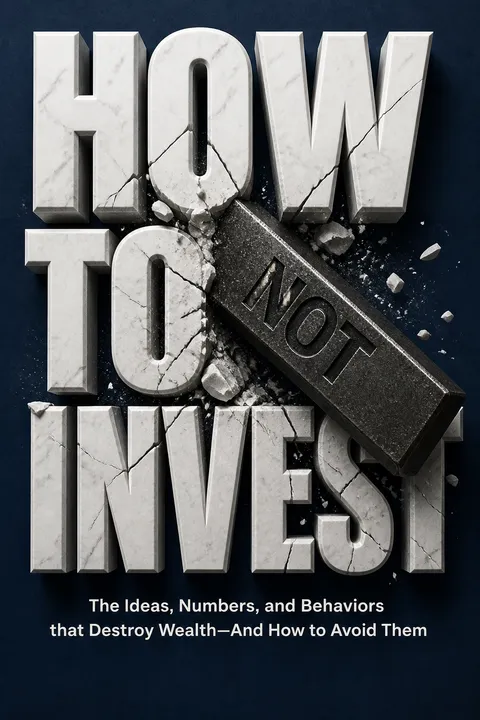


Key Takeaways
Build wealth by making fewer expensive mistakes, not by predicting winners.
Avoid the unforced error. Investor and author Charley Ellis compares investing to a tennis match in which most players lose by making avoidable mistakes. The edge often comes less from hitting spectacular winners than from not handing the other side easy points. A bad decision can erase years of steady gains, while avoiding it lets time and compounding do their work. The book’s central prescription is restraint: reduce the errors that drain wealth before hunting for clever ways to increase returns.
Aim for sound, not brilliant. Charlie Munger’s approach, as Ritholtz presents it, is to seek reliable judgment rather than extraordinary intelligence. That means controlling costs, resisting hype, and not making a large bet without understanding its purpose and risks.
This is a useful shift from performance heroics to error control. In safety engineering, a system often becomes more reliable by identifying and blocking common failure modes, not by demanding flawless performance from every operator. Investing has a similar asymmetry: one spectacular trade may help, but panic selling, leverage, or persistent fees can compound against an investor for years. The principle is not an excuse for passivity in every decision. It is a reminder that any attempt to improve returns should be judged against the additional ways it can fail.
Treat confident market calls as marketing, then check the seller.
Expertise has boundaries. Real estate investor Sam Zell was highly successful in his field, yet his recession forecasts repeatedly failed. In 2015, he warned that a recession was likely within a year; the next recession came in 2020, triggered by the pandemic. The halo effect makes an audience transfer a person’s success in one domain to unrelated claims. Ritholtz also cites Philip Tetlock’s study of about 28,000 expert forecasts, which found experts did not clearly outperform simple forecasting methods.
Interrogate the pitch. Ask what risk the advice creates, whether it fits the investor’s plan, and what it costs in fees, taxes, or missed opportunities. Then ask what the adviser is selling, what their record is, and whether they have conflicts. Media needs content, and financial products need customers, so confident prediction can serve promotion better than a portfolio.
The strongest lesson is not that expertise is worthless, but that it is domain-specific and must be assessed against a track record. A forecaster can still help identify assumptions or plausible scenarios, provided the forecast is treated as uncertain input rather than instruction. Accountability also matters: a dated record of predictions is more revealing than a memorable success story. The book’s broad dismissal of forecasting is most persuasive for precise market calls, not for every form of projection. Planning for several possible outcomes is different from claiming to know which one will occur.
Before fearing a big number, find the denominator.
A numerator is not context. Denominator blindness is the failure to judge a number against the larger group it describes. A headline about 3,000 layoffs sounds ominous, but at a company with 2.1 million employees, it represents less than 0.15% of the workforce. A 300-point market drop also means different things depending on the index: the book compares roughly 0.75% of a 40,000-point Dow with 6% of a 5,000-point S&P 500.
Ask what the number measures. The same habit applies to investing claims, economic data, and frightening risks. A large dollar loss means little without knowing the fund’s size. A rise in prices means less without comparing wages over the same period. Missing context can turn ordinary variation into apparent disaster.
This is a compact defense against misleading precision. A number can be accurate and still invite the wrong conclusion when its scale, time period, or comparison group is omitted. The next step is to ask whether the denominator itself is appropriate: a company-wide workforce may hide severe harm in one department, while a national average may conceal major differences among households. Context does not make a statistic automatically meaningful, but it exposes what question the statistic can and cannot answer.
Own the market haystack because a tiny minority creates its gains.
Winners are unusually rare. Research by finance professor Hendrik Bessembinder examined roughly 62,000 global stocks from 1990 to 2018. About 1.3% of companies generated all net global stock-market wealth creation in excess of Treasury returns. The five largest creators, including Apple, Microsoft, Amazon, Alphabet, and ExxonMobil, made up only 0.01% of the sample. Most individual stocks failed to produce positive cumulative returns over the period.
Broad indexing catches the outliers. An investor who buys a diversified, low-cost index holds both the eventual winners and the many ordinary or poor performers. As successful companies grow, market-cap-weighted indexes hold more of them. Picking the rare winners in advance, holding through severe declines, and knowing when to sell are all difficult tasks. Indexing trades the thrill of selection for broad exposure, lower costs, and fewer chances to sabotage the result.
The case for indexing is not that every company is good, or that an index cannot fall sharply. It is that the investor avoids needing to identify a small set of winners before their success is obvious. This resembles diversification in other uncertain fields: spreading exposure reduces dependence on any single forecast. There is still a choice about which markets and assets to own, and a market-weighted index can become concentrated in its largest firms. Broad ownership simplifies the problem; it does not abolish risk.
Write a plan before markets panic, then keep buying on schedule.
Decide while calm. A written financial plan sets goals, asset allocation, and acceptable risk before frightening headlines arrive. During the 2020 crash, one study of 653,455 brokerage accounts found that 30.9% of investors who panic-sold never returned to risky assets. Others tended to buy back at higher prices, after the news had improved and much of the recovery had already happened.
Make time do the work. Regular contributions to broad investments avoid the need to identify a perfect entry point. A suitable mix of stocks and bonds depends on goals, time horizon, and ability to tolerate volatility. Bonds can provide income and cushion some equity swings. The plan’s real test is not whether it predicts every downturn, but whether it remains usable when a downturn makes abandoning it feel urgent.
A plan works partly as a precommitment device: it moves decisions out of the moment when fear is strongest. Automatic contributions can reduce the temptation to wait for reassuring news, which often arrives after prices have recovered. Yet sticking with a plan should not mean ignoring changed circumstances. A job loss, new obligation, or near-term cash need can justify a deliberate adjustment. The useful distinction is between revising a plan because life changed and discarding it because headlines made uncertainty temporarily unbearable.
Replace point forecasts with probability ranges and long-cycle context.
Think in possible outcomes. Risk is not simply a predicted loss. It is the range of outcomes that could occur, including outcomes less favorable than the one an investor expects. Rather than claiming to know next year’s market level, investors can consider several scenarios and whether their portfolio can withstand them.
Zoom out beyond arbitrary labels. The familiar 20% threshold for a bear market does not reveal when to buy or sell. Ritholtz instead distinguishes long secular cycles, often lasting a decade or more, from shorter moves in the opposite direction. He argues that investor willingness to pay for earnings can change substantially across eras. During the 1982 to 2000 bull market, he estimates that most market gains came from expanding price-to-earnings multiples, not earnings growth alone. Cycle analysis adds context, not a reliable clock.
Scenario thinking is a practical middle ground between false certainty and helplessness. It asks whether a decision survives several plausible futures, rather than whether one forecast proves correct. Long-cycle frameworks can help explain why markets behave differently across decades, but their boundaries are easiest to see after the fact. They should therefore inform expectations and risk tolerance, not become a new timing system. Valuation can shape long-run returns while remaining a poor signal for the exact month to invest.
Judge investing decisions by process, not whichever outcome happened.
Luck can look like skill. A successful trade does not prove that the decision was sound, just as a losing trade does not automatically prove it was foolish. A coin flipper who gets a long run of heads may simply have been fortunate. Investors who chase a fund after a hot streak risk confusing a favorable outcome with a repeatable method.
Selling deserves scrutiny. A study of 783 institutional portfolios examined more than 89 million trading observations. Managers showed skill in buying stocks, but their actual sales underperformed randomly selected sales by about 50 to 100 basis points over the following year. When a holding disappoints, ask whether its original reason for ownership still holds and whether the capital has a better use. The purchase price is history, not a reason to keep holding.
Process evaluation is a defense against hindsight bias, but it needs evidence. A process should state what information matters, what would change the thesis, and how risk is limited. Otherwise, “good process” can become a flattering label attached to any result. The study’s random-sale comparison is especially provocative because it shows that professionals can have an analytical edge in one decision and a behavioral weakness in another. A useful review separates the quality of the decision from the emotional relief or regret produced by the final return.
Say "I don't know" before complexity rents space in your portfolio.
Notice the limits of expertise. Metacognition is the ability to judge one’s own knowledge and skill. The Dunning-Kruger effect describes how people with limited competence in a domain can overestimate their ability to assess it. In investing, that confidence can make an unfamiliar product seem understandable simply because its sales pitch is fluent.
Theranos shows the cost. Elizabeth Holmes’s company claimed it could run many blood tests from a finger prick. Its celebrity, awards, and multibillion-dollar valuation encouraged many backers to trust other people’s apparent confidence instead of demanding evidence. The medical and biotech investors who passed had relevant reasons for skepticism. A practical rule follows: if the investment’s mechanism, risks, or incentives cannot be explained plainly, pause rather than treating confusion as a personal failing.
Admitting ignorance is not merely modesty. It is a way to create space for verification before status, excitement, or fear of looking uninformed takes over. The most useful question is not whether an investor understands every technical detail, but whether the essential claims can be independently tested and the downside described. Some legitimate innovations are difficult to explain at first, so complexity alone is not proof of fraud. Refusal to answer basic questions, however, is a reason to withhold capital.
Keep employer stock from turning your paycheck into a single bet.
One company can threaten two sources of security. Employees already depend on an employer for income; holding much of their savings in the same company adds investment risk to employment risk. General Electric encouraged employee stock purchases with a generous 50% match. Yet GE, once a dominant blue-chip company, later lost about half its peak market value, while the broader S&P 500 rose substantially over the same period. A famous company is not a permanent guarantee.
Reduce exposure deliberately. When a single stock or other asset becomes a life-changing share of wealth, selling some can protect a real financial goal without requiring an all-or-nothing choice. Ritholtz describes selling a portion of vested Yahoo shares before the dotcom crash as a regret-minimizing approach: secure enough to change the family’s circumstances, while retaining some upside if the price keeps rising.
The employer-stock problem is a form of correlated risk: a company downturn can damage both the investor’s assets and ability to earn. Diversification is especially valuable when multiple parts of a household’s financial life depend on the same institution. Selling a concentrated holding can carry taxes and emotional costs, so the right amount depends on the person’s circumstances. The core question is whether additional exposure is still needed to meet a goal, or whether it mainly increases the scale of a possible loss.
Inspect fees, taxes, and adviser incentives before signing.
Costs compound too. A high fee or unnecessary tax bill reduces the money left to earn future returns. The Rosenau family, after winning the lottery, placed foundation assets with an insurance agent who bought $18.9 million in variable annuities and received a reported $1.2 million commission. The investments lost money over six years while the stock market more than doubled. The vehicle offered little tax advantage to a nonprofit funded with after-tax dollars.
Ask whose interests govern. A fiduciary is legally obligated to act for the client’s benefit; a broker operating under a suitability standard faces a different obligation. Investors should understand what they own, what they pay, and how the adviser earns money. Tax planning, including tax-loss harvesting and appropriate use of tax-advantaged accounts, can also improve the amount retained after taxes.
The story shows why trust should be paired with incentive analysis. A product can be legal and still be poorly matched to the client, while a large commission can reward a sale regardless of its long-term value. Fee comparisons also need context: advice may be worth paying for when it solves complex planning needs or helps prevent costly behavior. The relevant test is not whether a service costs money, but whether its benefits, risks, and conflicts are clear enough to justify the cost.
Spend within your means without letting penny-wise scolds run your life.
Money is a tool. The book’s practical spending rules are to spend less than you earn, invest for the future, and use what remains on things that genuinely matter. That is different from treating every purchase as financial sabotage. The popular claim that a $5 daily coffee becomes a million dollars assumes a 12% annual return for 40 years. Using a more modest historical equity return, the book estimates roughly $300,000 to $350,000 before inflation, or about $90,000 in today’s dollars.
Prioritize the real budget. Housing, healthcare, and education can outweigh small discretionary purchases. A latte is not harmless if spending consistently exceeds income, but eliminating it will not solve a structural shortfall. Major purchases deserve honest accounting of ownership costs, likely use, and the joy or security they provide.
This is a useful correction to advice that mistakes frugality for a complete financial strategy. Small habits can matter, but their importance depends on income, fixed costs, and the scale of the wider plan. The book’s rebuttal also shows how a technically possible projection can mislead when it assumes unusually high returns and ignores inflation. Good spending decisions are neither automatic indulgence nor automatic denial. They connect present enjoyment to future security without pretending that every pleasure carries the same financial weight.
Analysis
The book’s organizing move is to make omission, rather than prediction, the central investing skill. Its stories range from failed forecasts and misleading headlines to costly financial products, but they repeatedly point to the same mechanism: people act on a confident story before checking its evidence, scale, incentives, or fit with their own goals. The corrective is not superior forecasting. It is a process that is robust to being wrong: broad diversification, low costs, realistic risk, a plan made in advance, and enough self-awareness to resist panic.
That approach is persuasive because it links market behavior to ordinary cognitive limits. Humans overvalue vivid events, confuse familiarity with understanding, and struggle to separate luck from skill. The book’s most practical contribution is to translate those tendencies into questions an investor can actually use: What is the denominator? Who benefits from this advice? What would change the thesis? Can the plan survive a bad market without requiring a heroic decision?
A critical distinction is needed between humility and inaction. Acknowledging uncertainty does not mean all investments are equivalent or that analysis is futile. It means evidence should be weighed in proportion to its reliability, and decisions should be designed so one mistaken belief does not threaten the whole financial plan. Likewise, indexing reduces stock-selection risk but does not remove market, inflation, or concentration risk. Asset allocation, time horizon, liquidity needs, and taxes still matter.
The book’s use of vivid historical examples makes abstract biases memorable, though stories selected after outcomes are known can themselves invite hindsight bias. The deeper lesson is to prefer repeatable evidence over memorable anecdotes, including anecdotes that support the book’s own thesis. Overall, its strongest advice is not simply to avoid mistakes. It is to build a financial process that expects mistakes, limits their cost, and keeps a temporary burst of emotion from becoming a permanent portfolio decision.
Review Summary
How Not to Invest receives mostly positive reviews for its entertaining and insightful approach to investment advice. Readers appreciate Ritholtz's focus on avoiding common mistakes, emphasizing long-term thinking, and advocating for index fund investing. The book is praised for its accessibility and practical wisdom, though some critics find it repetitive or contradictory in places. Many reviewers highlight the author's emphasis on understanding human psychology in investing and the importance of ignoring market noise. Overall, it's considered a valuable resource for both novice and experienced investors.
People Also Read




Glossary
Denominator blindness
Numbers without scaleThe tendency to react to a number without comparing it with the group or total it describes. A report of thousands of layoffs, for example, cannot show how severe a cut is without the company’s total workforce. The same error makes market point changes and large dollar figures appear more meaningful than their relative size warrants.
Survivorship bias
Ignoring the failuresA distortion that occurs when analysis includes only the people, products, funds, or companies that survived, while excluding those that failed or disappeared. The remaining successes can make a strategy look more reliable than it was. In fund comparisons, excluding closed funds can overstate how often active managers outperform.
Secular bull market
Long-term rising market eraRitholtz uses this term for an extended market period, often lasting 10 to 20 years, supported by broad economic changes that favor corporate revenue and earnings growth. Investor willingness to pay more for a dollar of earnings can also expand, lifting valuations. Shorter downturns may occur within the longer rising era.
Core & Satellite
Index core, smaller additionsA portfolio structure built around a large holding in broad, low-cost index funds, with smaller positions in other strategies or assets. The core provides diversified market exposure; the satellite holdings allow limited investment in specific ideas or preferences. The approach is intended to keep experimentation from displacing the main long-term portfolio.
Cowboy Account
Small account for speculationA limited portion of an investor’s liquid assets set aside for active trading or speculative ideas. Its purpose is to contain the financial damage of risk-taking while allowing an investor who enjoys trading to participate. The main portfolio remains governed by a broader, more disciplined investment plan.
Tax-loss harvesting
Realizing losses for tax offsetsThe practice of selling an investment at a loss to create a realized loss that can offset taxable capital gains, subject to applicable tax rules. Investors may replace the holding with a similar investment to maintain exposure. Losses can also be carried forward or, within limits, used against ordinary income.
Direct indexing
Owning index stocks directlyAn investment approach in which an investor owns many of the individual securities in an index rather than holding only an index fund. This can make it possible to realize losses in individual stocks while retaining exposure to similar investments. The strategy can be useful for tax management, particularly for investors with concentrated appreciated holdings.
Dunning-Kruger effect
Misjudging one's competenceA finding in psychology that people with limited competence in a particular area may overestimate their ability in that area, partly because they lack the knowledge needed to judge their own performance. Metacognition, the ability to assess one’s own understanding, improves with expertise, but does not make experts immune to misjudgment.
Epistemic trespass
Judging beyond one's expertiseThe practice of making confident judgments in a field where the speaker lacks the relevant evidence or skills. Someone’s achievement in one domain does not automatically qualify them to assess another. In investing, this is a reason to evaluate whether an adviser or commentator has expertise specific to the claim being made.
About the Author
Other books by Barry Ritholtz

Download PDF
Download EPUB
.epub digital book format is ideal for reading ebooks on phones, tablets, and e-readers.








