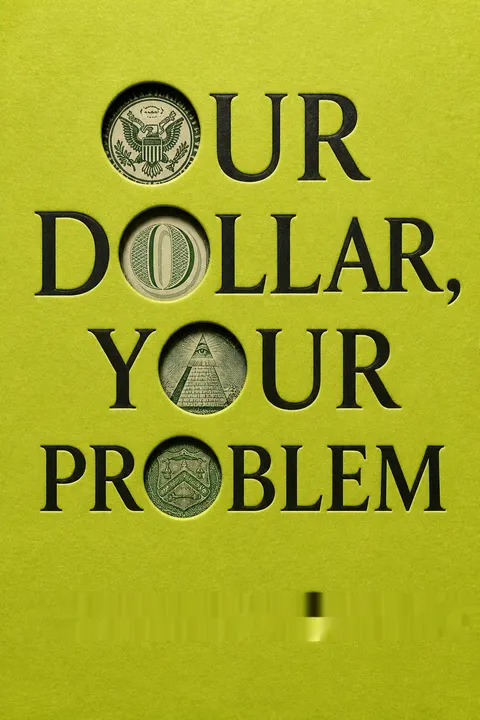


Key Takeaways
The dollar is America's asset, but its shocks become everyone's problem
Dominance has deep roots. The dollar did not become the world’s main currency by decree alone. After two world wars weakened Britain, the United States emerged with an enormous share of global output and the financial markets, legal protections, and political reach that made its currency useful. Once traders and central banks used dollars, it became cheaper for others to do the same. This network effect helps explain why the dollar now appears on one side of about 90 percent of foreign exchange trades, accounts for roughly 60 percent of global reserves, and prices about 80 percent of oil trade.
Use spreads the risk. The dollar’s convenience reaches beyond America. Countries borrow in it, price goods in it, and hold it as a reserve. That makes U.S. decisions consequential abroad. But inflation also reduces the value of dollar assets held by Americans, and higher U.S. interest rates can strain borrowers worldwide. The title’s provocation is only half the story: dollar policy is a global concern, and its consequences return home.
Currency dominance resembles infrastructure: once a common system lowers friction, replacing it requires more than a rival product. The striking point is that utility and power arrive bundled together. Users gain efficient trade, while the issuer gains room to borrow and influence financial rules. That bargain is not automatically fair or stable. The book’s strongest frame is therefore not “Is the dollar good or bad?” but “Who benefits from the system, who bears its shocks, and how much trust can it spend?”
Do not mistake a rival's fast growth for an inevitable currency handoff
Forecasts can age badly. In the 1960s and 1970s, prominent economists expected the Soviet economy to approach or surpass America’s. The USSR built industry, educated a workforce, and excelled in science and military technology. Yet command planning struggled to direct a complex economy toward innovation and consumer needs. Scarcity and corruption compounded the problem, while returns from building yet another factory or railway diminished.
Japan looked unstoppable too. After the 1985 Plaza Accord, the yen rose from 244 to 121 per dollar by 1987. The stronger currency helped inflate Japanese wealth: stocks and land soared, then collapsed, with the crisis emerging around 1992. The exchange rate shock mattered, but so did weak financial oversight, demographic decline, and investment with diminishing returns. Economic ascent creates opportunity, not a guaranteed currency succession.
These cases make a useful distinction between catching up in production and becoming the world’s financial anchor. A country can build excellent factories, technology, or military capacity without offering outsiders a currency they can freely hold, trade, and trust. The Japan account also resists an easy morality tale: American pressure contributed to its adjustment, but did not alone cause its long stagnation. Historical explanations are most useful when they preserve multiple causes rather than assigning one villain.
A currency union needs fiscal solidarity when members are hit unevenly
The euro is a political achievement. European countries replaced national currencies with a shared one, creating the most important alternative to the dollar. The project strengthened trade within Europe and offered members the credibility of a currency associated with low inflation. But it did not create a single treasury with comparable power to tax, spend, and support banks across the whole union.
Crisis exposed the gap. When Greece and other countries faced debt trouble, they could not devalue their own currencies or rely on a strong common fiscal authority. Investors had once treated many national debts as if they were equally safe, but risk returned sharply. In 2012, European Central Bank president Mario Draghi’s forceful commitment to defend the euro helped calm markets. Later joint pandemic spending showed greater solidarity, yet national borrowing costs still differ. A shared currency can pool monetary policy without fully pooling financial risk.
The euro illustrates a general institutional problem: shared rules are easiest to celebrate before losses must be shared. Monetary integration removes one adjustment tool, the national exchange rate, so other mechanisms must absorb shocks. Transfers, labor mobility, or flexible wages can help, but each has political limits. The union’s survival demonstrates that institutions can adapt under pressure; its recurring strains show that adaptation is not the same as resolution. A currency union is ultimately a pact about who helps whom, not merely how payments clear.
China can loosen the dollar's grip without replacing the dollar
Growth is not a currency. China’s economy transformed dramatically, but Rogoff argues that its growth model is slowing. Real estate and infrastructure together accounted for about 31 percent of GDP in 2021, including indirect activity. Housing space per person had surpassed levels in several richer European countries, while many smaller cities faced falling prices and outward migration. Local government financing vehicles, used to fund construction, carried debt estimated at about 50 percent of GDP by the end of 2023.
Currency influence can shift first. China need not overtake the United States to reduce dollar dominance. If the renminbi moves more freely, trading partners may use it more in trade and exchange-rate management, especially across Asian supply chains. China’s earlier effort to defend its currency consumed a quarter of its reserves in 2015 and led to tighter capital controls. A more international renminbi requires deeper, more open markets, not merely a large economy.
The key distinction is between a challenger’s scale and the qualities that make its money usable abroad. China can gain influence in trade invoicing even while the dollar remains the preferred store of value. That makes currency change less like a coronation and more like gradual market-share erosion. The construction evidence is persuasive because it connects a national growth story to local vacancies and debt. Still, the future path is uncertain: state capacity can spread losses or postpone recognition, even when it cannot make weak investments productive.
Use pegs to buy time, then build a credible exit
A peg offers visible reassurance. Fixing a currency to the dollar can help restore trust after inflation, simplify trade, and reassure lenders. But a country cannot simultaneously maintain a fixed exchange rate, open capital markets, and independent interest-rate policy. This constraint is known as the impossible trinity. When a peg becomes incompatible with domestic conditions, defending it can drain reserves and force painful rate increases.
Crises repeat the pattern. Mexico, Thailand, Russia, Brazil, and Argentina all endured damaging collapses after relying on rigid or managed exchange rates. Brazil’s 1994 Real Plan nevertheless helped break a history of extreme inflation. When the peg failed in 1999, the country moved toward a floating rate and inflation targeting. Some Asian economies chose a different compromise: larger reserves, stronger bank regulation, more local-currency borrowing, and limited exchange-rate flexibility. Stability can be built, but no peg should be mistaken for permanent protection.
The peg’s appeal is psychological as well as economic: it gives households a simple public signal that money will hold its value. That can be valuable when trust is shattered. The danger is that a credibility device can become a trap if leaders postpone adjustment until reserves and confidence are already depleted. The book’s account also shows why policy advice needs context. A temporary peg may be the least damaging bridge out of hyperinflation, even when it is a poor long-term destination.
Digital money still needs institutions, and illicit demand gives crypto value
Technology does not erase state power. Governments collect taxes, pay workers, define legal accounting units, and support financial institutions. Those functions help their currencies prevail over private alternatives. Bitcoin has real demand, especially in the underground economy, which the book estimates at roughly 17 percent of income in advanced economies and 32 percent in developing economies. Its use in illicit transactions and in moving funds around capital controls gives it practical value, even if it does not replace the dollar in ordinary legal commerce.
New forms face old risks. Stablecoins promise convenient dollar payments, but their issuers can face runs if reserves or backstops are inadequate. Central bank digital currencies could improve payments or widen government oversight, yet they might also pull deposits from banks that lend to businesses. The form of digital money matters less than its rules, reserves, privacy protections, and lender of last resort.
The most useful correction here is to separate technological novelty from monetary independence. A digital token can move value in new ways while remaining dependent on legal systems, custodians, or reserve assets. Crypto’s underground use also complicates the claim that it is either worthless speculation or a universal replacement for state money. The harder question is what kind of financial activity society wants to make easy, visible, and enforceable. A payment innovation can be impressive and still carry costs that its marketing leaves out.
The dollar's privilege buys cheap finance, but also geopolitical obligations
Safe assets earn a discount. Foreigners held about $8.2 trillion in U.S. government debt in 2024. Investors accept comparatively low returns because Treasury securities are liquid, widely accepted as collateral, and supported by deep markets and creditor protections. Estimates of the resulting borrowing advantage vary, but the book places a direct benefit around half a percent of U.S. output. America also acts as a financial intermediary, often holding riskier foreign investments while foreigners hold safer U.S. assets.
Influence brings obligations. Dollar dominance helps the United States finance itself and gives its government reach through sanctions and control over payment channels. It also creates incentives for other countries to build alternatives. The military dimension matters: the United States spends far more on defense than its major allies, and its security role helps sustain the system from which it benefits. Dominance is not a free lunch. It is a bargain involving borrowing advantages, geopolitical leverage, and costs that can be difficult to measure.
The phrase “privilege” can obscure a two-sided exchange. A trusted currency provides cheap funding, but markets also expect its issuer to preserve institutions and absorb shocks. The book makes a valuable connection between finance and security: power over payment networks complements military influence, while military commitments consume resources. One caution is that precise estimates of the privilege depend on assumptions about risk and returns. The qualitative advantage is clearer than any single headline number, and the burden is not borne evenly across Americans.
Treat low rates as weather, not a permanent fiscal foundation
Inflation control rests on trust. Central bank independence helps protect monetary policy from the short-term temptation to cut rates, spend, or tolerate inflation for political gain. That protection is not automatic. The Federal Reserve’s independence depends on political support, and a loss of credibility can raise long-term borrowing costs even when officials push short-term rates down.
Debt narrows future choices. U.S. public debt stood at about 121 percent of GDP in 2024, and the Congressional Budget Office projected it could reach 166 percent by 2054. Each one-point rise in the average interest rate on federal debt adds nearly $300 billion to the annual deficit. Rogoff argues that ultra-low real rates after the 2008 crisis were not a safe permanent assumption. The dollar may remain dominant, but persistent deficits, inflation pressure, and political interference could weaken its stability and share.
This is the book’s central warning about complacency: a long calm period can make a temporary condition look like a law of nature. The historical case for caution is strong, while the precise forecast for future rates is necessarily less certain. Debt is not simply good or bad; it gives governments room to respond to crises, but high servicing costs can consume that room. Protecting monetary credibility and preserving fiscal options are complementary goals, not rival ideologies.
Analysis
The book’s deepest argument is that dollar dominance is not a trophy awarded to the largest economy. It is a system assembled from market depth, legal credibility, security relationships, payment habits, and political power. These features reinforce one another, so the dollar can remain dominant even as U.S. policy creates crises or competitors grow. This framing helps explain why past challengers failed for different reasons: Soviet planning suppressed adaptation, Japan’s boom became financially fragile, and Europe built monetary unity without equivalent fiscal unity.
The most important distinction is between dominance and permanence. Rogoff does not predict an imminent replacement of the dollar. He argues that its peak may have passed, with change arriving through regional diversification, altered trade pricing, and competing payment networks rather than a single dramatic handoff. China is consequential precisely because it can loosen the dollar’s Asian reach without first matching America’s financial institutions or income. That is a more plausible challenge than a simple contest to become the biggest economy.
The book is especially effective when its macroeconomic claims are tied to institutional episodes: a peg defended until reserves run low, a central bank’s credibility tested by political demands, or construction-led growth leaving local governments with hidden liabilities. Its insider anecdotes make abstract mechanisms legible, though the breadth of historical narrative can blur the difference between established evidence and forward-looking judgment. The claims about China’s slowdown and future interest rates deserve attention as risk analysis, not certainty.
A useful synthesis is to view the dollar as both a public good and a strategic asset. Its shared infrastructure makes global commerce easier, but its issuer is not a neutral global trustee. Other countries’ dependence creates American leverage, while American domestic choices transmit costs abroad. The resulting feedback is the book’s central tension: the United States benefits from the system, yet its fiscal and political behavior can gradually make that system less attractive. The practical lesson is not to bet on the dollar’s collapse or immortality, but to recognize that trust is an asset that can erode before its formal status changes.
Review Summary
Our Dollar, Your Problem receives high praise for its insightful analysis of the U.S. dollar's global dominance. Readers appreciate Rogoff's clear explanations of complex economic concepts, his use of personal anecdotes, and his balanced perspective on future challenges. The book is lauded for its comprehensive coverage of historical currency rivalries, alternative currencies, and potential threats to dollar supremacy. While some find certain sections technical, most reviewers consider it essential reading for understanding global finance and recommend it for its accessibility and timely warnings about America's fiscal challenges.
People Also Read







Glossary
Vehicle currency
Currency used between othersA vehicle currency is used as an intermediary when two currencies are difficult or costly to exchange directly. A trader might convert Canadian dollars into U.S. dollars, then convert those dollars into Australian dollars. Because the dollar market is exceptionally deep, this two-step route can cost less than a direct exchange.
Impossible trinity
Three goals, only twoThe impossible trinity describes a constraint on economic policy: a country cannot simultaneously maintain a fixed exchange rate, allow open international capital flows, and set its own interest rates independently. It can pursue any two, but not all three indefinitely. A government that tries may face capital flight, reserve losses, or pressure to change its policies.
Tokyo consensus
Asia's managed currency stabilityThe Tokyo consensus is Rogoff’s description of the approach many Asian economies developed after the 1997-1998 financial crisis. Rather than choose between a rigid dollar peg and a fully floating currency, countries built reserves, strengthened financial regulation, deepened local capital markets, and allowed limited exchange-rate movement. The combination helped them manage dollar dependence without simply restoring the old fixed-rate model.
Exorbitant privilege
Benefits from issuing the key currencyExorbitant privilege refers to the advantages a country receives when its currency is widely used internationally. For the United States, these include strong demand for Treasury debt, lower borrowing costs, and the ability to borrow in its own currency. The term also covers broader financial advantages, such as attracting foreign savings while investing abroad in higher-return assets.
Convenience yield
Value of an asset's usefulnessA convenience yield is the benefit investors receive from holding an asset that is especially useful, liquid, or widely accepted, beyond the interest it pays. U.S. Treasury bills can earn lower returns than otherwise similar assets because they serve as safe holdings and as collateral in global financial transactions. Their practical usefulness makes investors willing to accept less interest.
Special drawing right
IMF reserve accounting unitA special drawing right, or SDR, is an international reserve asset created by the International Monetary Fund. It is valued using a basket of major currencies and can be held by governments through the IMF. It is not ordinary money for private citizens or businesses: when a government uses SDRs, it receives dollars or other currencies in the basket.
Global financial cycle
Synchronized cross-border capital flowsThe global financial cycle describes the tendency for international investment to expand and contract across many countries at once. Investors often move toward riskier assets during calm periods and retreat together when risks rise. Because emerging markets are relatively small within global finance, these synchronized shifts can overwhelm local conditions, even when a country has a flexible exchange rate.
Financial repression
Policy that channels funds to governmentFinancial repression occurs when governments use rules or controls to direct financial institutions toward holding public debt or to keep borrowing costs below market levels. It can reduce the government’s debt burden, but the cost is often borne indirectly by savers through lower returns, while private investment may be crowded out. Unlike foreign investors, domestic savers have fewer ways to move their funds elsewhere.
FAQ
What is Our Dollar, Your Problem by Kenneth Rogoff about?
- Insider’s view of global finance: The book provides a comprehensive history of global finance over the past seven decades, focusing on the rise and dominance of the U.S. dollar.
- Dollar’s global role: It explores how the dollar became the world’s dominant currency, the benefits and burdens of this status, and the challenges it faces from rivals and new technologies.
- Future outlook: Rogoff analyzes the prospects for the dollar, the emergence of alternatives like cryptocurrencies and central bank digital currencies (CBDCs), and the potential transformation of the global monetary system.
Why should I read Our Dollar, Your Problem by Kenneth Rogoff?
- Expert perspective: Kenneth Rogoff is a renowned economist and former IMF chief economist, offering unique insights from both academic research and policy experience.
- Comprehensive coverage: The book covers historical, political, and economic factors shaping global finance, making complex topics accessible to a broad audience.
- Timely relevance: With global finance at a crossroads, the book’s analysis of dollar dominance, rising debt, and emerging alternatives is crucial for understanding future economic shifts.
What are the key takeaways from Our Dollar, Your Problem by Kenneth Rogoff?
- Dollar dominance is not permanent: The U.S. dollar’s global supremacy is historically long but may be peaking, with transitions typically involving conflict and innovation.
- Challengers face major hurdles: Past and present rivals like the Soviet ruble, Japanese yen, and Chinese renminbi have struggled due to economic, political, and structural limitations.
- Risks and alternatives: Fixed exchange rates are fragile, and while cryptocurrencies and CBDCs are rising, they face significant obstacles to replacing the dollar.
- Political economy matters: Currency dominance is deeply tied to political power, military strength, and governance, with U.S. internal challenges threatening future stability.
How did the U.S. dollar become the dominant global currency according to Our Dollar, Your Problem by Kenneth Rogoff?
- Post-WWII economic strength: The U.S. emerged from World War II with unmatched economic power, accounting for a large share of global GDP.
- Bretton Woods system: The dollar was established as the anchor of the global monetary system, initially backed by gold, with other currencies pegged to it.
- Network effects and trust: The size and openness of U.S. financial markets, rule of law, and the convenience of a single global currency reinforced dollar dominance.
- Geopolitical and military backing: U.S. political and military power, along with the willingness to run deficits, supported the dollar’s central role.
What are the perks and costs of issuing the dominant global currency, as explained in Our Dollar, Your Problem by Kenneth Rogoff?
- Perks—lower borrowing costs: The U.S. benefits from global demand for Treasury debt, which lowers interest rates and borrowing costs.
- Exorbitant privilege: The dollar’s status allows the U.S. to borrow extensively, finance crises, and exert geopolitical influence through sanctions and surveillance.
- Costs—military and political burdens: Maintaining dominance requires significant military spending and global commitments, and exposes the U.S. to losses during global downturns.
- Risks to stability: Political pressures, rising debt, and potential loss of central bank independence threaten the sustainability of these advantages.
What are Special Drawing Rights (SDRs) and how does Kenneth Rogoff explain their role in Our Dollar, Your Problem?
- SDRs as accounting units: SDRs are not actual currencies but are used by the IMF to index loans and capital contributions, functioning mainly as a bookkeeping device.
- Issuance and limitations: While the IMF can create SDRs with member agreement, they are backed by hard currencies and their issuance is not costless.
- Distribution and impact: SDR allocations favor rich countries due to IMF voting shares, with developing countries benefiting from low-cost borrowing but facing repayment challenges.
- Not a dollar replacement: Rogoff argues that SDRs cannot replace the dollar due to governance, liquidity, and geopolitical constraints.
How does Our Dollar, Your Problem by Kenneth Rogoff describe the challenges and risks of fixed exchange rate regimes?
- Appeal and fragility: Fixed exchange rates offer stability and trust but severely constrain monetary policy and are prone to speculative attacks.
- Historical crises: The book details crises like the European ERM crisis, Mexican peso crisis, and Asian financial crisis, often triggered by overvalued pegs and unsustainable debt.
- Policy lessons: Fixed regimes are only sustainable with strong fiscal discipline or capital controls; flexible exchange rates with independent policy are generally more stable.
What is the “Tokyo Consensus” and how does Kenneth Rogoff explain its significance in Our Dollar, Your Problem?
- Asian response to crises: After the 1997-98 Asian financial crisis, many Asian countries accumulated large dollar reserves and maintained some capital controls to stabilize their currencies.
- Financial regulation improvements: These countries strengthened domestic financial regulation and increased central bank independence to avoid past crises.
- Contrast with other models: The Tokyo Consensus is more pragmatic than the “Washington Consensus,” emphasizing managed exchange rates and capital flow controls over full liberalization.
How does Our Dollar, Your Problem by Kenneth Rogoff assess China and the renminbi as challengers to dollar dominance?
- China’s economic rise: China’s rapid growth has made it a major economic power, but it faces slowing productivity, demographic decline, and financial risks.
- Real estate vulnerabilities: Overbuilding in real estate and infrastructure poses significant risks to China’s financial system and local governments.
- Renminbi’s limits: While China is promoting the renminbi in trade and allowing more flexibility, capital controls and political factors hinder full internationalization.
- Unlikely to supplant the dollar soon: Rogoff argues that the renminbi is unlikely to replace the dollar globally in the near future.
What does Kenneth Rogoff say about cryptocurrencies in Our Dollar, Your Problem?
- Niche value in underground economy: Cryptocurrencies like bitcoin are widely used for illicit transactions, capital flight, and ransomware payments.
- No chance of replacing the dollar: Rogoff asserts that cryptocurrencies will not supplant government-issued currencies in legal, tax-compliant transactions due to government regulatory power.
- Regulatory risks: Crypto exchanges lack government backstops and are vulnerable to runs; Rogoff predicts significant regulation within 10–15 years.
- Crypto evangelism critique: He warns that enthusiasm for crypto often ignores the political and economic realities that underpin currency dominance.
What are Central Bank Digital Currencies (CBDCs) and what insights does Kenneth Rogoff provide in Our Dollar, Your Problem?
- CBDCs defined: CBDCs are digital forms of central bank money, potentially available to individuals (retail) or institutions (wholesale).
- Development and rationale: Many central banks are developing CBDCs to improve payment efficiency, financial inclusion, and to respond to the rise of cryptocurrencies.
- Challenges and risks: CBDCs face technical, privacy, and political challenges, including the risk of disintermediating banks and concentrating government power.
- Global competition: The U.S. is cautious but technologically advanced, while China and the EU are moving faster, potentially eroding dollar dominance over time.
What does Kenneth Rogoff predict about the future of dollar dominance and the global monetary system in Our Dollar, Your Problem?
- Pax Dollar era peaking: Rogoff believes the era of unchallenged dollar dominance is likely peaking due to internal U.S. vulnerabilities and external pressures.
- Emerging alternatives: Cryptocurrencies, CBDCs, and efforts by China and the EU to internationalize their currencies are gaining traction as alternatives.
- Risks from U.S. policy: Rising U.S. debt, political polarization, and threats to central bank independence could undermine dollar stability.
- Global search for alternatives: Financial sanctions and surveillance by the U.S. are motivating countries to seek less U.S.-controlled payment systems, increasing the likelihood of a more multipolar currency world.
Download PDF
Download EPUB
.epub digital book format is ideal for reading ebooks on phones, tablets, and e-readers.








