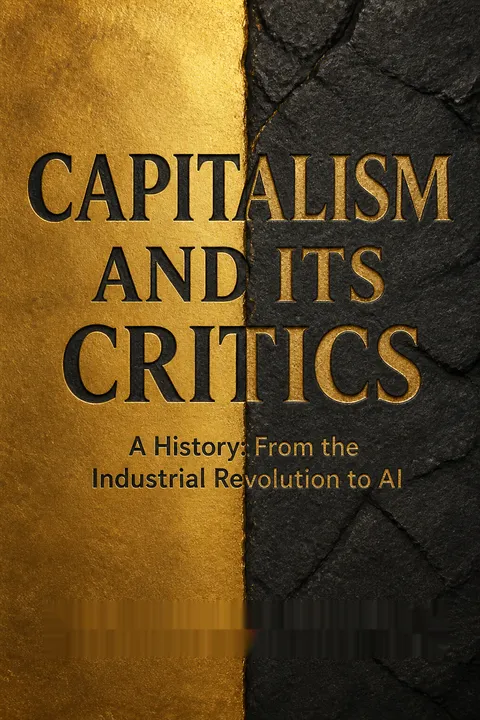


Key Takeaways
Read capitalism as a changing system, not a natural law
A moving target. Cassidy traces capitalism from colonial trade and early factories to corporations, managed economies, global supply chains, and artificial intelligence. He uses the term for systems organized around private ownership, investment of capital, and production for profit, while showing that their institutions and rules change over time. The critics differ sharply, but repeatedly ask who controls production, who receives its gains, and who bears its costs.
A history through dissent. From Adam Smith to Thomas Piketty, critics have warned that markets can reward monopoly, exploitation, inequality, instability, and destruction. Yet capitalism also generates extraordinary increases in output and productivity. The book’s central question is not whether the system is simply good or bad, but whether its power can be governed and its benefits broadly shared.
What's striking is the book's choice to treat criticism as a way of seeing the system, not as proof that every critic was right. The same economic change can create abundance for consumers and insecurity for workers, depending on where someone stands. This resembles institutional analysis: outcomes arise not from markets in the abstract, but from the rules around ownership, bargaining, and public authority. The method also has a limit. A history organized around critics can make their claims feel more coherent than the mixed evidence warrants, so each diagnosis still needs to be tested against the period it describes.
Follow the profits back to empire, slavery, and state power
A company becomes a government. The East India Company began as a trading enterprise, then gained military power and authority to collect taxes in Bengal. It could act as ruler and monopolistic buyer at once, forcing Indian producers to accept low prices. William Bolts exposed abuses, though his own account was self-interested. An internal company report later confirmed coercive purchasing. The company’s financial failures also led Britain to rescue it with public money and impose limited oversight.
A global industrial story. Adam Smith condemned chartered monopolies for combining private profit with public power. Eric Williams later argued that slavery and the triangular trade supplied markets, raw materials, and commercial activity that helped Britain industrialize. Historians dispute how much slave-trade profits directly financed factories, but the book shows that colonial commerce shaped the economy in which industrial growth took place.
The company’s story makes a durable political point: private ownership does not mean private power when a business can tax, police, and govern. Modern debates about corporate influence often focus on lobbying, but the East India Company shows a more direct fusion of commercial and state authority. The slavery argument also benefits from precision. Showing that colonial trade supported industrial development is not the same as proving that slavery alone caused the Industrial Revolution. Cassidy presents that distinction, preserving the moral and economic significance of slavery without reducing a complex transformation to one cause.
Judge technology by who controls its gains and bears its costs
Resistance had a logic. The Luddites were skilled textile workers who attacked machinery when employers used it to cut wages, undercut craft standards, and remove workers’ control. They were not simply opposed to invention. During the early nineteenth-century downturn, stocking knitters saw wages fall by about a third, while handloom weavers faced steep losses as power looms spread. Parliament criminalized machine breaking, and executions helped suppress protest without resolving workers’ insecurity.
Tools are not neutral in practice. Marx likewise distinguished machinery from its use under systems that reward owners for replacing labor. The distinction matters in the book’s discussion of artificial intelligence: new systems might complement workers and raise their capabilities, or substitute for them and weaken their bargaining position. Productivity gains do not decide which outcome occurs. Ownership, workplace rules, and the distribution of income help decide.
The Luddite episode clarifies a common confusion: opposition to a technology may actually be opposition to the terms on which it is introduced. That distinction is useful beyond factories, including debates about automation and AI. Productivity is a technical measure, while social benefit is a distributional judgment. A new tool can make production cheaper yet leave displaced workers worse off. The challenge is that protecting existing jobs is not always compatible with technological change. The stronger question is whether workers share in productivity gains and have a meaningful voice in transitions that reshape their livelihoods.
Explain inequality through ownership, bargaining power, and rent extraction
Look beneath earnings. Marx argued that workers create more value than they receive in wages, while owners retain the surplus. He also described unemployed workers as an industrial reserve army that can restrain wage demands. His account powerfully connects ownership and bargaining power, though his expectation that wages would remain near subsistence did not match later wage growth in many countries.
Different assets, similar questions. Henry George located the problem in land rents: as cities and economies grew, landowners could gain from rising land values without producing the underlying increase. His proposed remedy was to tax land value heavily. Thorstein Veblen examined status spending and the financial owners who could profit by controlling businesses without improving production. Piketty’s evidence of rising top income and wealth shares revived the question of how much inequality reflects contribution, and how much reflects power over assets.
These critics disagree about the main source of unearned income, but together they offer a practical diagnostic: distinguish productive contribution from income secured through ownership, scarcity, or bargaining advantage. This is more revealing than treating every high return as evidence of exceptional merit. At the same time, ownership and rent do not explain every difference in income. Skills, innovation, risk, and firm productivity also matter. The useful move is not to assume that all profits are exploitative, but to ask what institutions let some gains grow without a corresponding increase in value for others.
Count unpaid care as economic work, not private affection
The hidden workplace. Early feminists Anna Wheeler and Flora Tristan challenged laws and customs that made women financially dependent on men. They also confronted a changing labor market: women and children made up large shares of early textile workforces, while women remained responsible for much unpaid household labor. In the 1970s, Silvia Federici and the Wages for Housework movement argued that cooking, cleaning, and raising children sustain the paid workforce, although national accounts largely omit this work.
A political demand. Calling for wages was not only a request for household income. It was a way to expose how the economy relies on labor that is treated as natural duty rather than work. The campaign also challenged the separation between home and workplace, arguing that private family arrangements are shaped by public economic power.
The Wages for Housework argument connects feminist analysis to a basic measurement problem: what an economy counts as production reflects social choices, not a complete inventory of useful work. The comparison between paid and unpaid cleaning makes the omission easy to see. Recognition, however, does not automatically dictate a single remedy. Direct payments, public childcare, paid leave, and more equal sharing of care address different parts of the problem. The movement’s lasting contribution is to make unpaid labor visible as an economic condition, rather than to settle exactly how it should be compensated.
Treat global trade as a power relationship, not a neutral exchange
The center and the periphery. John Hobson argued that unequal incomes at home could leave rich countries with excess savings and weak consumer demand, encouraging imperial expansion in search of markets and investments. Later, Raúl Prebisch described Latin America as a peripheral economy whose export prices tended to weaken relative to manufactured imports. He and colleagues promoted import substituting industrialization, or building domestic industries behind protective measures.
Growth did not erase dependence. Latin America grew substantially during the postwar decades, but industrial gains were uneven, and many countries became reliant on imported machinery, foreign finance, and multinational firms. Dependency theorists argued that global trade could reproduce underdevelopment rather than automatically cure it. Their explanations were often too sweeping, but they redirected attention from trade volumes alone to who controls technology, investment, and the terms of exchange.
The center-periphery lens makes national averages less misleading by asking where value is created and where it goes. It also shows why identical trade rules can affect countries differently when their bargaining power and industrial capacity differ. Still, dependency is not destiny. East Asian economies combined state direction with export growth, complicating the claim that integration necessarily blocks development. The strongest lesson is conditional: access to markets can support growth, but domestic capabilities, public policy, and control over investment determine whether a country moves up the production ladder or stays confined to low-value roles.
Use public policy to stabilize markets before crisis becomes political rupture
Markets can stall. During the Great Depression, John Maynard Keynes argued that weak demand could leave businesses unwilling to invest and workers unemployed, even when resources sat idle. Public spending could raise demand through a multiplier, as one project’s wages became other people’s spending. After World War II, this approach became part of managed capitalism, alongside social insurance and international economic arrangements.
Protection follows exposure. Karl Polanyi argued that the state helped create free markets, including labor and land markets, and that society then pressed for protections against their harms. He called this interaction the double movement. The Depression showed how attempts to restore rigid market rules could intensify hardship and undermine democracy. Keynesian policies did not abolish crises, but they gave governments tools to limit economic collapse and political extremism.
The pairing of Keynes and Polanyi distinguishes two tasks that are often blurred: stabilizing demand and protecting people from market exposure. The first is macroeconomic, the second institutional and social. Neither is a complete substitute for the other. A spending increase can revive output without improving the distribution of power, while social protections can reduce hardship without restoring investment. The deeper point is that markets depend on public rules and public capacity. The debate is not state versus market in the abstract, but which interventions solve genuine coordination failures without creating new forms of capture or rigidity.
Expect full employment to provoke conflict over workplace authority
Jobs change power. Michał Kalecki argued that business leaders could oppose sustained full employment even when public spending helped profits. When workers no longer feared dismissal, they could bargain harder and challenge managerial control. Kalecki called attention to political limits on economic policy: employers’ confidence and investment decisions can give them influence over governments.
The backlash was concrete. In the 1970s, inflation and pressure on profits weakened support for postwar arrangements. Milton Friedman argued that policymakers could not permanently trade higher inflation for lower unemployment. Margaret Thatcher’s government then weakened unions, privatized public companies, and defeated the miners’ strike. British unemployment averaged 3.7 percent from 1960 to 1979 and 9.1 percent from 1980 to 1999. The shift restored managerial freedom but carried heavy social costs.
Kalecki’s contribution is to show that economic policy has a workplace politics. Full employment can alter the balance between managers and workers, so resistance may concern authority as much as inflation or profits. That does not make every inflation concern a pretext: rapid price increases can damage real incomes, especially for people with little bargaining power. The difficult policy question is how to coordinate wages and prices without using unemployment as the chief disciplinary tool. Thatcherism demonstrates the political effectiveness of the latter choice, but also the long-term costs of treating labor primarily as a variable cost.
Set ecological limits before growth spends the future’s resources
Production has a physical basis. Nicholas Georgescu-Roegen argued that economic production consumes energy and materials and generates waste, so the economy cannot be treated as a self-contained loop of money. His use of the entropy law emphasized that usable resources degrade and cannot be recycled without limit. J. C. Kumarappa made a related distinction between resources that renew through continuing flows, such as forest growth, and finite stocks such as coal.
Growth is a choice with tradeoffs. Georgescu-Roegen questioned whether efficiency and substitution could overcome physical limits. The book also presents the counterargument: higher prices and innovation can reduce resource use, and the United Kingdom cut emissions while its economy grew. Yet that example does not settle whether global growth can be decoupled from environmental damage quickly enough, or fairly enough, to protect poorer countries and future generations.
The ecological critique expands economics beyond prices to material throughput: every production system draws on physical resources and leaves residues. That is a necessary correction to models that treat nature as an unlimited backdrop. The hard question is not simply growth or no growth. It is which output grows, whose needs it serves, and whether emissions and resource use fall in absolute terms at the necessary pace. Innovation can reduce impact per unit, but efficiency alone may not prevent total use from rising when production expands.
Make AI raise worker capability, not merely replace labor
No ending is automatic. The book closes with capitalism facing climate change, inequality, financial instability, platform monopolies, and AI-driven displacement. Earlier crises did not end the system; governments repeatedly changed its rules, sometimes after severe damage. The likely direction depends on political choices, not on a fixed timetable for collapse.
Technology needs institutions. AI could help workers do tasks they could not previously perform, or allow companies to replace workers and concentrate control. The same tension appeared with factory machinery, but today’s tools diffuse much faster. Proposals discussed in the book range from stronger labor and competition rules to public investment, ecological limits, and new cooperative institutions. None is a ready-made successor system. Each asks how to keep innovation while preventing its gains from becoming a private windfall and its costs a public burden.
The final chapter resists both techno-utopian certainty and predictions of imminent collapse. That restraint matters because general-purpose technologies can create new capacities while disrupting existing jobs and institutions. The key distinction between complementing and replacing workers makes the debate concrete: productivity is not the same as shared prosperity. AI governance therefore belongs in labor policy, competition policy, and democratic oversight, not just engineering. The proposals remain incomplete, but the historical record supports one firm inference: technology’s social effects depend heavily on the ownership and rules surrounding its use.
Analysis
Cassidy’s organizing insight is that capitalism is best understood through repeated arguments over its boundaries. Each era produces a new version of the system, and critics identify different failure points: monopoly and colonial rule, mechanization and wage pressure, inadequate demand, financial instability, unpaid care, ecological limits, or global inequality. The book’s biographical structure turns those abstractions into lived conflicts. Bolts’s account of the East India Company, the Luddites’ desperate defense of skilled work, and Rosa Luxemburg’s opposition to war show that economic arguments emerge from institutions and historical circumstances, not from theory alone.
The strongest feature is its refusal to equate criticism with a single political program. Smith opposed monopoly while defending competitive markets; Keynes sought to stabilize capitalism; Kumarappa questioned growth itself; and Piketty proposed radical redistribution without claiming that history had supplied a ready-made alternative. This variety makes the book more than a parade of anti-capitalist arguments. It shows that the debate is also about what capitalism can become, and who has enough power to shape it.
The selection also has limits that Cassidy acknowledges. The story is centered largely on Europe and the United States, even when it concerns global systems. Its chosen thinkers are unusually articulate, while workers and communities more often appear through petitions, testimony, and the consequences of policy. Further, recurring predictions of collapse should not be confused with demonstrated laws. Capitalism has repeatedly adapted, but adaptation has often required state action and has not distributed gains evenly. The book’s deepest lesson is therefore not that one theory finally explains the system. It is that economic outcomes remain politically contested, and historical alternatives are real even when they fail, are suppressed, or are forgotten.
Review Summary
Capitalism and Its Critics receives mostly positive reviews, averaging 4.18/5. Readers praise Cassidy's sweeping, accessible survey of economic thinkers from Adam Smith to Piketty, appreciating its chronological, biography-driven structure and balanced treatment of complex ideas. Many highlight its value for non-economists and commend its inclusion of lesser-known figures like Polanyi, Kumarappa, and Federici. Critics note the book lacks a strong thesis, can feel like a surface-level textbook, and occasionally misrepresents thinkers. Some found it dense or dry, while others called it essential, timely reading.
People Also Read









Glossary
double movement
Market expansion and social protectionKarl Polanyi’s term for the paired development of market-making and protective responses. Governments establish or expand markets, including markets for labor and land, while groups in society press for laws and institutions that limit the resulting harms. The two processes interact and can produce political conflict rather than a stable, self-regulating market order.
monopsony
A market with one dominant buyerA market in which one buyer, or a small number of powerful buyers, faces many sellers with few alternatives. Because sellers depend on access to that buyer, it can push down the prices it pays. Cassidy uses the East India Company’s control over purchases from Bengal producers to illustrate how monopsony power can exploit weaker suppliers.
surplus value
Value workers produce beyond wagesIn Marxian analysis, surplus value is the value workers create beyond the value represented by their wages. The employer appropriates this remainder as profit or uses it to expand the business. Marx’s concept explains exploitation as a feature of wage production, even when workers and employers formally agree to a market exchange.
industrial reserve army
Unemployed workers disciplining wagesMarx’s term for the pool of unemployed or underemployed people available for work. Its presence can limit the bargaining power of employed workers because employers can replace them or use the threat of job loss to restrain wage demands. Engels had described this function before Marx developed it in Capital.
import substituting industrialization
Building domestic industry behind protectionA development strategy promoted by Raúl Prebisch and the Economic Commission for Latin America. Governments use tariffs, credits, and other support to encourage domestic firms to produce manufactured goods that had previously been imported. The approach produced substantial growth in parts of Latin America, but also contributed to uneven development and reliance on imported technology and foreign finance.
center-periphery
Unequal positions in global productionA framework associated with Raúl Prebisch that distinguishes industrial centers from countries positioned as suppliers of primary products. The theory argues that prices, bargaining power, and control of technology can allow the centers to retain more gains from productivity, while peripheral countries face weaker export prices and dependence on external markets.
Financial Instability Hypothesis
Booms can make finance fragileHyman Minsky’s account of why financial crises can arise from normal economic activity. During booms, lenders and borrowers become more willing to take risks, moving from loans backed by reliable cash flows to borrowing that depends on refinancing or rising asset prices. If credit tightens or prices fall, defaults and forced sales can spread through the system.
entropy law
Usable energy degrades over timeThe Second Law of Thermodynamics, applied by Nicholas Georgescu-Roegen to economic activity. Energy transformations reduce the amount of energy available for useful work and create waste. Georgescu-Roegen used this principle to challenge models that treat production as a closed circular flow and to stress that economic activity depends on finite physical resources.
social reproduction
Work that sustains the workforceThe paid and unpaid activities that maintain people and prepare future workers, including cooking, cleaning, childcare, and care for family members. Silvia Federici and other feminists argued that this labor supports the paid economy while often being excluded from wages and conventional measures of economic output.
Kondratiev wave
A proposed long economic cycleA long-term cycle of capitalist development, theorized by Nikolai Kondratiev, with an upswing and downswing lasting roughly a quarter-century each. Kondratiev associated these waves with large investments in basic capital goods and argued that capitalism could recover from downturns. The existence and causes of such cycles remain disputed.
r > g
Returns on capital exceed growthThomas Piketty’s shorthand for a condition in which the rate of return on capital exceeds the economy’s growth rate. When this persists, wealth already held can grow faster than wages and total income, encouraging greater concentration. Piketty treats it as a powerful tendency toward inequality, not as a complete explanation of every distributional outcome.
cash nexus
Relations reduced to paymentThomas Carlyle’s phrase for a society in which money and contractual payment become the dominant links between people. He used it to criticize the loss of social duties and reciprocal obligations under industrial capitalism. The phrase captures his concern that market transactions alone cannot meet the moral and communal needs of a society.
Download PDF
Download EPUB
.epub digital book format is ideal for reading ebooks on phones, tablets, and e-readers.








