Key Takeaways
1. The Paradox of Trading: Opportunity Amidst Widespread Failure
Today we live within a trading paradox where it’s both the best and the worst of times to be a trader.
Unprecedented access. The modern era offers traders unparalleled access to markets, instruments, and information. High-speed internet, smart trading apps, discount brokers, automated programs, and a vast ocean of trading knowledge make it seem like there's no excuse for failure. This technological wizardry and information abundance create an illusion of easy success.
Persistent failure. Despite these advancements, the stark reality remains: over 90% of active traders still fail. This enduring failure rate, consistent since the 1980s, highlights a profound disconnect between available resources and actual outcomes. The market is a confusing place, with an avalanche of questions about which markets, instruments, or techniques to choose, leading many to paralysis and poor decisions.
Beyond the noise. To navigate this paradox, traders must cut through the overwhelming noise and confusion. Success isn't found in chasing the latest "shiny" idea or relying on subjective opinions. Instead, it demands a realistic understanding of the market's true nature and a disciplined approach grounded in proven principles, rather than fleeting excitement or intellectual challenge.
2. Master the Math: 0% Risk-of-Ruin (ROR) is King, CAGR is Queen
If a trader wishes to enjoy longevity in the markets, they must commence trading with a 0% ROR.
Survival first. The absolute, non-negotiable priority for any trader is survival, which is directly tied to achieving a 0% Risk-of-Ruin (ROR). ROR is a statistical measure combining your strategy's expectancy (return per dollar risked) and your money management (capital risked per trade). Any ROR above 0% guarantees eventual ruin, making it the single most critical concept in trading.
Profitability metric. Once survival is secured, the next objective is to maximize returns, and the Compound Annual Growth Rate (CAGR) is the ultimate measure of a strategy's efficiency. Unlike average returns, CAGR reflects the true annualized compounded growth of your capital, providing an indisputable benchmark for profitability. An unscrupulous vendor might inflate "average" returns, but CAGR reveals the genuine long-term performance.
The universal truth. Profitable trading boils down to two core factors: the math and being the best loser. The math dictates a 0% ROR, achieved by combining a positive expectancy strategy with sound money management. This mathematical foundation is paramount, ensuring that your trading approach is statistically viable and not merely a gamble.
3. Embrace Losses: The Best Loser is the Long-Term Winner
The best loser is the long-term winner.
Losing is inevitable. Trading, especially trend trading, is inherently miserable and painful, characterized by frequent losses. Trend traders can expect to lose on average 67% of their trades. This reality demands a fundamental shift in mindset: instead of trying to avoid losses, traders must learn to welcome and accept them as an unavoidable cost of doing business.
Overcoming disposition effect. Most traders are "bad losers," succumbing to the disposition effect—the tendency to hold onto losing trades too long and sell winning trades too early. This emotional bias is a primary driver of failure. Successful traders, conversely, are "gold medalists at losing," consistently cutting losses short without anger or hesitation, adhering strictly to their trade plan.
Endurance is key. The path to profitability is not a smooth ride; it's a constant cycle of drawdowns and new equity highs. Surviving these turbulent, dark, and often despondent periods requires immense persistence and a robust psychological framework. Only by enduring the pain of repeated losses can a trader remain in the game long enough to capitalize on the few, but significant, winning trades that drive long-term success.
4. Science Validates Trend Trading: Exploit Market's "Fat Tails"
The existence of fat tails puts a mighty wrinkle in the bell curve theory and validates the pursuit of trend trading.
Challenging academic dogma. Traditional academic theories like the Random Walk Theory (RWT) and Efficient Market Hypothesis (EMH) assert that market prices are random and normally distributed, making it impossible to predict future movements or earn abnormal returns. These theories underpin many financial models, yet they fundamentally misrepresent market behavior.
The reality of "fat tails". Empirical evidence, however, reveals that market returns do not follow a normal bell-curve distribution. Instead, they exhibit "fat tails" – a significantly higher frequency of extreme price movements (both positive and negative) than a normal distribution would predict. These fat tails are not random anomalies but inherent features of market dynamics, occurring across all timeframes.
The scientific edge. The existence of fat tails scientifically validates trend trading. These extreme, directional moves are precisely what trend-following strategies aim to capture. While the RWT and EMH dismiss the value of studying past prices, the consistent appearance of fat tails proves that markets are not perfectly efficient or random, offering a tangible edge for disciplined traders who follow the trend.
5. Simplicity and Robustness are Gold: Avoid Complexity and Curve Fitting
The bottom line was, after 17 programmers and 4 or 5 years of testing, the basic 4 or 5 systems worked best.
Complexity kills. Many traders mistakenly believe that complex strategies with numerous rules, filters, and indicators offer a superior edge. However, complexity is often a symptom of excessive curve fitting—tailoring a strategy too perfectly to historical data, capturing noise rather than meaningful signals. This leads to fragile strategies that fail dramatically in live trading.
Embrace "less is more". Robust strategies are characterized by simplicity:
- Few rules: Minimizing discretionary decisions and potential for bias.
- Few indicators: Reducing reliance on variable-dependent tools that can be easily manipulated.
- Few variables: Limiting degrees of freedom to prevent over-optimization.
- Consistent values: Using the same variable values for both buy/sell setups and across all markets.
This approach ensures that the strategy captures broad market movements rather than specific historical quirks.
Robustness is the Holy Grail. A truly robust strategy performs consistently well across diverse market conditions and over extended periods, exhibiting a stable, upward-sloping equity curve on out-of-sample data. This stability, rather than dazzling but fleeting performance metrics, is what sustains a trader through inevitable drawdowns and builds long-term confidence.
6. Seek Evidence: Old, Proven Strategies Outperform New Ideas
The more time, the more out-of-sample results there is. The more time, the more evidence there is a strategy is robust.
History's lessons. The most reliable trading ideas are often the oldest. Strategies developed decades or even centuries ago, like David Ricardo's principles or Dow Theory, offer a wealth of "out-of-sample" performance data. This historical evidence is invaluable, proving their durability and effectiveness across countless market cycles and unforeseen events.
Beware the "new and shiny". Marketers exploit human nature's attraction to novelty, promoting "cutting-edge" strategies that promise to erase past losses. These new ideas, however, lack any real-world track record. They cannot provide hard evidence of robustness because no out-of-sample data exists, making them inherently speculative and often dopamine-driven marketing ploys.
The power of out-of-sample. When evaluating any strategy, prioritize those with extensive out-of-sample performance. This means the strategy has been tested and proven after its initial development or publication, not just optimized to fit past data. This verifiable track record builds genuine confidence, allowing traders to stick with a strategy during tough times, knowing it has endured similar challenges before.
7. Measure Real Risk: The Ulcer Performance Index (UPI) is Superior
The Ulcer Performance Index (UPI) is a far more accurate risk-adjusted return measurement as it recognizes and focuses on real individual and sequential (drawdown) downside risk.
Beyond standard deviation. Traditional risk metrics like the Sharpe Ratio, which use standard deviation as a proxy for risk, are fundamentally flawed for traders. Standard deviation treats all volatility—both positive (profits) and negative (losses)—equally, and it ignores the sequence of returns, failing to capture the psychological and financial pain of drawdowns.
The Ulcer Index (UI). A superior measure of risk is the Ulcer Index (UI), developed by Peter Martin. The UI specifically quantifies the depth and breadth of percentage drawdowns from equity highs. It focuses on the "real" risk that matters to traders: the average historical drawdown, reflecting how painful a strategy has been to trade.
The Ulcer Performance Index (UPI). Martin's UPI combines annual excess returns with the UI, providing a powerful risk-adjusted metric. It measures the return generated per unit of average drawdown risk, offering a far more accurate picture of a strategy's efficiency and tradability. A higher UPI indicates a better balance of returns for the experienced pain, guiding traders toward strategies that are not only profitable but also psychologically manageable.
8. Develop Turn-Key Strategies: Eliminate Subjectivity and Bias
Without specific rules you won’t be able to calculate a strategy’s expectancy and hence your ROR.
The discretionary trap. Most traders operate with incomplete or subjective trade plans, relying on their "discretion" to make final decisions. This approach is fraught with peril because it prevents the accurate calculation of expectancy and ROR, leaving traders blind to their true risk. Furthermore, it opens the door wide to cognitive biases that distort perception and decision-making.
Objective rules are essential. A "turn-key" strategy is one with clear, unambiguous, and objective rules for every aspect of trading:
- Setups: Precisely defining when a trading opportunity exists.
- Entry: Exact conditions for initiating a trade.
- Stops: Non-negotiable levels for cutting losses.
- Exits: Clear criteria for taking profits.
These explicit instructions allow for rigorous backtesting and ROR calculation, transforming trading from gambling into a purposeful, evidence-based endeavor.
Combatting cognitive biases. Turn-key strategies act as a powerful shield against inherent human biases like confirmation bias, recency bias, and anchoring bias. By removing subjective interpretation, they force traders to execute their plan without emotional interference. While a trader might still choose to be a "discretionary mechanical trader" (selectively taking signals from a proven system), the underlying methodology must be 100% objective to ensure a 0% ROR.
9. Benchmark Your Efforts: Surpass Proven Methodologies like Turtle Trading
If your efforts cannot surpass the benchmark, then you should consider trading it. Not your own designed strategy.
Avoid the relevancy trap. Many traders fall into the "relevancy trap," feeling compelled to trade only strategies they've personally developed, even if those strategies are inferior. This ego-driven pursuit often leads to underperformance. To counter this, every serious trader needs a robust, established benchmark strategy against which to measure their own development efforts.
Turtle Trading as the benchmark. The Turtle Trading strategy, a channel breakout system taught in 1983, serves as an excellent benchmark. It boasts:
- 37+ years of out-of-sample performance: Undeniable evidence of robustness.
- Simplicity: Few rules, no complex indicators.
- Strong risk-adjusted returns: High UPI and favorable reward/risk ratio.
- Manageable drawdown: Historically within acceptable limits for many traders.
If your self-developed strategy cannot objectively outperform Turtle Trading across key robustness and performance metrics, then trading the benchmark is the more rational and profitable choice.
The development blueprint. The strategy development process involves a six-step plan: find, code, review, compare, adjust (without curve fitting), and complete an equity curve stability review. This iterative process, always measured against a strong benchmark, ensures that any new strategy is rigorously tested and truly superior before being deployed with real capital.
10. Diversify Across Timeframes and Markets: The Holy Grail of Investing
Multiple uncorrelated strategies over multiple timeframes over multiple markets will smooth out your equity curve.
The power of uncorrelated assets. While individual strategies may experience drawdowns, combining multiple uncorrelated methodologies across diverse markets and timeframes can significantly smooth out overall portfolio equity. This diversification is considered the "Holy Grail of Investing" by experts like Ray Dalio, as it reduces reliance on any single market or technique.
Strategic diversification. A well-constructed portfolio should include:
- Technique diversification: A mix of trend-following and counter-trend strategies. When markets are choppy, counter-trend strategies can offset losses from trend followers, and vice-versa.
- Timeframe diversification: Operating across short, medium, and long-term horizons to capture different market cycles.
- Market diversification: Trading a broad portfolio of liquid, uncorrelated assets (e.g., currencies, commodities, indices, interest rates) to avoid concentration risk.
Smoother equity, better risk management. This multi-faceted diversification provides more trading opportunities, mitigates the risk of individual strategy or market failure, and ultimately leads to a smoother, more resilient equity curve. By embracing diversification, traders can enhance risk management and increase the likelihood of long-term, sustainable profitability.
Last updated:
Review Summary
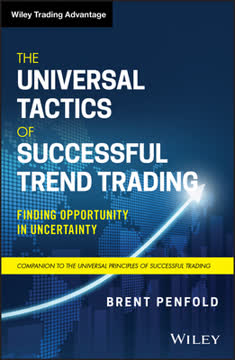
The Universal Tactics of Successful Trend Trading receives a 4.21 rating from 33 reviews. Readers appreciate its theoretical depth on price behavior and fat tails, though some basic content overlaps with the author's previous work. The book critiques the Sharpe Ratio, favoring the Ulcer Performance Index for risk-adjusted returns. A highlight includes testing classic strategies like Turtle Trading and Dow Theory, demonstrating their continued effectiveness. While the first half contains statistical weaknesses, the second half is considered strong, offering evidence-based strategies valuable as an ongoing reference.
Similar Books