

Key Takeaways
Treat the thirty-minute routine as the payoff for years of system-building
Freedom came after the failures. Bensdorp began trading with a family portfolio that had fallen about 30 percent in a few months. After rejecting advisers’ advice to buy more, he sold before Enron and WorldCom collapsed. His next attempt, trading on news with $30,000, brought constant anxiety and health problems. Years of study, strategy testing, and automation turned that chaotic approach into a rule-based routine.
The time claim has a catch. The book’s thirty minutes describes daily maintenance after the hard work of designing, programming, and testing a strategy. It is not a promise of easy income or a shortcut around risk. The author’s own front matter warns that simulated results do not guarantee future performance.
The personal arc gives the book a useful center of gravity: less screen time is an outcome of preparation, not a trick for producing returns. That distinction matters in any skilled occupation, where fluent performance often rests on invisible practice. Yet the freedom story can also make trading sound more dependable than it is. A flexible schedule is plausible; lifelong financial independence is not assured by automation, and readers should separate the lifestyle aspiration from evidence about a strategy’s future returns.
Trade tested price behavior, not stories about what prices should do
React instead of forecasting. Bensdorp contrasts discretionary trading, which interprets news and company fundamentals to predict what comes next, with strategic trading, which follows defined rules based on historical price movements. He treats price action as a measurable expression of market sentiment. In his example, gold fell from roughly $1,900 to $1,050 between 2011 and 2015 despite bullish arguments for owning it. A trend-based exit could have moved a trader out before the full decline.
Rules beat improvisation. The author also recounts the Turtle experiment, in which traders were taught a systematic method. He highlights that those who followed the rules most consistently performed best. The lesson is not that prices reveal a company’s true worth, but that a tested exit rule can protect traders from defending a losing prediction.
The strongest case for price-based rules is epistemic humility: markets aggregate many views, while an individual trader’s explanation can become a defense of a position. The approach also resembles feedback control, where action responds to observed conditions rather than a hoped-for forecast. Still, past price patterns do not establish a durable edge by themselves. A rule can be explicit and consistently executed yet fail when market structure changes, so evidence and ongoing risk limits remain essential.
Build a strategy your temperament can actually execute during losses
Self-knowledge is risk control. Bensdorp argues that a strategy must fit a trader’s patience, routines, beliefs, and tolerance for going against the crowd. Someone impatient may abandon trend following before its larger winners arrive. Someone unable to ignore alarming news may struggle to buy oversold stocks, the core move in a mean-reversion approach. Trading for thrills is particularly dangerous because it encourages people to seek excitement rather than follow a process.
Weaknesses can be designed around. The author describes himself as disinclined toward detail and routine, so he used programmers and automation to handle work that did not suit him. He discusses Myers-Briggs preferences as a prompt for reflection, not an absolute classification. His practical test is whether a person can follow a strategy through its losing periods, not whether the strategy looks attractive on paper.
This is a human-factors argument, not merely a personality exercise. In aviation and medicine, reliable systems account for predictable human limitations instead of assuming perfect attention and judgment. A trader can apply the same logic by reducing discretionary decisions and matching the workload to real habits. Personality tests should not be treated as destiny, however. Observed behavior under stress, including small-scale real trading, is more informative than a type label.
Specify every trading decision before automating the strategy
Turn beliefs into instructions. Before coding, the trader needs an objective and a testable belief about market behavior. The book organizes a complete strategy around decisions such as what to trade, which stocks qualify, how to rank candidates, when to enter, and how to exit. It also asks traders to define position size, stops, reentry rules, and profit-taking in advance. This removes the temptation to invent a new rationale after a trade starts moving against them.
Build in the right order. Objectives include more than a target return. They include acceptable drawdowns, available time, trade frequency, and personal constraints such as whether an account permits short selling. Indicators should quantify an existing idea, not supply one by themselves. For example, a moving average can help define an uptrend, while an oscillator can help identify an unusually oversold stock.
The value of this planning structure is that it exposes hidden choices. A trader who says they follow a strategy may still be improvising on stock selection, trade size, or exits. Making those choices explicit improves both testing and accountability. The structure does not make a strategy sound, though. A fully specified method can still encode a weak hypothesis, and precision should not be mistaken for proof.
Combine strategies that struggle in different market conditions
Different methods need different weather. Trend following aims to capture sustained price moves, but can be whipsawed when markets move sideways. Mean reversion looks for prices that have moved unusually far and may snap back, while short strategies can benefit from declines. Bensdorp proposes running several tested approaches together rather than betting on a forecast about whether the market will rise, fall, or stall.
Diversification must be tested. The book reports that adding a short mean-reversion strategy to its Weekly Rotation backtest raised annualized return from about 19 percent to 26 percent and reduced maximum drawdown from roughly 30 percent to 23 percent. These are historical model results, not expected returns. The author calls a combination of strategies with different performance patterns noncorrelated, but correlations can change, and short trades may be unavailable or restricted.
The portfolio logic is stronger than the claim that a collection can profit in every market. Combining distinct sources of return can smooth outcomes, much as mixing assets with different risk exposures can reduce dependence on one outcome. The crucial word is distinct: several strategies that all react to the same market shock may offer little real diversification. Correlation should be measured across stressful periods as well as calm ones, and operational constraints on short selling matter.
Choose tolerable losses before deciding how much return to pursue
Risk capacity sets the scale. Position sizing determines how much capital is exposed on each trade. In one example, a trader risks 2 percent of equity on a position, calculating the share count from the distance between entry and stop. The book adds a cap on total position size because a stock can gap past a stop, making the planned loss larger than expected.
Imagine the dollars, not just percentages. Bensdorp says people often overestimate their ability to withstand a drawdown, so he asks them to picture the actual loss in their account. A 50 percent decline requires a 100 percent gain just to recover. He recommends beginning with a smaller risk level than the trader believes they can handle, then learning from experience. Lower exposure usually means lower potential returns, but may make consistent execution more realistic.
This is a practical application of loss aversion: abstract percentages often feel manageable until they become rent, tuition, or retirement savings. Converting a drawdown into dollars makes the decision concrete and helps prevent a risk plan from being built around bravado. Position limits cannot eliminate gaps, liquidity problems, or correlated losses. Their purpose is to keep exposure within a chosen range, not to make a risky asset safe.
Use weekly momentum or short-term reversals for distinct market patterns
Momentum follows strength. The Weekly Rotation strategy checks the broad market’s position relative to its 200-day moving average, then selects up to ten S&P 500 stocks with strong 200-day price gains. Positions are reviewed weekly and replaced when they no longer rank among the leaders. If the market filter fails, the strategy can sit in cash, limiting exposure during some declines.
Reversals buy or sell extremes. The book’s long mean-reversion model searches for volatile stocks in a longer-term uptrend that have become sharply oversold, then aims to exit after a small rebound or a time limit. Its short counterpart looks for unusually overbought stocks and bets on a pullback. The models use explicit filters and exits, but their historical performance depends on the chosen data, rules, and trading costs.
These examples make the book’s central distinction concrete: momentum joins an established move, while mean reversion bets that an extreme move will partially reverse. They are not simply opposite opinions about the market; each requires different entry logic, patience, and tolerance for losing streaks. Readers should resist copying the settings as universal recipes. Small changes in filters, available stocks, and execution costs can materially alter a backtest.
Challenge impressive backtests before risking real money
A polished curve can deceive. A backtest applies rules to historical market data to estimate how a strategy might have performed. Bensdorp warns that exceptionally strong results may reflect over-optimized settings, software errors, or lucky historical patterns. He describes asking a business partner to try to break each new strategy and recommends checking whether its underlying market logic makes sense.
Test the plumbing too. His strategies use historical records that include stocks later removed from indexes or delisted, an important safeguard against survivorship bias. Yet a backtest still cannot fully reproduce live trading. Slippage, liquidity, short availability, changing rules, and the temptation to abandon a strategy can all widen the gap between simulated and actual results. The book itself says past results do not guarantee future outcomes.
The instruction to falsify rather than celebrate a model aligns with good scientific practice: a hypothesis earns confidence by surviving attempts to disprove it. Including delisted securities is a meaningful defense against one common source of inflated results. But robustness requires more than a plausible story and a long historical chart. Out-of-sample tests, realistic transaction costs, and small live trials can reveal weaknesses that the original optimization process hides.
Measure trading success by rule-following, not daily profit
Losses are part of the method. A losing trade is not automatically a mistake; in this framework, a mistake is overriding a valid rule. Bensdorp treats trading as a business whose results emerge across many trades, not as a daily contest in being right. He recommends logging trades and execution errors so that the trader can compare actual behavior with the tested plan and spot problems such as a software bug.
Routine protects attention. Once the system is designed, the intended routine is to update end-of-day data, scan for signals, place orders, and return to ordinary life. The author argues against watching financial news or monitoring positions intraday when those activities invite emotional overrides. This discipline is useful only if the strategy and its risks have been understood; automation can execute flawed instructions just as consistently as sound ones.
The process scorecard helps separate decision quality from short-term luck, a distinction used in many probabilistic professions. It also turns execution errors into observable data instead of moral failures. The counterpoint is that adherence cannot become blind faith. A rule-based trader still needs predefined conditions for checking data quality, broker failures, and whether live performance has diverged materially from the model. Discipline includes following a review process, not merely refusing to reconsider.
Analysis
The book’s most durable contribution is its account of trading as a design problem. It asks readers to connect market beliefs, explicit rules, personal limits, and execution into one system. That is more useful than presenting a collection of indicators as a secret formula. The personal narrative supports this argument: Bensdorp’s early dependence on news and intuition produced stress, while years of measurement and automation made the work more structured.
The book is also a sales-minded presentation of specific strategies and strong historical results. Its own disclaimer correctly notes that simulated performance is not a promise. Readers should therefore treat reported returns as claims about particular historical tests, not as a forecast or proof that an edge will persist. A backtest can be undermined by optimization, incomplete costs, market changes, or a trader’s inability to follow its drawdowns. Combining approaches may help, but diversification is conditional on their risks remaining meaningfully different.
A useful reading is to separate the process lessons from the performance promises. Define a hypothesis, specify the rules, test them skeptically, limit exposure, and observe real execution. Those steps can improve decision quality even if a given strategy disappoints. Automation reduces impulsive intervention, but it does not remove uncertainty or make losses harmless. Nor does a thirty-minute routine describe the years of research, capital, software, and operational support that may precede it.
Ultimately, the book is most convincing when it argues for humility, precommitment, and personal fit. It is least convincing when its confident language makes complex markets sound reliably manageable. The reader should keep the discipline and testing framework, while independently verifying every return claim and deciding whether the capital at risk can genuinely be lost.
Review Summary
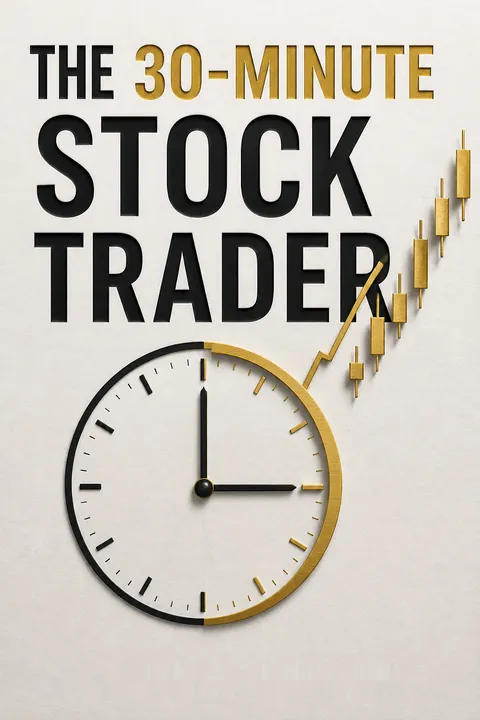
The 30-Minute Stock Trader receives mostly positive reviews, with readers praising its clear, practical approach to automated stock trading. Many appreciate the step-by-step instructions for creating a personalized trading strategy based on historical data. Readers find the book accessible for both beginners and experienced traders, valuing its emphasis on time efficiency and lifestyle adaptability. Some critics note the book's self-promotional aspect, but most reviewers consider it a valuable resource for those seeking financial freedom through systematic trading.
People Also Read









Glossary
Strategic trading
Rule-based market participationBensdorp’s term for trading through predefined rules based mainly on historical price behavior. A strategic trader responds to specified market conditions instead of making fresh predictions from news or company analysis. The method is intended to reduce discretionary decisions, but its rules still need testing, risk limits, and realistic execution.
Mean reversion
Trading a move backA strategy based on the idea that unusually large price moves may partly reverse. In the book’s long version, the trader buys a stock that has become oversold, often while it remains in a broader uptrend, and seeks to exit after a rebound. The short version looks for overbought stocks and anticipates a decline.
Trend following
Staying with price momentumA trading approach that enters in the direction of an established price trend and exits when rules indicate that the trend has weakened or ended. It seeks to capture a portion of large sustained moves, accepting that many trades may lose and that some profits can be given back before an exit signal appears.
Lockstep
Assets moving togetherBensdorp’s label for periods when stocks from different sectors move in the same direction because broad market sentiment dominates their individual differences. In such conditions, holding a variety of sectors may provide less protection than expected. The term emphasizes that sector diversification does not necessarily protect a portfolio from a broad market decline.
Weekly Rotation strategy
Weekly stock momentum selectionA long-only strategy described in the book that checks the broad market against a 200-day moving-average band, then selects up to ten S&P 500 stocks with strong recent performance. Positions are reviewed weekly and rotated out when they no longer rank among the leaders. When the market filter is not met, the strategy may remain in cash.
Fixed fractional risk
Fixed equity risk per tradeA position-sizing method that sets a chosen fraction of account equity as the planned risk on each trade. The number of shares is calculated from that risk amount and the distance between the entry price and stop price. Because prices can gap through stops, the method does not guarantee that the realized loss will stay within the planned fraction.
ATR%
Price-adjusted volatility measureAverage True Range expressed as a percentage of a stock’s price. Average True Range estimates typical price movement over a selected period; converting it to a percentage makes volatility more comparable across stocks with different share prices. Bensdorp uses ATR% as a filter for identifying stocks with enough movement for certain short-term strategies.
Turtle experiment
Rules-based trader trainingThe book’s reference to the trading experiment associated with Richard Dennis and Bill Eckhardt, in which trainees learned a systematic method. Bensdorp uses the story to emphasize consistent execution: people following the rules more closely performed better than those who deviated. The lesson concerns adherence, not a guarantee that any particular system remains profitable.
twelve ingredients
Components of a trading planBensdorp’s organizing checklist for specifying a trading strategy. It covers objectives and beliefs, the securities and filters used, trade setups and rankings, entry and exit decisions, and position sizing. Together, these decisions make a strategy testable and executable. Completing the checklist does not establish that the strategy has an edge; that requires separate evidence.
Download PDF
Download EPUB
.epub digital book format is ideal for reading ebooks on phones, tablets, and e-readers.








