

Key Takeaways
Let thought experiments stretch your senses, while evidence keeps the journey honest.
A journey in the mind. The book begins on a beach beneath the stars, then sends the reader through the solar system, galaxies, atoms, and the early universe. These are imagined trips, not claims of physical travel. Each scene makes a difficult idea easier to picture, from gravity to quantum fields.
Imagination with guardrails. The trip follows what science could describe in the book's early twenty-first-century setting, while its boundaries become part of the story. Some claims are established by observation, others are mathematical proposals, and some remain mysteries. The reader's task is not to accept every image literally, but to use it to ask better questions.
Thought experiments are a form of model-building: they let people test the consequences of an idea before an experiment is possible. Their strength is also their danger. A vivid picture can make a metaphor feel like a physical object, as when spacetime is described as a fabric. The book's beach-to-atom journey works best when readers keep that distinction in view. The narrative encourages curiosity, while the evidence hierarchy supplies discipline: an observed effect, a tested theory, and a speculative extension are not interchangeable.
The atoms in your body were forged in stars that had to die.
Stellar foundries. Stars shine because gravity compresses their cores until hydrogen nuclei fuse into helium, releasing energy. As stars evolve, they forge heavier elements. The book emphasizes that carbon, oxygen, and other atoms in Earth and human bodies came from earlier generations of stars, then entered the clouds from which new stars and planets formed.
Death makes worlds possible. Without stellar processes scattering heavier elements, the universe would contain almost entirely hydrogen and helium. The Sun itself is expected to swell and threaten Earth in roughly five billion years. The opening vision of that future gives the cosmic story a human stake: the same processes that made life possible also make our world temporary.
Stellar origins connect personal identity to cosmic history without requiring mystical claims: the atoms in a body have a history older than Earth. This is a useful example of how science can enlarge a sense of belonging while preserving material explanations. The book's dramatic opening does simplify stellar endings. The Sun is not expected to explode as a supernova; the central point is that its later evolution will make Earth uninhabitable. Distinguishing the vivid warning from the precise mechanism keeps wonder from becoming misinformation.
Treat gravity as geometry, and time as local rather than universal.
Einstein revises Newton. Newton's equations describe planetary motion remarkably well, but they leave a small unexplained shift in Mercury's orbit. Einstein's general theory of relativity explains gravity as the effect of matter and energy on spacetime's geometry. Objects and light follow that geometry, rather than being pulled by an invisible rope.
Clocks disagree. Special relativity adds that motion affects elapsed time, while general relativity says gravity does too. In 1971, Hafele and Keating flew atomic clocks around Earth and found tiny differences from a clock left on the ground, broadly matching predictions. GPS also requires adjustments for clock differences between satellites and Earth. Time is not a single universal ticker.
The shift from force to geometry is more than a change of metaphor. It replaces a familiar explanation with a framework that predicts new observations, including the bending of light and differences in clock rates. The book's rubber-sheet image helps introduce curvature, but a sheet is only a partial analogy: spacetime is not a material surface sagging into some outside space. The distinction matters because successful scientific pictures are often scaffolds, not literal portraits. Their value lies in the predictions they support.
Read distant light as history: redshift reveals an expanding, once-hot universe.
The sky sends old news. Light takes time to travel, so looking far away also means looking into the past. Scientists use the distinctive patterns in starlight to identify the atoms in distant objects. They also find that light from remote galaxies is shifted toward redder wavelengths. The more distant the galaxy, the greater the shift, evidence that space itself is expanding.
A hot beginning leaves a trace. Reversing that expansion implies a denser, hotter past. The cosmic microwave background is leftover radiation from when the universe became transparent, about 380,000 years after the Big Bang. Today it is roughly 2.7 kelvin above absolute zero. The surface of last scattering marks the farthest light we can see, not necessarily the edge of all existence.
Cosmology is a historical science: its evidence arrives as light that has crossed immense distances, so observation and reconstruction are inseparable. The case for a hot early universe is powerful because several lines of reasoning converge, including expansion and the background radiation. Yet a horizon must not be mistaken for a wall around the entire cosmos. It marks a limit on information available to observers here. That distinction is a broader lesson in science: the boundary of measurement is not automatically the boundary of reality.
Explain ordinary matter through fields, electrons, and the rules they obey.
Matter has structure. Atoms contain nuclei surrounded by electrons. Nuclei contain protons and neutrons, which are built from quarks held together by gluons. The book presents particles as expressions of underlying quantum fields, with photons carrying electromagnetic interactions and other field particles associated with the strong and weak interactions.
Tiny rules shape daily life. The Pauli exclusion principle prevents identical electrons from occupying the same quantum state. This helps explain why atoms form layers, why chemistry varies between elements, and why solid objects resist being pushed through one another. Most of the mass in protons and neutrons comes from the energy of the strong interaction, while the Higgs field contributes mass to some fundamental particles. The familiar world grows from these hidden rules.
The explanatory payoff is striking: the same underlying physics accounts for both an atom's chemistry and the apparent solidity of a table. That is a powerful reduction, but reduction is not the same as saying that every higher-level description is dispensable. Chemistry and biology still require their own concepts and methods. The field metaphor also needs care. It helps readers imagine a common origin for particles, but fields are not literally invisible oceans filled with miniature beads. The book's strongest claim is explanatory unity, not a simple mechanical picture.
Empty space is active, but quantum uncertainty is not a license to control reality.
The vacuum is not blank. In quantum field theory, even a region cleared of ordinary particles retains fields in their lowest-energy states. The book describes temporary fluctuations and uses the Casimir effect, a measurable force between closely spaced plates, to show that different arrangements of a vacuum can have physical consequences.
Observation has limits. Quantum theory predicts probabilities rather than a single certain outcome for many measurements. The Heisenberg uncertainty principle limits how precisely position and momentum can be specified together. Schrödinger's cat dramatizes the unresolved question of how quantum possibilities relate to the everyday world. These ideas do not imply that human attention can freely reshape events. They describe constraints built into the theory and experiments, not personal powers.
Quantum theory unsettles everyday intuition because its mathematics does not describe tiny versions of familiar objects moving along hidden, ordinary paths. The book's image of particles exploring every possible route is a vivid way to introduce the path-integral formulation, but those routes are not best understood as little classical journeys. Likewise, measurement does not necessarily mean a conscious person looking; physical interaction and environmental decoherence matter. The unresolved status of quantum interpretation is genuine, and readers benefit from separating tested predictions from competing stories about what the equations mean.
About 95% of the cosmos is inferred through effects, not directly seen.
Gravity reveals missing mass. Stars at the edges of galaxies move too quickly for the visible matter alone to hold them in orbit. Observations of galaxies and clusters support the presence of dark matter, an unseen component that contributes gravity. The book gives an approximate ratio of five parts dark matter to one part ordinary matter.
Expansion reveals another mystery. Measurements of distant supernovae showed that cosmic expansion is accelerating, prompting the name dark energy for whatever drives that effect. In the book's 2015-era accounting, ordinary matter makes up about 4.6% of the universe, dark matter about 23%, and dark energy about 72%. The labels describe evidence and effects. They do not yet identify what either dark component is.
These mysteries show science working through inference rather than direct sight. Astronomers do not need to see dark matter to test whether its gravitational effects match observations across different systems. Dark energy is more conceptually unsettled: accelerated expansion is observed, while its cause remains unclear. Modified theories of gravity are also possible explanations to examine. The book's percentages should be read as estimates from its period, not eternal constants. The durable insight is the imbalance between what can be measured and what is understood.
Treat black holes as stress tests for physics, not proof that speculation is settled.
Gravity reaches a limit. General relativity predicts singularities where its account of spacetime breaks down, including at the centers of black holes and in descriptions of the universe's earliest moments. A black hole's horizon is a boundary beyond which light cannot escape to distant observers. Stephen Hawking's calculations predict that black holes emit radiation and can evaporate, bringing quantum physics and gravity into the same problem.
The frontier remains open. If evaporation erases information about what fell in, it creates the black hole information paradox. The book surveys possible responses, including inflation, a universe without boundary, and string theory with extra dimensions and branes. These are proposals, not equally confirmed discoveries. The search for a quantum theory of gravity is the larger goal connecting them.
Black holes are valuable because they force two highly successful frameworks into the same extreme setting. General relativity describes gravity at large scales, while quantum field theory describes matter and its interactions, but neither framework alone resolves the deepest black-hole questions. Hawking radiation remains a theoretical prediction in the book's account, and string theory has not supplied decisive experimental confirmation. This is not a weakness in the narrative so much as its central lesson: a coherent mathematical idea can guide research without yet earning the status of established fact.
Analysis
The book's deepest achievement is architectural. It turns scale into a teaching method: a beach becomes a launch point, the Sun becomes a nuclear furnace, an airplane introduces relative time, a kitchen magnet opens onto fields, and a black hole exposes the limits of existing theories. This sequence gives readers a felt reason to revise intuition instead of merely memorizing terminology. The recurring imagined traveler also unifies subjects that are usually taught in separate courses.
Its epistemic structure is strongest when it distinguishes observation from inference. Mercury's orbit tests gravity, atomic clocks test relativity, spectra reveal composition, and the cosmic background supports a hot early universe. The narrative then crosses into less certain territory, where dark components, inflation, black-hole evaporation, and strings carry different evidential weight. That progression models a crucial scientific habit: confidence should track the kind of evidence available.
The accessible metaphors are both asset and liability. A curved fabric, a sea of fields, or particles taking every path makes abstraction memorable, but each can be mistaken for a literal mechanism. In particular, quantum measurement and vacuum fluctuations are more nuanced than a simple story of observers making possibilities choose. Readers should treat these scenes as intuition aids, then return to the mathematical and experimental claims they are meant to illuminate.
The book is explicitly framed by knowledge available around 2015, so its numerical estimates and descriptions of active experiments belong to that moment. Its most durable conclusion is not that science has already explained everything. It is that reliable theories can be powerful within known limits, and that those limits provide the clearest map of where new questions begin. The result is a popular science journey that preserves wonder without pretending that wonder is evidence.
Review Summary
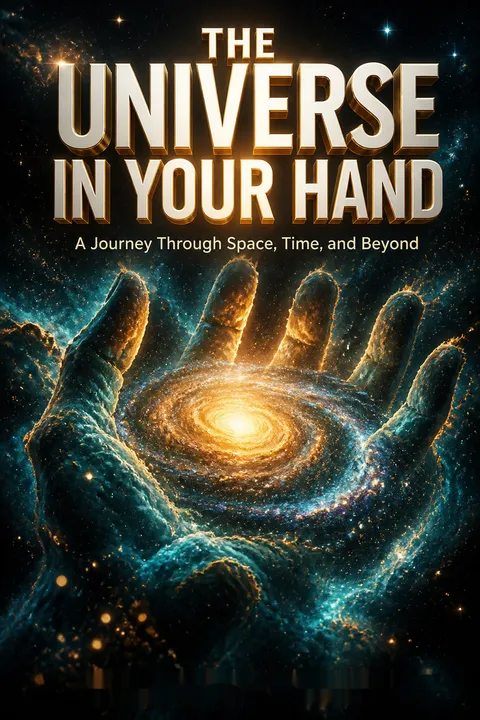
The Universe in Your Hand receives mostly positive reviews for making complex physics concepts accessible to general readers. Many praise Galfard's engaging writing style and ability to explain difficult ideas clearly. Readers appreciate the book's comprehensive coverage of modern physics, from relativity to quantum mechanics. Some find certain sections challenging or confusing, but overall the book is seen as an excellent introduction to theoretical physics for non-scientists. Several reviewers note it sparked their interest in learning more about the universe.
People Also Read

Glossary
Spacetime
Space and time combinedThe combined framework of three dimensions of space and one of time. In Einstein's general theory of relativity, matter and energy affect spacetime's geometry, and that geometry shapes how objects and light move. It replaces the idea that space and time are wholly separate, fixed backgrounds.
General theory of relativity
Einstein's theory of gravityEinstein's theory describing gravity through the geometry of spacetime. Matter and energy alter that geometry, and objects follow paths shaped by it. The theory explains effects Newtonian gravity does not fully capture, including Mercury's orbital shift and the bending of light, but it breaks down at singularities.
Special theory of relativity
Rules for fast-moving observersEinstein's 1905 theory describing how measurements of space and time differ between observers in relative motion. It preserves the same speed of light for all observers and consequently predicts time dilation and length contraction. It applies to motion without incorporating gravity's full effects.
Surface of last scattering
The universe's visible early boundaryThe distant region and early epoch from which the oldest light observable from Earth was released. Before the universe became sufficiently transparent, photons repeatedly scattered off matter and could not travel freely. The light from this transition is observed today as the cosmic microwave background.
Cosmic microwave background radiation
Afterglow of the early universeRadiation that fills the observable universe and is interpreted as the cooled remnant of light released when the universe became transparent. Its nearly uniform temperature and small variations provide important evidence for a hot, expanding early universe and for the formation of later cosmic structure.
Quantum field
Underlying source of particlesA field extending throughout space and time whose quantized excitations are described as particles. In the book's account, electrons and photons are associated with the electromagnetic field, while quarks and gluons are associated with the strong interaction field. Quantum field theory describes how such fields and their excitations interact.
Pauli exclusion principle
Rule limiting identical fermionsA quantum rule stating that identical fermions, including electrons, cannot occupy the same quantum state. It helps determine how electrons arrange themselves in atoms and underlies many properties of ordinary matter, including atomic structure and resistance to compression or overlap.
Heisenberg uncertainty principle
Limit on paired measurementsA principle of quantum mechanics that restricts how precisely certain pairs of properties, such as position and momentum, can be specified together. It is not merely a limitation of imperfect instruments. It reflects the structure of quantum descriptions and the outcomes they permit.
Dark matter
Unseen matter inferred gravitationallyA component inferred from gravitational effects that visible matter alone does not adequately explain, including the motions of stars within galaxies and galaxies within clusters. It does not emit or interact with light in a way that makes it visible to ordinary telescopes. Its underlying nature remains unknown.
Dark energy
Cause of accelerated expansionThe name given to whatever accounts for the observed acceleration of the universe's expansion. The book discusses the cosmological constant as one possible explanation. The accelerating expansion is supported by observations, but the physical nature of dark energy is unresolved.
Hawking radiation
Radiation predicted from black holesA theoretical prediction that quantum effects near a black-hole horizon cause the black hole to emit radiation and lose energy. If the process continues, the black hole can shrink and evaporate. The prediction links quantum physics with gravity, but the book notes that it had not been directly detected.
Planck scale
Threshold for quantum gravityA set of extremely small scales of length, time, and mass formed from fundamental physical constants. At these scales, quantum effects and gravity are expected to matter together, so existing theories cannot be applied independently with confidence. A complete account requires a theory of quantum gravity.
String theory
Theory built from vibrating stringsA theoretical framework in which fundamental entities are described as tiny vibrating strings rather than pointlike particles. Different vibrations are proposed to correspond to different particles, including a quantum of gravity. The framework also requires additional dimensions and remains without decisive experimental confirmation in the book's account.
Download PDF
Download EPUB
.epub digital book format is ideal for reading ebooks on phones, tablets, and e-readers.








