

Key Takeaways
Sell to the person in front of you, not an imaginary average buyer
Start with the buyer. In 1935, Ogilvy wrote a sales guide for Aga cookers after working as a door-to-door salesman. Its core method was to learn about each prospect before making a pitch: understand her household, work, interests, and priorities, then emphasize the product benefits that matter to her. A cook, a doctor, and a stockbroker would not respond to the same case. Listing every selling point was less useful than finding the right one.
Make every claim earn attention. Ogilvy urged advertisers to use plain language, concrete facts, and a complete sales argument in each advertisement. Readers might never see another ad in the campaign, so each one had to make sense alone. He warned against empty superlatives and jokey distractions, which can make a serious offer seem less credible.
This is an early version of customer discovery: learn what people value before deciding what to say. Modern behavioral research likewise finds that decisions depend heavily on context, habits, and perceived relevance, not just a product's abstract features. Yet personalization can turn into confident stereotyping if a seller assumes that profession or income predicts an individual's preferences. Ogilvy's strongest advice is therefore not to memorize demographic scripts, but to observe, ask, and adapt. The buyer is a person to understand, not a category to exploit.
Make research a flashlight, not a permission slip
Use evidence to improve the work. In a 1949 talk, Ogilvy compared two advertisements for the same product. They occupied the same space and cost the same, but one reached 31 times more prospects. He argued that art direction affects how many relevant people a campaign reaches, and research can help reveal which visual choices work.
Act on what you learn. Ogilvy studied competitors' advertisements, gathered product facts, and sought colleagues' opinions on headlines. He also warned that information is wasted when managers use it to justify existing beliefs rather than change course. He illustrated the difference with wartime intelligence: information about Japan was valuable when decision-makers acted on it, not merely when they possessed it. Research matters when it alters a decision or improves a campaign.
The useful distinction is between collecting information and building an organization that can respond to it. In evidence-based medicine, tests improve care only when clinicians interpret results and change treatment; the same logic applies to marketing. Ogilvy's insistence on action also exposes a familiar institutional failure: people may prefer a flattering answer to a useful one. Still, a dramatic result from two advertisements does not establish a universal design rule. Tests need suitable audiences, clear measures, and enough repetition to distinguish a real effect from chance.
Build a brand people recognize before chasing this quarter's discount
Treat advertising as an investment. Ogilvy came to see each campaign as a contribution to a brand's accumulated reputation, not merely a bid for an immediate sale. He argued that products with few functional differences need a distinct, consistent personality to stand apart. A company that changes its image every season risks becoming indistinct, even if each new campaign looks fresh.
Beware the discount habit. In a 1986 speech, he warned that companies were spending heavily on retail deals instead of sustaining advertising. He cited promotion allowances of $18 billion, double their level six years earlier, and described Chase & Sanborn coffee as a brand that faded after relying on price cuts. He also drew on research suggesting that a discount can prompt trial without changing consumers' usual brand choices.
Ogilvy's argument anticipates the distinction between short-term sales lift and long-term brand equity: repeated, coherent signals can make a name easier to recognize and choose. But the contrast between advertising and promotions should not be mistaken for a universal law. Discounts can help people discover unfamiliar products, and price can matter greatly when budgets are tight or products are interchangeable. The strategic question is whether a promotion recruits future preference or simply rents a brief increase in volume. That requires measuring what happens after the deal ends.
Pair a clear promise with an idea people will remember
Strategy needs a spark. Ogilvy's standard advertising case began with positioning, meaning the place a product should occupy in the customer's mind, and a promise of a real benefit. But in 1977 he noticed that campaigns could satisfy both requirements and still be too dull to attract attention. He called for a Big Idea, a memorable central concept that makes a campaign distinctive and gives its message force.
Balance is the discipline. Earlier, Ogilvy had criticized advertising that put entertainment or cleverness ahead of selling. He later clarified that sound strategy without creative distinction was not enough either. His aim was work that could both hold attention and make the product's case. The creative idea should intensify the promise, not bury it beneath a stunt or a joke.
This is a productive answer to the false choice between performance and creativity. Attention is scarce, so an advertisement must earn a moment of consideration; but attention without a persuasive connection to the product is an expensive detour. The best creative constraint is therefore a specific promise that gives invention something to serve. There is a measurement challenge, though: immediate sales can miss effects on recognition or future preference, while awards can reward novelty without commercial value. A sound evaluation uses more than one time horizon.
Hire people who repair your blind spots, then give them room
Build for complementary strengths. Ogilvy told managers to pair their weaknesses with other people's strengths. A leader strong in strategy but weak in production needed a production expert nearby, not another strategist with the same gap. He also urged employers to hire people more capable than themselves. His metaphor of Trumpeter Swans described the rare creative leaders who combined original talent with the ability to inspire others.
Do not overvalue conventional credentials. Ogilvy himself was expelled from Oxford, worked as a cook and salesman, and entered American advertising at 38. A London agency hired him despite his unconventional background; he became a celebrated copywriter and built a major agency. His story supports imaginative hiring, though it does not prove that credentials or expertise are unimportant. The point is to assess what a candidate can contribute, rather than treating a standard career path as the only evidence of ability.
This is a practical case for cognitive diversity: teams can make better decisions when members bring genuinely different skills and ways of seeing a problem. The condition is that differences must be integrated through trust and clear responsibility. Otherwise, complementary expertise becomes turf conflict. Ogilvy's own path makes a persuasive argument against credentialism, but exceptional success stories can distort hiring judgment by making rare outcomes seem predictable. A fair process looks beyond pedigree while still testing relevant skill, judgment, and the ability to work with others.
Build a culture where candor and high standards coexist
Make standards visible. Ogilvy wanted an agency known for excellent work, honest conduct, strong training, and respect for clients and consumers. He discouraged office politics, bullying, favoritism, and long written feuds. Managers should ask for advice, listen upward, delegate real responsibility, and develop people so they can take on larger roles. He also believed work should include humor and enjoyment, not just pressure.
Keep accountability human. In a 1962 address, he advised managers to set demanding expectations, recognize exceptional performance, and give staff new challenges. He viewed a strong culture as a shared set of habits and values, not a slogan. He also insisted on attention to ordinary discipline, from meeting deadlines to protecting client information. The combination matters: warmth without standards invites drift, while standards without respect breed fear and silence.
The pairing resembles what organizational researchers call psychological safety with accountability: people need enough security to raise problems, and enough clarity to know that poor work will be addressed. Neither ingredient works well alone. Ogilvy's emphasis on candor and kindness can support learning, while his language about relentless work and strict standards needs careful interpretation. Long hours are not a reliable measure of commitment, and pressure can suppress the very dissent an organization needs. The durable principle is demanding work with humane conditions, not exhaustion as proof of virtue.
Write clearly, decide directly, and bring the right tools
Clarity is part of the work. Ogilvy linked good writing to clear thinking. He recommended short words, sentences, and memos, and advised writers to identify the action they wanted from the reader. He suggested letting important drafts sit overnight, reading them aloud, and asking a colleague to improve them. Jargon, in his view, often obscured weak thought rather than conveying expertise.
Make meetings useful. He expected even junior staff to contribute, since they might hold information a senior person lacked. The most junior attendee could help by bringing the relevant advertisement, research, or schedule into the room, or by finding the specialist needed for a decision. Meetings without their essential documents, he argued, waste time. When a request requires immediate action, a direct conversation can be more effective than another memo.
Clear writing reduces the mental effort required to understand a request, and well-prepared meetings reduce the effort required to make a decision. Those benefits compound in organizations where information travels across many roles. Ogilvy's advice also gives junior employees a meaningful way to participate without waiting for seniority to grant permission. Direct conversation, however, is not always a substitute for writing. Decisions involving complex reasoning, accountability, or remote teams often need a written record. The useful rule is to choose the medium that makes the next step clearest.
Keep clients only when you can serve them honestly
Protect the consumer's trust. Ogilvy urged the agency to take clients whose products it could recommend without reservation, and to tell clients what it would advise if it owned their companies. He treated truthful claims and respect for consumers as professional duties, not optional polish. He also objected to clients who mistreated agency staff, because damage to the team could undermine work for everyone.
Sometimes the right decision is to leave. Ogilvy resigned the Rolls-Royce account after learning that serious mechanical problems affected cars being sold in the United States. He believed the agency could not responsibly keep urging people to buy a product it knew was failing. In another case, he left a client because an executive's treatment of staff had become intolerable. Both decisions put credibility and working conditions ahead of retaining revenue.
Professional independence is most visible when it costs money. An agency that can challenge a client credibly may become more valuable than one that agrees with every request, because its advice is less easily dismissed as self-serving. The difficulty is structural: firms often depend on a few large accounts, which can make principled refusal financially dangerous. Ogilvy's examples are powerful because the conflict is concrete, but ethical practice also needs systems, such as escalation routes and shared standards, so that integrity does not rely on one unusually forceful leader.
A founder proves leadership by making the company less dependent on him
Transfer authority before necessity forces it. Ogilvy admitted that the agency once revolved around him, leaving it vulnerable if he disappeared. He eventually stopped managing day to day, seeing clients, and creating campaigns. He later said that his partners developed and the agency grew faster after he stepped back. This was not a retreat from interest: he continued to advise, travel to offices, and care about the work.
Build continuity into the structure. His management principles treated offices as partnerships, with leaders who shared responsibility and developed capable successors. He wanted many people to lead, rather than a single executive carrying every decision. That approach reduces dependence on one person's judgment and makes growth more sustainable. It also asks founders to accept a difficult trade: influence may continue, but control must become genuinely shareable.
Founder dependence is a form of organizational risk. A company that relies on one person's relationships, taste, or decision-making may perform brilliantly until that person leaves, becomes unavailable, or becomes wrong. Succession is therefore not a ceremonial event but a capability built through delegated authority, shared knowledge, and real room for others to decide. Stepping back is not automatically wise, however. It works best when successors are prepared and responsibilities are clear. Otherwise, a founder's absence can create a vacuum rather than resilience.
Analysis
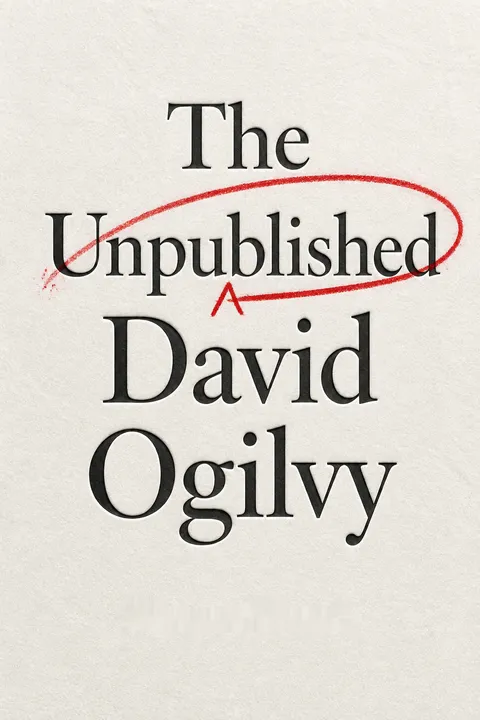
The Unpublished David Ogilvy is less a conventional business book than a portrait assembled from sales manuals, memos, speeches, lists, and an extended interview. Its variety is a strength: the same mind appears in different roles, from young salesman studying a household to founder worrying that his agency depends too heavily on him. Across those settings, one principle holds the collection together: communication must produce a real effect. Advertising should help sell, research should change decisions, writing should make action clear, and management should develop people who can do excellent work.
The most interesting tension is between discipline and invention. Ogilvy demands facts, research, consistency, and professional craft, yet he also warns that technically sound campaigns can be so dull that nobody notices them. His answer is not to choose data over creativity, or creativity over evidence, but to make each constrain and strengthen the other. The same duality shapes his management advice: high standards alongside humane treatment, strong leadership alongside distributed responsibility, ambition alongside self-criticism.
His example also gives the collection narrative force. A man who failed at Oxford, sold cookers, and entered American advertising at 38 builds a large agency, then recognizes that centralizing its decisions around himself threatens its future. That arc makes his counsel on unconventional hiring and succession more persuasive than abstract advice alone.
The book is nevertheless a product of its time and its author's forceful personality. Some management claims are asserted rather than demonstrated, and particular views on work, hierarchy, and leadership should not be treated as universal rules. His consumer advice can also sound more confident than evidence warrants. The lasting value lies less in copying his opinions than in adopting his habits of attention: study the customer, inspect the facts, make the work distinctive, communicate plainly, and judge success by the quality of both the result and the organization that produced it.
Review Summary
The Unpublished David Ogilvy is highly regarded, with an average rating of 4.14 out of 5. Readers praise Ogilvy's wisdom on advertising, leadership, and business management. The book, a compilation of memos, letters, and speeches, offers insights into Ogilvy's philosophy and character. Many reviewers appreciate his practical advice, emphasis on hard work, and commitment to excellence. Some find the format disjointed, but most consider it a valuable read for those in creative industries, management, or interested in advertising history.
People Also Read










Glossary
Big Idea
Memorable campaign conceptA Big Idea is the central creative concept that makes an advertising campaign distinctive and memorable. In Ogilvy's view, a campaign needs more than correct product positioning and a credible benefit. Its organizing idea must also earn attention and help the message stay in the consumer's mind.
brand image
Accumulated brand impressionBrand image is the collection of associations and impressions people attach to a product or company. Ogilvy treats every advertisement as a contribution to that accumulated identity. Consistent campaigns can strengthen recognition and preference over time, while frequent shifts in tone or personality can leave a brand indistinct.
Magic Lantern
Advertising principles presentationThe Magic Lantern is Ogilvy's name for a teaching presentation of advertising principles. He describes it as including the importance of positioning and a product promise, as well as the need for a memorable creative idea. He urged creative leaders to show the material to new staff as a way of establishing shared standards.
Trumpeter Swans
Creative leaders who inspireTrumpeter Swans is Ogilvy's metaphor for rare creative directors who unite exceptional personal talent with the ability to lead and inspire others. He contrasts them with capable administrators who do not produce remarkable work, brilliant creatives who struggle to manage, and people who lack either strength.
islands of leadership
Distributed leadership centersIslands of leadership are the capable leaders Ogilvy wanted throughout an organization, not only at its top. Department heads and partners should explain standards, guide colleagues, resolve problems, and develop others. Distributing leadership reduces reliance on a single office head and helps professional standards survive as a company grows.
FAQ
What's "The Unpublished David Ogilvy" about?
- Collection of Writings: "The Unpublished David Ogilvy" is a compilation of David Ogilvy's memos, notes, speeches, and letters that were not previously published. It provides insights into his thoughts and philosophies on advertising and management.
- Personal Insights: The book offers a personal glimpse into Ogilvy's life, including his career journey, personal anecdotes, and reflections on his experiences in the advertising industry.
- Advertising Philosophy: It highlights Ogilvy's advertising principles, his approach to creativity, and his belief in the power of research and data in crafting effective advertising campaigns.
Why should I read "The Unpublished David Ogilvy"?
- Learn from a Legend: David Ogilvy is often referred to as the "Father of Advertising." Reading his unpublished works provides a unique opportunity to learn directly from one of the most influential figures in the industry.
- Timeless Advice: The book contains timeless advice on advertising, management, and leadership that remains relevant in today's business environment.
- Inspiration and Motivation: Ogilvy's passion for advertising and his dedication to excellence can inspire and motivate readers to pursue their own professional goals with vigor and creativity.
What are the key takeaways of "The Unpublished David Ogilvy"?
- Importance of Research: Ogilvy emphasizes the critical role of research in advertising, advocating for data-driven decisions to create effective campaigns.
- Creative Excellence: He stresses the need for creativity in advertising, urging advertisers to develop big ideas that capture attention and drive sales.
- Leadership and Management: Ogilvy shares his principles of management, highlighting the importance of ethical leadership, nurturing talent, and maintaining a strong corporate culture.
What are the best quotes from "The Unpublished David Ogilvy" and what do they mean?
- "We sell – or else." This quote underscores Ogilvy's belief that the primary purpose of advertising is to sell products. It reflects his focus on results and effectiveness in advertising.
- "The consumer is not a moron. She is your wife." Ogilvy emphasizes the importance of respecting the intelligence of consumers and creating advertising that speaks to them honestly and directly.
- "You cannot bore people into buying your product; you can only interest them in buying it." This quote highlights the necessity of engaging and captivating advertising to capture consumer interest and drive sales.
How did David Ogilvy's early career influence his advertising philosophy?
- Diverse Experiences: Ogilvy's early career included roles as a chef, salesman, and researcher, which provided him with a broad perspective and understanding of different industries and consumer behavior.
- Salesmanship: His experience as a door-to-door salesman taught him the importance of understanding consumer needs and crafting persuasive messages, which became a cornerstone of his advertising philosophy.
- Research Background: Working with George Gallup at the Audience Research Institute instilled in Ogilvy a deep appreciation for research and data, influencing his approach to creating evidence-based advertising.
What is David Ogilvy's approach to leadership as discussed in "The Unpublished David Ogilvy"?
- Empowerment and Responsibility: Ogilvy believed in empowering his employees by giving them responsibility and treating them as adults, which he felt would help them grow and succeed.
- Ethical Leadership: He emphasized the importance of maintaining high ethical standards and honesty in all dealings, both internally and with clients.
- Encouraging Innovation: Ogilvy encouraged a culture of innovation and creativity, believing that change and new ideas were essential for growth and success.
How does "The Unpublished David Ogilvy" address the concept of corporate culture?
- Strong Culture: Ogilvy believed that a strong corporate culture was crucial for success, and he worked to cultivate a culture of excellence, creativity, and ethical behavior at Ogilvy & Mather.
- Values and Traditions: The book discusses the values and traditions that Ogilvy instilled in his company, such as respect for individuals, a focus on quality, and a commitment to client success.
- Impact on Performance: Ogilvy argued that a positive corporate culture not only improves employee morale but also enhances the overall performance and reputation of the company.
What role does creativity play in David Ogilvy's advertising philosophy?
- Central to Success: Creativity is central to Ogilvy's advertising philosophy, as he believed that innovative and engaging ideas are essential for capturing consumer attention and driving sales.
- Big Ideas: He advocated for the development of "big ideas" that stand out and make a lasting impression, rather than relying on gimmicks or superficial tactics.
- Balance with Research: While valuing creativity, Ogilvy also emphasized the importance of grounding creative ideas in research and data to ensure they are effective and relevant.
How does "The Unpublished David Ogilvy" illustrate the importance of client relationships?
- Mutual Respect: Ogilvy believed in building relationships based on mutual respect and honesty, ensuring that both the agency and the client work towards common goals.
- Client-Centric Approach: He emphasized understanding the client's business and needs, tailoring advertising strategies to align with their objectives and deliver results.
- Long-Term Partnerships: Ogilvy valued long-term partnerships with clients, focusing on delivering consistent quality and value to maintain trust and loyalty.
What insights does "The Unpublished David Ogilvy" provide on the role of research in advertising?
- Foundation for Success: Ogilvy viewed research as the foundation for successful advertising, providing the insights needed to understand consumer behavior and preferences.
- Data-Driven Decisions: He advocated for using research to inform creative decisions, ensuring that advertising messages are relevant, targeted, and effective.
- Continuous Learning: Ogilvy believed in the importance of continuous learning and staying informed about market trends and consumer insights to adapt and improve advertising strategies.
How does "The Unpublished David Ogilvy" address the challenges of managing a global advertising agency?
- Unified Culture: Ogilvy emphasized the importance of maintaining a unified corporate culture across all offices, ensuring consistency in values and standards worldwide.
- Local Adaptation: While maintaining a global culture, he also recognized the need for local adaptation, allowing offices to tailor strategies to fit regional markets and consumer preferences.
- Leadership and Collaboration: Effective leadership and collaboration across offices were key to managing a global agency, fostering communication and cooperation to leverage the strengths of each location.
What personal anecdotes in "The Unpublished David Ogilvy" provide insight into his character and leadership style?
- Resigning Accounts: Ogilvy shares stories of resigning accounts when clients were difficult or products were subpar, demonstrating his commitment to integrity and quality.
- Handling Mistakes: He candidly discusses his mistakes, such as selling shares too early, showing his willingness to learn and grow from his experiences.
- Passion for Advertising: Personal anecdotes reveal Ogilvy's passion for advertising and his dedication to excellence, inspiring readers to pursue their own careers with similar enthusiasm.
About the Author
Other books by David Ogilvy

Download PDF
Download EPUB
.epub digital book format is ideal for reading ebooks on phones, tablets, and e-readers.








