

Key Takeaways
Investigate secretive institutions without treating secrecy as proof of a master plan
Two kinds of secrecy. The book distinguishes overt societies, which operate publicly but conceal rituals or internal rules, from covert groups, which avoid public recruitment and may guard their existence or activities. Freemasonry serves as its example of the first type; the Illuminati and organized crime as examples of the second. The distinction helps explain why groups with very different purposes can all attract suspicion.
A warning, not a verdict. Jackson’s central concern is that secrecy can protect influence and wrongdoing. But he also acknowledges that information about these groups mixes fact, speculation, and deliberate misinformation. That tension is essential: secrecy can justify careful questions, but it cannot by itself establish a coordinated conspiracy.
What's useful here is the distinction between a group's public face and its private practices. It prevents the mistaken assumption that every private ritual signals criminal intent, while leaving room to ask how secrecy affects accountability. The harder question is what evidence would count against a conspiracy claim. Without an answer, suspicion can become self-sealing: confirmation is treated as proof, and missing evidence as proof of concealment.
Study Alamut as a warning about loyalty weaponized by political movements
A fortress and a hierarchy. The book traces the Hashashin to the Nizari Ismaili movement and its leader Hassan-i-Sabbah, who established a stronghold at Alamut around 1090. It describes an order organized in ranks, with selected followers trained as fedayin, committed operatives who carried out political assassinations. The Mongols captured Alamut in 1256, ending the order's power there.
Separate legend from lesson. Jackson recounts stories of converts being drugged and shown an artificial paradise, but the text does not establish those dramatic details as fact. Its more durable point is how a tight hierarchy, intense ideological commitment, and personal obedience can turn belief into an instrument of political violence. The book's direct lineage from the Hashashin to modern armed groups, however, is an analogy, not proof of continuity.
Alamut gives the book its strongest origin story because it links secrecy to a concrete political tactic: an organization using disciplined operatives to intimidate rivals. The episode also shows why memorable legends need careful handling. A paradise garden makes for a compelling explanation of recruitment, but a vivid story is not necessarily a verified one. The broader lesson about obedience remains worth considering without accepting every detail of the legend.
Separate the Templars' documented fall from their many claimed afterlives
A military order becomes a legend. Founded around 1120 to protect pilgrims, the Knights Templar grew from a small group into a wealthy military and financial institution. In 1307, King Philip IV of France ordered arrests, including that of Grand Master Jacques de Molay. The order was formally dissolved in 1312. Accusations of heresy and secret worship helped justify the crackdown, but the book acknowledges that many charges were never proven.
A name travels further. Jackson describes later organizations that borrow Templar symbols or claim descent from the order, including Masonic bodies and modern groups. Such claims help explain the Templars' lasting cultural appeal, but a shared name, ritual, or emblem does not establish an unbroken historical line. The distinction matters because the book often moves from suggestive resemblance to claims of inherited influence.
The Templars show how a historical institution can acquire a second life through stories about its unexplained disappearance. Those stories may inspire later groups, even when there is no evidence of direct succession. This is a useful distinction between influence and continuity: a modern organization can borrow an older group's imagery without inheriting its membership, mission, or authority. The book's dramatic treatment sometimes blurs those separate claims.
Keep the historical Illuminati distinct from today's all-purpose conspiracy label
A short-lived Bavarian order. Adam Weishaupt founded the Illuminati in 1776. The group adopted an initiation structure influenced by Freemasonry and promoted ideas including secular government and freedom from religious authority. Bavarian authorities banned it, and it was declared dissolved in 1785. Jackson argues that the dissolution may have concealed continued activity, but the text does not establish a documented chain of organization from that group to present-day institutions.
Symbols do not settle the case. The book connects the Illuminati to dollar-bill imagery, revolutions, influential families, and later global organizations. These connections are presented as evidence of a vast continuing project, but resemblance and association cannot prove coordination. Keeping the historical order separate from the modern conspiracy label helps readers assess each claim on its own evidence.
The historical Illuminati and the modern idea of an omnipresent Illuminati are different propositions. The first concerns a named eighteenth-century group; the second requires evidence that its organization, leadership, or plans persisted across generations. That distinction is basic but powerful. Symbols are especially weak evidence because they can be reused, interpreted differently, or adopted for effect. A claim about a continuing institution needs records of continuity, not just recurring imagery.
Test every link with records, alternatives, and a standard applied both ways
The book's three “S”s. Jackson classifies material as speculative, meaning plausible but unresolved; spurious, meaning built on tenuous or unsubstantiated links; and skeptical, meaning resistant to claims that challenge prior beliefs. The framework encourages readers to distinguish levels of certainty, though the book sometimes treats skepticism as closed-mindedness rather than as a method of checking evidence.
Compare claims with proof. Jackson cites COINTELPRO, an FBI program to surveil and disrupt political groups that was exposed through official records in 1971. The example shows that covert state activity can be established by documentation. By contrast, a chain of famous names or an allegation repeated across books is not equivalent evidence. Ask what sources support each link, what other explanation fits, and what finding could disprove the claim.
The three-part classification is most useful when applied symmetrically. A reader should scrutinize both official denials and sensational accusations, rather than assuming that one side is automatically honest. COINTELPRO offers a helpful contrast within the book: evidence of a real covert operation emerged through records, not simply through symbolic interpretation or a long list of connected people. A rigorous account also needs to identify uncertainty instead of treating doubt as disloyalty.
Scrutinize elite policy meetings without mistaking access for command
Private forums, public stakes. The Council on Foreign Relations dates to 1921, the Bilderberg meetings began in 1954, and David Rockefeller helped establish the Trilateral Commission in 1973. The book emphasizes that these bodies bring together influential political, financial, and business figures, sometimes under rules that limit public access to discussion. Such settings can shape who meets, which ideas circulate, and how policy is debated.
Influence is not omnipotence. Jackson interprets overlapping membership and support for international cooperation as evidence of a unified drive toward centralized world rule. But shared attendance alone does not demonstrate that participants coordinate policy or control governments. The sounder question is how these forums influence decisions in particular cases, and whether their processes are transparent enough for the public to assess.
Private policy forums deserve scrutiny because access is itself a form of influence: participants can exchange ideas and build relationships outside public view. That concern does not require imagining a single command center. Network analysis distinguishes a connection between people from proof that they share intent or act together. The book is right to ask who has access to elite discussions, but its strongest claims need evidence of concrete decisions and causal influence.
Demand evidence before turning centralization into a single hidden plot
A theory of concentrated rule. The book uses synarchy, a doctrine of “joint rule” associated with French occultist Joseph Alexandre Saint-Yves d’Alveydre, to describe government by an enlightened elite with extensive control over society. Jackson connects this idea to fears about international institutions and a proposed Committee of 300, which he traces through competing stories about wealthy merchants and industrialists.
Origins matter. One account links the Committee to a 1909 statement attributed to industrialist Walther Rathenau. The book explains that the claim was later used to promote an anti-Semitic conspiracy based on the forged Protocols of the Elders of Zion. It also gives an earlier, speculative origin tied to the East India Company. These incompatible stories make the Committee a case for separating documented institutions from theories about them.
The concern about concentrated authority is meaningful even when a particular hidden committee is unproven. Large institutions can centralize decisions through ordinary rules, funding, and political access, without a secret agreement among every powerful actor. The distinction protects two important questions at once: whether power is accountable, and whether a specific conspiracy claim is supported. The Committee's association with fabricated anti-Semitic material makes careful sourcing especially important.
Treat Skull & Bones as a network, not automatic proof of coordination
A small, closed circle. Founded at Yale in 1832, Skull & Bones selects a limited number of students each year. The book describes private initiation rituals, a restricted membership list, and assets managed through the Russell Trust Association. It then follows connections between alumni and institutions including government agencies, financial organizations, and the Council on Foreign Relations.
Connection is not complicity. Those overlaps can raise legitimate questions about access, favoritism, and elite recruitment. They do not, by themselves, verify claims of grave robbery, criminal initiation rites, or a shared plan among members. The book sometimes places documented career connections beside much less substantiated allegations, making the evidentiary difference easy to miss. Readers should assess each claim separately rather than letting the atmosphere of the society do the work of proof.
A selective student society can matter even if it is not directing world events. Repeated contact among future leaders may create trust, shared assumptions, and opportunities unavailable to outsiders. That is a plausible account of influence, but it differs from a coordinated conspiracy. A careful analysis asks whether the network changes decisions or outcomes, not only whether prominent people belong to it. The book's strongest case concerns exclusivity; its most sensational claims require stronger support.
Read Bohemian Grove's rituals as clues to culture, not proof of crimes
A private retreat with theatrical rites. The Bohemian Club began in 1872 as a gathering place for artists and journalists; the book describes its later retreat in California as a meeting ground for wealthy business and political figures. Its “Cremation of Care” ceremony, staged before a large owl statue, dramatizes setting aside everyday worries. The book also recounts claims that important political and scientific plans were discussed there.
A setting is not a smoking gun. A private gathering can help people form relationships and exchange ideas, and its secrecy may reasonably invite questions. But an owl, a costume, or a theatrical performance cannot establish criminal activity or prove that a policy was decided there. The book itself notes that some of the most lurid claims remain allegations. Focus on verifiable conduct, participants, and decisions.
The Grove illustrates how ritual can strengthen a group's identity and signal who belongs. That social function can be politically relevant without making the ceremony evidence of a crime. The more powerful the attendees, the more important it is to ask what they do with their access and whether their decisions can be scrutinized. Symbolic interpretation is evocative, but records of actions and outcomes are a firmer basis for judgment.
Ground criticism of the Jesuits in documented conduct, not inherited legend
A real institution, layered accusations. Founded in 1534 by Ignatius of Loyola and six companions, the Society of Jesus became a prominent Catholic order with a history of missionary work and education. Jackson describes its suppression in 1773 and restoration in 1814, alongside longstanding hostility from political and religious rivals. He also notes that the Monita Secreta, a purported set of secret Jesuit instructions published in 1612, is widely regarded as a hoax.
Name actual harms. The book reports that in 2011 a Jesuit province in the Pacific Northwest was ordered to pay $166 million to about 450 survivors of child sexual abuse. That specific institutional accountability is more substantial than unsupported stories about secret oaths or hidden political command. Criticism is strongest when it identifies evidence and responsible institutions without treating every member as guilty by association.
This chapter shows why skepticism about conspiracy claims should not become indifference to real institutional harm. A false document can fuel prejudice, while documented abuse demands accountability regardless of whether a broader theory is true. The distinction is not between believing institutions and distrusting them; it is between claims supported by evidence and claims sustained by inherited suspicion. Keeping those categories separate makes criticism more precise and more credible.
Analysis
This book is a sweeping, thesis-driven survey of organizations whose secrecy, rituals, or elite membership have made them objects of suspicion. Its narrative moves from Alamut and the Templars through the Illuminati, Freemasonry, policy forums, private clubs, and the Jesuits. The recurring claim is that networks of wealth and influence may conceal efforts to centralize power. The organizing appeal is clear: familiar names and institutions appear in overlapping circles, turning a complicated history into a connected story.
The chief challenge is that the book often moves between different kinds of evidence without marking the transition. A group's existence, a person's membership, a meeting between influential people, a shared political goal, and a coordinated covert plan are separate claims. Proof of one does not establish the next. The text sometimes acknowledges that claims are speculative, then uses them as support for much firmer conclusions. Its lists of famous names can create an impression of proof through accumulation, even when the links vary greatly in quality.
A careful reader can preserve the book's useful question while revising its method: Who benefits from secrecy, what decisions are made outside public view, and what records show their effects? The book itself supplies examples of both rumor and documented covert activity, making comparison possible. The best way to read it is as a catalogue of allegations and a prompt to examine power, not as reliable verification that its many groups share one plan. Its lasting value lies in directing attention to access, accountability, and the difference between association and coordination.
Review Summary
The World's Most Dangerous Secret Societies receives mixed reviews, with an average rating of 3.30 out of 5. Some readers find it informative and eye-opening, praising the author's fact-based approach and the book's entertainment value. Others criticize it for being boring, poorly written, and lacking credible sources. Several reviewers express disappointment with the book's content, describing it as gossip-like and conspiracy-driven. Some appreciate the historical connections made, while others find the narration in the audiobook version problematic. Overall, opinions vary widely on the book's quality and credibility.
People Also Read


Glossary
overt secret society
Public group, private practicesJackson's category for organizations that maintain a visible public presence while keeping some rituals, internal rules, or member obligations private. Freemasonry is his main example. The term distinguishes public-facing associations from groups that conceal their existence or avoid open recruitment; it does not imply that the organization's hidden practices are harmful.
covert secret society
Hidden, invitation-only groupJackson's category for organizations that do not openly recruit and whose membership or activities are guarded from public view. He associates such groups with political influence or organized crime. The label describes a mode of operation, not proof that a group exists as alleged or that it pursues a particular conspiracy.
three “S”s
Three claim categoriesJackson's shorthand for speculative, spurious, and skeptical approaches to claims about secret societies. Speculative claims are possible but unresolved; spurious claims rest on weak or unsubstantiated connections; skeptical responses question the claims. The book encourages readers to sort evidence this way, though it sometimes portrays skepticism itself as bias.
synarchy
Rule by an enlightened eliteA political doctrine presented in the book through the ideas of Joseph Alexandre Saint-Yves d’Alveydre. Jackson describes it as “joint rule” by an elite claiming special enlightenment, paired with extensive state control. He uses the concept to frame concerns about centralized government, while the existence of a doctrine does not prove that later institutions follow it.
fedayin
Committed Nizari operativesThe term Jackson uses for members of Hassan-i-Sabbah's order who accepted missions that could end in their deaths. In his account, selected recruits from lower ranks were trained to carry out political assassinations. The book's dramatic stories about how recruits were persuaded should be treated separately from this description of the order's structure.
Cremation of Care
Bohemian Grove ceremonyA theatrical ceremony described as the centerpiece of Bohemian Grove's gathering. Participants stage the destruction of a symbolic figure before a large owl statue, representing a temporary setting aside of daily worries. The rite helps define the group's private culture, but its imagery alone does not demonstrate criminal conduct or prove that political decisions are made there.
COINTELPRO
FBI disruption programThe book identifies COINTELPRO as an FBI program that surveilled, infiltrated, discredited, and disrupted domestic political organizations. It says the program was denied before documents became public in 1971 and prompted an official investigation. Jackson uses it as an example of covert activity that can be established through records rather than inference alone.
FAQ
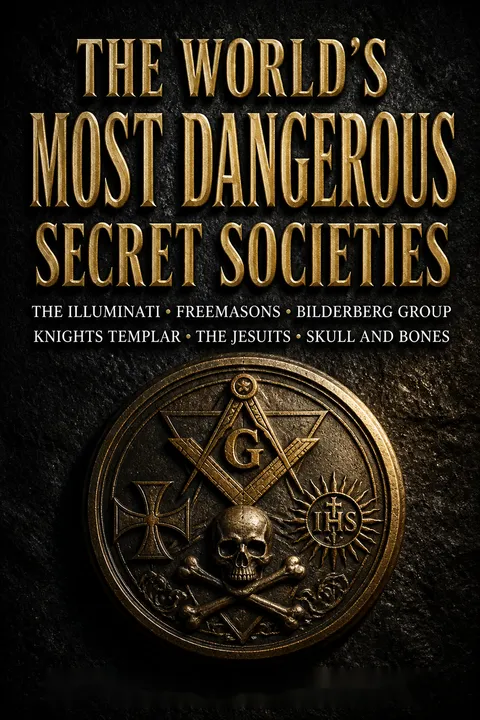
1. What’s "The World’s Most Dangerous Secret Societies" by James Jackson about?
- Comprehensive overview of secret societies: The book explores the origins, history, influence, and alleged dangers of various secret societies, both historical and modern.
- Focus on power and manipulation: Jackson examines how these groups may wield hidden power, manipulate world events, and influence politics, economics, and culture.
- Range of societies covered: The book covers groups such as the Illuminati, Freemasons, Knights Templar, Bilderberg Group, Skull & Bones, Jesuits, and others.
- Critical and investigative approach: The author aims to separate fact from fiction, addressing both well-documented evidence and conspiracy theories, while encouraging readers to think critically.
2. Why should I read "The World’s Most Dangerous Secret Societies" by James Jackson?
- Understand hidden influences: The book provides insight into how secret societies may shape global events and institutions, which is valuable for anyone interested in history, politics, or conspiracy theories.
- Critical thinking encouragement: Jackson emphasizes the importance of skepticism and vigilance, urging readers to question official narratives and consider alternative explanations.
- Broad historical context: The book connects ancient and modern societies, showing how secretive organizations have evolved and persisted over centuries.
- Accessible introduction: It serves as both an introductory and cautionary text, making complex topics approachable for readers new to the subject.
3. What are the key takeaways from "The World’s Most Dangerous Secret Societies" by James Jackson?
- Secret societies are diverse: They range from overt, public organizations like the Freemasons to covert, invitation-only groups like the Illuminati and Skull & Bones.
- Power and secrecy are central: Many societies use secrecy to maintain control, influence members, and pursue agendas that may conflict with mainstream values.
- Fact vs. fiction is blurred: The book highlights the difficulty in distinguishing between well-researched history and speculative conspiracy, noting that misinformation is common.
- Impact on society: Secret societies have allegedly played roles in major historical events, revolutions, wars, and the shaping of modern institutions.
4. What are the main secret societies discussed in "The World’s Most Dangerous Secret Societies" by James Jackson?
- Historical and modern groups: The book covers the Hashshashins, Knights Templar, Illuminati, Freemasons, Trilateral Commission, Bilderberg Group, Council on Foreign Relations, Skull & Bones, Committee of 300, Bohemian Grove, and the Society of Jesuits.
- Interconnectedness: Jackson explores how these groups may be linked through shared members, ideologies, or overlapping agendas.
- Varied origins and purposes: Each society has unique origins, rituals, and stated or alleged goals, ranging from religious devotion to global governance.
- Controversial legacies: Many of these societies are associated with conspiracy theories, accusations of manipulation, and, in some cases, documented criminal or unethical behavior.
5. How does James Jackson define and classify secret societies in "The World’s Most Dangerous Secret Societies"?
- Overt vs. covert societies: Overt societies, like Freemasons, have a public presence and often claim transparency, while covert societies, like the Illuminati, operate in secrecy and by invitation only.
- Motivations for secrecy: Secrecy can be used to protect members, maintain control, conceal controversial beliefs, or hide illicit activities.
- Role of fear and exclusivity: Fear of repercussions and the allure of forbidden knowledge are central to the appeal and function of secret societies.
- Overlap and evolution: Some groups may shift between overt and covert status, and their purposes can evolve over time, blending political, religious, and economic motives.
6. What is the alleged influence of the Illuminati according to "The World’s Most Dangerous Secret Societies" by James Jackson?
- Origins and goals: Founded in 1776 by Adam Weishaupt, the Illuminati allegedly sought to overthrow existing power structures and establish a new world order based on equality and reason.
- Modern conspiracy theories: The Illuminati are often accused of orchestrating revolutions, wars, and global events, with supposed control over banking, media, and governments.
- Bloodline theory: Jackson discusses the idea of 13 Illuminati bloodlines, including the Rockefellers, Rothschilds, Kennedys, and others, who allegedly perpetuate the group’s influence.
- Symbolism and pop culture: The Illuminati’s symbols, such as the all-seeing eye, are said to permeate currency, media, and entertainment, fueling public fascination and suspicion.
7. How does "The World’s Most Dangerous Secret Societies" by James Jackson connect Freemasonry to global events and other secret societies?
- Historical influence: Freemasonry is linked to the founding of the United States, revolutions, and the spread of Enlightenment ideals.
- Relationship with the Illuminati: The book suggests that Freemasonry provided a structure and network that the Illuminati exploited for their own agenda.
- Controversial offshoots: Irregular or illicit Masonic lodges are associated with radical movements, criminal activity, and political subversion.
- Modern decline and legacy: While mainstream Freemasonry is portrayed as less influential today, its historical impact and connections to other societies remain significant.
8. What roles do the Trilateral Commission, Bilderberg Group, and Council on Foreign Relations play in "The World’s Most Dangerous Secret Societies" by James Jackson?
- Elite think tanks: These organizations are described as modern, overt secret societies that bring together political, financial, and industrial leaders to shape global policy.
- Alleged agenda: Jackson argues that their true purpose is to foster globalization, centralize power, and erode national sovereignty in favor of a one-world government.
- Transparency vs. secrecy: While these groups claim to be open and publish some information, their private meetings and overlapping memberships with other secret societies raise suspicions.
- Influence on policy: The book details how these groups have allegedly influenced major political decisions, economic policies, and international relations.
9. What is the significance of Skull & Bones and Bohemian Grove in "The World’s Most Dangerous Secret Societies" by James Jackson?
- Elite recruitment and networking: Skull & Bones is portrayed as a breeding ground for future leaders in politics, intelligence, and finance, with a strong culture of secrecy and nepotism.
- Bohemian Grove as a power retreat: The Grove is depicted as a gathering place for the global elite, where informal alliances are forged and major decisions are allegedly influenced.
- Controversies and rituals: Both groups are associated with bizarre rituals, allegations of criminal behavior, and connections to other secret societies.
- Impact on American leadership: Many prominent U.S. politicians, presidents, and business leaders are said to be members or attendees, reinforcing their influence.
10. How does "The World’s Most Dangerous Secret Societies" by James Jackson address the Society of Jesuits and their alleged global influence?
- Origins and mission: The Jesuits were founded as a Catholic order devoted to education, missionary work, and strict obedience to the Pope.
- Controversies and conspiracies: The book discusses accusations of political manipulation, involvement in the Counter-Reformation, and secretive oaths and rituals.
- Modern scandals: Recent sexual abuse scandals and alleged connections to intelligence agencies like the CIA are explored.
- Role in global power structures: Jackson suggests that the Jesuits, through education and covert influence, have played a significant role in shaping religious and political history.
11. What are the main methods and tactics used by secret societies, according to "The World’s Most Dangerous Secret Societies" by James Jackson?
- Secrecy and initiation: Strict oaths, rituals, and hierarchical structures are used to maintain loyalty and control information.
- Infiltration and manipulation: Societies allegedly infiltrate governments, financial institutions, and media to advance their agendas.
- Misinformation and psychological operations: Deliberate spreading of false or confusing information is used to protect secrets and discredit critics.
- Use of symbolism and ritual: Esoteric symbols, ceremonies, and coded language reinforce group identity and mystique.
12. What are the best quotes from "The World’s Most Dangerous Secret Societies" by James Jackson and what do they mean?
- “The truth may indeed be the strongest sword of all. And if I have done anything to sharpen that sword, then my task is complete.” – Emphasizes the author’s goal of promoting critical thinking and vigilance against hidden power.
- “Where there’s smoke, there’s often fire.” – Suggests that even speculative or spurious claims about secret societies may contain elements of truth worth investigating.
- “The secret society is now enjoying a semi-ironic prestige in popular culture…” – Reflects on how secret societies have become both a subject of fascination and trivialization in modern media.
- “My personal opinion is that we are currently living in a world where freedom of expression and livelihood are being threatened by these very entities…” – Expresses the author’s belief that secret societies and their influence are a real and present danger to individual freedoms.
- “Who was the fool, who the wise man, beggar or king? Whether poor or rich, all's the same in death.” – Quoted from the Skull & Bones Tomb, this line underscores the theme of mortality and the leveling effect of death, regardless of power or status.
Download PDF
Download EPUB
.epub digital book format is ideal for reading ebooks on phones, tablets, and e-readers.








