

Key Takeaways
Notice when a mistake becomes an all-day trial about your worth
A small error can grow. As a young pastor, Jared Mellinger was sent to collect his boss from an airport. He confused Hamburg, Germany, with Hamburg, Pennsylvania, and drove to a tiny airstrip beside a cornfield. Once he realized the mistake, he spent the journey home interrogating himself: Was he incompetent? Would he fail as a pastor? What did others think of him? One mishap became a sweeping judgment of his character and future.
Attention can turn into a trap. The book calls looking inward introspection. It can help people understand their thoughts and actions, but relentless self-monitoring often feeds shame instead of solving anything. Mellinger’s Christian answer is not to erase the self, but to stop treating it as the central subject and redirect attention toward Christ, other people, and the world beyond the mind.
The airport story captures how a specific failure can become a global identity claim: not just a wrong turn, but proof of being unfit for life. That distinction is useful beyond religious practice. Self-review helps when it identifies a correctable action; it becomes rumination when it repeatedly asks what the action says about the whole person. The Christian remedy here is a change of attention, not a denial of error. That distinction matters: moving outward should not mean evading responsibility, but it can prevent a mistake from becoming an endless self-sentencing.
Learn who you are by looking toward the God who made you
Identity is received, not invented. Mellinger argues that endless inward searching cannot provide a stable answer to who a person is. He borrows an image from Thomas Chalmers: self-examination is like trying to inspect a dark room by staring harder. The remedy is to open the curtains and let in sunlight. In the book, that light is the Bible’s account of God, humanity, and Christ.
The cross gives perspective. Looking to Christ, Christians see human dignity in the image of God, the seriousness of sin, a new identity for those united to Christ, and a future shaped by hope. The book distinguishes worth from merit: people do not earn God’s love, yet are not worthless. This view offers a reference point beyond shifting feelings, appearance, achievement, or comparison.
The dark-room image explains why introspection can become less accurate as it intensifies: more attention is not automatically more insight. A person’s beliefs about identity need standards outside the self, whether those standards come from faith, relationships, or considered commitments. The book’s specifically Christian standard is God’s view as revealed through Christ. That can loosen the grip of performance-based identity, though it also asks readers to accept a theological account of human nature rather than treating identity as a purely private discovery.
Reject both self-worship and self-contempt as rival forms of self-focus
Two mirrors, same fixation. Mellinger contrasts Narcissus, the mythic figure absorbed by his own reflection, with Dobby, the mistreated house elf from the Harry Potter stories who sees himself as worthless and punishes himself. One represents exaggerated self-importance, the other self-loathing. Both make the self the measure of everything.
Trade self-rating for sober judgment. The book rejects the idea that low self-esteem is cured by repeatedly telling oneself how impressive one is. It cites a Harvard Business Review article summarizing research that high self-esteem does not reliably produce better performance or success. In Mellinger’s Christian framework, a person can acknowledge sin and limits while also receiving dignity and love from God. The alternative to I am wonderful or I am worthless is gratitude directed beyond the self.
This section is strongest when it refuses the false choice between grandiosity and humiliation. A stable self-view need not depend on constant praise, nor on relentless criticism. The distinction between worth and moral achievement also allows honest accountability without treating failure as proof of worthlessness. One caution is that the book’s critique of self-esteem could be misread as a critique of all self-respect. Its argument is more precise: self-approval cannot bear the weight of being a person’s ultimate foundation.
Let self-examination serve faithfulness, not become your life's main occupation
Reflection has different motives. The book notes that people may look inward because they want to honor God, because a reflective temperament draws them that way, or because they hope to find peace by improving their self-image. They may also fixate on sin, search for a hidden fault behind suffering, or simply follow the self-centered pull of human nature. These motives do not all call for the same response.
The goal is outward movement. Nathaniel Hawthorne’s minister Arthur Dimmesdale hides his wrongdoing and torments himself with private guilt. His inner punishment neither makes things right nor brings peace. Mellinger’s term Christ-ospection describes turning attention from self-analysis toward Christ. Healthy reflection can reveal where help, confession, or change is needed; it is not meant to become a permanent investigation of one’s motives or identity.
Naming different motives improves the advice because inward attention is not automatically unhealthy. A reflective personality can be useful, and self-examination can uncover real harm that needs repair. The practical test is what reflection produces: clearer responsibility and action, or more self-preoccupation without movement. The book’s theological language gives its readers a destination for that movement. Even outside that tradition, the distinction remains useful: insight should support a chosen good, not become a substitute for living toward one.
In despair, tell the truth, then redirect attention toward God's record
Honesty need not become a spiral. In Psalm 77, Asaph describes sleeplessness, distress, and doubts about whether God still cares. He speaks plainly about his suffering, but the more he turns his trouble over in his mind, the heavier it becomes. He then recalls God’s past actions and character, including the rescue of Israel through the sea. The circumstances remain difficult, but his focus changes.
Use more than one explanation. Mellinger advises readers not to assume that doubt proves spiritual failure. Exhaustion, overwork, poor health, or isolation may contribute; a trusted friend can help assess what is happening. The book encourages remembering promises and seeking support, while warning against joining the inner voice of despair in harsh self-condemnation. It does not promise that distress will disappear at once.
The movement in Psalm 77 is more credible than forced optimism: distress is named before attention is redirected. Remembered evidence can challenge the feeling that a painful present has always been true and will always remain true. The book also wisely resists reducing every low mood to a spiritual defect. Its pastoral suggestions are not a complete account of mental health, however. Persistent or severe despair may need professional care alongside prayer, friendship, and religious support.
Interrogate guilt before treating every guilty feeling as a verdict
A feeling is not proof. False guilt is a sense of blame that is not supported by what God requires. Mellinger describes six distinctions that can help test it:
1. God’s approval versus other people’s approval.
2. Accurate versus inaccurate self-assessment.
3. Weakness versus sin.
4. Temptation versus sin.
5. Responsibility versus concern about outcomes beyond one’s control.
6. Biblical principles versus one particular way of practicing them.
Comparison manufactures charges. A parent may see another family’s picture-perfect camping trip online and conclude that ordinary family life is a failure. But a method, such as holding weekly family devotions, is not automatically a universal command. Nor is a parent responsible for every choice a child makes. The distinctions do not excuse actual wrongdoing; they help separate genuine obligations from standards invented through comparison, fear, or personal preference.
This is the book’s most practical diagnostic tool because it breaks vague guilt into questions that can be checked. Its distinction between responsibility and concern is especially useful: caring about an outcome does not mean controlling it. The framework also protects people from mistaking limitations for moral failures. Care is needed when applying it, since someone’s claim of false guilt should not silence people harmed by their actions. A trustworthy friend, clear standards, and willingness to repair harm help keep the test honest.
Review your life briefly, rested, biblically, and with room for grace
Timing changes the verdict. Nancy Wilson describes a mother who reaches bed after a demanding day, then begins listing unfinished chores, impatient words, missed devotions, and perceived failures. Mellinger argues that late-night exhaustion is a poor setting for a sweeping judgment of one’s life. Self-examination works better when it is deliberate, periodic, and undertaken with enough distance to see the whole picture.
Look for growth as well as failure. Begin from the assurance of Christ, use biblical standards rather than comparison, and ask for God’s help and trusted people’s perspective. Keep the review short. Name a real area for change and identify one concrete response, such as apologizing or making time to pray. Also notice evidence of good: patience, service, love, or growth. The point is not to issue a final rating, but to respond faithfully.
The advice treats self-assessment as a practice with conditions, rather than as an uninterrupted duty. That is a valuable safeguard: fatigue and discouragement can distort judgments, while a specific next step turns reflection into behavior. The invitation to notice good alongside failure also prevents a skewed record in which only mistakes count as evidence. The spiritual standard remains central to the book, but its practical design is broadly intelligible: choose a useful moment, consult better evidence, and limit the review.
Confess real sin promptly, then let forgiveness have the final word
Seeing sin can deepen hope. In Luke’s Gospel, a woman known for wrongdoing expresses gratitude to Jesus after receiving forgiveness. Her attention is not fixed on proving her goodness; it is drawn to the one who has shown mercy. Mellinger shares a time when listing his own pride initially discouraged him. Friends helped him see that noticing the pride could reflect growing honesty, not proof that he was getting worse.
Do not stop at accusation. The book rejects both ignoring sin and endlessly dwelling on it. Brief review can uncover actions, omissions, or motives that need confession and change. But the purpose of seeing sin is to seek forgiveness and return to Christ, not to punish oneself. Mellinger’s formulation is that human sin is serious, but Christ’s mercy is greater. Repentance is meant to lead toward renewed love, not permanent self-condemnation.
The balance here is important: minimizing wrongdoing blocks repair, while turning guilt into self-punishment can keep the offender at the center of attention. Confession changes the question from what does this failure prove about me to what happened, whom did it affect, and what response is needed? The book grounds that movement in forgiveness through Christ. For the idea to remain ethically sound, receiving grace should accompany concrete accountability, especially when another person has been harmed.
Use creation's beauty to interrupt the closed loop of self-absorption
Attention can be drawn outward. Charles Spurgeon experienced depression and physical suffering, yet recommended taking notice of the natural world. Mellinger presents creation not as a cure for depression, but as a source of wonder and a reminder of God beyond the self. The stars, rain, animals, flowers, and ordinary changes of weather can turn attention from private rumination toward gratitude and awe.
Practice noticing. The book encourages recovering what it calls wonder in commonplace things, receiving ordinary pleasures with thanks, and using nature as a prompt for reflection. Jesus points anxious listeners toward flowers; Proverbs directs the idle to observe ants. These examples treat creation as more than scenery: it can teach, delight, and humble. Enjoying beauty does not make hardship unreal, but it can keep hardship from occupying the whole field of vision.
This is a concrete account of attention as something that can be redirected through experience, not just argument. Noticing color, sound, weather, and living things gives the mind material beyond its own self-evaluation. The book’s qualification matters: an outing cannot be promised as a treatment for depression. Still, pleasure and awe need not be dismissed as frivolous. In this account, receiving the world with gratitude is part of spiritual life, not a distraction from it.
Seek community and service when self-consciousness makes you withdraw
Other people widen the frame. T. S. Eliot’s character J. Alfred Prufrock agonizes over how others will judge his appearance and conversation. His imagined scrutiny keeps him isolated and unable to connect. Mellinger uses the poem to show how fear of judgment can trap a person in a private performance, even when other people are not paying much attention to him.
Belonging becomes practice. A local church can offer friendship, shared worship, help with burdens, and honest feedback. It also gives people work to do for one another. Mellinger’s humorous story of a tree that hoards its shade, leaves, and fruit until it becomes a stump makes the point: gifts find their purpose in being shared. Serving someone else can shift attention away from the question of how one is coming across and toward what another person needs.
Community offers more than distraction. Other people can correct distorted self-assessments, provide practical care, and give a person a role beyond being evaluated. Service also makes attention reciprocal: the other person is not merely an audience for one’s performance. Yet community helps only when it is safe enough for honesty. Groups that rely on shame or constant comparison can intensify the very self-consciousness they are meant to ease.
Make Christ the object of attention, not another project of self-improvement
The final direction is outward. The book’s closing image is a teenager sitting alone in a van while his family takes in the view at Jenny Lake, beneath the Grand Teton Mountains. Mellinger never saw the scenery firsthand. He uses the missed view to represent the cost of staying enclosed in the self: something beautiful is present, but attention remains fixed elsewhere.
Let every self-assessment lead somewhere. Mellinger uses extra-spection to describe looking beyond oneself, especially toward Christ. In his Christian framework, sin points to the need for forgiveness, weakness to the need for strength, and good works to grace at work. Hebrews portrays the Christian life as a race run with attention fixed on Jesus. The aim is not to perfect one’s self-image, but to live with less self-preoccupation and more trust, worship, and love.
The van makes an effective closing image because it shows the opportunity cost of inward fixation: attention is limited, and what it rests on shapes what becomes visible. The book’s answer is not self-erasure but a different center of gravity. That distinction keeps its ideal from becoming another demand to monitor whether one is sufficiently self-forgetful. Its most persuasive practical test is whether attention to Christ frees a person for greater trust and care, rather than creating a new standard for self-judgment.
Analysis
Think Again is a pastoral argument about attention: people can inspect themselves so persistently that self-knowledge becomes self-entrapment. Its sequence matters. It first makes the problem vivid through an absurd airport mistake that becomes a referendum on a young pastor’s competence. It then offers a theological alternative: identity is not discovered through unlimited inward scrutiny, but received through God’s account of human dignity, sin, forgiveness, and hope. From there, the book separates several problems that often blur together, including distorted self-image, despair, false guilt, real sin, and ordinary weakness.
The most useful contribution is not a ban on reflection. It is a set of boundaries around reflection. Examine deliberately rather than compulsively, distinguish responsibility from outcomes beyond one’s control, and consider evidence of grace as well as failure. Those practices make the book more nuanced than a simple command to stop thinking about oneself. Its pastoral tone also protects readers from interpreting every weakness or low mood as moral failure.
The book’s framework is explicitly Christian, and its proposed center is Christ rather than a general technique for emotional regulation. That specificity gives its claims coherence for Christian readers, but it limits how far its theological conclusions can be generalized. Readers outside that tradition may still find value in the distinctions between useful review and repetitive self-judgment, while grounding identity elsewhere.
A further boundary is important: redirecting attention can interrupt rumination, but it does not by itself resolve every cause of distress. The book acknowledges physical exhaustion and social support, yet its main lens remains pastoral and spiritual. Persistent depression, trauma, or anxiety may call for qualified clinical care as well. The strongest reading therefore treats the book as a guide to spiritual attention and self-assessment, not as a complete mental-health protocol. Its enduring question is practical: does looking inward lead to truthful repair and renewed outward engagement, or merely to another round of accusation?
Review Summary
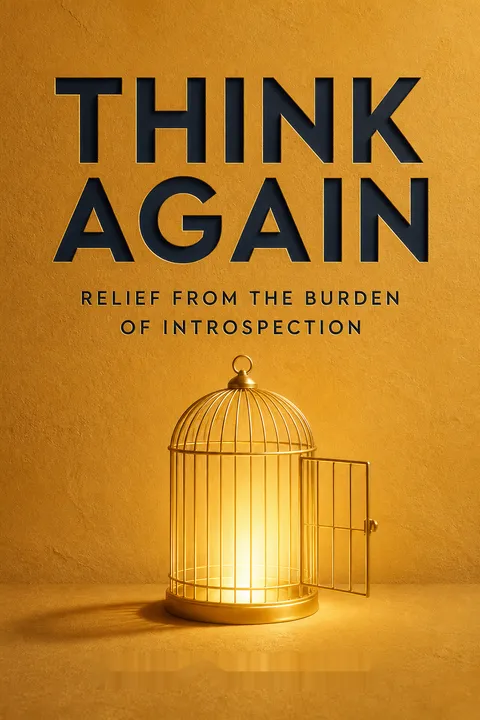
Think Again offers relief from excessive introspection, encouraging readers to focus more on Christ than themselves. Reviewers praise its biblical approach, practical advice, and gospel-centered message. Many found it life-changing, helping them combat negative self-thoughts and find freedom in Christ. The book is commended for its balance, readability, and use of Scripture and classic Christian authors. Readers appreciate Mellinger's personal insights and pastoral tone. Overall, it's highly recommended for those struggling with introspection or counseling others who do.
People Also Read





Glossary
Introspection
Looking inwardThe act of observing and reflecting on one’s thoughts, emotions, actions, and identity. Mellinger treats introspection as potentially helpful, since self-examination can reveal where change is needed. It becomes harmful when inward attention is excessive, repetitive, and disconnected from faith, action, or attention to anything beyond the self.
Christ-ospection
Reflection redirected toward ChristMellinger’s term for turning from self-focused analysis toward attention to Christ. It does not require complete unawareness of oneself. Rather, it places self-knowledge within a Christian understanding of Christ, so that sin, weakness, and good works point beyond the self toward forgiveness, strength, and grace.
Renegade self-reflection
Unplanned, self-accusing reviewMellinger’s label for aimless evaluation that floods the mind, often when a person is tired, discouraged, or emotionally strained. Instead of producing proportionate understanding or a useful next step, it tends to generate anxiety, self-condemnation, and generalized judgments about one’s character or life.
False guilt
Unfounded sense of blameA feeling of guilt that does not correspond to actual wrongdoing or a biblical obligation. It can grow from comparison, fear of other people’s judgment, confusion between weakness and sin, or treating one preferred practice as a universal requirement. Mellinger distinguishes it from real guilt, which calls for confession and repentance.
Self-forgetfulness
Freedom from constant self-consciousnessA state in which thoughts about oneself no longer dominate attention or control emotional reactions. Mellinger does not mean total ignorance of one’s behavior or needs. He means becoming absorbed in God, other people, meaningful work, art, worship, or the world, rather than connecting every experience to personal status or approval.
Circle of responsibility
Boundary of personal dutyA tool for distinguishing what a person is responsible to do from what they care about but cannot control. The smaller circle represents assigned duties; a larger circle represents wider concerns. The distinction helps prevent people from taking guilt for outcomes that belong to other people or lie beyond their power.
Extra-spection
Looking beyond oneselfMellinger’s term for the outward and upward attention he sees as central to Christian life. It includes looking to Christ, noticing creation, and caring for other people. It is not a rejection of self-examination; instead, it gives self-knowledge a destination beyond continued analysis of the self.
Download PDF
Download EPUB
.epub digital book format is ideal for reading ebooks on phones, tablets, and e-readers.








