

Key Takeaways
Choose the move that wins, not the move that saves your reputation
The safer-looking shot. In elite soccer, penalty kicks succeed about 75 percent of the time. Goalkeepers usually dive left or right, so a shot straight down the middle can be more successful, even though only 17 percent of kicks go there. The catch is social, not technical: if the keeper stays put and blocks the ball, the kicker looks foolish. A corner shot offers a more respectable excuse if it fails, even when it gives the team worse odds.
Notice whose payoff counts. Players say they want to win, but fear of public embarrassment can quietly shape their choice. Thinking like a Freak means examining the real incentive beneath the stated goal. The center is not always right, since keepers adapt, but unconventional choices deserve a fair test against the evidence.
The penalty kick makes an abstract problem visible: individual reputation and collective success can point in different directions. Similar tensions appear in organizations when employees avoid a sound but unpopular decision because failure would be personally memorable. The example does not prove that people are simply selfish. It shows how institutions can make self-protection rational, even when everyone claims to share a larger goal. A useful follow-up is to ask who bears the blame if an experiment fails, and who receives credit if it works. Changing those consequences may matter more than exhorting people to be brave.
Say what you don't know, then design a way to learn it
Confidence is not evidence. In a long study, political experts made thousands of forecasts and performed only modestly better than a simple prediction of no change. A separate review of stock-market pundits found an accuracy rate below 50 percent. Bold predictions are rewarded when they succeed and quickly forgotten when they fail, which makes overconfidence an attractive career strategy.
Build a feedback loop. A retailer believed its television ads boosted sales because sales rose when ads aired, but the ads ran on major shopping days anyway. The company had not separated cause from coincidence. A randomized test, with some markets receiving no ads, could have provided better evidence. The same principle applies to ordinary decisions: admit uncertainty, test a manageable question, and use the result to update the plan.
Uncertainty is useful when it is made operational. A forecast that includes probabilities can be checked against outcomes, while a vague claim of certainty tends to escape accountability. Experiments also force teams to specify what success would look like before they see the results. Still, not every question can be randomized, and a small test may miss effects that emerge over time or differ across groups. Humility should therefore lead to better-designed inquiry, not to the assumption that nothing can be known.
Redefine the task before trying harder at the wrong one
Change the question. Competitive eater Takeru Kobayashi entered a contest whose record stood at just over 25 hot dogs and buns. He ate 50. Instead of asking how to eat more quickly, he asked how to make each mouthful easier to manage. He separated the meat from the bun, broke the hot dogs into pieces, soaked and compressed the buns, and tracked his practice on video and in spreadsheets.
Treat limits as hypotheses. Kobayashi approached competitive eating as a trained sport, not as an ordinary meal performed faster. That shift revealed techniques his rivals had overlooked. The book calls one of his bun-and-hot-dog strategies the Solomon Method. His record was not proof that every limit is imaginary; it showed that some limits reflect inherited methods and assumptions rather than physical necessity.
Kobayashi's improvement resembles process redesign in manufacturing: a task can become easier when its steps are separated, reordered, or measured. His achievement also illustrates the value of deliberate practice, where repeated attempts produce information rather than merely fatigue. The lesson has boundaries. A record can be artificial, but bodies, budgets, and safety constraints are often real. The productive question is not whether limits should be ignored, but which ones have been measured and which ones have merely been repeated.
Trace persistent problems to causes, not their visible symptoms
Look beneath the shortage. Sending food to a famine zone may relieve immediate hunger, but famine can persist because institutions prevent people from obtaining food that exists. Poverty likewise reflects more than an empty wallet; weak legal, political, and economic systems can keep people from building secure livelihoods. Aid aimed only at the visible deficit may leave the mechanism producing it untouched.
Follow causes backward. For decades, ulcers were commonly blamed on stress, spicy food, and excess stomach acid. Doctors treated pain, but the condition often returned. Barry Marshall and Robin Warren found bacteria in ulcer patients. Marshall swallowed a cultured sample himself, developed stomach inflammation, and helped establish the role of H. pylori. Their discovery redirected treatment toward the infection rather than symptoms. Root causes can be harder to change, but treating symptoms alone can keep failure in business.
Root-cause thinking is powerful because interventions often fail when they target a proxy rather than the process generating it. The ulcer story is especially persuasive because it connects observation, a risky test, and a treatment that follows from the proposed mechanism. Social problems are less tidy: causes interact, and an intervention can work at one level while leaving others intact. A causal explanation should therefore be treated as a map to test, not a final answer. The question is whether changing the suspected cause reliably changes the outcome.
Think small, stay curious, and make investigation enjoyable
Start with a tractable question. Large reforms often bundle many assumptions together, making it difficult to know what helped. In a study of schoolchildren in rural China, researchers provided eyeglasses to students who needed them. The glasses cost about $15 per pair, and after a year the students who wore them showed substantially greater learning gains than peers who remained without correction. A small, concrete intervention illuminated a neglected barrier to learning.
Keep the child's question. Children may notice what experienced adults dismiss as obvious or irrelevant. The authors connect curiosity with play: people tend to practice more when they enjoy the work. Generating many ideas is useful if bad ones can be discarded before action. Small investigations do not solve every large problem, but they can uncover overlooked causes and produce evidence that grand arguments rarely supply.
Small experiments can be a form of intellectual risk management: they limit the cost of being wrong while making room for surprise. The eyeglasses example is memorable because a modest physical tool addresses a barrier that school policy debates can overlook. Yet a promising result in one setting does not automatically travel to another. Replication, local fit, and follow-up matter, especially when programs are scaled. Curiosity is not a substitute for expertise; it is a way to ask experts better questions and to notice where established explanations have stopped looking.
Design incentives around what people actually do, not what they profess
Watch behavior, not speeches. When a father offered his young daughter candy for using the toilet, she quickly learned to make repeated tiny visits to collect more rewards. The incentive worked, but not quite as intended. In a California study, residents said environmental concern was their strongest reason to conserve electricity. Yet a message describing neighbors' conservation was more effective than messages appealing to morality, social duty, or saving money.
Anticipate the response. At Petrified Forest National Park, a sign announcing how much wood visitors stole was followed by more theft on the trails where it appeared. The warning may have made stealing seem common or urgent. Incentives can trigger behavior their designers never intended, because people respond to the practical meaning of a rule, not only its stated purpose. Measure the response and revise when it surprises you.
The gap between stated preferences and revealed preferences is a reminder that self-report is not a transparent window into motivation. People may sincerely describe the reason that sounds most admirable, while social context quietly drives the choice. This does not make moral concern fake; it means motives can coexist and shift with the setting. Incentive design also raises an ethical question: an effective nudge can respect people's agency, or exploit an informational advantage. Good design should consider both what changes behavior and whether the method is acceptable.
Build signals that let the honest and committed sort themselves out
Make choices reveal types. David Lee Roth said Van Halen's tour contract banned brown M&M's. The odd clause served as a quick test: if brown candies appeared, the promoter may not have read the detailed safety requirements, so the band checked the venue more carefully. At Zappos, new hires could accept a payment of roughly $2,000 and leave during training. Fewer than 1 percent took the offer, allowing the company to identify people less suited to its culture before investing further.
Let selection do work. A separating equilibrium is a situation in which people with different characteristics choose different options, making those differences visible. The book also describes scammers using deliberately implausible messages to screen for unusually gullible targets. Such screening can save time, but the same logic can serve helpful or harmful aims.
Self-selection can be cheaper than trying to infer commitment from interviews or promises. A choice with a real cost often contains more information than a polished statement, which is why trial periods, portfolios, and opt-in commitments can be useful. But signals are imperfect: a strong candidate may reject an onerous test for reasons unrelated to ability, and a dishonest person may learn to mimic the desired response. The design should therefore connect the signal to the actual trait that matters, while avoiding unnecessary barriers that exclude capable people.
Persuade with honest trade-offs and stories, not insults or perfect promises
Respect the audience's judgment. Research described in the book found that greater scientific and numerical literacy did not necessarily make people less divided over climate change. People can use knowledge to defend identities and group commitments, not simply to revise beliefs. An argument must therefore make sense to its recipient, not merely satisfy its author.
Give facts a human shape. A useful story includes evidence, context, and a chain of causes, rather than relying on one vivid anecdote. When the prophet Nathan wanted King David to recognize his wrongdoing, he told a story about a rich man taking a poor man's only lamb; David condemned the act before realizing the story described him. Effective persuasion also acknowledges a proposal's costs and the strongest points on the other side. Insults usually close the conversation.
Stories help people remember how events connect, while numbers help establish whether the story is typical or exceptional. The two forms of evidence work best together. A narrative can also smuggle in assumptions, so vividness should not be mistaken for proof. The authors' advice to concede weaknesses strengthens credibility because listeners already know that real choices involve trade-offs. Persuasion is not control: a fair argument can improve understanding and still fail to change someone's position, especially when the disagreement is bound up with identity or trust.
Quit projects whose future cost exceeds what they can still return
Separate past spending from future value. The sunk-cost fallacy is the tendency to continue a failing commitment because of resources already spent. Those resources cannot be recovered; the relevant question is what the next hour, dollar, or year could accomplish elsewhere. At an invention lab, researchers tested a promising self-sterilizing surface, found it worked, and stopped when the technology needed to make it affordable was not ready. A quick, inexpensive failure preserved room for other work.
Test the decision. The authors invited people torn over major choices to follow a coin flip. More than 40,000 decisions were submitted, and about 60 percent of participants followed the result. Early reports suggested that people who quit a job or relationship were happier, though the evidence was not definitive. A premortem, imagining a project's failure and listing its causes in advance, can also reveal reasons to stop before losses grow.
Quitting is not the opposite of persistence; it is a choice about where persistence belongs. Opportunity cost makes the hidden alternative visible, while a premortem gives dissent a legitimate place before momentum hardens into commitment. The coin-flip project is suggestive, not a universal decision rule: participants chose to submit, and a random result cannot account for obligations, risk, or other people's welfare. Its value is as a prompt. If a coin's answer feels intolerable, that reaction may reveal a preference the decision-maker had been avoiding.
Analysis
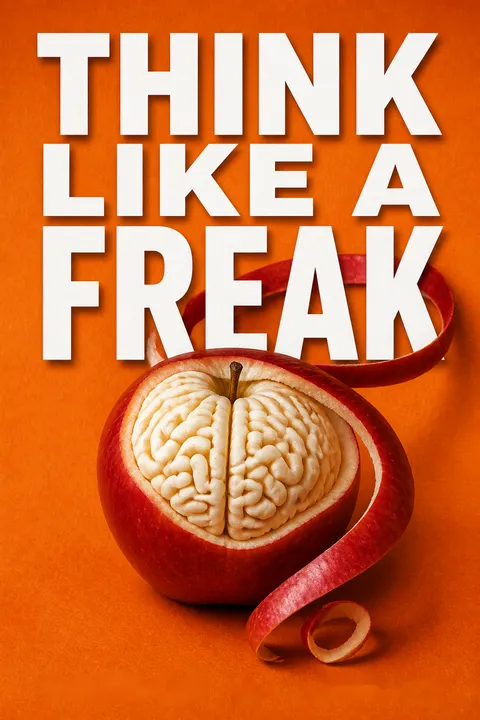
Think Like a Freak turns the economic habit of asking who benefits into a general method for inquiry. Its most important move is not calculation alone, but displacement: change the question, identify the incentives hidden behind stated motives, and look for a test that could prove the preferred explanation wrong. Kobayashi's eating strategy, the ulcer investigation, and the retailer's advertising dilemma are very different stories, yet each begins when someone stops treating the established framing as inevitable.
The book's storytelling makes abstract tools portable. A reader can remember the center-directed penalty kick, the girl gaming the candy reward, and the fake restaurant winning an award long after forgetting a formal definition. This is an effective teaching design, though it creates a responsibility to distinguish memorable illustration from representative evidence. Some examples are persuasive demonstrations of possibility, not conclusive estimates of how common a behavior is or whether an intervention generalizes.
Its economic lens is strongest when it corrects moralized explanations with observable behavior. It is less complete when preferences, power, and institutions are treated as though they can be separated cleanly. People do respond to incentives, but they also interpret rules through identity, history, and unequal authority. A well-designed experiment can measure an intervention's consequences without settling whether its goal is just. Similarly, tracing a root cause does not automatically identify a feasible or ethical remedy.
The book's practical ethic is therefore best understood as disciplined curiosity rather than cleverness for its own sake. Admit uncertainty, but do not stop there. Form a question narrow enough to investigate, gather feedback, and revise when reality refuses to cooperate. Use unconventional strategies with humility, since other people adapt and incentives can be gamed. And treat quitting as an allocation decision, not a verdict on character. This combination makes the book's advice useful beyond economics: it encourages intellectual flexibility while preserving accountability for what the evidence actually supports.
Review Summary
Think Like a Freak received mixed reviews from readers. Many enjoyed the authors' storytelling and unconventional approach to problem-solving, praising the book's entertaining anecdotes and accessible writing style. However, some critics found the content repetitive, especially for those familiar with the authors' previous works or podcast. While some readers appreciated the practical advice on thinking differently, others felt the book lacked depth compared to its predecessors. Overall, opinions varied on whether the book offered valuable insights or merely rehashed familiar concepts in a lighter format.
People Also Read








Glossary
economic approach
Data-led problem analysisA way of examining social and practical problems through evidence about behavior, incentives, and resource allocation rather than relying only on intuition or ideology. It asks what people actually do, what constraints they face, and which mechanisms may explain an outcome. The approach is not limited to financial markets or economists.
ultracrepidarianism
Advice beyond one's expertiseThe habit of offering confident opinions or advice on subjects outside one's knowledge or competence. The book uses the term to warn that expertise in one field does not automatically transfer to another. Recognizing the boundary of one's knowledge can prevent confident but poorly grounded judgment.
natural experiment
Unplanned comparison in the worldA real-world event or policy change that creates different conditions for different groups, resembling an experiment even though researchers did not assign people randomly. By comparing affected and less-affected groups, investigators may learn about cause and effect. The comparison still depends on whether the groups and timing provide credible evidence.
field experiment
Test in real settingsAn experiment conducted in an ordinary real-world environment rather than a controlled laboratory. Researchers can assign different treatments, often at random, and observe behavior under familiar conditions. Field experiments may produce more realistic evidence than artificial tasks, although they can be harder to control and may raise practical or ethical constraints.
declared preferences
What people say they wantThe choices or motivations people report when asked directly. These statements can differ from revealed preferences, which are inferred from actual behavior. The distinction matters when people describe socially approved reasons for acting, while their decisions respond more strongly to convenience, social pressure, money, or other incentives.
Cobra effect
An incentive that worsens a problemA backfire in which a reward intended to reduce an unwanted behavior makes the problem worse by encouraging people to produce or preserve the behavior. The book illustrates the idea with bounties that can create new markets for the very pests or pollutants they are meant to eliminate.
separating equilibrium
Choices reveal hidden differencesA situation in which people with different characteristics choose different options, allowing an observer to distinguish between them. A well-designed test or offer may prompt committed and uncommitted people, or guilty and innocent people, to respond differently. The resulting signal is informative only if the options create genuinely different incentives.
premortem
Imagine failure before launchA planning exercise in which participants assume a project has failed and independently list the reasons it might have gone wrong. By treating failure as an imagined fact, the method can make it easier to surface risks that people hesitate to raise during optimistic planning. It is intended to improve preparation, not to predict failure with certainty.
sunk-cost fallacy
Past costs distort future choicesThe tendency to continue a project or commitment because time, money, or effort has already been invested, even when those resources cannot be recovered. A sound decision compares the likely future benefits and costs of continuing with the alternatives. Past investment matters only insofar as it changes what can happen next.
FAQ
What's "Think Like a Freak" about?
- Authors' Background: "Think Like a Freak" is written by Steven D. Levitt and Stephen J. Dubner, the authors of "Freakonomics." They aim to teach readers how to think more creatively and rationally about problems.
- Problem-Solving Approach: The book encourages readers to approach problems with a fresh perspective, challenging conventional wisdom and using data-driven analysis.
- Wide Range of Topics: It covers diverse topics, from economics and psychology to everyday decision-making, using real-world examples and anecdotes.
- Goal of the Book: The authors aim to equip readers with tools to think differently, solve problems more effectively, and make better decisions.
Why should I read "Think Like a Freak"?
- Unique Perspective: The book offers a unique way of looking at problems, encouraging readers to question assumptions and think outside the box.
- Practical Advice: It provides practical advice and strategies that can be applied to personal and professional challenges.
- Engaging Stories: The authors use engaging stories and examples to illustrate their points, making complex ideas accessible and entertaining.
- Broadened Thinking: Reading the book can help broaden your thinking and improve your problem-solving skills.
What are the key takeaways of "Think Like a Freak"?
- Challenge Conventional Wisdom: Don't accept conventional wisdom without questioning it; often, it's wrong or incomplete.
- Embrace "I Don't Know": Admitting ignorance is the first step to learning and finding the right answers.
- Think Small: Focus on small, manageable problems rather than trying to solve everything at once.
- Use Incentives Wisely: Understand and leverage incentives to influence behavior effectively.
How do the authors suggest we "Think Like a Freak"?
- Redefine Problems: Approach problems by redefining them to uncover new solutions, as demonstrated by Takeru Kobayashi in competitive eating.
- Experiment and Gather Feedback: Use experiments to gather feedback and learn from failures, as seen in various case studies throughout the book.
- Ignore Artificial Limits: Challenge artificial limits and barriers that may hinder problem-solving and innovation.
- Have Fun: Embrace a playful and curious mindset to foster creativity and innovation.
What is the "Teach Your Garden to Weed Itself" concept?
- Self-Weeding Garden: This concept involves setting up situations where people reveal their true intentions or capabilities, allowing problems to solve themselves.
- King Solomon's Wisdom: The authors use the biblical story of King Solomon to illustrate how strategic thinking can reveal the truth.
- David Lee Roth's M&M Clause: Van Halen's contract rider, which demanded no brown M&Ms, served as a test to ensure venues read their detailed technical requirements.
- Practical Application: This concept can be applied in various contexts, such as hiring processes or security measures, to efficiently identify issues or unfit candidates.
How do incentives play a role in "Think Like a Freak"?
- Understanding Incentives: The book emphasizes the importance of understanding what truly motivates people, beyond just financial incentives.
- Case Studies: Various case studies, such as the California energy experiment, demonstrate how different incentives can lead to unexpected outcomes.
- Designing Effective Incentives: The authors discuss how to design incentives that align with people's true motivations and encourage desired behaviors.
- Avoiding Backfire: They also warn about the potential for incentives to backfire if not carefully considered and tested.
What is the significance of "I Don't Know" in the book?
- Admitting Ignorance: The authors argue that admitting "I don't know" is crucial for learning and problem-solving.
- Overcoming Biases: It helps overcome biases and assumptions that can cloud judgment and hinder progress.
- Encouraging Curiosity: Embracing uncertainty encourages curiosity and a willingness to explore new ideas and solutions.
- Real-World Examples: The book provides examples of how acknowledging ignorance has led to breakthroughs and better decision-making.
How does "Think Like a Freak" address the concept of quitting?
- Reevaluating Quitting: The book challenges the stigma around quitting, suggesting it can be a strategic decision rather than a failure.
- Opportunity Cost: It emphasizes considering opportunity costs and sunk costs when deciding whether to quit.
- Case Studies: Examples like the Freakonomics Experiments website illustrate how quitting can lead to better outcomes and happiness.
- Letting Go: The authors encourage readers to let go of unproductive commitments to focus on more promising opportunities.
What are some of the best quotes from "Think Like a Freak" and what do they mean?
- "The first step in solving problems: put away your moral compass." This quote suggests that moral judgments can cloud objective analysis and hinder problem-solving.
- "If you ask the wrong question, you’ll surely get the wrong answer." It highlights the importance of framing problems correctly to find effective solutions.
- "Few people think more than two or three times a year." This quote, attributed to George Bernard Shaw, underscores the rarity and value of deep, independent thinking.
- "Sometimes in life, going straight up the middle is the boldest move of all." It encourages taking unconventional approaches that may seem counterintuitive but can lead to success.
How do the authors use storytelling in "Think Like a Freak"?
- Engaging Narratives: The authors use storytelling to make complex ideas relatable and memorable.
- Illustrating Concepts: Stories are used to illustrate key concepts, such as incentives, problem-solving, and quitting.
- Real-World Examples: The book includes real-world examples and anecdotes to demonstrate the application of Freakonomics thinking.
- Persuasion Tool: Storytelling is presented as a powerful tool for persuasion and teaching, capturing attention and conveying messages effectively.
What role does experimentation play in "Think Like a Freak"?
- Learning Through Experiments: The authors advocate for using experiments to test hypotheses and gather feedback.
- Field Experiments: They highlight the value of field experiments in understanding human behavior and solving problems.
- Failure as Feedback: Experiments are seen as opportunities to learn from failure and refine approaches.
- Practical Applications: The book provides examples of how experimentation has led to insights and innovations in various fields.
How can "Think Like a Freak" help in everyday decision-making?
- Challenging Assumptions: The book encourages questioning assumptions and thinking critically about everyday decisions.
- Practical Tools: It offers practical tools and strategies for approaching problems and making better choices.
- Broadened Perspective: By adopting a Freakonomics mindset, readers can gain a broader perspective on issues and opportunities.
- Improved Problem-Solving: The insights and examples in the book can enhance problem-solving skills and lead to more effective decision-making.
Freakonomics Series
About the Author
Download PDF
Download EPUB
.epub digital book format is ideal for reading ebooks on phones, tablets, and e-readers.








