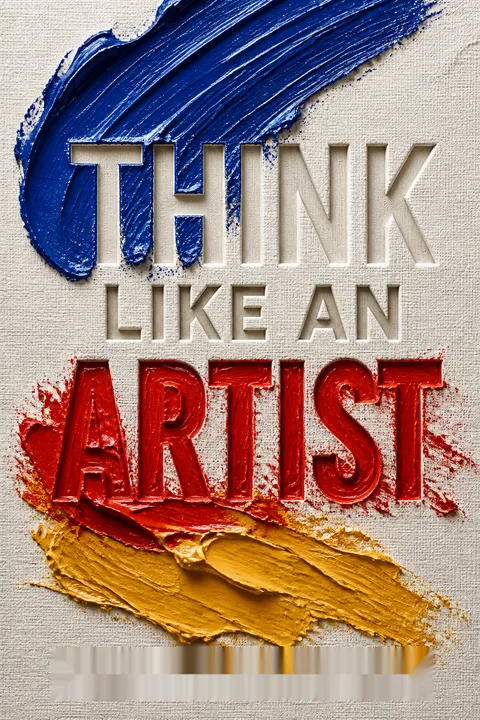


Key Takeaways
Treat creativity as a practice, not a rare talent reserved for artists.
Creativity starts in ordinary life. Gompertz argues that imagining a meal, a witty message, or a new way to solve a problem already uses creative ability. The difference between a person who creates and one who does not is often less about innate genius than about finding a focus that makes imagination useful. The book opens with the author's memories of ballet pioneers Ninette de Valois and Frederick Ashton, whose work gave their imagination a direction and their lives a purpose.
Claim permission for yourself. Artists do not wait for formal approval before beginning. Learning skills matters, but a credential is not what makes someone creative. The practical first move is to choose an interest and start making something, whether that means a business, a design, a performance, or a painting.
The useful distinction is between a broadly human capacity and the expertise required to produce strong work. Curiosity and imagination may be widespread, but mastery still takes time, feedback, and practice. This framing helps people begin without pretending that talent is irrelevant or that all work is equally accomplished. It also challenges a common gatekeeping habit: treating creativity as a professional identity instead of a set of actions. The book's democratic claim is strongest when understood as permission to participate, not a promise that every attempt will be original or excellent.
Build a business around your work to buy time for the work.
Money can protect creative freedom. Artists are not exempt from rent, materials, or the need to find an audience. Andy Warhol made commerce part of his art, while Vincent van Gogh treated his brother Theo as a financial partner, sending progress reports and asking for further investment. The point is not that profit must be the artist's highest aim. Income can fund the time and materials needed to keep creating.
Turn resources into more than sales. Theaster Gates took this idea into his Chicago neighborhood. He sold artworks made from materials recovered from abandoned buildings, then used the proceeds to renovate properties as cultural spaces. His Dorchester Projects included a record archive, a book collection, and a cinema. His business model joined artistic production to community investment.
This account usefully replaces the myth of the artist untouched by practical life with a more credible model: craft needs infrastructure. In entrepreneurship, a viable revenue stream can preserve autonomy by reducing dependence on a single patron or employer. Gates's example also shows that value is not inherent in raw materials alone; it depends on interpretation, trust, and the institutions willing to recognize it. Still, his success should not be mistaken for a simple recipe. Access to galleries, collectors, and capital is uneven, and artistic enterprise cannot by itself repair structural deprivation.
Treat dead ends as material, then change the plan instead of quitting.
A bad result is not a final verdict. The book separates a failed attempt from the painful feeling of being a failure. Public judgment can change with time: painters rejected by the Paris Salon, including Monet, Manet, and Cézanne, were later treated as innovators. More usefully, errors can reveal what to alter. The creative process is iterative: test, assess, revise, and test again, rather than repeating a method that is not working.
Let the route change. Bridget Riley struggled to find an individual direction until she set aside her familiar use of color and explored black-and-white abstraction. That shift drew on ideas she had studied for years. Gompertz calls such a productive change a Plan B: an unexpected new direction built from earlier experience. David Ogilvy's varied work before advertising similarly became preparation for his later career.
The chapter's strongest idea is not that every setback is secretly beneficial, but that creative work requires separating a disappointing outcome from a permanent judgment of ability. This resembles iterative design, where a prototype is evidence about a solution, not a verdict on the designer. Persistence becomes more intelligent when paired with diagnosis and revision. There is a necessary caution: not every project deserves endless effort, and sunk costs can masquerade as commitment. A useful pivot preserves the underlying purpose while changing the approach, rather than treating endurance as a virtue in itself.
Feed curiosity with study, then turn passion into disciplined experiments.
Interest supplies the raw material. Gompertz describes creativity as a chain: enthusiasm prompts inquiry, inquiry builds knowledge, and knowledge gives imagination something specific to transform. Marina Abramović showed this early. After seeing military jets paint trails across the sky, she asked the authorities to stage a similar event. They dismissed her, but the request reflected an artist testing what an idea might become.
Research makes risk meaningful. Abramović and her collaborator Ulay created performances that examined trust, dependence, and physical limits. Their work required preparation, not just a provocative concept. Caravaggio likewise studied earlier painters and explored optics before developing his dramatic approach to light and shadow. The book's portrait of both artists makes a practical point: serious creative work combines feeling with informed experimentation.
Curiosity is more than collecting novelties. It becomes productive when attention is sustained long enough to build a model of how something works, then tested through action. This connects creative practice to scientific inquiry, where observation and experiment discipline intuition. Passion can keep that inquiry alive, but intensity alone is not evidence of value. The Abramović examples also invite an ethical question: when performance uses danger or bodily strain, the artist's preparation and the audience's understanding matter. The broader lesson is to let genuine interest guide investigation, while applying judgment to the methods used.
Make originality by combining influences, then reshape them through your temperament.
Ideas have sources. Homospatial thinking is the deliberate act of placing separate ideas or images together in the mind so a new connection can emerge. Gompertz illustrates this with Picasso, whose early paintings openly borrowed from admired artists. Copying helped him learn techniques; originality came when he transformed those influences rather than merely reproducing them.
Synthesis makes the work personal. In 1901, Picasso's grief and study of earlier painters converged in works associated with his Blue Period. His 1945-46 lithographs of a bull show another kind of transformation: through successive images, he reduced a detailed animal to a few essential lines. The result was not a new subject from nowhere, but a distinct arrangement of experience, observation, memory, and deliberate editing.
The chapter describes creativity as synthesis rather than creation from a vacuum, a view compatible with how expertise often works: stored knowledge gives the mind components to recombine. Picasso's progression also clarifies that influence is not the same as imitation. But the language of taking or stealing ideas needs a boundary. Transformation, attribution, and respect for ownership distinguish learning from appropriation. The practical question is not simply what has influenced a creator, but what new understanding the creator contributes. Reduction matters too: a crowded set of influences only becomes legible when weaker elements are removed.
Interrogate assumptions until an idea earns its form.
Questions expose weak foundations. The Socratic method is a disciplined practice of questioning assumptions to test whether an idea holds together. It is not cynicism: its purpose is to uncover problems and improve an argument or design. Edgar Allan Poe described making a poem through a sequence of deliberate decisions, while filmmaker J. J. Abrams worked through practical questions about character motivation and plot before settling a script.
Reason can create new forms. Piero della Francesca used mathematical perspective to rethink how a painting could represent three-dimensional space. In the Flagellation of Christ, he worked through problems of depth, volume, light, and composition. The example shows that questioning is not an abstract exercise. It can help a creator discover what a medium needs to do, then make informed choices despite the lack of perfect certainty.
A useful question changes what can be seen or tested. This is close to the logic of falsification: a claim becomes clearer when its weaknesses are actively sought, rather than protected from scrutiny. Yet questioning can become a refuge from commitment. Creative work eventually requires a decision made under uncertainty, not proof that no alternative is possible. The balance is to use skepticism to improve the choice, then accept responsibility for choosing. This approach is especially valuable in collaborative settings, where explicit questions can reveal hidden assumptions before they harden into costly decisions.
Plan the whole experience while adjusting the smallest detail.
Context changes what details mean. Artists must move between the overall design and the local choice. Adele's performance in a vast arena felt intimate because she held the audience's attention at both scales. Painter Luc Tuymans plans exhibitions as connected ensembles before he begins individual paintings, then works quickly with a clear larger structure in mind.
A tiny feature can guide attention. Tuymans calls a painting's point of entry the detail that first catches a viewer's eye and draws them into the image. In Vermeer's Girl with a Pearl Earring, a minute touch of pink near the mouth changes how the girl's expression reads. These examples show why composition is not just a collection of attractive parts. The creator must consider how each part directs attention and contributes to the whole.
This is a strong lesson in systems thinking: a small component can alter the interpretation of an entire experience, while a coherent whole gives that component significance. The same principle appears in interface design, where a single cue can shape how someone navigates a complex product. Tuymans's advance planning also shows how preparation can make execution faster. The tradeoff is that a plan can become too controlling. A useful structure should coordinate details without preventing discoveries that only become visible during the act of making.
Develop a point of view from what only you notice.
Your perspective can become your signature. A point of view is not merely a recognizable style; it is the particular meaning a creator finds in a subject. Peter Doig struggled to paint landscapes until he realized he needed distance from a place before he could represent it. The remembered landscape became a way to explore how memory reshapes experience.
Personal vision can challenge omission. Rembrandt turned grief, aging, and professional troubles into a more inward style of painting. American artist Kerry James Marshall, by contrast, responded to the absence of Black subjects and artists in the Western art history he encountered. His paintings placed Black life in conversation with established European traditions. In both cases, the subject became powerful because it was filtered through a specific, personally grounded perspective.
A point of view is both an artistic choice and a way of noticing. It can make familiar material newly visible, especially when it brings forward experiences that dominant narratives have excluded. This connects to standpoint theory, the idea that social position can shape what evidence and questions become available. Perspective, however, is not automatically insight. Strong work still requires craft, attention to others, and a willingness to revise one's interpretation. The productive aim is not to treat identity as a guarantee of authority, but to recognize how lived experience can generate questions others have overlooked.
Risk public judgment, and find allies willing to back ambitious work.
Making work means becoming visible. Artists expose ideas to judgment before they can know how an audience will respond. Michelangelo initially resisted painting the Sistine Chapel ceiling, doubting his experience with fresco and suspecting that rivals wanted him to fail. He accepted the commission, designed an ambitious scheme, and spent four years completing it. The achievement required courage, but also a patron who continued to support the project.
Innovation needs room to be misunderstood. The book also points to artists who challenge institutions from outside them, including Banksy, and to Ai Weiwei's use of art under political pressure. New work can meet dismissal or suppression before its purpose is understood. Support may come from a patron, a gallery, a collaborator, or an audience willing to give an unfamiliar idea time.
Courage is often described as an individual trait, but this story makes its social conditions visible. People take more creative risks when they have resources, allies, and some protection from immediate punishment. That insight connects artistic patronage to psychological safety in teams: disagreement and experimentation become possible when failure is not treated as a personal offense. Still, exposure is not equally safe for everyone. Calls to be brave should not obscure the unequal costs of speaking publicly, especially for people facing censorship, discrimination, or economic precarity.
Pause between making and judging to catch what the maker cannot see.
Change roles before revising. The book uses the artist's chair as an image for a shift from creator to critic. David Hockney would sit back, inspect a painting, then sometimes make a small adjustment that changed the composition. J. M. W. Turner added a vivid red mark to a seascape after seeing it beside a rival's painting, turning a minor detail into a stronger visual anchor.
Reflection can take time. Marcel Duchamp spent years considering and refining his installation Étant Donnés. His example contrasts with fast corrections, but the principle is similar: making and evaluation are different mental tasks. A useful pause lets the creator see the work as an audience might, notice what is missing, and decide whether to revise, leave it alone, or begin again.
The shift from production to evaluation resembles metacognition: stepping outside an activity to monitor how well it is working. It can improve judgment because immersion narrows attention, while distance helps reveal proportions and unintended effects. The pause need not mean waiting for inspiration; it can be a deliberate review with criteria. There is also a danger in endless evaluation, which can erode confidence and delay completion. A practical boundary is to decide in advance what kind of evidence would justify another revision.
Teach people how to think, not merely what to repeat.
Education should develop judgment. Bob and Roberta Smith's campaign, All Schools Should Be Art Schools, argues for an educational attitude that values independent thinking, experimentation, and critique. At art school, he learned to study a problem, decide what mattered, and make something in response. Facts were starting points for inquiry, not merely material to memorize for an exam.
Build institutions for making. Gompertz extends the argument to workplaces, suggesting that rigid hierarchies can discourage employees from contributing ideas. Collaborative critique, projects, and opportunities to define problems could help people practice both creativity and resilience. The aim is not to discard foundational knowledge or every test. It is to give learners and workers more chances to use what they know, make choices, receive feedback, and develop useful work.
The argument challenges a real mismatch: education often rewards correct recall, while complex work also requires framing problems, weighing evidence, and communicating decisions. Project-based learning can make those capacities visible, especially when critique is specific and constructive. Yet knowledge and creative practice are not rivals. Students need shared foundations before they can question them intelligently, and open-ended assessment can inherit bias if standards are vague. The strongest version of the proposal combines rigorous subject knowledge with authentic projects, transparent feedback, and room for more than one defensible answer.
Analysis
Gompertz presents creativity less as a mysterious gift than as a sequence of learnable behaviors. The recurring pattern is consistent: find a subject worth attending to, gather knowledge, combine what is already available, question the result, make a decision, and expose the work to an audience. Artists supply vivid examples because their process is visible, but the argument applies equally to business, education, and civic life.
The book's most productive correction is its refusal to separate imagination from practical life. Van Gogh's reliance on Theo, Warhol's commercial intelligence, and Gates's neighborhood projects show that creative autonomy depends on material conditions. That moves the discussion beyond inspirational advice. A practice needs time, money, tools, and often supporters. The same point complicates the book's call for individual courage: boldness is valuable, but institutions shape who can afford to be bold and whose work receives attention.
Its account of originality is also persuasive because it makes influence explicit. Picasso's development is not a miracle of invention from nothing; it is a visible transition from imitation to synthesis and selection. This model is useful across disciplines, where new solutions often emerge by recombining existing methods. But the metaphor of stealing should be handled carefully. Influence becomes creative contribution through transformation, not through ignoring attribution or power differences.
The book's optimism about universal creativity is best read as an invitation rather than a scientific claim that everyone has equal aptitude or opportunity. Creative capacity can be broadly shared while skill, recognition, and resources remain unevenly distributed. Its enduring lesson is therefore both personal and institutional: begin making, learn from what happens, and create environments where people can question, revise, and contribute without needing to fit a narrow image of the artist.
Review Summary
Think Like an Artist receives mixed reviews, with an average rating of 3.86 out of 5. Many readers find it inspiring and insightful, praising its anecdotes about famous artists and practical advice on creativity. Some appreciate the book's emphasis on perseverance, curiosity, and courage in artistic pursuits. However, critics argue it focuses too heavily on visual arts and lacks depth in addressing other creative fields. Some readers feel the book doesn't fully deliver on its promise to help readers live more creative lives, while others consider it a valuable resource for aspiring artists and creative thinkers.
People Also Read

Glossary
Homospatial thinking
Combining ideas in one mental spaceA creative process in which two or more distinct ideas, images, or entities are mentally placed together, prompting a new connection or identity. The book uses Picasso's work to show how influences and experiences can be combined and transformed into something that is not simply a copy of any one source.
Socratic method
Questioning assumptions systematicallyA method of inquiry associated with Socrates that tests beliefs through pointed questions. Rather than accepting an assumption as fact, the questioner examines its logic, implications, and contradictions. In the book, this method models how creators can investigate a problem, strengthen an idea, and make decisions with greater clarity.
point of entry
Detail that draws viewers inLuc Tuymans's term for the feature in a painting that first catches a viewer's attention and invites closer looking. It may be a small, deliberate visual detail rather than the central subject. The term emphasizes that artists can shape how an audience approaches and interprets an image.
Plan B
A productive change of directionGompertz's recurring label for a shift from an original ambition or approach to a different one that proves more fruitful. The new direction is not necessarily a rejection of earlier work; it can draw on accumulated skills and experiments. Bridget Riley's move toward black-and-white abstraction is one example.
chiaroscuro
Dramatic contrast of light and shadeA painting technique that uses strong differences between illuminated areas and shadows to create depth, volume, and drama. The book highlights Caravaggio's use of the technique, in which figures and actions seem to emerge from dark surroundings. Its visual influence extends beyond painting to later photography and film.
FAQ
What's "Think Like an Artist" about?
- Exploring Creativity: "Think Like an Artist" by Will Gompertz delves into the mindset and practices of artists to uncover how they think and create. It aims to show how these approaches can be applied to lead a more creative and productive life.
- Artist Traits: The book identifies common traits among successful artists, such as curiosity, bravery, and skepticism, and explains how these can be harnessed by anyone.
- Practical Advice: Gompertz provides practical advice and insights into how adopting an artist's mindset can enhance creativity in everyday life and work.
- Inspiration from Artists: The book draws on examples from famous artists like Picasso, Warhol, and Duchamp to illustrate its points.
Why should I read "Think Like an Artist"?
- Enhance Creativity: The book offers strategies to unlock and enhance your creative potential, applicable in various fields beyond art.
- Learn from Masters: It provides insights into the lives and methods of renowned artists, offering inspiration and practical lessons.
- Broaden Perspective: By understanding how artists think, you can gain a new perspective on problem-solving and innovation.
- Applicable to All: Whether you're an artist or not, the book's lessons are designed to be universally applicable, helping anyone to think more creatively.
What are the key takeaways of "Think Like an Artist"?
- Creativity is Universal: Gompertz argues that everyone has the capacity for creativity, not just artists, and it can be cultivated with the right mindset.
- Traits of Artists: Key traits such as curiosity, bravery, and skepticism are essential for creative thinking and can be developed by anyone.
- Practical Application: The book provides practical advice on how to apply these artistic traits to everyday life and work to enhance creativity and productivity.
- Learning from Failure: Emphasizes the importance of learning from failure and viewing it as a necessary part of the creative process.
How does Will Gompertz define creativity in "Think Like an Artist"?
- Combination of Ideas: Creativity is seen as the ability to combine existing ideas in new ways to produce something original.
- Curiosity and Passion: It requires a deep curiosity and passion for a subject, which fuels the imagination and leads to innovative ideas.
- Iterative Process: Creativity is an iterative process involving experimentation, questioning, and refinement of ideas.
- Beyond Art: Gompertz emphasizes that creativity is not limited to art but is a valuable skill in all areas of life.
What are the best quotes from "Think Like an Artist" and what do they mean?
- "We cannot all paint like Picasso or sculpt like Michelangelo, but we can all think like an artist." This quote encapsulates the book's central message that the mindset of an artist is accessible to everyone.
- "Good business is the best art." Quoting Andy Warhol, this highlights the intersection of creativity and entrepreneurship, suggesting that successful artists are also savvy businesspeople.
- "The unexamined idea is not worth realizing." This echoes Socratic principles, emphasizing the importance of questioning and critical thinking in the creative process.
- "Creativity is more than just being different. Making the simple, awesomely simple, that’s creativity." This quote by Charles Mingus, included in the book, underscores the value of simplicity and clarity in creative work.
How does "Think Like an Artist" suggest overcoming creative blocks?
- Change of Scene: Moving to a new environment can stimulate the senses and provide fresh inspiration, as seen in the experiences of artists like Peter Doig.
- Embrace Failure: Viewing failure as a part of the creative process helps to learn and grow from setbacks rather than being discouraged.
- Question Everything: Employing a skeptical mindset to question assumptions can lead to new insights and breakthroughs.
- Find Your Voice: Discovering a personal point of view or unique perspective is crucial for overcoming creative blocks and producing original work.
What role does skepticism play in creativity according to "Think Like an Artist"?
- Questioning Assumptions: Skepticism involves questioning assumptions and challenging the status quo, which can lead to new ideas and innovations.
- Socratic Method: The book highlights the Socratic method of inquiry as a tool for critical thinking and problem-solving in the creative process.
- Avoiding Cynicism: While skepticism is constructive, it is important to avoid cynicism, which can be destructive and stifle creativity.
- Independent Thinking: Skepticism encourages independent thinking, allowing creators to develop unique ideas and solutions.
How does "Think Like an Artist" address the concept of failure?
- Part of the Process: Failure is presented as an inevitable and necessary part of the creative process, leading to growth and improvement.
- Learning Opportunity: Each failure provides valuable lessons and insights that can inform future creative endeavors.
- Plan B: Many successful creative individuals have achieved their breakthroughs through a Plan B, highlighting the importance of adaptability.
- Persistence: The book emphasizes the importance of persistence and resilience in overcoming failure and achieving creative success.
What does "Think Like an Artist" say about the importance of having a point of view?
- Unique Signature: A personal point of view is what differentiates an individual's work and gives it a unique signature.
- Expression of Ideas: Having something to say is crucial in creativity, as it drives the expression of ideas and originality.
- Inspiration Source: A clear point of view can serve as a source of inspiration and motivation for creative work.
- Overcoming Blocks: Discovering a personal point of view can help overcome creative blocks and lead to more meaningful and impactful work.
How does "Think Like an Artist" suggest we can apply artistic traits to everyday life?
- Curiosity and Passion: Cultivate curiosity and passion for subjects of interest to fuel creativity and innovation in daily tasks.
- Bravery in Expression: Be brave in expressing ideas and taking creative risks, even in non-artistic fields.
- Skeptical Inquiry: Use skeptical inquiry to question assumptions and explore new possibilities in problem-solving.
- Embrace Failure: View failures as learning opportunities and part of the process of achieving success in any endeavor.
What does "Think Like an Artist" suggest about the future of education?
- Art School Approach: The book suggests adopting an art school approach to education, focusing on creativity and independent thinking.
- Project-Based Learning: Emphasizes the value of project-based learning over traditional exams to foster creativity and critical thinking.
- Personalized Curriculum: Advocates for a more personalized curriculum that caters to individual interests and encourages self-discovery.
- Preparation for Creative Economy: Preparing students for a future creative economy by teaching them how to think, not just what to think.
How does "Think Like an Artist" propose we rethink the workplace for creativity?
- Collaborative Environment: Suggests creating a more collaborative and less hierarchical work environment to foster creativity.
- Freelance Model: Envisions a future where more people are self-employed, working with businesses rather than for them.
- Rewarding Creativity: Proposes new systems of remuneration that recognize and reward creative contributions more equitably.
- Empowering Workforce: Aims to empower individuals by valuing their unique talents and contributions, leading to a more motivated and creative workforce.
Download PDF
Download EPUB
.epub digital book format is ideal for reading ebooks on phones, tablets, and e-readers.








