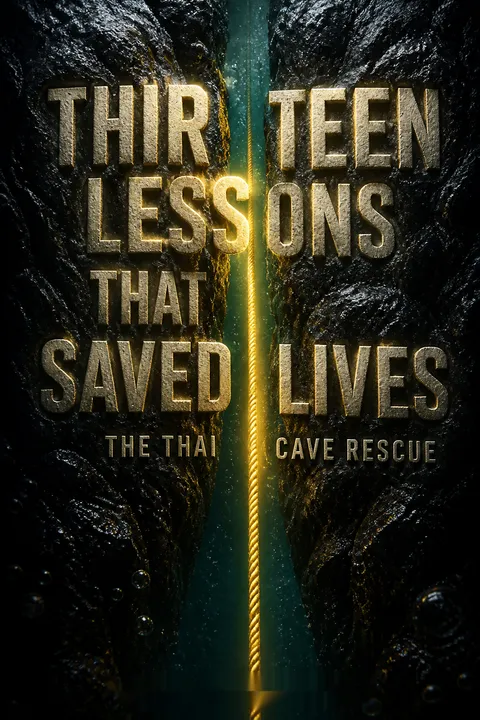


Key Takeaways
Ask why not, then take the first responsible step
The rescue began with a question. In June 2018, twelve boys and their coach became trapped by floodwater inside Thailand’s Tham Luang cave. John Volanthen, a volunteer cave diver with decades of experience, initially doubted he could join the rescue. He and diving partner Rick Stanton were not yet invited, and officials might refuse their help. Volanthen challenged that hesitation by weighing his actual skills against the need, then called Stanton and worked to secure permission.
Start with something manageable. Volanthen calls this the travelator: committing to one small action makes the next steps easier to take. Packing equipment, making a call, or researching a role can begin movement toward a daunting goal without requiring certainty about the entire journey. The question is not permission to charge ahead. It is a way to test whether a worthwhile first step is available.
What's useful here is the distinction between confidence and evidence. Volanthen does not wait to feel fearless. He checks whether his training matches the problem, then acts. That resembles a practical decision rule in entrepreneurship: test the next consequential assumption before investing in the whole venture. The limit matters, too. A small first step is valuable when it gathers information or opens an option. In a hazardous setting, momentum alone is not proof that the goal is wise. The question becomes productive only when paired with competence, permission, and a willingness to stop.
Treat 'it'll be fine' as a warning light, not reassurance
Small problems compound. Volanthen describes the Incident Pit Theory, the way several individually manageable problems can combine until escape becomes difficult. In Tham Luang, rain was still driving floodwater into the cave. On the first attempt, the team saw an air pocket shrinking above a passage. Continuing might have placed the divers in a trap, so they turned back rather than treating urgency as a reason to ignore conditions.
Notice your personal signal. For Volanthen, the thought that everything will probably be fine often appears when he senses trouble but is tempted to press on. He turns that phrase into a cue to reassess his limits, the environment, and his own state. A decision to stop can feel like lost progress, but it may protect the possibility of trying again under safer conditions.
This is a useful corrective to cultures that equate persistence with virtue. In safety-critical work, an early stop preserves options, while a late stop may no longer be possible. The idea also translates to projects: sunk costs can make people defend a failing plan because they have already invested in it. A warning phrase can interrupt that reflex. Still, no single inner signal is infallible. Anxiety can flag genuine risk, but it can also arise from novelty. The cue should prompt an evidence check, not automatically dictate retreat.
Widen your attention before a mission makes you blind
Focus has a blind spot. In the 1999 invisible gorilla experiment, viewers counted basketball passes and many missed a person in a gorilla costume crossing the scene. Volanthen connects this inattentional blindness, failing to notice what falls outside a demanding focus, to the rescue. While searching for the boys, he and Stanton found four Thai workers stranded by rising water. Their phones were still on a bank, and they refused to leave without them. The divers had to change priorities, retrieve the phones, and get the workers out.
Keep scanning the edges. A single goal can make other people, risks, or obligations disappear from view. Volanthen’s advice is to periodically widen attention: check the surroundings, the people affected, and the capacity remaining. The rescue team’s original mission mattered, but ignoring the workers would have created another emergency.
The story makes an important point about attention as a limited resource, not a moral failing. A person can be careful and still miss what a task has pushed beyond awareness. In teams, a second observer can help by monitoring context while someone else concentrates on execution. The phone episode also shows why good plans need room for human motives, even when those motives seem irrational under pressure. The challenge is not to notice everything at once, which is impossible, but to build deliberate moments for checking what the current focus may be hiding.
Rest before exhaustion turns a hard problem into a bad decision
Recovery changes judgment. After days of failed dives, worsening conditions, and tense dealings with officials, Volanthen and Stanton were close to giving up. A visit to a nearby temple gave them distance from the rescue site. The break did not solve the technical problem, but it restored energy and perspective. When they returned, water levels had fallen, and cooperation with other teams had improved.
Rest is part of the work. Volanthen compares mental recovery to diving decompression, the gradual return from depth that helps prevent serious injury. In ordinary life, a short pause can interrupt fatigue-driven mistakes and help someone process disappointment rather than immediately trying to prove themselves again. Rest is not a guarantee of insight, and it cannot replace action when time is critical. It is a way to preserve the capacity to act well.
The decompression analogy gives rest a practical function: it is not an indulgence added after real work, but maintenance that protects performance. That fits what is known broadly about fatigue and decision-making, which deteriorate when people operate without recovery. The temple visit also suggests that a change of setting can loosen a person’s mental grip on a problem. There is a necessary qualification: in emergencies, breaks must be calibrated to the actual clock and danger. Rest helps only when it supports a more capable return, rather than becoming avoidance disguised as self-care.
Solve emergencies in seconds, minutes, then hours
Shrink the time horizon. Time-slicing is Volanthen’s method for sorting a crisis into immediate, medium-term, and longer-term tasks. He learned its value during a dive in France, when he became stuck in a narrow passage with poor visibility and a malfunctioning rebreather display. Instead of trying to solve the whole dive at once, he first created room to breathe, then restarted the equipment, then worked out how to return and manage decompression.
Handle the urgent first. His shorthand is three seconds, three minutes, and three hours. First secure the next breath or address immediate danger. Then orient yourself and choose the next workable action. Only after that should attention shift to the longer route out. The same order can help with a frightening stack of paperwork or a road accident: stabilize, assess, and plan.
Time-slicing is a compact way to protect working memory. Under stress, trying to solve every consequence simultaneously can produce paralysis or impulsive action. A short, explicit sequence gives attention somewhere useful to land. Its strength is not that every emergency fits three neat intervals, but that it separates immediate survival from later logistics. The method also discourages premature planning: a person cannot sensibly solve the next several hours while an immediate threat remains unresolved. In practice, the time windows should flex to the event rather than be treated as a rigid formula.
Prepare for surprise with options, not predictions
Accept the changed reality. After ten days underground, the Wild Boars were found alive. Volanthen had spent time preparing himself for the possibility of finding bodies, but the discovery required an immediate mental reset. He counted all thirteen people, checked their condition, reassured them, and recorded video to prove they had survived.
Keep plans available. Volanthen calls his mental store of prepared responses the Library of Plans. It contains approaches drawn from experience, training, and deliberate what-if thinking. When he needed to lift the boys’ morale, he adapted a group cheer he knew from working with Cub Scouts. The point is not to predict exactly what will happen. It is to have flexible options ready, then adapt one to the facts in front of you.
Preparedness is most valuable when it increases flexibility rather than confidence in a single forecast. Volanthen’s response shows how a familiar technique can be repurposed when circumstances change. This resembles scenario planning in organizations: leaders rehearse possible disruptions so they can recognize patterns quickly, while avoiding the illusion that a plan has eliminated uncertainty. There is a balance to strike. Endless worst-case rehearsal can become anxiety, not preparation. A useful plan should identify an actionable response, clarify who can help, and remain easy to revise when reality differs from the imagined scenario.
Own the part you can control, and admit what you cannot
Responsibility starts with honesty. Volanthen distinguishes considered responsibility from emotional overreaction. In Tham Luang, he and Stanton learned that the trapped boys had been given too little food, so they took ration packs into the cave despite being moved to advisory roles. They acted on a concrete need they could address. On another dive, Volanthen accidentally cut an abandoned communications wire. Rather than conceal the damage, he reported where the break was and offered to repair it.
Know your limits, too. Taking ownership does not mean pretending to have every skill or authority. Volanthen urges people to name their strengths, acknowledge weaknesses, and ask for help when needed. Honest reporting lets others make better decisions, while overconfidence can create risks for the whole group.
This account separates responsibility from control. A person can own an error, communicate a need, or contribute expertise without claiming authority over the entire operation. That distinction is central to reliable teamwork: hidden mistakes deprive others of information, while clear admissions make correction possible. The ration delivery also shows initiative grounded in a specific gap, rather than a desire to be in charge. A caution follows from the story: stepping around formal authority can sometimes undermine coordination. Ownership works best when action is transparent and the people responsible for the broader system can respond.
Build trust through competence, candor, and clear roles, not heroics
Trust is earned in practice. Volanthen and Stanton relied on years of diving together. In one deep cave, Stanton’s rebreather failed, and he asked Volanthen for his own unit. The equipment exchange was risky and unusual, but Volanthen trusted his partner’s judgment and helped him through the immediate danger. In Thailand, the scale of the rescue required more people, so the team brought in experienced divers they knew and assessed newer arrivals through lower-risk tasks.
Make the work legible. The lead divers handled the boys underwater; support divers staged equipment; surface controllers managed logistics and communication. Sharing information and credit helped the mixed international team work toward one result. Trust did not mean assuming everyone was interchangeable. It meant knowing who could do what, and relying on them to do it.
The chapter’s strongest insight is that trust is not merely warmth or loyalty. It is a practical judgment built from demonstrated competence, understood roles, and reliable communication. Distributed teams need that structure because no single person can monitor every moving part. The story also resists the lone-hero narrative: the divers depended on logistical support, military personnel, and medical expertise. However, trust should not become an excuse to avoid verification. In high-risk settings, checklists and cross-checks complement trust by making expectations explicit and catching errors before personal confidence is tested.
When action adds danger, pause and let the situation settle
Movement is not always progress. During a dive in Font del Truffe, Volanthen surfaced in a chamber and could not find Stanton, who had become disoriented in stirred-up sediment. Searching blindly could have consumed gas or trapped another diver. Volanthen waited, allowing the water to clear. Stanton also paused, found a safe air pocket, and eventually discovered a dry route around the flooded passage.
Test the impulse to rush. Volanthen suggests asking whether an immediate reaction will make matters worse or move the situation toward its goal. A pause is useful when it allows uncertainty, agitation, or conflict to settle and when no urgent threat demands action. It is not passivity. In the cave, waiting preserved the divers’ options and made a clearer next move possible.
This is a powerful account of restraint as active risk management. In conflict, emergency response, and debugging, rapid intervention can alter a system before its behavior is understood, making diagnosis harder. Waiting can restore information. The crucial condition is that the pause must be safe enough to take. A person facing immediate injury, a rising threat, or a shrinking window may need to act decisively. The lesson is therefore not to do nothing by default. It is to distinguish urgency from agitation, then choose the response that preserves the most useful options.
Choose the simplest plan that is reliable enough for the stakes
Complexity can become a hazard. After considering elaborate proposals, the rescue team settled on a stark method: one experienced diver would guide one sedated boy through the flooded sections. Each boy wore a full-face mask, a modified buoyancy jacket, and a tether connecting him to the diver. Support teams staged equipment along the route. The team planned to bring out four boys per day over three days, followed by the coach.
There was no risk-free choice. The boys could not safely learn cave diving in time, while leaving them in the cave through monsoon season was not viable. The chosen method had little redundancy, so equipment was tested repeatedly and roles were carefully arranged. The decision was not between danger and safety. It was between imperfect options, with the simplest workable approach judged most likely to save lives.
This is a concrete example of engineering under constraint. More safeguards can improve resilience, but each extra person, device, or handoff can also create new failure points. The team’s problem was to find a workable balance between redundancy and operational simplicity in a cramped, low-visibility cave. This is a useful model for any high-stakes system: assess the environment, define the required outcome, and add complexity only when its protective value exceeds its cost. The book’s account also shows why risk decisions need transparent reasoning, especially when one option places responsibility for vulnerable people in others’ hands.
Rehearse the difficult moves until the process becomes repeatable
Practice exposed weak points. Before the rescue, the team tested its equipment and procedures in a swimming pool with local volunteers. They also walked the cave route on a scaled map, using chairs and bottles to mark chambers and supplies. These rehearsals revealed confusion about handoffs and equipment placement. A separate test of the stretcher showed that a small volunteer could slip through, prompting the team to adjust the straps.
Prepare for feelings, not just motions. Volanthen mentally rehearsed both the physical sequence and the possibility that a boy might die in his care. Repeating the rescue process over three days also created a kind of winning streak: each safe delivery reinforced careful preparation. He used simple routines and counted successful steps, rather than assuming that yesterday’s result guaranteed success today.
Simulation is valuable because it makes coordination errors visible before the real stakes arrive. The cave team rehearsed not only individual skills but also transitions between people, equipment, and locations, where complex operations often break down. Mental rehearsal of painful outcomes can also reduce the shock of confronting a feared possibility, provided it leads to a practical response rather than rumination. The boundary is fidelity: a swimming pool cannot reproduce the darkness, exhaustion, or pressure of Tham Luang. Rehearsal improves readiness, but it cannot make a novel situation fully familiar.
Set a finish line you can own, then let enough be enough
Success needs a personal measure. Volanthen’s goal was not to become a public hero. It was to help bring the boys and their coach out without making a fatal mistake. In three days, the divers evacuated all thirteen, and the trapped rescuers followed. The achievement drew international attention, but Volanthen’s lasting satisfaction came from the people surviving and the team doing its job.
Enjoy the work, not only the applause. He argues that people can choose meaningful benchmarks rather than borrowing society’s definition of success. His routine of preparing equipment carefully, completing each stage, and tracking progress made demanding work repeatable. He also accepts that turning back from a dangerous dive can be a success if it preserves the chance to return. A modest, chosen standard can be more durable than chasing recognition.
The ending avoids a familiar trap in achievement stories: treating public recognition as the natural proof of value. Volanthen defines success by an outcome he could influence, then returns to ordinary life rather than making rescue the measure of his identity. That is a psychologically sturdy approach because it ties satisfaction to process and chosen standards, not uncontrollable applause. Yet personal benchmarks should not become a way to minimize harm or evade accountability. In this story, the standard matters because it is linked to others’ survival, disciplined preparation, and a sober understanding of limits.
Analysis
The book’s central achievement is to make a technically extraordinary rescue legible as a sequence of decisions rather than a miracle of nerve. Volanthen’s narrative moves from self-doubt, through the search and the discovery of the boys, into the design and execution of an evacuation. Each psychological lesson is tested against physical constraints: air supplies, rising water, visibility, fatigue, and the limited number of divers able to reach the stranded group. That grounding prevents the advice from floating free as generic motivation.
The most convincing principles are those tied to observable procedures. Turning back when water rises, dividing an emergency into time horizons, assigning team roles, and rehearsing handoffs all have clear mechanisms. They reduce cognitive overload or preserve options. The more subjective claims, such as trusting a quiet inner signal or using worst-case visualization, are best treated as prompts rather than universal laws. The same internal alarm can identify danger or amplify fear, and vividly imagining disaster can prepare one person while overwhelming another.
The narrative also reveals a useful tension between initiative and authority. The divers sometimes acted on urgent needs despite being sidelined, but the rescue succeeded through coordination with military, medical, and logistical teams. Individual courage mattered, yet expertise alone could not solve the operation. The practical lesson is not to imitate extreme risk-taking. It is to identify the specific responsibility one is qualified to carry, communicate clearly, and remain accountable to the wider system.
Finally, the story’s extraordinary outcome should not be mistaken for proof that every risk can be managed successfully. The death of former Navy SEAL Saman Gunan makes that limit unmistakable. The lessons offer tools for judgment, not guarantees. Their value lies in helping readers see more clearly, prepare more deliberately, and recognize when the safest available choice is still imperfect.
Review Summary
Thirteen Lessons that Saved Thirteen Lives receives generally positive reviews, with readers praising its gripping account of the Thai cave rescue and the author's personal experiences. Many appreciate the practical life lessons interwoven with the rescue narrative. Some readers find the self-help aspects less engaging, preferring more focus on the rescue itself. The audiobook narration by the author receives mixed feedback. Overall, readers value the unique perspective and insights provided by Volanthen, though some desire more emotional depth or comprehensive coverage of the entire rescue operation.
People Also Read





Glossary
the travelator
small steps create momentumVolanthen’s metaphor for beginning a daunting task with one manageable action. Once someone commits to that first step, practical next steps can become easier to take. The idea is not that progress becomes automatic or that risk disappears. It is a way to reduce the psychological barrier to starting while focusing attention on the next action rather than the entire challenge.
The Incident Pit Theory
small errors compoundA model of how several minor problems can combine into a dangerous situation. Each poor decision can make the next problem harder to resolve, until the person or team has little room to recover. Volanthen uses the image to emphasize noticing early warning signs, correcting manageable issues, and turning back before the accumulated risks become overwhelming.
the Quiet Voice
a personal warning cueVolanthen’s term for an internal signal that a person may be ignoring a problem or stretching beyond safe limits. In his own experience, the reassuring thought that everything will be fine can signal that he needs to stop and assess the situation. The cue is personal, not an infallible intuition, and should prompt a check of the evidence and available safety margins.
time-slicing
prioritize by time horizonA method for handling pressure by dividing a complex situation into immediate, medium-term, and longer-term concerns. Volanthen describes these horizons as seconds, minutes, and hours. The person addresses the most urgent need first, such as breathing or immediate safety, then works on orientation and the next steps, before considering the longer route to resolution.
the Library of Plans
prepared responses for surprisesVolanthen’s metaphor for a collection of possible responses built from experience, training, advice, and deliberate what-if exercises. When an unexpected situation arises, a person can draw on a relevant plan and adapt it instead of inventing a response from scratch under pressure. The plans are options, not predictions, and must be revised to fit the facts.
the Joey Approach
keep a wide safety marginVolanthen’s joking label for staying well away from a safety limit rather than operating just beside it. The idea is to preserve a buffer for unexpected changes in conditions, personal alertness, or equipment performance. He applies it to diving, where a small shift in risk factors can make a previously acceptable plan unsafe.
The Inert Package Plan
diver transports sedated childThe rescue method developed to move the Wild Boars through Tham Luang’s flooded passages. Each child was sedated, fitted with a full-face breathing mask and modified buoyancy equipment, and tethered to an experienced diver, who guided him through the water. Support teams staged equipment and assisted between flooded sections. The approach was highly risky and required repeated equipment checks and rehearsals.
the invisible gorilla test
focused attention misses contextAn experiment in which viewers counted basketball passes and many failed to notice a person in a gorilla costume crossing the scene. Volanthen uses it to illustrate inattentional blindness: intense attention to one task can make other visible events go unnoticed. The example supports his advice to deliberately widen attention during demanding work.
Rehearsal Of Concept (ROC)
walk through an operationA planning exercise used in the rescue to simulate the route, roles, and handoffs before the actual evacuation. The team represented cave chambers and equipment locations with simple objects, then walked through the sequence. The exercise exposed misunderstandings and allowed the divers and support teams to correct their plan before carrying children through the flooded cave.
Download PDF
Download EPUB
.epub digital book format is ideal for reading ebooks on phones, tablets, and e-readers.








