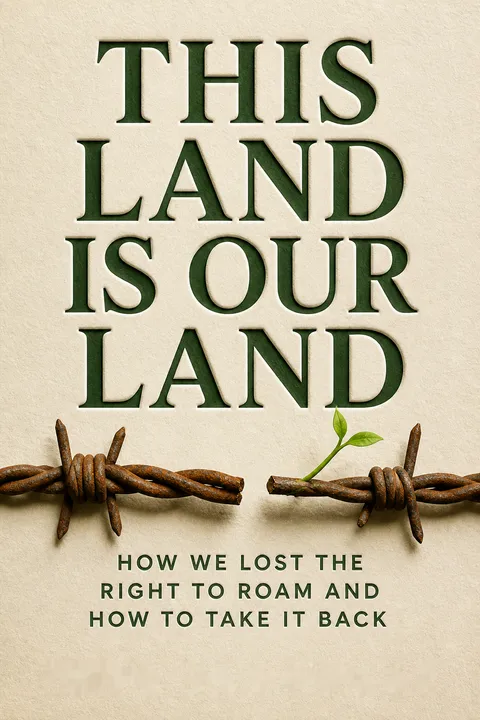


Key Takeaways
Reopen nearby countryside before children inherit a landscape of fences.
A childhood freedom vanished. Ken Ilgunas begins with Country Meadows, his childhood neighborhood in New York, where children once explored woods, ponds, and unfinished building lots without treating every boundary as a barrier. As subdivisions spread, forests and fields disappeared, fences and warning signs multiplied, and the next generation lost places it had never known. The pattern is not unique: between 1982 and 2007, development consumed 41 million acres of American forest and farmland, according to the book.
Access shapes daily life. Many Americans have no safe, appealing route from home to a natural space. The author links this landscape to sedentary routines, limited outdoor play, and isolation, while arguing that better sidewalks alone cannot replace access to fields and woods. The proposal is a right to roam: permission to use much privately owned land for harmless recreation.
What's striking is that the argument begins not with grand wilderness, but with the small, ordinary places that make outdoor life part of a week rather than a vacation. That shifts the policy question from how to create more spectacular parks to how to make nature reachable near home. Childhood memories can clarify what has been lost, but they can also idealize a past that was not equally safe or accessible for every child. A durable policy should therefore pair open land with safe routes, clear rules, and attention to who feels welcome using it.
Treat ownership as stewardship, not an absolute right to exclude.
Access need not end ownership. The right to roam means allowing people to walk, camp, or pursue other low-impact recreation on much privately owned land, while landowners retain ownership and can continue ordinary uses. It does not mean that visitors may enter homes, damage property, disrupt work, or ignore privacy. The author estimates that opening privately owned American land could make roughly 1.5 billion acres available for countryside recreation.
Exclusion has unequal effects. The book cites a USDA survey estimating that agricultural land makes up 49 percent of the Lower Forty-Eight, while only about 1.2 percent of the population owned agricultural land in the data it discusses. Its case is not that everyone should own every acre, but that a small group’s power to bar everyone else from vast landscapes deserves scrutiny.
The distinction between owning land and controlling every possible use of it is central. Property is a legal bundle of powers, not a single indivisible fact, so societies can protect ownership while adjusting access rights. That makes the proposal less radical than abolishing private property, though it still redistributes a meaningful privilege. The difficult question is how to draw the line between a harmless visit and an intrusion on work, privacy, or ecological needs. Responsible access is strongest when those boundaries are specific enough to guide visitors and flexible enough to reflect different landscapes.
Remember that laws turned ordinary passage into trespass.
Property rules have histories. In England, enclosure converted shared lands into private holdings over centuries. Between 1760 and 1870, nearly 4,000 acts of Parliament enclosed about one-sixth of the country. Commoners lost access to land they had used for grazing, gathering, and travel. In 1932, around 400 working-class ramblers deliberately crossed the privately controlled Kinder Scout moor to protest their exclusion. Their arrests helped build a movement that eventually won broader access rights.
America once worked differently. In the early United States, people commonly walked and hunted on unimproved, unenclosed land. After the Civil War, laws restricting Black people’s access to hunting and gathering helped landowners limit the independence of newly freed people. The history shows that access rules are not neutral or timeless: they can distribute freedom, power, and vulnerability.
Kinder Scout makes a useful point about how protest can change the public meaning of a boundary. The walkers did not simply ask for a path; they challenged the assumption that private ownership automatically settled who could enjoy a landscape. The American history adds an essential warning: open access for some has coexisted with dispossession and exclusion for others, especially Native Americans and Black Americans. A modern access policy cannot be justified by nostalgia alone. Its legitimacy depends on whose history it recognizes, whose safety it protects, and whether it expands shared benefit without repeating older injustices.
Copy Scotland's access principle, then teach people how to honor it.
Different systems offer different lessons. England and Wales opened 3.4 million acres of privately owned mountains, moors, heaths, downs, and commons through the Countryside and Rights of Way Act, but access is limited mainly to walking, picnicking, and sightseeing. Scotland's Land Reform Act opened almost all rural land and inland water to recreation, travel, and education, provided people behave responsibly. Its outdoor access code gives practical guidance, while local forums help landowners, recreation groups, and officials resolve disputes.
A simple rule can be workable. The book reports that England and Wales spent about $102 million mapping eligible terrain. Scotland instead used a broader access principle and local administration, which it says costs about $10 million annually. Sweden's allemansrätten offers another model: a widely accepted custom guided by a compact ethic of not disturbing or damaging nature.
The comparison is less about importing a foreign statute wholesale than about choosing a governance style. Detailed maps create predictable boundaries, but can be costly and confusing. A broad principle is easier to understand, yet depends more heavily on public education, local mediation, and shared expectations. Scotland's experience suggests that access and responsibility are complementary rights, not opposing camps. Still, customs cannot be transferred by legislation alone. Outdoor skills, land-use patterns, and trust differ across societies, so an American version would need local experimentation rather than a single national template.
Measure public land by reachable acres, not acreage on a map.
Public does not always mean accessible. The book estimates that federal and state governments own about 35 percent of US land, but much of it lies in sparsely populated Western states. Five states hold 62 percent of public land while containing just 3.7 percent of the population. In addition, the Bureau of Land Management reported that about 23 million acres of its land were inadequately accessible because private property blocked the way.
The pressure is rising. National parks received a record 331 million visits in 2016, even as the four federal agencies managing recreation lands lost more than 17 million acres between 1990 and 2013. The author argues that distant, crowded parks cannot replace ordinary access close to home, especially as the population grows and developed areas expand.
This distinction between nominal supply and usable supply is familiar in public policy: a service can exist on paper while remaining out of reach because of distance, cost, or missing connections. Access should therefore be assessed by practical measures, including travel time, safe entry points, and whether visitors can use a place without specialized equipment. The book's acreage figures make the problem visible, but they do not fully capture differences in disability, transportation, or cultural welcome. A fair measure of public access must ask not only how much land is open, but who can actually get there.
Make nearby nature available as everyday preventive health infrastructure.
A walk can matter medically. The book reports that US adults averaged 5,117 steps a day in one 2010 study, and that 41 percent of Americans met the study's definition of sedentary in a 2012 analysis. A review of 18 studies involving 460,000 people found that walking was associated with a 31 percent reduction in cardiovascular events. These findings support making routine walking possible, rather than treating exercise as an occasional trip to a distant park.
Green settings may help the mind, too. In a Stanford study described in the book, people walking through a green campus area experienced less anxiety and rumination than those walking beside heavy traffic. Scottish doctors have also used green prescriptions, recommending outdoor activity for some health needs. Access does not replace medical care, but it can make healthy routines easier to begin.
The strongest policy insight is that the environment can make healthful behavior convenient or nearly impossible. This is a familiar idea in public health: prevention often depends less on individual motivation than on whether daily surroundings support movement. Natural settings may offer benefits beyond exercise, including relief from mental fatigue, but the evidence described here does not mean every health condition responds equally to outdoor activity. Nor does a trail alone fix unsafe roads or unequal park quality. Nature access works best as one layer of a broader health system.
Open places carefully, because responsible visitors can help protect them.
More people can mean more care. Opponents reasonably worry about litter, damage, noise, and disruption. Yet the book describes Scotland's Callendar Estate, where manager Guy Wedderburn stopped trying to keep people out and welcomed local visitors. The estate had faced fires and dumping; after access increased, ordinary visitors helped watch over the grounds, and vandalism and fire problems declined. A visible, well-kept place also encouraged better behavior.
Education matters more than scolding. Sweden's Keep Sweden Tidy Foundation used school programs, community cleanups, and outdoor education to teach people to care for shared landscapes. In 2016, about 767,000 Swedes took part in its cleanup campaign. These examples do not prove every site will improve when opened, but they show that access can build responsibility when people understand both the invitation and the rules.
The estate story challenges the assumption that safety always comes from exclusion. In some settings, more legitimate users create informal oversight and a sense of collective responsibility. That resembles the logic of well-managed commons: shared use can work when users communicate, have clear norms, and can respond to misuse. But the result is not automatic. A crowded swimming hole, fragile habitat, or isolated property may need limits, maintenance, or seasonal closure. Openness is not a magic substitute for management; it changes who participates in management and who can notice when something goes wrong.
Pilot local access laws, then expand what communities can govern.
Start where rules can be tested. The author proposes beginning with municipal zoning or state laws that allow local governments to open suitable land for recreation. Communities could define which activities are permitted, protect homes and cultivated fields, and temporarily close areas for conservation or land management. Local access forums, modeled on Scotland's, could bring landowners, hikers, farmers, and public officials together to resolve conflicts.
Legal design matters. Some scholars in the book argue a broadly applied access law may be constitutional because owners keep using their land; others believe courts could treat it as a taking. State constitutional amendments are another possible route. The author recommends strong protection from injury lawsuits, except when a landowner deliberately creates a hazard, and clear penalties for visitors who damage land or ignore access rules.
Local pilots offer a way to learn before committing to a uniform national rule. They can reveal which kinds of land need seasonal restrictions, what education visitors lack, and how much administration costs. They also make participation tangible: people can debate a known trail or woodland rather than an abstract national property code. The legal uncertainty is real, and local experimentation does not eliminate it. Any pilot should publish its rules, track ecological and safety effects, and include landowners and communities who have historically been denied a voice in decisions about land.
Treat land as a shared living inheritance, not merely private territory.
Ecology connects what ownership divides. The book draws on Aldo Leopold's land ethic, the idea that people belong to a community that includes soils, waters, plants, and animals. A landowner's choices can affect neighbors and ecosystems beyond a property line, so ownership carries responsibilities to the wider community and future generations. The author also invokes philosopher John Rawls's thought experiment: people designing society without knowing whether they will be rich or poor might choose fairer rules for access and ownership.
Access is a modest beginning. Woody Guthrie's famous song about the country carries a vision of shared belonging that conflicts with an absolute power to exclude. Ilgunas argues that opening land for recreation will not erase unequal ownership or repair dispossession, but it can help make shared responsibility visible and practical.
The ecological argument deepens the case beyond recreation: property decisions occur inside connected systems, not on isolated parcels. That insight supports duties to protect water, habitat, and future users, even when access is restricted for sound ecological reasons. It also complicates the language of shared inheritance. Native nations have distinct sovereignty and claims that cannot be reduced to a general public entitlement to roam. A just land ethic must therefore combine broad access with ecological limits, historical repair, and respect for communities whose relationships to land predate the modern property system.
Analysis
This book's most useful move is to make property feel less like a natural fact and more like a public arrangement with winners, losers, and alternatives. The right to roam is not a demand to abolish ownership. It is a proposal to limit one specific power, the right to exclude, for low-impact recreation. That distinction helps turn a seemingly radical idea into a question of institutional design: which uses should owners control, which uses should the public share, and what responsibilities make sharing legitimate?
The historical account strengthens that reframing. Kinder Scout shows that access can change through organized pressure, while the American record reveals how exclusions have also served racial and economic control. Yet history is not a simple argument for reopening every boundary. Indigenous dispossession, the uneven distribution of land, and legitimate needs for privacy and conservation complicate any claim that all citizens have equal standing to enter all places. Shared access should not flatten those differences.
The strongest practical evidence comes from Scotland and Sweden, where access is paired with behavioral expectations, education, and local conflict resolution. That combination matters more than the slogan of roaming alone. Laws can authorize access, but habits determine whether it remains welcome. A US policy would need clear exclusions for homes, active crops, sensitive habitats, and hazardous sites, along with liability protections and public education. It would also need ways to manage heavy use near cities.
The book sometimes links access to broad gains in health, trust, and civic solidarity. Those are plausible benefits, but they should be treated as contributions, not guaranteed outcomes. A trail cannot reverse inequality by itself. Still, the central insight holds: when land is treated only as a private fortress or as distant public wilderness, ordinary people lose daily contact with the landscapes that sustain them. A fairer property system can preserve ownership while making the countryside more accessible, accountable, and shared.
Review Summary
This Land Is Our Land receives mostly positive reviews, with readers praising its thought-provoking exploration of the "right to roam" concept. Many appreciate Ilgunas's thorough research, balanced arguments, and engaging writing style. Reviewers find the book informative and eye-opening, especially regarding property laws in other countries. Some readers express skepticism about implementing such ideas in the US, citing cultural differences and private property concerns. Overall, the book sparks discussions about land access, public spaces, and the relationship between humans and nature.
Glossary
right to roam
public access across open landA right to use much privately owned countryside for low-impact recreation, such as walking or camping, without obtaining individual permission. It does not transfer ownership. The landowner retains the ability to use the land, protect privacy, and prevent interference with work, while visitors are expected to respect property and the environment.
enclosure
conversion of common landThe historical process of taking land used by communities and making it privately controlled, often by fencing or hedging it. In England, enclosure was advanced through acts of Parliament and changed commoners' access to fields, woods, and paths. It helped turn ordinary movement across land into legally defined trespass.
commons
community-managed shared resourcesLand or resources used collectively under shared rules, rather than treated as unrestricted property belonging to everyone in an identical way. Historical commons could support grazing, gathering wood, drawing water, and community events. The book emphasizes that commons were often managed through local customs and institutions, not left open to unlimited use.
Countryside and Rights of Way Act (CRoW)
limited English and Welsh access lawA 2000 law that opened specified types of privately owned land in England and Wales, including mountains, moors, heaths, downs, and registered commons, to public access. Its permitted activities are limited mainly to walking, picnicking, and sightseeing. It does not create unrestricted access across all countryside or allow activities such as camping and cycling.
Land Reform (Scotland) Act (LRSA)
Scottish countryside access lawScotland's 2003 law establishing broad public access to most rural land and inland water for recreation, education, and travel. Access depends on behaving responsibly and is subject to exclusions, including homes, gardens, and land where access would interfere with certain uses. The law is supported by the Scottish Outdoor Access Code and local access forums.
right of responsible access
access balanced by conductThe Scottish approach to public access, emphasizing that the public's freedom to use land comes with duties to respect owners, other users, and the environment. Visitors should avoid damage, protect privacy, and not disrupt land management. Landowners also have protections and may temporarily close land for appropriate purposes. The idea is broader than a right simply to wander without restraint.
allemansrätten
Swedish public access customA Swedish tradition of public access to much of the countryside, including many privately owned areas. It permits activities such as walking, camping, swimming, and gathering some wild foods, while excluding homes, gardens, cultivated fields, and certain protected areas. Its guiding principle is to avoid disturbing people or damaging nature. It is rooted largely in custom rather than a single detailed access statute.
land ethic
ecological responsibility in communityA concept associated with ecologist Aldo Leopold that expands the idea of community to include soils, waters, plants, and animals. People are understood as members of ecological systems, not conquerors standing outside them. The land ethic asks individuals, including landowners, to consider the health of the wider community and the consequences of their decisions for future generations.
moral licensing
good deeds excusing other harmsThe tendency to treat a visible good action as permission to behave less responsibly elsewhere. In the book's environmental discussion, protecting celebrated wilderness areas can create the impression that nature is being cared for, while pollution and degradation continue in ordinary landscapes outside park boundaries. The concept warns against treating conservation of a few places as a substitute for responsibility across the whole environment.
About the Author

Download PDF
Download EPUB
.epub digital book format is ideal for reading ebooks on phones, tablets, and e-readers.








