

Key Takeaways
Leave the routine when it numbs you, and seek direct contact with life.
A dish shift became a turning point. In Deadhorse, Alaska, Ken Ilgunas had fallen from aspiring writer to dishwasher at an oil camp, spending his evenings scrubbing pots and watching television. A risky nighttime paddle and hike with his coworker Liam brought them face to face with the Arctic landscape, and then into the forbidden Prudhoe Bay oil field. They were frightened, lost, and unequipped for the night, but the ordeal made Ilgunas feel intensely awake.
The idea took a direction. Disgusted by the industrialized Arctic and newly energized by the walk, the two men imagined hiking the route of the proposed Keystone XL pipeline. Liam eventually dropped out, but Ilgunas continued alone. The walk would become an attempt to encounter the places, workers, landowners, and conflicts that arguments about energy often reduce to abstractions.
What's striking is that the awakening comes through discomfort, not a perfected escape from modern life. The night hike interrupts a repetitive work routine by demanding attention to weather, direction, danger, and companionship. That resembles a basic principle of embodied learning: some knowledge becomes vivid only when the body has to act on it. Still, hardship is not automatically clarifying, and risk is not a universal remedy for dissatisfaction. The useful lesson is narrower: deliberately changing one's setting can reveal what a familiar routine has made easy to ignore.
Walk where the conflict happens, not only where the scenery is safe.
The route was the reporting. Ilgunas rejected established long-distance trails because they would keep him within a prepared corridor, away from towns, industry, and private land. He instead followed the proposed pipeline across the Great Plains, navigating with maps and a compass, crossing pastures, and asking strangers for water and places to sleep. In Texas, he and his companion Storms walked beside an active construction corridor and were stopped by police after entering it.
A walk changes what counts as evidence. The journey began with a flight over Alberta's tar sands, where tailings ponds and vast extraction pits made industrial scale visible. At the other end, the refineries near Port Arthur showed where the oil economy led. Between them, the route connected landscapes to the people who lived and worked among them, rather than treating energy as a debate detached from place.
This is a form of reporting by proximity. A map can show a pipeline as a line, while walking reveals the farms, water sources, work camps, and communities that line crosses. The method also has limits: a single traveler sees a narrow slice of a complicated system, and a dramatic route can privilege vivid encounters over representative ones. Its strength is not statistical completeness. It makes material connections harder to keep abstract, giving readers a grounded starting point for asking what an energy decision costs, and for whom.
Solo travel makes you practice selves your routines never require.
One person had to become a whole crew. Without Liam, Ilgunas handled navigation, cooking, water treatment, repairs, logistics, and the delicate work of persuading wary landowners to trust him. He had to shift from solitary introvert to careful conversationalist, reading people's reactions and explaining his plans. The constant movement made familiar tasks automatic, freeing his attention for observation and thought.
The body set the terms. Blisters, a broken toe, and painful shin splints repeatedly threatened the trip. When his leg became too painful to continue, he rested in Shaunavon rather than willpower his way through injury. Months of walking left him physically tougher, but the deeper change was practical: he discovered capabilities by needing them, not by imagining himself transformed in advance.
The memoir makes personal growth less mystical and more behavioral. New circumstances require new actions, and repeated action can make a previously awkward role feel available. This fits the idea of a possible self: people learn who they can be partly by trying out unfamiliar behaviors. But the lesson should not be mistaken for a prescription to travel alone or ignore bodily limits. The injury chapters make clear that adaptation includes stopping, treating damage, and revising a plan, not merely displaying toughness.
See the prairie as a living archive, not a blank expanse.
The apparent emptiness has a long history. The Great Plains once supported immense grasslands and large herds, and their ecology was shaped by changing climates, glaciers, Indigenous societies, colonization, fences, and industrial agriculture. Ilgunas describes a region that feeds the continent while losing native habitat: the book reports that 465,000 square miles of natural grassland had been destroyed and that 60 percent of prairie-dependent bird species were declining.
What looks still is not simple. The traveler encounters cows and farms, but also coyotes, pronghorn, deer, and remnants of a much richer ecosystem. A landscape can appear monotonous from a highway and become intricate at walking speed. Its present condition carries visible traces of earlier decisions about settlement, land use, and what kinds of life are allowed to remain.
Calling the plains empty is not just a failure of attention; it can make their conversion seem consequence-free. Environmental history counters that illusion by showing how each apparently ordinary field is the result of ecological processes and human choices. This way of seeing also guards against romanticizing the past: the region's history includes Indigenous displacement, difficult livelihoods, and ecological losses, not a pristine Eden. The value of the archive metaphor is that it asks readers to notice layers, while leaving room for the conflicts and costs in each layer.
Treat property lines as political choices, not nature's borders.
A walk across America required trespass. Much of Ilgunas's route crossed privately owned farmland because the proposed pipeline did not follow public trails. Barbed wire, posted signs, and fear of being shot turned ordinary walking into a legal and social risk. He contrasts this with European and Scandinavian traditions that allow people to travel across some uncultivated land, subject to duties such as respecting homes and property.
Access has a history. The book traces American property patterns through colonial ideas, federal land surveys, westward settlement, and barbed wire, which divided open prairie into visible boundaries. It also notes a practical complication: landowners may fear lawsuits if someone is injured on their land. The question is not simply whether owners are generous, but how law and custom distribute access to nature.
The contrast between private ownership and public access reveals that freedom is partly designed into law. A landscape can be physically open yet functionally inaccessible if there are no trails, public lands, or accepted ways to cross it. That observation connects recreation to broader debates about the commons: shared access can create public value, but it also needs rules that protect land and people. The book's provocation is persuasive, though any right to roam must take local conditions, land stewardship, and liability seriously.
Listen for the livelihood beneath every argument about oil.
The people were not symbols. Ilgunas met workers who took demanding oil jobs to support families, a farmer who negotiated substantial compensation for a pipeline crossing, and landowners who opposed TransCanada's secrecy and contract terms. Some residents saw a pipeline as income for a declining town; others feared for their land and water. Meeting them made it harder to divide the debate into pure environmentalists and villains.
Understanding is not agreement. The author recognizes why short-term jobs and local compensation matter, while arguing that they do not settle questions about climate, pollution, or who benefits. In Nebraska, farmers and ranchers opposed the proposed route because they worried about the Ogallala Aquifer. Their resistance broadened the campaign beyond the usual image of college activists and environmental groups.
This section benefits from political economy: people's stated beliefs are often entangled with wages, land, family security, and the survival of a town. Taking those interests seriously is not the same as treating every claim as equally supported or every consequence as acceptable. It is a way to understand why evidence alone rarely moves a debate. The account also cautions against reducing workers to their industry. Yet empathy should not become an excuse to ignore who holds decision-making power or who bears long-term environmental risk.
Accept help, and let vulnerability expose your own reflexive prejudice.
The lone traveler depended on strangers. Families, church communities, and townspeople offered meals, showers, beds, medical supplies, and shelter, often without asking about his politics or beliefs. In Nebraska, a woman even gave him a hotel room. Ilgunas came to see that traveling alone did not mean managing alone; it meant asking for help and trusting people he had just met.
His own instincts were not always generous. In Kansas, a Black man asked to use his phone after his car slid off a snowy road. Ilgunas said he had no phone, then realized he had reacted defensively and had misjudged a person who needed help. He never learned whether the man got assistance. The episode made his own vulnerability a test of whether he could extend the trust others had shown him.
The reversal matters: being misread by others does not automatically make someone better at reading people. The memoir resists an easy story in which the traveler receives kindness and becomes morally superior; his own hesitation exposes how quickly fear can reproduce the very suspicion he resents. Social trust grows through small acts, but it is not evenly distributed, and perceived safety differs with race, gender, and circumstance. That complexity sharpens the takeaway: generosity is a practice, not a personality trait one can simply claim.
Do not confuse uncertain forecasts with permission to stop acting.
Climate fear can become paralysis. While recovering from injury, Ilgunas read about rising emissions, fossil-fuel dependence, and the difficulty of changing energy systems. He wondered whether opposing one pipeline mattered amid a world already built around oil. He also considered the temptation of despair: if disaster seems inevitable, giving up can feel like relief from responsibility.
Uncertainty cuts both ways. The book does not use uncertainty to dismiss climate science. Instead, Ilgunas questions confidence about precisely how the future will unfold, including whether unanticipated negative feedbacks might limit some effects. That uncertainty is not a reason to relax; it is a reason not to treat catastrophe as settled. He ends with a modest stance: keep caring and acting without pretending to know the final outcome.
This is a useful distinction between uncertainty about outcomes and uncertainty about whether a problem exists. Confusing the two supports both denial and fatalism. A decision-making lens suggests that when potential harms are large and difficult to reverse, uncertainty can strengthen the case for precaution rather than weaken it. At the same time, apocalyptic messaging can exhaust audiences if it offers no credible path for agency. The section's balance is to retain urgency without claiming certainty, a harder and more durable posture than either complacency or doom.
Question what society calls necessary before demanding more oil.
Dependence is real, but it is not an argument's end. Ilgunas knew that his food, clothing, and equipment relied on petroleum, so he could not pretend to live outside the fossil-fuel economy. He rejects the claim that using oil disqualifies someone from criticizing its harms: dependence may explain the problem, but it does not make every expansion wise.
The word need deserves scrutiny. The author cites estimates of roughly 5,000 temporary construction jobs and about 30 permanent jobs for the Keystone XL, while noting that much of the oil processed at the Texas refineries was intended for export. He argues that the pipeline's benefits should be weighed against environmental costs and the possibility of consuming less, rather than assumed necessary because oil is already embedded in daily life.
The distinction between dependence and necessity is central to debates about infrastructure. A system can make a resource difficult to avoid while still leaving choices about expansion, distribution, and alternatives. The author's own petroleum-based gear use strengthens the argument because it acknowledges participation rather than claiming purity. The challenge is that reducing consumption is not equally feasible for every household or region, and transition costs fall unevenly. Serious scrutiny of need should therefore ask not only how much can be used less, but who gets practical alternatives.
A campaign can lose its vote and still change who resists.
The walk did not stop every pipe. By the time Ilgunas finished his 1,900-mile journey, construction on the southern portion of the Keystone XL was underway, and he knew his trek had not halted the broader oil economy. In November 2015, President Obama rejected the northern Keystone XL proposal after years of demonstrations, court battles, and appeals. The book does not claim that one walk caused that decision.
The coalition had widened. In Nebraska, Ilgunas found farmers, ranchers, Native leaders, and local residents opposing the route for different reasons, including concern about water and land. The campaign helped make pipeline opposition more visible and drew people beyond its expected activist base. The outcome was neither total victory nor futility: one proposal was rejected, other infrastructure fights continued, and the public understanding of who could oppose a pipeline had changed.
Political outcomes are often evaluated as if a campaign either wins or fails at a single decision point. This story suggests a longer measure: whether opposition expands its constituency, changes what is publicly discussable, and gives future campaigns a wider base. Those effects are harder to attribute than a formal rejection, so they should not be inflated into proof of causation. Still, a narrow scorecard misses how movements build capacity. The most convincing claim here is not that the hike changed history alone, but that resistance became more locally rooted and politically diverse.
Analysis
The book works as a travel memoir, environmental argument, and study in changing perspective. Its organizing device is a physical line across the continent, but the line keeps encountering boundaries that are not visible on maps: private ownership, economic dependence, cultural suspicion, ecological loss, and the limits of the author's own confidence. The journey supplies a narrative engine, while the people met along the way complicate the environmental position that launched it.
Its strongest method is embodied comparison. The tar sands viewed from a plane, a worker's account of camp life, a farmer's compensation, and a walk across a field are different kinds of evidence. None is sufficient by itself. Together they make the pipeline legible as both an industrial object and a chain of human choices. The book's humor and physical vulnerability help prevent its politics from becoming a lecture, although the author's judgments about some rural communities sometimes harden into generalizations. His own uncomfortable moments, especially his initial mistrust of a stranded stranger, are important correctives to that tendency.
The book also exposes a tension within environmental argument: abstract future harms compete with immediate needs such as employment, water, and community survival. Ilgunas does not resolve that tension with a neat policy formula. He argues instead that a society's habits of consumption shape what it calls necessary, and that people must be able to imagine alternatives before they can support them. His eventual hope is deliberately modest. A single march cannot substitute for institutions, collective action, or economic transition, but it can make a hidden landscape and its conflicts harder to ignore. The lasting achievement is not a claim of personal heroism. It is a changed scale of attention, from the individual step to the historical and ecological ground beneath it.
Review Summary
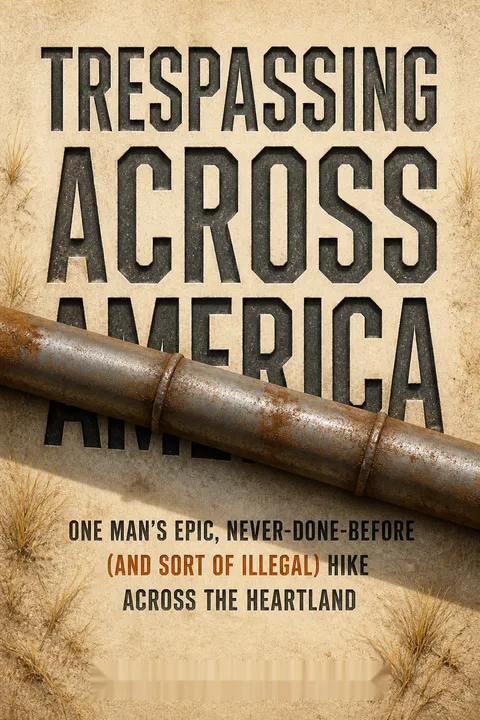
Trespassing Across America chronicles Ken Ilgunas's 1,900-mile hike along the Keystone XL pipeline route. Readers praise Ilgunas's writing style, descriptions of landscapes and people, and balanced approach to environmental issues. Some criticize his lack of deep engagement with the pipeline topic or self-reflection on privilege. The book offers insights into rural America, property rights, and climate change. While some found it slow-paced or unfocused, many appreciated Ilgunas's honesty, humor, and ability to capture the beauty of the plains and the kindness of strangers.
People Also Read

Glossary
Buffalo Commons
Proposed prairie restorationA proposal by Deborah and Frank Popper to restore a large area of the Great Plains as a wildlife landscape, including the return of bison. Their original vision described a 139,000-square-mile sanctuary that could also support tourism. Many residents opposed it because they saw the proposal as a threat to their livelihoods and communities.
Allemansrätt
Swedish right to roamA Swedish tradition and legal principle that allows people to travel through much of the countryside, including some privately owned land, while respecting homes and avoiding damage. Ilgunas uses it as a contrast with the United States, where fences, signs, and property law make cross-country walking difficult outside public land and designated trails.
Biophilia
Human affinity for lifeE. O. Wilson's term for the human capacity to feel drawn to other living things and the natural world. In the book, this idea supports the possibility that care for nature can grow through familiarity and knowledge, rather than being limited to abstract environmental principles.
Land ethic
Ethics extended to ecosystemsAldo Leopold's idea that moral responsibility should include the wider biotic community, not only human beings. The book presents this ethic as a way to judge actions by whether they preserve the integrity, stability, and beauty of the natural community, while recognizing that ethical belief alone may not overcome powerful economic interests.
Dilbit
Diluted bitumenA shortened term for diluted bitumen, the tar-sands material that Texas landowner Mike Bishop said the pipeline would carry. Bishop argued that the contract described crude oil instead, and that dilbit was heavier, more corrosive, and more toxic. His dispute became one example of landowners challenging the pipeline's terms and effects.
About the Author

Download PDF
Download EPUB
.epub digital book format is ideal for reading ebooks on phones, tablets, and e-readers.








