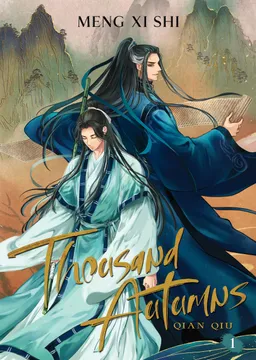


Summary Unavailable
This book is not suitable for a summary (it may be a textbook, workbook, cookbook, reference book, or collection). However, you can still explore the FAQs, about author, and other metadata below!
Plot Summary
Shen Qiao Falls
Returning to the martial world after a decade of seclusion, Huanyue Sect leader Yan Wushi hears that Kunye, a Göktürk champion, has challenged Shen Qiao, head of Xuandu Mountain. Yan doubts that Kunye could truly defeat a disciple of the legendary Qi Fengge so completely. As he and his disciple Yu Shengyan travel below the peaks, Shen Qiao falls from the duel site, his body broken and his sword landing nearby.
Yu Shengyan recognizes the weapon and the fallen man. Yan gives no sign of compassion, but orders his disciple to use a rare healing pill. To Yan, Shen Qiao’s collapse from revered sect leader to helpless stranger offers a chance to test whether goodness survives the loss of status and power.
The novel begins by making an injury both physical catastrophe and philosophical experiment. Yan’s rescue is not mercy in any ordinary sense: he sees Shen Qiao’s vulnerability as an opportunity to test his conviction that people are selfish underneath their ideals. That makes the central relationship unequal from its first moment, with one man treating suffering as evidence to collect and the other not yet able to explain what he believes. The precipice also establishes the book’s recurring pressure: public rank can vanish in an instant, while character is measured by what a person does afterward.
A Borrowed Identity
After carrying Shen Qiao to a villa, Yu Shengyan helps him recover for months. When Shen wakes, he remembers neither his name nor his past, and cannot see. Yu exploits the confusion by claiming Shen belongs to Huanyue Sect and is his younger martial brother.
Yan supports the deception for his own amusement: he expects Shen to despair when he learns that his martial arts and position are gone, then hopes to draw him into the demonic sect. Instead, Shen accepts their care with steady gratitude and quietly endures his treatment.
Yan discovers a trace of true qi in Shen’s damaged body and assigns him to accompany Yu on a mission in Qi. The assignment is meant to make the supposedly righteous stranger participate in violence before he can recover his former identity.
The false affiliation turns dependence into a moral trap. Shen cannot verify the story told about him, so his trust is not a choice made with full information; still, his courtesy is not simply passivity. He responds to immediate care with gratitude without surrendering his own judgment. Yan, by contrast, treats identity as something that can be imposed through circumstance: give a man a new name, a new group, and a violent task, then watch whether he becomes what others call him. The scene’s quiet tension comes from Shen’s intact ethical instincts surviving even when memory and sight do not.
The Warning in Yecheng
In Yecheng, Yu finally tells Shen that their assignment is to kill Yan Zhiwen, a Hehuan Sect agent, along with his family. Shen questions why the wives and children must die, then uses an errand involving Han Eying, a powerful official’s daughter, to send Yan Zhiwen a warning. Yu finds the household empty and realizes Shen has sabotaged the mission.
When Yu confronts him, Shen admits it and recognizes that he is not truly a Huanyue disciple. He explains that innocent relatives should not pay for a sect’s feud. Yan has already left for Zhou; his steward orders Shen to leave the villa without money or supplies. Yu identifies him as Xuandu Mountain’s missing leader, but warns that his own sect has not come looking.
Shen’s first consequential choice after awakening is not to recover his name but to protect strangers. The act is deliberately small and practical: he notices a prescription ingredient, uses a social encounter, and gives the target enough warning to move his household. That ingenuity contests Yan’s assumption that helplessness makes a person easy to remake. Yet the rescue earns no gratitude from the people it protects, and Shen is expelled into danger for doing it. The episode distinguishes ethical action from social reward: Shen judges the act by whether he could have prevented avoidable harm, not by what anyone will think of him.
Three Donkey Sandwiches
Penniless and still nearly blind, Shen reaches a ruined temple in Funing County, where sixteen-year-old Chen Gong has made a shelter among beggars. Chen tries to claim Shen’s food, then negotiates a daily rent of three donkey-meat sandwiches.
Shen earns the money by telling fortunes, drawing conclusions from the hands and circumstances of the people who consult him. When the beggars return in force to rob them, Shen uses his bamboo cane and fragments of remembered technique to drive them off, then collapses from the strain.
Chen spends their money on an inn and a doctor. The two leave Funing together: Shen intends to find Xuandu Mountain, while Chen hopes to build a life beyond seasonal labor and eventually learn enough martial skill to survive.
Chen’s appetite and suspicion make a sharp counterpoint to Shen’s composure, but their bargain creates an intimacy neither would have chosen in abstract terms. Shen helps by reading people accurately, not by claiming supernatural certainty; Chen offers protection and practical care, though he frames both as debts to be repaid. Their companionship is built through food, money, and shared risk, the ordinary currencies of a life that the martial world tends to overlook. Chen’s decision to leave also shows how quickly contact with violence can transform ambition: the jianghu is no longer a glamorous escape but a dangerous world he still wants to enter.
The Scroll at Chuyun
At Chuyun Temple, Shen and Chen cross paths with Liuhe Guild deputy Yun Fuyi, who is escorting a supposedly ordinary cargo. That night, Qi’s martial master Murong Qin attacks, and Hehuan disciple Bai Rong reveals that Yun carries a volume of the Zhuyang Strategy, a legendary manual sought by rival sects. Yan Wushi and Buddhist master Xueting arrive, turning the temple into a standoff.
When Bai Rong reaches for Chen as a shield, Shen pushes him clear and is nearly killed. Yan intervenes, briefly restores Shen’s sight, and makes him read the bamboo scroll aloud. He then destroys it, leaving every listener to rely on memory. The temple’s abbot and two young monks are found murdered, and Shen and Chen bury them before leaving.
The scroll transforms private learning into public danger. Its value lies not only in what it teaches but in the uncertainty created when the original is destroyed and each listener must reconstruct it from memory. Yan deliberately creates that uncertainty, turning knowledge into a source of future factional conflict. Shen’s decision to save Chen is the scene’s moral center: he risks himself before he knows whether anyone will protect him in return. The murdered monks make the cost of the martial contest brutally literal. The jianghu does not remain separate from ordinary life; its contests occupy homes, bodies, and people who never consented to join them.
Chen Leads the Hunters
After Bai Rong seeks to force Shen and Chen to recall the scroll, they escape while she is distracted by her older martial brother, Huo Xijing. Shen then separates from Chen, hoping to keep the boy from becoming a target. Chen soon encounters Mu Tipo, a powerful Qi noble who hunts people for sport and threatens to enslave him. To save himself, Chen leads Mu Tipo’s party to Shen’s inn.
Shen appears frail but defeats the prince’s attendants with his cane, takes Mu Tipo hostage, and leaves him incapacitated at a border inn before continuing alone. Yan Wushi, who had watched from nearby, reveals that the scroll’s two volumes may explain the remnant qi in Shen’s body. His attack on Shen forces that dormant power to answer.
The title’s betrayal is not a simple moral verdict on Chen. He acts under a credible threat, and Shen recognizes that fear can make survival more urgent than loyalty. Shen’s refusal to condemn him preserves a distinction between understanding harm and excusing it. At the same time, Shen’s escape from Mu Tipo shows that vulnerability is not the same as helplessness: he uses timing, technique, and the prince’s own overconfidence to reverse their positions. Yan’s presence complicates every apparent rescue. He allows danger to unfold until it becomes useful, treating another person’s ordeal as an experiment whose outcome he wants to observe.
The Manual Wakes
After Shen survives Mu Tipo, Yan strikes him with enough force to make him meet the blow rather than flee. Under that pressure, Shen’s stagnant true qi begins moving, and he withstands a portion of Yan’s power. Yan explains that Shen had already trained with another volume of the Zhuyang Strategy, passed down by Qi Fengge.
The reading at Chuyun supplied a second volume, and the two have begun to awaken each other inside Shen’s body. Yan takes him toward Northern Zhou, not from affection but because Shen’s cultivation offers a living way to study the manual. During the journey, Shen gives food to starving refugees and faces a father who tries to seize his remaining bread. A child’s gratitude moves him to give away his last portion too.
The return of strength arrives through coercion, not through a triumphal recovery. Yan’s violence may unlock Shen’s capacity, but it also confirms that Yan values him partly as a means to understand the Zhuyang Strategy. Shen’s response to the refugees makes the philosophical conflict concrete: he gives limited help, refuses an impossible demand, and then chooses to help one child again. His compassion is neither a claim that he can save everyone nor a denial that people can behave cruelly. Yan sees the same scene as evidence for cynicism; Shen sees suffering as a reason to act within his limits.
Xuandu's Closed Door
Near Xuandu Mountain, Shen and Yan learn that acting leader Yu Ai is preparing a public gathering that may formalize his authority. Shen sneaks up the mountain to speak with the martial brother he once trusted most.
Yu Ai welcomes him, then admits that he secretly poisoned Shen with a slow-acting drug before the duel. He wanted Shen to lose to Kunye, believing Xuandu Mountain had to abandon its isolation and compete politically to preserve its influence.
Yu Ai insists he did not intend Shen’s catastrophic fall and says other disciples and elders support his reforms. Shen asks whether Xuandu is cooperating with the Göktürks, but Yu Ai refuses to explain the larger plan and will not let Shen leave. Their childhood closeness cannot make the betrayal less real.
Yu Ai’s betrayal is persuasive because it grows from a political argument rather than mere appetite. He believes institutional survival requires adaptation, and he sees Shen’s restraint as a danger to the sect. Shen, however, understands that a worthy end does not erase the coercion used to reach it. Their shared history intensifies the rupture: Yu Ai knows exactly which memories once made Shen trust him. The scene refuses the comfort of treating betrayal as proof that affection was always false. It shows instead that genuine bonds can coexist with incompatible visions of responsibility, and that intimacy can become the very instrument by which trust is exploited.
The Mountain Refuses Him
Shen refuses to join Yu Ai’s Göktürk dealings and tries to leave Xuandu Mountain. Yu Ai blocks him, then attacks when persuasion fails. Though Shen has recovered only part of his strength, he uses their childhood familiarity to evade Yu Ai until a strike breaks his cane and wounds him. Yan Wushi intervenes and overwhelms Yu Ai in a brief, devastating duel.
When Tan Yuanchun arrives, Shen sees that the sect’s elders and disciples have largely accepted Yu Ai’s leadership. Rather than expose the dispute before the whole mountain or reclaim a title he no longer believes he can carry, Shen asks Yan to take him away. Yan uses Shen to interrupt Yu Ai’s attack, then escapes with him as the other disciples approach.
Shen’s departure is not a clean victory over betrayal. He has learned the truth, but truth does not restore authority or repair the community he grew up in. His refusal to reclaim leadership is partly a judgment about his present capacity and partly a rejection of rule by public humiliation. Yan’s intervention saves him while making clear that he will not protect Shen according to conventional ideals of dignity. Shen leaves with agency, but not independence: he chooses the road beside a man whose motives remain self-serving. The scene therefore trades the security of belonging for the harder freedom to decide what kind of person he will become.
A Cane Against the Demons
On the journey toward Chang’an, Yan repeatedly forces Shen to spar, using their fights to study the two volumes of the Zhuyang Strategy. Under that pressure, Shen reaches a new level of sword intent despite blindness, injury, and lingering poison. Later, Yan’s first disciple Bian Yanmei finds Yan, only to discover that Huo Xijing has killed Bian’s servant while impersonating him.
Huo tries to seize Shen as an escape route. Shen avoids his grasp and attacks, eventually killing him when Huo’s own technique leaves him exposed. Hehuan leader Yuan Xiuxiu arrives and fights Yan in a fierce duel. When she then attacks Shen, Yan finally intervenes and carries him away. Bian learns that the sickly traveler is the former leader of Xuandu Mountain.
Shen’s development is measured through action rather than restored status. His growing skill does not make him less compassionate, but it gives him the power to stop someone whose violence would otherwise continue unchecked. Killing Huo unsettles Shen because it forces him to examine the gap between his usual opposition to killing and his judgment that this particular predator must be stopped. Yan’s choice to protect him from Yuan Xiuxiu is significant precisely because it is selective: he does not become benevolent, but Shen has become important enough that Yan will not let another person dispose of him. Their bond remains ethically uneasy and emotionally charged.
Lessons in Chang'an
At Yan’s residence in Chang’an, Bian Yanmei mistakes Shen’s place beside Yan for dependence, but Shen calmly makes clear that killing Huo was his own decision. Yan reports the results of Xuandu Mountain’s public gathering: the young Chunyang disciple Li Qingyu defeated several opponents, then Yu Ai narrowly beat him.
Xuandu’s attempt to advertise its renewed strength instead gave Li a national reputation. Yan also tells Shen that a Göktürk envoy has visited Xuandu, deepening the suspicion that Yu Ai’s alliance is part of a larger plan.
At a merchants’ gathering, Shen listens as travelers debate whether Zhou will attack Qi, Chen, or the Göktürks. Yan gives Shen an invitation to the birthday celebration of Su Wei’s mother, where Li Qingyu may appear.
The political world reaches Shen through information rather than spectacle. He listens to merchants because he recognizes the cost of his former isolation, learning that power is made not only by martial contests but also by alliances, trade, and rumor. Li Qingyu’s emergence unsettles Shen without provoking jealousy; he can recognize another person’s ability without treating it as an insult to his own worth. The news from Xuandu, however, keeps the old wound politically active. Yu Ai’s choices now affect more than the sect’s internal leadership. Yan’s invitation draws Shen toward a gathering where family history, international ambition, and martial reputation will meet.
The Ring at the Banquet
Shen attends Su Wei’s mother’s birthday banquet in Yan’s place and meets officials, sect representatives, and Princess Qingdu. He speaks with the thoughtful official Puliuru Jian and recognizes Liuhe Guild leader Dou Yanshan among the guests.
The gathering changes when Duan Wenyang, an envoy serving Empress Ashina, arrives and demands that Madam Qin return a ring. He claims that thirty years earlier she traveled to the Göktürk court, became a disciple of Hulugu, and stole the sacred keepsake that could summon martial allies from beyond the Great Wall.
Madam Qin confirms that the ring is Hulugu’s, but says she took it to prevent an invasion of the Central Plains. Duan explains that he has come to fulfill Hulugu’s final request, then asks Shen to witness the dispute.
The book ends by turning a private family history into a question of public legitimacy. Madam Qin’s past binds the Su household to the same Göktürk power that shadows Yu Ai’s choices, but her act of theft was intended to prevent conquest rather than secure personal advantage. The ring therefore carries two incompatible meanings: to Duan it is a rightful inheritance, while to Madam Qin it is a barrier that once helped protect the Central Plains. Shen is asked to witness, not to fight, and that distinction matters. His emerging role may depend on judging competing accounts of duty where neither tradition nor authority provides an easy answer.
Analysis
This volume asks whether goodness is a stable conviction or a luxury protected by status. Shen Qiao begins as a sheltered sect leader, then loses rank, sight, memory, strength, and the trust of people he considered family. Yet his ethical practice becomes more specific under pressure. He secretly warns an official’s family, protects Chen Gong, gives food to a starving child, and kills Huo Xijing when he believes no lesser action will prevent further harm. His kindness is not identical to innocence: he learns that some people exploit generosity, but refuses to treat that fact as proof that all generosity is foolish.
Yan Wushi offers the opposing hypothesis. He sees virtue as a mask for self-interest and repeatedly engineers situations that might force Shen to confirm it. His rescue of Shen, the false sect identity, the dangerous journey, and the relentless martial tests all contain strategic motives. Still, the relationship acquires emotional friction that neither man can reduce to strategy alone. Yan’s teasing and selective protection expose a curiosity that his stated philosophy cannot comfortably explain, while Shen’s gratitude never becomes submission.
The novel also refuses to isolate personal morality from political choices. Yu Ai’s betrayal is motivated by fear that Xuandu Mountain will become irrelevant, and the competing claims at the Su banquet concern a relic that could reshape the balance between the Göktürks and the Central Plains. Institutions claim to protect traditions, yet their leaders must decide whether withdrawal, intervention, or alliance will cause the least harm. The final ring revelation makes history an active political force rather than background lore. Shen is asked to witness a conflict in which both sides claim duty, and the volume closes before he can resolve it. Its emotional destination is therefore not restoration but a sharpened capacity to judge, act, and remain answerable for the consequences.
Last updated:
Report IssueReview Summary
People Also Read


Characters
Shen Qiao
The Unbroken DaoistThe former leader of Xuandu Mountain is a gifted martial artist whose instinct is to protect people before asking what they can offer him. His calm is not ignorance of pain: he has to rebuild his body, memory, and place in the world after a catastrophic defeat. Raised within a sheltered, affectionate sect, he begins with little knowledge of political life, yet he is observant, resourceful, and capable of revising his assumptions. His ethical center is practical rather than self-congratulatory. He does not believe he can save everyone, but he cannot ignore a preventable harm directly in front of him. That consistency makes him a challenge to those who treat kindness as weakness or strategy.
Yan Wushi
The Misanthropic Demon LordLeader of Huanyue Sect and a martial artist of terrifying ability, Yan is ambitious, proud, and convinced that people act from selfishness even when they speak of virtue. His wit is often cruel, and he takes pleasure in provoking those who resist his conclusions. He is also politically astute, using his influence in Northern Zhou while pursuing the reunification of the demonic sects and the secrets of the Zhuyang Strategy. Shen fascinates him because hardship does not produce the cynicism Yan expects. Yan’s attention mixes strategic calculation, curiosity, and a teasing intimacy that he rarely explains. His independence is formidable, but he does not mistake attachment for a reason to become gentle.
Chen Gong
The Hungry StriverA homeless teenager from Funing County, Chen has learned to treat trust as a risk and every meal as a small victory. His rough manner and fierce self-protection conceal a powerful desire to rise beyond the life available to him as a seasonal laborer. He admires the martial world before he understands its costs, then sees how quickly powerful people can make ordinary lives disposable. Shen becomes his companion and an ethical counterweight, though Chen’s choices are shaped by fear as much as affection. He is neither a simple villain nor a reliable friend; he is a young person trying to survive without the resources that would make honorable choices easier.
Yu Ai
The Reforming Acting LeaderA senior disciple of Qi Fengge and once Shen Qiao’s closest martial brother, Yu Ai is disciplined, ambitious, and deeply invested in Xuandu Mountain’s future. He believes the sect’s longstanding withdrawal from worldly affairs risks leaving Daoism powerless as rival traditions and rulers compete for influence. His political vision is driven by institutional fear as well as personal conviction: he wants the sect to matter, and he is willing to use methods Shen rejects. Their closeness makes their disagreement intimate rather than abstract. Yu Ai’s stern presentation masks an old vulnerability and a lifelong need to prove himself worthy of leadership.
Yu Shengyan
Yan's Eager DiscipleYan Wushi’s younger disciple is talented, ambitious, and accustomed to measuring worth through strength. He believes his master’s harsh philosophy and learns to approach Shen as a useful experiment rather than an equal. Yet he is not as detached as Yan: caring for Shen during recovery and witnessing Shen’s choices bring his assumptions into contact with a kind of integrity he has rarely encountered. Yu’s mixture of cruelty, curiosity, and occasional compassion makes him a revealing intermediary between the two central men.
Bian Yanmei
Yan's Shrewd First DiscipleYan’s first disciple manages Huanyue Sect’s affairs and serves as a trusted link to the Northern Zhou court. Practical and politically capable, Bian has spent years compensating for Yan’s absence without claiming his authority. He is skilled enough to recognize the gap between ordinary fighters and grandmasters, but his judgment can still be shaped by appearances. His encounter with Shen complicates his assumptions about dependence, dignity, and what it means to belong to a rival sect.
Qi Fengge
The Absent GrandmasterThe late leader of Xuandu Mountain and Shen Qiao’s master, Qi Fengge remains a standard against which the martial world measures itself. His teachings emphasize restraint, spiritual cultivation, and distance from political struggle. He loved his disciples and passed on a legacy that shaped both their abilities and their disagreements. His choice to limit access to the Zhuyang Strategy reflects his fear that knowledge can create violence as readily as mastery.
Kunye
The Göktürk ChampionA powerful Göktürk martial artist and disciple of Hulugu, Kunye challenges Shen Qiao in a duel that reverberates through the political and martial worlds. His reputation rests on strength, but his later conduct suggests discipline and calculation rather than simple aggression. His connection to Yu Ai hints that the duel belongs to a larger contest between sects and states.
Hulugu
The Northern GrandmasterOnce the foremost martial artist of the Göktürks, Hulugu lost a famous duel to Qi Fengge and stayed out of the Central Plains for twenty years. His students carry his reputation into a changed political landscape. His history with Madam Qin and his legacy as a martial master link personal choices to the ambitions of the Göktürk court.
Yuan Xiuxiu
The Hehuan Sect LeaderThe leader of Hehuan Sect is a formidable fighter who cultivates an alluring public manner and uses underestimation to her advantage. Her sect competes with Yan Wushi’s for influence, and she is adept at turning charm, negotiation, and violence toward the same goal. Her apparent flirtation with Yan masks a sharp political intelligence and a readiness to test the limits of his power.
Bai Rong
The Cunning Hehuan DiscipleA clever disciple of Hehuan Sect, Bai Rong uses disguises and charm to get close to people and pursue valuable information. She understands that alliances within her own sect are as dangerous as rival factions. Her interest in Shen grows from the knowledge he has encountered, but she approaches him as a means to an end rather than as a friend.
Huo Xijing
The Face-Stealing PredatorA notorious martial artist from Hehuan Sect, Huo Xijing uses a face-changing method that depends on taking other people’s faces. His pursuit of beauty has become a predatory obsession, making him feared across factional boundaries. He represents a form of power that treats another person’s identity and body as property.
Xueting
The Buddhist GrandmasterA renowned Buddhist fighter and former State Preceptor of Northern Zhou, Xueting occupies an uneasy position after the emperor’s policies weaken Buddhist influence. His measured manner contrasts with Yan Wushi’s provocation, but his own interest in the Zhuyang Strategy reveals the difficult boundary between spiritual duty and worldly ambition.
Yun Fuyi
The Liuhe Guild DeputyThe capable deputy leader of the Liuhe Guild, Yun Fuyi is entrusted with a dangerous escort mission that draws powerful factions into conflict. She reads people carefully and tries to protect her subordinates, though the scale of the forces against her limits what she can promise. Her presence shows how a commercial organization can be pulled into martial and political struggles.
Murong Qin
Qi's Court ChampionA martial leader connected to the Qi court, Murong Qin seeks the Zhuyang Strategy for political and personal advantage. His confidence rests on his reputation as one of Qi’s strongest fighters, and he uses official power alongside martial force.
Mu Tipo
The Cruel Qi NobleA favored noble of Qi’s emperor, Mu Tipo uses wealth and authority to indulge his appetite for domination. His human hunts expose how courtly status can shield cruelty from consequence and turn vulnerable people into entertainment.
Tan Yuanchun
The Gentle Senior BrotherQi Fengge’s eldest disciple is mild, compassionate, and reluctant to take sides in conflict. His reputation for kindness earns the trust of Shen Qiao and the respect of other disciples, though his instinct to mediate leaves him poorly suited to political contests.
Xie Xiang
The Confident Confucian HeirA gifted disciple of Linchuan Academy, Xie Xiang is known for his martial skill and intellectual promise. He is proud of his abilities and his school’s place in Southern Chen, but his pride is tempered by a genuine concern for bystanders and a capacity to reconsider his judgment.
Zhan Ziqian
Xie Xiang's Senior CompanionA senior martial brother accompanying Xie Xiang, Zhan Ziqian is more approachable and conciliatory than his younger companion. He values courteous exchange and recognizes potential in people beyond their public reputation.
Li Qingyu
The Rising Chunyang MasterA gifted disciple of Chunyang Monastery, Li Qingyu enters public view as a formidable young fighter. His rapid rise challenges Xuandu Mountain’s traditional prominence and signals that reputations in the jianghu are never permanently secured.
Madam Qin
The Su Family MatriarchMother of Su Wei and Su Qiao, Madam Qin is a respected matriarch whose quiet public life conceals a history connected to the Göktürks. She is composed under scrutiny and prepared to defend the choices she made in a dangerous political era.
Duan Wenyang
The Göktürk EmissaryAn imposing martial artist who arrives at the Su family celebration under the authority of Empress Ashina, Duan Wenyang carries a claim tied to Hulugu’s past. He is confident, direct, and willing to disrupt a prestigious gathering to pursue what he considers a rightful obligation.
Puliuru Jian
The Observant Court OfficialA learned official of Northern Zhou, Puliuru Jian treats Shen with consideration and discusses Daoism without condescension. His wide experience makes him a useful guide to the social and political circles Shen is only beginning to understand.
Plot Devices
The Zhuyang Strategy
Knowledge worth fighting overA legendary five-volume martial manual assembled from the insights of Tao Hongjing and the traditions of Daoism, Buddhism, and Confucianism. Different volumes are held by sects or remain missing, making the work a source of extraordinary martial potential and political danger. Shen has trained with one volume, then reads another aloud at Chuyun Temple after Yan briefly restores his sight. Yan destroys the physical scroll, ensuring that every faction must rely on imperfect memory and competing copies. Its teachings also help revive Shen’s damaged cultivation and draw Yan into testing him.
Blindness and Amnesia
A life stripped of certaintyShen wakes from a catastrophic fall unable to see and unable to remember his identity. These conditions make him dependent on others for information and movement, while also forcing him to sharpen his hearing and read people through touch, speech, and inference. His vision fluctuates as he recovers, and Yan can briefly restore it by manipulating his qi, at a cost to its longer healing. The impairment is not merely an obstacle: it changes how Shen fights and how he must decide whom to trust.
The Bamboo Cane
A frail man's hidden weaponShen’s plain walking cane is first a practical aid for navigating while blind, then becomes his substitute sword as he relearns what his damaged body can do. Its unremarkable appearance encourages stronger opponents to underestimate him. With it, he defends Chen Gong from beggars, resists Mu Tipo’s entourage, and faces skilled martial artists. The cane also marks the fragile stage of his recovery: when it breaks during his escape from Xuandu Mountain, Shen must continue without the tool that has joined mobility, self-defense, and memory of his former discipline.
The Five Volumes
Cultivation through opposing pathsThe Zhuyang Strategy’s volumes connect bodily cultivation with the five organs, aspects of spirit, and virtues associated with the five phases. Its principles allow Shen’s remaining true qi to revive and help him rise toward a new level of sword mastery. Yan studies the manual as a resource for expanding his own martial arts, while Shen’s cultivation is rooted in Xuandu Mountain’s Daoist training. The shared source of their power creates a practical link between opponents whose beliefs remain sharply divided.
The Göktürk Ring
A relic with political reachThe gold-patterned ring worn by Madam Qin is identified by Duan Wenyang as Hulugu’s sacred keepsake. He claims it can summon martial allies from several lands to support a Göktürk invasion of the Central Plains. Madam Qin acknowledges taking it decades earlier, but argues that removing it prevented a devastating northern campaign. The ring makes an old personal history immediately relevant to current diplomacy, and the volume ends before Shen can decide how to judge the competing claims.
Thousand Autumns: Qian Qiu (Novel) Series
About the Author
Meng Xi Shi (梦溪石) is a celebrated Chinese web novel author known for writing compelling stories within the danmei (boys' love) genre. She has garnered a significant following both in China and internationally, with her works being translated into multiple languages, including English and Thai. One of her most acclaimed novels is Thousand Autumns, a wuxia-inspired tale blending action, romance, and rich historical elements. Her storytelling is praised for its intricate plots, well-developed characters, and emotional depth. Meng Xi Shi continues to be a prominent figure in the world of Chinese online fiction and LGBTQ+ literature.
Download PDF
Download EPUB
.epub digital book format is ideal for reading ebooks on phones, tablets, and e-readers.








