

Plot Summary
The Shackle on Mu Qing
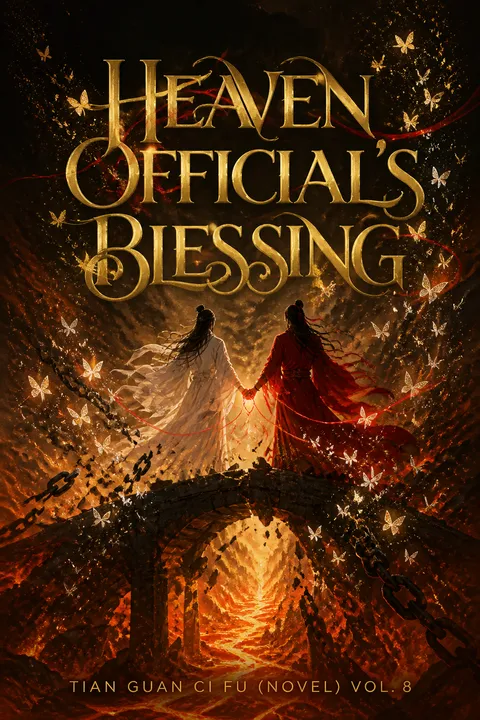
Deep in the ruined Wuyong palace, Feng Xin insists Mu Qing knocked him unconscious during the destruction of the Heavenly Capital. Xie Lian challenges the certainty of a witness who never saw his attacker, and the two former companions nearly come to blows. Hua Cheng returns and spots a cursed shackle on Mu Qing's wrist.
Under questioning, Mu Qing admits he struck Feng Xin to force him out of the burning capital, then lost him when a fetus spirit attacked. He also says Jun Wu shackled him after he refused an order to harm Xie Lian. His evasions make the story difficult to trust, but his fear and shame complicate the suspicion. Before they can settle the matter, the armory's weapons begin to stir.
The scene turns distrust into an evidentiary problem: Feng Xin knows Mu Qing's habits, yet that intimacy makes accusation feel more certain than proof. Mu Qing's confession reveals a familiar defense mechanism, hiding a clumsy attempt at protection behind denial because he expects contempt rather than gratitude. The cursed shackle gives that private conflict political weight. The group must decide whether to judge him by his imperfect conduct or by the coercion he describes, while the awakening armory forces them to act before they can reach a comfortable verdict.
The Lava Takes the Palace
The armory's weapons attack until Hua Cheng shatters them, opening an exit. Xie Lian's attempt to help makes Hua Cheng fear he intends to turn a blade on himself; Xie Lian reassures him, but his careless joke about being cut only deepens Hua Cheng's distress. The group presses onward as lava floods the palace.
They ride empty shells across the molten current, then find Mu Qing fleeing ahead of them. At a sheer drop, Xie Lian saves Feng Xin and Hua Cheng with Ruoye, while Mu Qing catches a ledge above the lava. Xie Lian risks the crossing to pull him up. Before they can regroup, White No-Face seizes Xie Lian and drags him down, and Hua Cheng dives after him.
Rescue here is both physical and relational. Xie Lian refuses to let suspicion erase Mu Qing's claim on help, while Hua Cheng's alarm exposes how deeply Xie Lian's old self-destructive habits still frighten him. The peril makes their different forms of care visible: Hua Cheng tries to shield, Xie Lian chooses who deserves saving, and Feng Xin follows into danger rather than abandon either friend. White No-Face's return interrupts this fragile cooperation at the very moment the group appears to have survived the palace.
Three Friends Over Wuyong
Xie Lian wakes on the broken Heaven-Crossing Bridge with Mu Qing, whose hands and legs are burned. He supports him despite the danger, explaining that Mu Qing's account rings true and that refusing to help would violate his own principles. When the bridge collapses, molten spirits attack from below.
Mu Qing chooses to leap down and fight them so Xie Lian can keep moving, admitting that he once envied Xie Lian, doubted his generosity, and wanted his friendship despite his own bitterness. Feng Xin arrives by riding the lava's floating shells and hauls Mu Qing back with Ruoye. Their arguments resume, but the admission changes their footing: the three former companions now face the same danger together and search the bridge for Hua Cheng.
Mu Qing's confession matters because it does not purify him. He remains proud, defensive, and resentful, but finally names the need underneath those habits. Xie Lian's response distinguishes forgiveness from idealization: he can know someone's failings and still refuse to turn them into a death sentence. Feng Xin's arrival makes friendship practical rather than sentimental. Each man risks himself for the others, and the old quarrels continue, now less able to conceal the attachment they once distorted.
The Mask Cracks Open
Silver fragments and Eming's deep sword marks lead Xie Lian toward the clash ahead. Hua Cheng is fighting White No-Face, whose mask has cracked under the force of their blows. The state preceptor recalls a young wrath ghost who once protected trapped humans in Mount Tonglu, carved out his own eye to forge a blood weapon, and then rejected ascension.
Xie Lian recognizes the story as Hua Cheng's hidden past. White No-Face calls him a devoted believer before snatching Fangxin from Xie Lian and shedding his disguise. The revealed man is Jun Wu, the Heavenly Emperor, in white armor. He takes up Fangxin, its original name Zhuxin, and renews the fight with greater power, aiming repeated strikes at Hua Cheng's remaining eye.
The past changes the meaning of Hua Cheng's power. His weapon is not merely proof of strength but the cost of choosing other lives over his own survival, a choice that transformed devotion into action. Jun Wu's unmasking also collapses the boundary between the orderly heavens and the calamity stalking Xie Lian. The sword returns to its former owner, but its history now links the ancient catastrophe of Wuyong to the present conflict. The fight is no longer a contest with an unknown monster; it is a reckoning with authority that has become personal.
A Crown Prince Says No
Jun Wu turns his attack toward Xie Lian and taunts him with the years after Xianle fell, including the time he nearly became the White-Clothed Calamity and helped spread Human Face Disease. Xie Lian fears Hua Cheng will reject him, but Hua Cheng steadies him.
Together they exploit a weak point in Jun Wu's armor, left by Xie Lian's sword assault centuries earlier. Jun Wu then captures Xie Lian and repeatedly smashes his head against stone, demanding submission. Xie Lian refuses.
Feng Xin and Mu Qing strike from behind, giving Hua Cheng the opening to sever Jun Wu's holding hand and free Xie Lian. Hua Cheng pours his spiritual power into Xie Lian until the cursed shackles binding him for centuries break. Xie Lian regains his strength, shatters Jun Wu's armor, and pins him with Zhuxin.
Jun Wu's violence is not simply an attempt to win; he tries to make pain produce obedience, treating Xie Lian's refusal as an insult to the order he built. Xie Lian's stubbornness answers that coercion with a choice he makes while fully aware of the cost. His fear of being judged for his darkest history shows how shame can persist even inside loving bonds. Hua Cheng's power gives Xie Lian the means to fight, but the final refusal remains Xie Lian's own. Their victory depends on alliance, memory, and consent rather than domination.
The Red Robes Scatter
As Jun Wu lies defeated, the state preceptor stays beside him, urging him to release the past rather than continue a war with no remaining purpose. Xie Lian leaves Jun Wu alive and shields his face from the rain. Then Hua Cheng's robes begin to turn transparent. He has spent too much spiritual power breaking Xie Lian's shackles and cannot remain embodied.
Before he disappears, he reveals that he was the nameless ghost who followed Xie Lian through his worst years, protecting him without demanding recognition. Xie Lian understands at last that Hua Cheng witnessed his failures as well as his triumphs and stayed. Hua Cheng dissolves into silver butterflies, leaving a red string behind. Xie Lian cannot move as the butterflies fade.
The revelation resolves a long asymmetry: Xie Lian remembers hardship as isolation, while Hua Cheng has carried those same years as a history of witnessing. Devotion is not presented as worship of an untarnished ideal; Hua Cheng knows Xie Lian's violence, despair, and shame, and loves the person who endured them. Yet that unconditional attachment has a cost. His disappearance turns love into absence again, so the revelation brings joy and grief in the same instant rather than neatly resolving either.
Lanterns Find the Waiter
The scattered heavenly officials gather on Mount Taicang to rebuild their court, but Xie Lian stays behind, certain Hua Cheng will return to the place where they last separated. He repairs the cottage, plants flowering trees, clears the paths, and fills the months with small tasks that make the mountain ready for someone who may never come.
On the next Shangyuan Festival, he sees lanterns descending toward his home. Hua Cheng stands among them, restored, wearing an eyepatch and carrying the same fierce presence. They run to meet each other. The reunion answers the promise left behind by the butterflies, but it does not erase the year of waiting. Xie Lian has learned to wait with the patience Hua Cheng once gave him.
The year of waiting transforms devotion from a dramatic sacrifice into a daily practice. Xie Lian does not defeat absence by denying grief; he makes a home, tends its paths, and continues living while keeping a place open for Hua Cheng. The preparations are concrete acts of hope rather than passive fantasy. Their meeting reverses the old pattern of one person pursuing and the other being pursued. Each now knows what it means to remain faithful across time, and that reciprocal knowledge gives the reunion its force.
The Heavens Rebuild
The rebuilt Upper Court struggles with missing records and crowded temporary quarters, while Mu Qing handles the accounts and Feng Xin spars with him as usual. The Rain Master brings food and rare silk to repair Ruoye. At the foot of the mountain, Xuan Ji has dissipated, her resentment finally spent.
Jian Lan leaves with her monstrous son Cuocuo, declining Feng Xin's offer of care because she will not make their old love a burden he must carry. Lang Qianqiu returns one of Xie Lian's childhood coral pearls, preserved through the history of Yong'an.
Feng Xin later captures Ling Wen when she comes back for the Brocade Immortal; the officials put her to work restoring their records. She explains that the robe could not manipulate Hua Cheng because his trust and willingness to sacrifice were genuine.
Reconstruction is shown as administrative labor and difficult boundary-setting, not a clean reset. The court needs Ling Wen's competence even while holding her accountable, and Xuan Ji's disappearance comes through the end of resentment rather than victory over a rival. Jian Lan's choice resists the fantasy that love obliges people to reunite; she protects her independence and her son. The returned pearl reconnects Xie Lian with a past shaped by loss, while the Brocade Immortal episode contrasts coercive control with a bond sustained by freely given trust.
Puqi Shrine Reopens
Quan Yizhen's forgotten gold helps the villagers rebuild Puqi Shrine, and Xie Lian hosts a noisy celebration there with Hua Cheng. Feng Xin and Mu Qing sweep the courtyard, only for Shi Qingxuan to arrive with a crowd of beggars who once helped guard the human array. Ghost cooks provide food, including a rooster spirit bathing in the soup pot, and an unseen guest empties a whole batch of bowls before anyone can stop him.
When the gathering grows too loud, Xie Lian and Hua Cheng slip away hand in hand. The novel closes its central story with a folk tale pairing the unlucky Scrap Immortal and the powerful Red-Robed Ghost King: worshipping both together brings good fortune, as their separate legends become one.
The shrine's celebration gathers people who occupy different ranks without pretending those differences have vanished. Beggars, gods, and ghosts eat in one courtyard, and the comic disorder makes hospitality an action rather than a pious abstraction. Xie Lian's life remains visibly humble even after his power returns; the shrine is rebuilt through villagers' care, not imperial grandeur. The closing folk belief reframes bad luck as relational: Xie Lian's misfortune is not erased, but Hua Cheng's presence changes what it can mean.
The Riddle Says Hua Cheng
During a Yuanxiao festival in Ghost City, Xie Lian remembers eating the sweet rice dumplings alone at a roadside stall before he and Hua Cheng were reunited. Hua Cheng notices his attention and later arranges a bowl for each of them at Thousand Lights Temple. Before that, the ghosts steer Xie Lian through lantern riddles whose answers combine into a teasing declaration naming Hua Cheng as his husband.
Xie Lian solves the clues quickly, recognizes the trick, and lets the ghosts scatter under Hua Cheng's look. The remembered loneliness gives way to a shared meal. At last, Xie Lian can taste the festival food as something other than a reminder of the family and warmth he once watched from outside.
Food becomes a measure of whether memory is still only an archive of deprivation or can be joined to present experience. The earlier bowl was edible but emotionally inaccessible; the shared one lets Xie Lian revisit the same holiday without being stranded in its old loneliness. The riddles turn public teasing into a small celebration of intimacy, yet the emotional resolution happens privately at the table. Hua Cheng does not erase the past meal. He gives Xie Lian a new one beside it.
Seventeen Again
A memory-eating monster leaves Xie Lian with the mind of his seventeen-year-old self and no recollection of the eight centuries since. He wakes confused and injured, then discovers that Feng Xin and Mu Qing have changed into older, more formidable versions of themselves. The name Hua Cheng stirs an inexplicable longing, and a chance meeting with the red-clad San Lang deepens it.
Xie Lian believes he has been deceived and fears the fall of Xianle is his own failure. San Lang eventually reveals that he is Hua Cheng, explains how the monster stole the missing years, and guides Xie Lian toward the memories inside it. Xie Lian chooses to recover them, knowing they contain grief as well as love.
The amnesia episode tests identity without treating memory as the sole source of selfhood. Xie Lian's younger mind recoils from the person he has become, yet instinctively trusts Hua Cheng and repeats the moral choices that define him. The episode also exposes how easily achievement becomes the measure by which he judges himself: he reads survival as failure because his youthful ambition had no room for collapse. Hua Cheng offers testimony rather than flattery, helping Xie Lian confront the past without pretending it was painless.
A Storybook Wedding
While Hua Cheng is mildly ill, Xie Lian tries to keep him company by reading an old folk story. Its poor Scrap Immortal disguises himself as a bride to investigate a Ghost Groom, only to find that the feared king is courteous and waiting for his destined beloved. The tale borrows details from their lives, then twists them into an increasingly indecent comedy.
Xie Lian objects to its inventions and worries about who might read it, while Hua Cheng enjoys every exaggeration and urges him onward. The story's romance is ridiculous, but its ending still moves Xie Lian: beneath the errors, strangers have recognized the shape of their devotion and made it into a legend.
Folklore works here as a communal distortion that nevertheless preserves emotional truth. The tale misstates events, but its invented plot understands the lovers' central pattern: fear gives way to recognition, and a supposed monster becomes a shelter. Xie Lian's embarrassment marks the difference between private experience and public myth, where intimacy is endlessly repackaged for amusement. Hua Cheng's delight shows that being misunderstood by details does not necessarily mean being unseen. The story is false in its particulars and oddly accurate in its affection.
The Cave Learns to Love
After Mount Tonglu's eruption, Xie Lian visits the Cave of Ten Thousand Gods and finds that his abundant spiritual power has animated Hua Cheng's carved statues of him. A statue recalling his poisoned ordeal under the Land of the Tenders is suffering again, so Hua Cheng creates a statue of himself to help it. Xie Lian blesses the new figure, and the two statues join.
They then animate a small carving of Hua Cheng as a battered child. The boy, fierce toward Hua Cheng, shyly offers a flower to the statue of the God-Pleasing Crown Prince, who welcomes him. Seeing the lonely figures find companions, Xie Lian and Hua Cheng decide to carve a counterpart for every statue that still waits alone.
The cave gives material form to memory: each statue fixes Xie Lian at a different moment, including one shaped by pain that he would rather not display. Hua Cheng's response is not to erase that image but to meet it with another presence. The child statue's flower condenses the origin of devotion into a gesture small enough to hold in two hands. Their decision to pair the remaining figures imagines care as repeatable, while also acknowledging that every version of a person may need a different kind of witness.
A Birthday Lock Breaks
Xie Lian secretly prepares Hua Cheng's first meaningful birthday celebration and forges him a longevity lock from the silver mask buried with Xie Lian's own grave. The mask's lingering blood returns to his body, causing stabbing pain whenever he sees or thinks of Hua Cheng. Xie Lian hides the symptoms until the celebration, where the pain makes him collapse.
Feng Xin and Mu Qing trace the problem to the grave and the blood-tainted metal. Hua Cheng destroys the lock, ending the curse, even though it was Xie Lian's carefully made gift. The birthday is salvaged with a clumsy embroidered belt Xie Lian made earlier. Hua Cheng wears it proudly, while Xie Lian tries to keep the design hidden.
The birthday gift binds care to bodily history: Xie Lian turns an object from his own burial into a blessing, only to discover that the past still has physical consequences. Hua Cheng's destruction of the lock is an act of protection that refuses to preserve a symbol at the cost of Xie Lian's health. The replacement belt is intentionally imperfect, and its value lies in the labor and vulnerability it carries. Their affection does not require beautiful objects; it makes even a ridiculous one worth wearing.
Analysis
This volume brings its central conflict to a conclusion by making recognition, rather than power alone, decisive. Xie Lian can fight Jun Wu only after Hua Cheng breaks the shackles that have restrained him, but the victory depends just as much on Xie Lian refusing to change under violence. His resistance is not an assertion that he has never failed; the revelations about his past make clear that he has done terrible things and still remains capable of choosing what to do next. The novel treats moral identity as a practice, not a spotless record.
The relationships around Xie Lian are likewise built through imperfect acts. Feng Xin and Mu Qing quarrel because their old bonds remain alive beneath resentment. Jian Lan refuses an imposed reunion, showing that care can require distance. The heavenly court rebuilds through bureaucratic work, while the village rebuilds Puqi Shrine through shared resources. These mundane efforts prevent the finale from reducing repair to a single heroic gesture.
Hua Cheng's devotion is powerful because it does not demand that Xie Lian be innocent, grateful, or easy to love. Yet the story also gives devotion costs: Hua Cheng fades after giving too much, and Xie Lian experiences the terror of waiting for someone he cannot summon back. Their eventual reunion makes love reciprocal rather than merely sacrificial. Xie Lian waits as Hua Cheng once did, and both become people who know what absence asks of the one left behind.
The volume's comic extras extend these ideas into folk memory and domestic ritual. A festival bowl, a badly sewn belt, a storybook's distortions, and a cave of statues all turn affection into something tangible. Grand powers matter, but so do the repeated small choices that make a shared life possible.
Review Summary
Heaven Official's Blessing has captivated readers with its epic love story, complex characters, and masterful storytelling. Fans praise the emotional depth, character development, and satisfying conclusion. Many express deep attachment to the main couple, Xie Lian and Hua Cheng, calling their romance unparalleled. Readers appreciate the blend of humor, action, and heartfelt moments. While some found certain plot elements or character arcs less engaging, the overall reception is overwhelmingly positive. Many readers describe the series as life-changing and eagerly anticipate rereading it.
Characters
Xie Lian
The enduring crown princeOnce Crown Prince of Xianle and now a god accustomed to scraping by, Xie Lian meets catastrophe with practical kindness and an unusually durable sense of humor. He is physically formidable, but his defining strength is ethical: he keeps choosing to help people even when they distrust him, misunderstand him, or have harmed him. His history has left him with shame and a habit of treating his own pain lightly, sometimes to the alarm of those closest to him. He is not untouched by anger or despair; he has to decide, repeatedly, what kind of person he will be after suffering. His bond with Hua Cheng gives him a place where his whole history can be known.
Hua Cheng
The red-robed ghost kingRuler of Ghost City and one of the most powerful beings in the Three Realms, Hua Cheng is feared for his scimitar, silver butterflies, wealth, and unpredictable temper. Around Xie Lian, he is attentive, playful, and fiercely protective, though his instinct to shield can become alarm when Xie Lian risks himself. His devotion is not based on an idealized image: he is drawn to Xie Lian's courage and kindness while accepting the pain, anger, and mistakes that accompany them. Hua Cheng's confidence masks a capacity for sacrifice, and his love is expressed less through promises than through sustained action.
Feng Xin
The blunt loyal archerA martial god and Xie Lian's longtime companion, Feng Xin is hardworking, protective, and quick to anger. His blunt speech often makes his concern sound like accusation, particularly when he quarrels with Mu Qing. He is a capable fighter whose first instinct is to move toward danger, but his personal life exposes the limits of courage: he cannot simply restore the family he longs to protect. Feng Xin's affection is real even when his words are clumsy, and his relationship with Xie Lian carries the weight of shared service, distance, and old loyalty.
Mu Qing
The guarded martial godA martial god known for his sharp tongue and immaculate self-control, Mu Qing often hides vulnerability behind contempt and denial. His history with Xie Lian and Feng Xin is shaped by class insecurity, rivalry, and the belief that he is regarded as inferior. He wants recognition but distrusts the kindness that might offer it, so he frequently makes connection harder than it needs to be. Beneath the prickliness is a strong sense of responsibility and a real capacity for courage. His skill at sewing and administration offers a quieter counterpoint to the hostile image he cultivates.
Jun Wu
The composed heavenly rulerThe Heavenly Emperor presents himself as measured, powerful, and willing to hear the concerns of others. His authority rests on long experience and immense spiritual force, but his calm exterior conceals deep wounds and rigid expectations. He is especially invested in Xie Lian, a concern that can feel protective until it becomes controlling. Jun Wu's need to have his judgments vindicated makes disagreement difficult for him to tolerate. He embodies the danger of turning personal pain into a universal rule, then demanding that others live according to it.
Mei Nianqing
The weary state preceptorA diviner and former teacher to Xie Lian, Mei Nianqing carries intimate knowledge of the ancient kingdom of Wuyong and of the people who shaped it. He can be distracted by cards and irritable with students, but his humor does not blunt his moral seriousness. His history gives him a painful perspective on what happens when loyalty becomes entangled with a need to prove who was right. He cares for Xie Lian while remaining emotionally tied to the past he shared with Jun Wu.
Jian Lan
The fiercely independent motherA former citizen of Xianle and the mother of Cuocuo, Jian Lan is direct, resilient, and protective of her independence. Her difficult life has taught her to distrust promises that are not supported by present action. She cares deeply for her son and refuses to make her survival someone else's obligation. Her history with Feng Xin is tender but complicated, and she is able to distinguish affection from the decision to build a life together.
Cuocuo
The unruly fetus spiritJian Lan's monstrous child is a small, volatile ghost with a frightening appearance and a stubborn attachment to his mother. His behavior can be dangerous, but he also shows fear, loyalty, and the ordinary need for care beneath his unnatural form. His connection to Feng Xin remains difficult for both of them to understand. Cuocuo is a reminder that a being's appearance does not neatly explain its bonds or its capacity to respond to protection.
Ling Wen
The indispensable administratorLing Wen is the Heavenly Court's most capable civil official, known for making its bureaucracy function through sheer discipline and intelligence. She is pragmatic and reserved, with a willingness to use people and systems to achieve her aims. Her competence does not make her morally simple; she can be both responsible for serious harm and essential to the repair of institutions. Her work often goes unnoticed until everyone else discovers how much depends on it.
Lang Qianqiu
The earnest young martial godA martial god raised as a prince of Yong'an, Lang Qianqiu is straightforward, proud, and governed by a strong belief in justice. His certainty can harden into vengeance when he believes someone has committed an unforgivable wrong. Yet he is also capable of tenderness, especially toward children, and his attempts to care for Guzi complicate his sense of who deserves compassion.
Rain Master
The generous farm guardianA reclusive heavenly official who prefers farming to court politics, the Rain Master is quiet, generous, and dependable in a crisis. Their gifts of food and materials are practical expressions of care, offered without demanding attention in return. The Rain Master brings steadiness to a community rebuilding after disaster.
Shi Qingxuan
The generous former wind masterSociable and impulsive, Shi Qingxuan retains a generous spirit despite losing the status and resources once associated with divine office. They remember promises made to ordinary people and follow through, even when it means organizing a chaotic crowd. Their warmth makes them a bridge between heavenly officials and people who have learned not to treat gods as untouchable.
Pei Ming
The proud northern generalA popular martial god with a reputation for charm and womanizing, Pei Ming is confident in battle and less comfortable when others see him needing help. His pride makes gratitude awkward, particularly when the person who helped him is the Rain Master. Beneath his swagger, he is a capable official who can recognize when the court needs someone else's expertise.
Pei Xiu
The reserved former generalA disciplined former martial official, Pei Xiu tends to meet conflict with formal restraint. He is linked to Banyue through a difficult history and serves practically when the heavenly court needs help guarding its temporary prison.
Banyue
The somber protectorA former state preceptor and now a wrath ghost, Banyue is quiet and self-effacing but driven by the wish to keep others from suffering as she has. Her solemnity hides a durable moral courage.
Xuan Ji
The haunted former generalOnce a distinguished general, Xuan Ji becomes consumed by an attachment that turns rejection into grievance. Her story illustrates how humiliation and fixation can narrow a person's world until little remains beyond the wound.
Guzi
The child seeking familyA young boy who longs for his father, Guzi approaches an unstable world with the simple hope that family can be restored. His trust places difficult emotional demands on the adults around him.
Quan Yizhen
The impulsive martial prodigyA gifted martial god with little interest in social convention, Quan Yizhen acts on instinct and expresses care through concrete offerings. His generosity can be bewilderingly literal, but it is sincere.
Heaven's Eye
The intrusive cultivatorA pompous human cultivator whose supernatural sight can expose what others would rather keep private, Heaven's Eye mixes genuine ability with a poor sense of discretion. His observations often create embarrassment even when he means to help.
Plot Devices
Cursed shackles
Power held in checkThe shackles restrict Xie Lian's spiritual power and make him vulnerable despite his history as a formidable god. Jun Wu's shackle on Mu Qing also turns suspicion into a physical sign of coercion. Their eventual breaking changes the balance of the battle, but the device matters beyond combat: it gives visible form to power exercised through restraint and obedience.
The Heaven-Crossing Bridge
A road through old ruinThe broken bridge, built in ancient Wuyong as a route toward heaven, hangs above lava filled with the dead. Its unstable spans force Xie Lian, Feng Xin, and Mu Qing to cooperate while the spirits try to drag them down. The bridge also connects the present crisis to Wuyong's ancient disaster and carries the final duel toward its climax.
Eming and Ruoye
Weapons with attachmentEming, Hua Cheng's living scimitar, channels his lethal skill and behaves with an eager, almost childish fondness for Xie Lian. Ruoye, Xie Lian's sentient silk band, rescues companions, binds enemies, and repeatedly stretches beyond its apparent limits. Their personalities make the weapons extensions of the relationships around them, while their practical abilities supply crucial ways through the armory, lava, and battle.
The Cave of Ten Thousand Gods
Memory made in stoneHua Cheng's hidden cave contains countless statues depicting Xie Lian across different stages of his life. The carvings turn private devotion into a physical archive, and their animation after Xie Lian's spiritual power surges lets old moments behave like living presences. The cave provides both an intimate after-story setting and a comic, tender way to show how memory can preserve pain while also creating companionship.
The silver longevity lock
A gift becomes a cureXie Lian reforges a treasured silver mask from his own grave into a birthday lock for Hua Cheng. Lingering blood and spiritual residue in the metal return to Xie Lian's body and trigger pain around Hua Cheng. Destroying the lock breaks the harmful connection, making the object both a sincere gift and the source of the crisis it must resolve.
天官赐福 [Tiān Guān Cì Fú] Series

About the Author
Other books by Mò Xiāng Tóng Xiù


Download PDF
Download EPUB
.epub digital book format is ideal for reading ebooks on phones, tablets, and e-readers.








