Plot Summary
1. The Laughingstock Crown Prince
Xie Lian, once the beloved Crown Prince of Xianle, is now the laughingstock of the heavens. After two banishments and centuries of hardship, he ascends for a third time, only to be met with ridicule and suspicion. With no worshippers, no temples, and no spiritual power, he is assigned menial tasks and is shunned by his peers. Yet, beneath the humiliation, Xie Lian's heart remains gentle and determined. He vows to save the common people, even as the world turns its back on him. His journey begins anew, marked by loneliness, poverty, and the faint hope that he can still do good, even as a god of misfortune.
2. The Ghost King's Red Umbrella
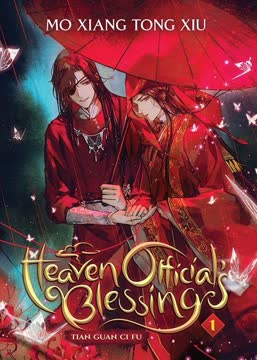
During his first mission as a newly re-ascended god, Xie Lian encounters a powerful and enigmatic ghost king: Hua Cheng, the Crimson Rain Sought Flower. Hua Cheng is infamous, feared by gods and ghosts alike, yet he shows Xie Lian unexpected kindness. Their fates become entwined as Hua Cheng offers his help, shielding Xie Lian from danger with a red umbrella. The encounter is both unsettling and strangely comforting, and Xie Lian is left wondering about the true nature of this ghost king who seems to know far more about him than he lets on.
3. The Scrap Immortal's Third Ascension
Xie Lian's third ascension is met with skepticism and derision from the heavenly court. He is assigned impossible debts, forced to collect scraps, and is the subject of endless gossip. Yet, he faces every humiliation with a smile, his resilience unbroken. He is joined by two junior officials, Nan Feng and Fu Yao, whose bickering and loyalty add both comedy and tension to his journey. Together, they investigate supernatural mysteries, and Xie Lian's compassion for mortals and ghosts alike sets him apart from the other gods.
4. The Ghost Bride's Seduction
Xie Lian is sent to Mount Yujun to investigate the disappearance of brides. Disguised as a bride himself, he is lured into a trap set by a vengeful ghost. The case leads him to confront the pain of unfulfilled love, jealousy, and the consequences of obsession. Hua Cheng appears again, guiding Xie Lian through danger and revealing glimpses of his own tragic past. The mission ends with the truth behind the ghost bride's curse, and Xie Lian's growing realization that not all monsters are born evil—some are made by heartbreak.
5. The Human Face Disease Returns
A deadly plague, the Human Face Disease, resurfaces, spreading terror and suspicion. Xie Lian discovers that the disease is born from the resentment of the dead, and that its cure is as cruel as its cause: only those who have killed are immune. As panic spreads, the people turn on each other, and Xie Lian is forced to witness the darkness in human hearts. He is accused, betrayed, and ultimately sacrificed by those he tried to save. The experience leaves him scarred, but also more determined to protect the innocent, no matter the cost.
6. The White-Clothed Calamity
White No-Face, the White-Clothed Calamity, emerges as the true mastermind behind the Human Face Disease and the fall of Xianle. He is a being of infinite malice, born from the despair and hatred of the world. White No-Face torments Xie Lian, tempting him to give in to vengeance and despair. He is both a mirror and a nemesis, reflecting Xie Lian's darkest fears and regrets. Their encounters are battles of will, and Xie Lian's refusal to become a monster is both his greatest strength and his deepest pain.
7. The Heaven-Crossing Bridge
The story of the ancient Kingdom of Wuyong and its crown prince is revealed—a tale that mirrors Xie Lian's own. The Crown Prince of Wuyong, beloved and brilliant, tries to save his people from disaster by building a bridge to the heavens. Betrayed by gods and mortals alike, he fails, and his kingdom is destroyed. The echoes of his tragedy haunt Xie Lian, who must confront the possibility that he is destined to repeat the same mistakes. The Heaven-Crossing Bridge becomes a symbol of hope, hubris, and the price of trying to save the world.
8. The God of Misfortune's Redemption
Banished and powerless, Xie Lian wanders the mortal realm, collecting scraps and enduring humiliation. Yet, even as a god of misfortune, he continues to help those in need. Along the way, he meets a nameless ghost fire—a wandering soul who becomes his most devoted believer. Their bond is quiet but profound, a testament to the power of kindness in a world that has forgotten how to hope. Xie Lian's journey is one of self-forgiveness, as he learns that even the most broken can still bring light to others.
9. The Ghost City's Secret
Xie Lian is drawn into the Ghost City, a place where ghosts and humans mingle, ruled by Hua Cheng. Here, he discovers the complexity of the ghost king's rule—both ruthless and compassionate. The city is a reflection of Hua Cheng's own heart: filled with pain, longing, and the desire to protect. As Xie Lian navigates the city's dangers, he uncovers secrets about Hua Cheng's past, his connection to the Crown Prince of Xianle, and the true nature of devotion. The Ghost City becomes a place of both temptation and revelation.
10. The Supreme's True Name
The truth of Hua Cheng's identity is revealed: he is San Lang, the nameless ghost fire who once followed Xie Lian, the Star of Solitude, the Supreme Ghost King who has loved Xie Lian for eight hundred years. Their bond is tested by trials, misunderstandings, and the machinations of gods and ghosts. Yet, through every hardship, Hua Cheng's devotion never wavers. The red string of fate that binds them is both a promise and a lifeline, and Xie Lian must finally accept that he is worthy of being loved.
11. The Kiln's Final Trial
Mount Tong'lu reopens, and millions of ghosts gather for the chance to become a Supreme. Xie Lian and Hua Cheng enter the Kiln, facing deadly trials, old enemies, and the darkness within themselves. White No-Face seeks to break Xie Lian, to make him his successor, but Xie Lian refuses to give in. With the help of Hua Cheng and his friends, he confronts his past, his regrets, and his hopes. The final battle is both physical and spiritual, a test of will and love.
12. The Devoted Believer's Promise
The nameless ghost fire, Hua Cheng, reveals the depth of his devotion: "To die in battle for you is my greatest honour." Xie Lian realizes that he has never been alone, that even in his darkest moments, someone has always believed in him. Their love is not one of perfection, but of acceptance—of flaws, of pain, of the past. Together, they break the curse of the Kiln, and Xie Lian is finally freed from the chains of guilt and shame.
13. The Crown Prince's Last Believer
In the aftermath of the final battle, Xie Lian is left with the knowledge that he is not the god the world wanted, but he is the god that one person needed. The last believer, the one who never gave up, is enough. Xie Lian learns that the value of a god is not in the number of worshippers, but in the sincerity of a single heart. The story becomes a meditation on faith, redemption, and the power of love to heal even the deepest wounds.
14. The Red String of Fate
The red string that binds Xie Lian and Hua Cheng is both literal and symbolic—a connection that cannot be broken by time, distance, or death. Their reunion is both joyful and bittersweet, as they must learn to live with the scars of the past. Yet, in each other, they find the courage to hope again. The red string becomes a symbol of trust, vulnerability, and the willingness to be seen and loved for who they truly are.
15. The End of the Heavenly Capital
The Heavenly Capital is destroyed, and the old order is swept away. Xie Lian and his friends must rebuild, not just the city, but their own lives. The gods and ghosts who once fought each other now find common ground, and the world is changed by the courage of those who refused to give up. Xie Lian's journey comes full circle, as he learns that true strength is not in never falling, but in always getting back up.
16. The Reunion at Puqi Shrine
Xie Lian returns to Puqi Shrine, the place where he once collected scraps and found hope in the kindness of strangers. Here, he is reunited with Hua Cheng, and together they build a new life. The shrine becomes a place of laughter, friendship, and healing—a testament to the power of second chances. The story ends not with grand battles, but with the quiet joy of being together, and the promise that, no matter what comes, they will face it side by side.
17. The Gilded Banquet's Blood Debt
The truth behind the Gilded Banquet is revealed—a massacre that haunts the survivors and shapes the destinies of gods and mortals alike. Xie Lian must confront the consequences of choices made in desperation, and the pain of being both victim and perpetrator. The banquet becomes a symbol of the cycle of violence and the need for forgiveness, both of others and of oneself.
18. The Path of No Regrets
In the end, Xie Lian and Hua Cheng choose each other, not because they are perfect, but because they are willing to try. Their love is not a fairy tale, but a journey—one of falling, rising, and walking together. The story closes with the affirmation that, even in a world filled with suffering, there is still beauty, still kindness, and still the possibility of happiness. By the Heaven Official's blessing, no paths are bound.
Characters
Xie Lian
Once the beloved Crown Prince of Xianle, Xie Lian is a figure of both tragedy and resilience. Banished from the heavens twice, he endures centuries of hardship, humiliation, and loneliness. Yet, his compassion for mortals and ghosts alike never fades. He is gentle, selfless, and stubbornly hopeful, even as the world brands him a god of misfortune. Xie Lian's journey is one of self-forgiveness, as he learns to accept his own flaws and to believe that he is worthy of love. His relationship with Hua Cheng is the heart of the story—a testament to the power of devotion, redemption, and the courage to hope again.
Hua Cheng (San Lang)
Hua Cheng, also known as the Crimson Rain Sought Flower, is the most feared and powerful ghost king in the three realms. Yet, beneath his ruthless exterior lies a heart that has loved Xie Lian for eight hundred years. He is cunning, mischievous, and fiercely protective, willing to do anything for the one he loves. Hua Cheng's devotion is both his strength and his vulnerability, and his journey is one of learning to accept love in return. His past as the nameless ghost fire, his sacrifices, and his unwavering faith in Xie Lian make him one of the most compelling characters in the story.
Jun Wu / White No-Face
Jun Wu, the Heavenly Martial Emperor, is both mentor and nemesis to Xie Lian. As White No-Face, he is the embodiment of despair, jealousy, and the destructive power of obsession. His desire to shape Xie Lian into his successor is both a twisted form of love and a reflection of his own regrets. Jun Wu's complexity lies in his ability to inspire both admiration and horror, and his downfall is a cautionary tale about the dangers of unchecked ambition and the need for compassion.
Shi Qingxuan
Shi Qingxuan, the Wind Master, is a source of warmth and humor in the story. Despite losing everything, he remains optimistic and generous, always ready to help a friend in need. His friendship with Xie Lian is genuine and supportive, and his struggles with fate and identity add depth to his character. Shi Qingxuan's journey is one of self-acceptance and the courage to keep smiling, even in the face of adversity.
Feng Xin
Feng Xin, the Martial God of the South, is Xie Lian's childhood friend and bodyguard. Fiercely loyal, blunt, and protective, he stands by Xie Lian through every hardship. His own struggles with love, duty, and self-worth mirror Xie Lian's, and his journey is one of learning to let go and to forgive. Feng Xin's unwavering support is a constant source of strength for Xie Lian, even when words fail.
Mu Qing
Mu Qing, the Martial God of the West, is complex, prideful, and often misunderstood. His relationship with Xie Lian is fraught with jealousy, resentment, and unspoken affection. Mu Qing's journey is one of self-discovery, as he learns to confront his own insecurities and to accept the love and forgiveness he has always craved. His dynamic with Feng Xin and Xie Lian adds depth and realism to the story's exploration of friendship and regret.
Pei Ming
Pei Ming, the Martial God of the North, is both a source of comic relief and a figure of surprising depth. Known for his womanizing ways, he is also a skilled strategist and a loyal friend. Pei Ming's past, his regrets, and his willingness to face the consequences of his actions make him a nuanced character. His interactions with Xie Lian, Hua Cheng, and the other gods highlight the complexities of power, reputation, and redemption.
Shi Wudu
Shi Wudu, the Water Master, is driven by ambition and the desire to protect his brother. His willingness to manipulate fate and to make difficult choices leads to both his rise and his downfall. Shi Wudu's story is a meditation on the cost of power, the pain of regret, and the need for forgiveness. His relationship with Shi Qingxuan is both heartbreaking and redemptive.
He Xuan (Black Water)
He Xuan, the Ship-Sinking Black Water, is a figure of quiet menace and deep sorrow. His quest for revenge is both justified and tragic, and his interactions with Xie Lian and Hua Cheng reveal the complexities of justice, loyalty, and the consequences of betrayal. He Xuan's story is a reminder that even the most fearsome can be shaped by pain and loss.
Bai Jing (The Brocade Immortal)
Bai Jing, the spirit of the Brocade Immortal, is a symbol of unrequited love, betrayal, and the destructive power of obsession. His story parallels Xie Lian's in its exploration of devotion, sacrifice, and the longing to be remembered. Bai Jing's fate is both a warning and a testament to the enduring power of the heart.
Plot Devices
The Red String of Fate
The red string that binds Xie Lian and Hua Cheng is both a literal spiritual device and a symbol of their unbreakable connection. It represents trust, vulnerability, and the willingness to be seen and loved for who they truly are. The red string is used throughout the story to signify moments of intimacy, rescue, and reunion, and its presence is a constant reminder that, no matter how far apart they are, they are always linked.
The Heaven-Crossing Bridge
The Heaven-Crossing Bridge is both a physical structure and a metaphor for the desire to save others, to reach for the impossible, and to bear the weight of the world. Its collapse is a turning point in the story, marking the loss of innocence and the beginning of Xie Lian's journey through suffering and redemption. The bridge's remains become a place of trial, memory, and ultimately, reconciliation.
The Human Face Disease
The Human Face Disease is a manifestation of the pain, hatred, and despair that lingers after tragedy. It is both a physical and spiritual affliction, spreading through fear and the willingness to harm others. The disease serves as a plot device to explore the darkness in human hearts, the consequences of betrayal, and the possibility of forgiveness.
The Brocade Immortal
The Brocade Immortal is a cursed robe that manipulates, controls, and destroys. It is both a tool of revenge and a symbol of the destructive power of obsession. The Brocade Immortal's journey through the story mirrors the fates of its creators and wearers, and its ultimate resolution is a meditation on the need to let go of the past.
The Kiln and Mount Tong'lu
Mount Tong'lu and the Kiln are places of both danger and possibility. They are the sites of the story's most intense battles, the birthplace of Supremes, and the setting for Xie Lian's final confrontation with his past. The Kiln's trials are both physical and spiritual, forcing characters to confront their deepest fears, regrets, and hopes.
The Narrative Structure
Heaven Official's Blessing weaves together multiple timelines, flashbacks, and perspectives to create a rich, layered narrative. The use of prophecy, foreshadowing, and parallel stories (such as the tale of the Crown Prince of Wuyong) deepens the emotional impact and highlights the cyclical nature of suffering and redemption.
Analysis
Heaven Official's Blessing is a sweeping epic that explores the nature of suffering, redemption, and the enduring power of love. At its heart, it is the story of two souls—one a fallen god, the other a ghost king—who find in each other the courage to hope again. The novel is both a deconstruction and a celebration of the xianxia genre, blending humor, tragedy, and romance with philosophical depth. Through Xie Lian's journey, the story interrogates the meaning of divinity, the cost of compassion, and the possibility of forgiveness. Hua Cheng's unwavering devotion is both a source of comfort and a challenge, forcing Xie Lian to confront his own worth and to accept that he is deserving of love. The narrative's use of parallel stories, unreliable narrators, and shifting perspectives invites readers to question the nature of truth, memory, and fate. Ultimately, Heaven Official's Blessing is a meditation on the resilience of the human (and inhuman) heart, the necessity of kindness, and the belief that, even in a world filled with suffering, there is still beauty, still hope, and still the possibility of happiness. By the Heaven Official's blessing, no paths are bound.
Last updated:
Review Summary
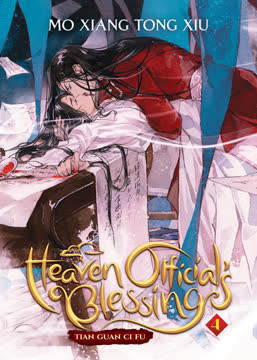
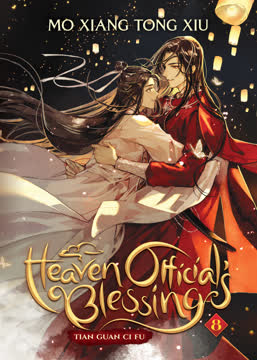
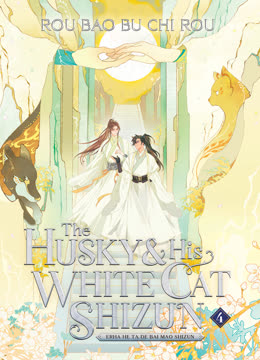
Heaven Official's Blessing volume 4 receives overwhelmingly positive reviews (4.76/5), praised for intense romantic development between main characters Xie Lian and Hua Cheng, including memorable kissing scenes and domestic moments. Readers highlight the emotionally devastating Black Water arc featuring Shi Qingxuan and the Shi brothers' tragedy. The volume balances humor with angst, introduces beloved character Quan Yizhen, and features shocking plot twists about heavenly officials. The cover art generates significant enthusiasm. Despite the romance, readers warn of profound emotional pain and darkness throughout.
天官赐福 [Tiān Guān Cì Fú] Series