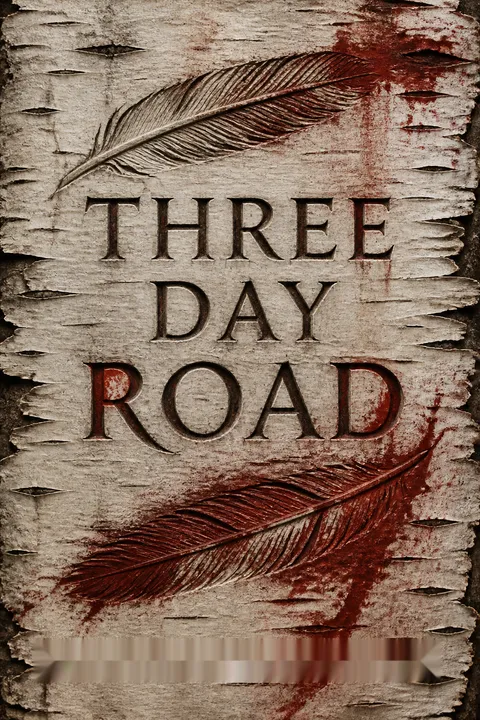


Plot Summary
The Wrong Ghost Returns
Niska has paddled alone to a railway town after receiving two contradictory reports: her nephew Xavier was officially dead, while his friend Elijah was wounded and expected home. When the train empties, she nearly mistakes the thin soldier on crutches for Xavier’s ghost. He recognizes her, and the two embrace, each having believed the other dead.
By the river, Niska sees Xavier inject himself with morphine before she can reach him. She does not confront him. Instead, she helps him into her canoe and turns north, away from the staring townspeople and toward the bush where she can protect him. Fever, a missing leg, failing hearing, and the drug’s dwindling supply make the homeward journey a race against his collapse.
The reunion reverses the usual homecoming: Niska returns expecting to receive a wounded friend, only to discover that the man before her is the nephew she mourned. Their mutual error shows how war reduces people to unreliable records, while the body carries truths the paperwork cannot hold. Xavier’s concealed injection also establishes the novel’s immediate crisis. Niska can carry him away from the town, but she cannot simply paddle him out of what the war has done. Her patience becomes active care, and the river becomes both route and refuge.
Two Boys, One Trail
Years earlier, Niska took her young nephew Xavier from the residential school and raised him in the bush, teaching him to hunt, track, make clothing, and read the land. Xavier later met Elijah, another boy scarred by the school and left without dependable family.
They became close through shared hunts, but Xavier was the natural tracker while Elijah was quick with words and hungry for company. Their bond deepened through years of living with Niska, who taught them both to recognize fear and survive it.
As young men, they decided to join the Canadian army together. Niska warned that war would change them, then gave each a medicine bundle before they paddled south. Their decision carried them from a life governed by seasons into a war they barely understood.
The friendship begins as a practical partnership, but it grows into a chosen kinship that neither boy can easily name. Xavier’s skills are learned through attention and restraint; Elijah’s gifts depend on performance, language, and the ability to draw others close. Their different strengths are already visible, as is the imbalance that will later matter: Xavier watches, while Elijah wants to be seen. Niska’s teaching offers an alternative model of authority, grounded in care for land and relations. Their enlistment is therefore not a simple escape from home. It is a departure from the only world that has taught them how to live.
Niska Learns the Cost
As a girl, Niska lived through a winter when game vanished and thirty people faced starvation. Her father, the Cree leader, allowed a hungry camp to eat a hibernating bear, carefully following the customs that honored the animal.
Soon after, Micah’s starving wife returned alone, carrying meat from her murdered husband and showing signs of becoming a windigo. Niska’s father killed the woman and her infant to prevent further harm, and the camp survived when hunters found a moose.
Cree families treated the act as necessary, but Hudson’s Bay Company authorities arrested Niska’s father for murder. He died in their jail, away from the land and people he had led. Niska inherited both his spiritual responsibility and the danger of being judged by outsiders.
The episode gives windigo killing a specific moral shape: it is not triumph over a monster but a devastating act taken to stop hunger and violence from consuming a community. Niska sees the costs before she is old enough to understand them, so her later authority is inseparable from grief and responsibility. The colonial arrest compounds the harm by applying an external legal category without regard for the crisis that produced the killing. Her father’s death also makes cultural knowledge precarious. Niska is not simply inheriting power; she is inheriting the burden of deciding when survival demands an act that cannot be made clean.
The School Cannot Hold Her
After her father’s death, Niska’s mother tried to keep the family together, but a priest and soldier seized Niska for residential school. Niska resisted the nuns’ efforts to cut her hair and erase her language, eventually escaping with her mother through a broken window.
Back in the bush, she learned healing and spiritual practices from her mother and became a diviner. As a young woman, she fell in love with a French trapper, briefly imagining a life beyond solitude. When a Cree hunter needed her help, she chose her responsibility to the community and sent the trapper away.
He later lured her into a church, assaulted and humiliated her, and claimed to have stolen her spiritual power. Niska asked the lynx spirit to answer her pain; the trapper went mad and died, while she reclaimed her practice.
Niska’s life repeatedly places intimacy against obligation, but the conflict is not simply between love and tradition. The school uses coercion to sever her from her people; the trapper exploits her trust and turns the language of spiritual power into a weapon. Her response does not erase the injury. Instead, she returns to ceremony and accepts a role she once hoped to escape. The lynx becomes a figure of perception and agency, not a shortcut to revenge. Niska survives by recovering the practices that colonial authority tried to discredit, while recognizing that survival may leave her more isolated than before.
Fire on the River
Before joining the army, Xavier and Elijah travelled south by canoe and encountered a forest fire that suddenly shifted toward their camp. Smoke erased the riverbanks, embers burned the canoe’s blankets, and the boys had to push the craft against the current while sheltering in the water.
Elijah insisted they travel toward a stretch already burned, reasoning that the flames would have nothing left to consume there. They survived, found a charred moose for food, and emerged at a sharp boundary between blackened ground and living forest.
The ordeal exposed Elijah’s appetite for danger and Xavier’s instinct to question it. After selling their canoe and buying clothes in town, the friends continued to enlist, leaving the bush for a war that promised a different kind of fire.
The fire is a trial of judgment as much as endurance. Xavier’s caution and Elijah’s appetite for risk are already pulling in different directions, even though both are necessary to their survival. The burned landscape offers a troubling preview of what the war will do to land: destruction followed by a visible edge, but not necessarily restoration. Their decision to enlist after surviving the blaze reveals that danger itself is not enough to turn them back. Elijah sees the war as an opportunity to become someone extraordinary; Xavier follows partly from loyalty, carrying Niska’s warnings into a world where their inherited ways will be both useful and misunderstood.
The Trenches Take Them
In Europe, Xavier and Elijah arrive at a front where Canadian soldiers accidentally fire on their own men and the rain never seems to stop. The new recruits march through mud, rubble, and shellfire toward Saint-Eloi.
When their platoon becomes lost in fog, the two Cree hunters scout ahead and locate nearby Belgian soldiers, guiding their unit back to safety. Once in the trenches, Xavier learns the sounds of different shells and follows Corporal Thompson into no man’s land.
A flare exposes him to German fire, but he dives back into the trench with only a mud bruise. Their hunting knowledge earns respect, yet Xavier remains wary of the army’s assumptions about Indigenous men. Elijah, by contrast, quickly wins attention with fluent English, jokes, and confident stories.
The battlefield initially rewards the boys for knowledge their society has treated as primitive. Tracking, silence, and reading terrain become military assets, but the army values the results more readily than the people who developed those skills. Xavier understands the front through listening and observation; Elijah adapts by mastering the language and social codes around him. The contrast is not simply temperament. It is a difference in how each man seeks safety: Xavier becomes less visible, while Elijah makes himself indispensable and memorable. Their first success together still feels like friendship, but it also begins the public imbalance that will make Xavier’s contributions easier to overlook.
A Match Wins Xavier
Corporal Thompson recognized the boys’ patience and taught them to build concealed sniper nests, judge distance, and fire without exposing their position. Their first true raid into enemy territory ended with bombs thrown into a crater and the sound of men dying below; Xavier understood that he had crossed from hunting animals to helping kill people.
Later, at a rifle competition, Elijah and Xavier faced a celebrated marksman from the 48th Highlanders. Xavier outshot him in a near-impossible match-lighting contest, earning his fellow soldiers’ respect and the nickname X.
Sniping then became routine: Xavier spotted movement, Elijah fired, and their confirmed kills rose. Xavier felt the moral weight of the work, while Elijah began to treat the battlefield as the place where his talent could finally make him important.
The match competition gives Xavier recognition, but recognition arrives through an exhibition of lethal skill rather than through his quieter labor as a spotter. The nickname makes him legible to the regiment while also compressing his identity into a function: a target is something he can hit. Thompson’s training likewise translates traditional knowledge into military technique, with no equivalent recognition of the cultural world from which it came. The boys’ first kills complicate the apparent triumph. Xavier registers the dead as moral facts; Elijah interprets them as evidence of aptitude. Their shared competence therefore opens a widening emotional distance, even as the army treats them as a successful team.
The Sniper in the Dead
Sean Patrick, a young soldier who had helped Xavier feel included, died from a German sniper’s shot through the neck. Xavier and Elijah joined Thompson in searching for the marksman, whose copper bullets and precise attacks had made him a feared presence. They worked out that he must be hiding in no man’s land, not firing down from the German trenches.
When the sniper shot at them from beneath a corpse, Elijah was blinded by dirt and Xavier fired twice, killing him. On a later patrol, Xavier searched the body and took the sniper’s rifle and insignia. The kill brought revenge for Sean Patrick, but it also gave Xavier a new personal claim to lethal skill. Elijah’s admiration sharpened into envy, since Xavier had made the decisive shot.
Sean Patrick’s death turns sniping from a contest of skill into a matter of grief and responsibility. Xavier’s precision protects his comrades, yet the victory does not settle the emotional account. Taking the dead sniper’s rifle gives him a tangible object that joins hunting craft to battlefield violence, and the weapon will become a recurring marker of their rivalry. Elijah’s reaction is important because it reveals that their partnership does not protect them from competition. Xavier’s quiet competence can be overlooked by officers and admired by his friend at the same time, but admiration is already becoming possessive.
Lisette Leaves No Shelter
During a lull near Saint-Eloi, Xavier fell in love with Lisette, the pub owner’s daughter. After Elijah helped bring them together, Xavier and Lisette met secretly and shared a brief intimacy that gave him a life beyond the trenches to imagine.
Transferred to the fighting near Vimy, Xavier later stole away to visit her during leave. He found her with a British officer and struck him when she refused to let him stay. The army confined Xavier and threatened punishment for absence without leave.
Elijah translated for him and invented a story that Xavier had gone looking for food, while Sergeant McCaan supported the explanation. Xavier returned to his unit angry with Elijah for manipulating the encounter, and wounded by Lisette’s rejection. The episode left him more isolated from the men around him.
Lisette’s relationship briefly offers Xavier a future organized around tenderness rather than survival. Its collapse exposes how little control he has over either intimacy or his own story. Elijah’s interference may begin as an attempt to help, but it turns Xavier’s desire into something managed by someone else. The assault on the officer then makes the private wound an institutional danger, and Elijah again uses language to protect him. Xavier benefits from that protection while resenting its cost. The episode deepens the pattern of dependence between the friends: Elijah can rescue Xavier with words, but his help also reinforces the power imbalance between the one who speaks and the one who is heard.
Vimy’s Bloodied Ridge
At Vimy Ridge, Xavier and Elijah established a forward sniper position before a Canadian assault supported by a creeping barrage. When German troops emerged from deep shelters and machine guns cut into the advancing Canadians, both men fired from their concealed position.
Xavier shifted to a second nest and picked off two German machine-gunners, helping reduce the fire. The Canadians captured the ridge at terrible cost. Gilberto was killed in front of Xavier during the assault, while Elijah’s actions earned him a medal and growing fame.
Xavier, wounded and concussed, survived after Elijah carried him back to safety. During recovery, the men celebrated their victory, but Xavier saw that the praise flowed toward Elijah. Their success had secured ground for the army without repairing the distance opening between them.
The battle turns the friends’ accumulated skill into public consequence, but recognition remains uneven. Xavier’s shifting position and accurate shots help protect the advance, while Elijah’s audacity makes a story that travels easily through the unit. Gilberto’s death gives the victory its human cost, refusing to let military success become a clean answer to slaughter. Xavier’s concussion and rescue deepen his physical reliance on Elijah at the very moment he becomes more resentful of Elijah’s fame. The ridge is both an achievement and a fracture: the army gains high ground, while Xavier and Elijah lose some of the equality that once defined their friendship.
Passchendaele’s Human Mud
At Passchendaele, rain and shelling turned the ground into mud deep enough to swallow wounded men. Xavier and Elijah were sent ahead through a ruined village to clear a sniper’s position. Xavier shot a woman who appeared suddenly in the dark, then discovered her young child hiding nearby.
Elijah killed the child, claiming he had mistaken the struggle for an immediate threat. Xavier was horrified, but Elijah kept the incident from the command and later credited Xavier with killing an enemy sniper.
The deaths hardened Xavier’s guilt and weakened his trust in his friend. Meanwhile, the original members of their section disappeared one by one. When Elijah later joked that German meat was human, Xavier’s disgust showed how far Elijah’s appetite for violence had carried him from the boy he knew.
The civilian deaths mark a moral rupture that cannot be folded into the language of combat. Xavier’s shot is an error made in darkness, but discovery does not undo its consequence; Elijah’s choice to kill the child compounds the horror. By hiding the deaths and redirecting the official account, he protects both men from scrutiny while depriving Xavier of a truthful reckoning. The battlefield has already taught the soldiers to normalize corpses and fear. Here that normalization enters their own actions. Xavier’s revulsion is not proof of innocence, but it preserves a distinction between survival and appetite that Elijah is steadily losing.
The Letter Misread
In 1918, a disastrous raid left Sergeant McCaan dead and Corporal Thompson gravely wounded; Elijah survived after hiding through the day and bringing Thompson back. Soon afterward, Xavier received a letter written for Niska by Joseph Netmaker.
Because the English was awkward, Fat read it as saying that Xavier was the last of his family and that God understood if he had to kill Elijah. The original message had meant that Elijah too should pray and survive, but Xavier did not know that.
He began to believe Niska was dead and that he might have to stop his friend. When Elijah asked him to divine from a German shoulder blade, Xavier refused to sanction the killing. Later, he nearly injected Elijah with morphine, then withdrew the needle and left him alive.
The letter’s mistranslation converts care into a command to kill, making language itself a dangerous battlefield. Niska’s concern reaches Xavier through a chain of imperfect translation, while the army’s language has trained him to expect orders rather than interpretive uncertainty. The misunderstanding intensifies his isolation at precisely the moment Elijah needs intervention. Xavier’s refusal to divine for him, and his decision not to inject him, are small acts of resistance against a friendship that has become entangled with violence and addiction. They do not resolve the crisis, but they show that Xavier still distinguishes helping Elijah from obeying him.
Elijah Silences the Witnesses
Elijah’s morphine dependence and killing had made him increasingly dangerous. When Lieutenant Breech confronted him with accusations brought by Grey Eyes, Elijah drew his revolver in anger. Before the confrontation could resolve, a German shell struck the dugout and threw all three men down.
Xavier and Elijah recovered first. Elijah found Grey Eyes alive and beat him to death with a piece of wood, then killed the wounded Breech rather than risk a court-martial or prison.
He covered the bodies with earth and wreckage, then called for help, presenting the shelling as the cause. Xavier did not stop him. The deaths left the two friends bound by a secret that could not be reported without exposing them both, while Elijah believed he had finally removed every threat to his freedom.
The shell creates an opportunity, not an excuse. Elijah chooses to kill men who could expose him, then uses the confusion of bombardment to disguise deliberate acts as battlefield casualties. Xavier’s silence makes him complicit, but the text shows how that complicity is shaped by fear, loyalty, and exhaustion rather than simple agreement. The episode destroys the remaining distinction between Elijah’s public heroism and private violence. His claim to freedom is especially revealing: he imagines freedom as the absence of consequences, not as the capacity to choose differently. Xavier sees the danger, yet feels unable to sever the bond that makes him its witness.
The Last Hunt Turns
As the Canadian advance pushed east and German forces retreated, Xavier and Elijah continued scouting and killing. Elijah’s tally became enormous, and morphine allowed him to treat himself as an untouchable hunter.
Xavier, increasingly deaf and exhausted, wanted the war to end and began to fear what his friend had become. After Xavier read Niska’s letter as a command to kill Elijah, the two men carried that tension into their final advance. In a meadow, Elijah attacked a young German soldier and continued stabbing him after he was no longer a threat.
Xavier challenged him, but Elijah defended the killing as survival. The scene left Xavier facing a choice he had postponed for years: protect the friend he remembered or stop the man who now stood before him.
The German retreat removes some of the practical logic that had once made each killing seem necessary, but it does not remove Elijah’s need to continue. His identity has fused with the hunt, and the absence of an enemy who can easily justify his violence leaves Xavier confronting its excess directly. Xavier’s deafness deepens his isolation, while Elijah’s confident explanations try to make moral judgment sound like tactical error. The meadow is not a sudden transformation; it is the point at which Xavier can no longer pretend that friendship alone will restore the person he loved.
The Rifle Between Friends
During a final attack, Xavier and Elijah took cover together as machine-gun fire pinned the Canadians down. Xavier shot the gunner, but the bombardment struck nearby and knocked them apart. Elijah tried to embrace him, then turned violent; Xavier strangled him until a shell blast interrupted them.
For a moment Elijah seemed to return to himself, but he began choking Xavier again. Xavier struck him with a rifle and, weeping, pressed the weapon across Elijah’s throat until he died.
He took Elijah’s medicine bundle and identification, then was wounded by an explosion. In hospital, staff mistook Xavier for Elijah and treated him as the decorated hero. Xavier let the confusion stand, clinging to the identity that seemed to keep his friend alive while morphine numbed his grief.
The killing is both an act of protection and the severing of the relationship that has organized Xavier’s life since boyhood. The exchange of bundles and identification makes grief material: Xavier literally carries Elijah’s name into the hospital. His acceptance of the mistaken identity is not a simple deception for advantage. It is a way to postpone the unbearable knowledge that he killed his closest friend, and that the celebrated soldier in the bed is not the man the nurses believe him to be. War has made their identities interchangeable to institutions, while their private bond remains painfully specific.
The River Carries Them Home
At home, Niska feeds Xavier broth and stories while his morphine runs out and withdrawal tears through his body. Her accounts of her father, her own survival, and Xavier’s childhood give him a history larger than the battlefield.
In the sweat lodge, Niska helps him face the dead and the violence he has carried. Xavier finally recognizes the identification he took from Elijah and understands that the hospital’s hero was him, not his friend. He confesses his part in Elijah’s death and receives a spiritual farewell, though he cannot excuse everything Elijah did.
Niska’s vision of two future boys playing beside the water suggests that Xavier’s line may continue. At dawn they resume the paddle north, not cured of grief, but no longer travelling alone inside it.
Niska’s storytelling does not erase Xavier’s guilt or substitute for medical care; it restores sequence and relationship where trauma has made experience fragmentary. The sweat lodge gives his memories a communal and spiritual container, allowing him to acknowledge Elijah without surrendering judgment. The corrected understanding of the letter also matters: Niska had urged both men to return, not Xavier to murder his friend. The future vision opens a possibility beyond survival, while the northward journey brings the frame back to its starting point. Home is not a return to an untouched past. It is a place where Xavier can begin living with what happened.
Analysis
Three Day Road makes war visible through a double fracture: the destruction of bodies and the disruption of ways of knowing. Xavier and Elijah’s hunting skills let them survive and excel in a military system that otherwise treats them as outsiders. Yet the army recognizes those skills mainly when they produce kills. It rewards Elijah’s public bravado more readily than Xavier’s quieter labor, converting Indigenous knowledge into imperial usefulness without granting equal dignity to its bearers.
The novel refuses to make either man a simple emblem. Xavier is not untouched by violence; he kills civilians and carries guilt, even as he preserves a capacity to distinguish necessity from appetite. Elijah is not born monstrous. His need for recognition, the injuries of institutional abuse, and morphine’s counterfeit relief feed a transformation that his comrades often mistake for heroism. Their friendship makes the change intimate: Xavier knows the boy beneath the sniper’s performance, which is why separating the two becomes so painful.
Niska’s story offers neither sentimental refuge nor an easy contrast between Indigenous wisdom and Western cruelty. Her knowledge includes hard choices, and her community has suffered hunger, forced schooling, imprisonment, and cultural displacement. But her practices locate healing within relationship: to land, ancestors, stories, and the living person who must be fed and heard. The hospital can identify Xavier as a decorated soldier, but it cannot tell him who he is. Niska’s stories restore that identity without pretending the damage can be reversed.
The circular return to the river does not cancel the war’s consequences. Xavier comes home amputated, addicted, and bereaved. What changes is his isolation. By telling the truth of Elijah’s death and entering ceremony with Niska, he begins to carry memory rather than flee it. The novel’s deepest argument is that survival depends not only on remaining alive, but on preserving enough connection to recognize what violence has made of us and to imagine a future beyond it.
Review Summary
Three Day Road is widely praised for its powerful storytelling, weaving together the narratives of Xavier Bird, a Cree WWI veteran struggling with morphine addiction, and his aunt Niska, an Oji-Cree medicine woman. Readers commend Boyden's vivid depictions of trench warfare, rich Indigenous cultural elements, and the windigo motif. Most reviewers find it emotionally compelling and historically illuminating, particularly regarding First Nations contributions to WWI. Some critics note the prose can feel flat or overly graphic, and a few raise concerns about the author's Indigenous identity claims.
People Also Read



Characters
Xavier Bird
The watchful hunterA Cree hunter raised by his aunt Niska, Xavier is quiet, observant, and most at ease when reading tracks or moving through the bush. He and Elijah become close as boys, and Xavier’s patience and marksmanship make him valuable to the army. He is less drawn to language and acclaim than Elijah, which leaves him vulnerable to being overlooked even when his skills shape their successes. Xavier’s moral life is intensely attentive: he notices the individual body beneath the target, and he carries his choices long after others have buried them. His loyalty can be a source of courage, but it can also make it difficult for him to act against someone he loves.
Elijah Whiskeyjack
The brilliant storytellerElijah is Xavier’s closest friend, an orphan shaped by residential school and by his early life with Niska and Xavier in the bush. Fluent in English and gifted at reading people, he can charm fellow soldiers and talk his way through situations that leave Xavier silent. He also craves recognition and tests the limits of danger, traits that make him an effective scout and sniper. Elijah’s humor and social ease are genuine, but they also help him control how others see him. His attachment to Xavier is deep, and the friendship gives him a rare place where he can be known beyond his performance.
Niska
The keeper of storiesNiska is Xavier’s aunt, a Cree woman who has lived largely in the bush and inherited her father’s role as healer and windigo killer. She is practical, self-reliant, and shaped by the loss of family, colonial violence, and the demands of keeping others alive. Her knowledge includes plants, hunting, ceremony, and visions, but she does not treat any of these as easy answers. Niska’s care is often expressed through action: she paddles long distances, prepares food, and tells stories when ordinary remedies fail. She can be wary of intimacy, yet she remains committed to kinship and to passing knowledge forward.
Sergeant McCaan
The soldiers’ guardianMcCaan is the red-haired sergeant who commands Xavier and Elijah’s section. He is blunt and profane, but his attention to the men under him is steadier than that of many officers. He recognizes the boys’ field skills, gives them responsibility, and often tries to shield them from needless danger. His authority rests less on ceremony than on practical judgment and earned trust.
Corporal Thompson
The patient instructorThompson teaches Xavier and Elijah the technical craft of scouting and sniping, from concealment to reading shellfire. Small and quiet, he respects their hunting knowledge rather than treating it as a novelty. His competence gives the young soldiers a model of discipline that is neither showy nor cruel.
Lieutenant Breech
The contemptuous officerBreech is a rigid officer who values obedience, hierarchy, and appearances. He treats Xavier with open condescension and distrusts the independence that makes the two Cree soldiers effective. His authority is formal, but it often lacks the practical understanding McCaan and Thompson bring to the front.
Henry Grey Eyes
The compromised comradeGrey Eyes is an American-born soldier who befriends Elijah and shares his access to morphine. His dependence makes him unreliable, though he can still function within the unit and maintain a guarded place among the men. He illustrates how soldiers use drugs to control pain and fear, and how secrecy can become another danger in the trenches.
Sean Patrick
The open-hearted recruitSean Patrick is a talkative, underage soldier from Ontario who welcomes Xavier into the company more readily than most. His humor and friendliness make him an important social bridge between Xavier and the other men. His skill with a rifle also reveals that military talent is not confined to the two Cree snipers.
Gilberto
The devoted family manGilberto is a broad-shouldered Italian Canadian farmer who writes regularly to his wife and children. His caution and warmth make him a steady presence among the soldiers, while his loyalty leads him into dangerous work when comrades need help. He values home and family even as war repeatedly interrupts his efforts to reach them.
Graves
The veteran survivorGraves is an older soldier who has already fought in another war. He joined again because civilian life offered little, but the conflict he encounters is far worse than the adventure he expected. His experience makes him useful to younger soldiers, and his growing closeness to Fat gives the unit a small picture of chosen family.
Fat
The unlikely survivorKnown by a nickname that reflects his size, Fat is often anxious and physically awkward in the trenches. He survives repeated danger and becomes close to Graves, whose affection gives him more confidence. His ordinary vulnerabilities contrast with the army’s demand that every man appear fearless.
Lisette
Xavier’s first loveLisette is the shy daughter of a French pub owner. Her brief connection with Xavier offers him a glimpse of tenderness and a life beyond military service. She is not simply a symbol of escape: she has her own limits and circumstances, which Xavier cannot fully understand from the distance of a short wartime romance.
Joseph Netmaker
Niska’s message carrierJoseph is an older Cree man who can read and write English after attending school. He helps Niska obtain information about the soldiers and sends her message toward the front, acting as a fragile link between home and war.
Rabbit, also called Anne
Niska’s lost sisterRabbit is Niska’s younger sister and Xavier’s mother. Residential school and life near the town separate her from Niska’s bush existence. Her choices and absence shape the family history that Niska tries to preserve for Xavier.
Peggy
The legendary Indigenous sniperPeggy is an Ojibwe sniper whose reputation travels among Canadian soldiers. He works independently and receives little official recognition, making him a point of comparison for Elijah and a reminder that Indigenous expertise is often celebrated informally but minimized by command.
Micah
The desperate hunterMicah is a young hunter in Niska’s childhood community who leaves with his wife and infant during a famine. His determination to find food for his family becomes part of the community’s most painful encounter with hunger and windigo danger.
Plot Devices
Niska’s Stories
Memory as medicineNiska tells Xavier stories during their canoe journey home, drawing on her own past, his childhood, and the history of their family. Her accounts give him context for the war memories he has been unable to face directly. The stories also create a second narrative strand, revealing Niska’s life and Cree practices while Xavier’s recollections disclose the battlefield. Storytelling does not undo the harm or guarantee recovery. It gives Xavier a structure in which experience can be remembered, named, and shared rather than endured alone.
The Morphine
Pain’s false refugeMorphine first appears as battlefield medicine for wounds, then becomes a habit Elijah embraces and Xavier acquires after his own injuries. It dulls physical pain and offers temporary escape from memory, while dependence gradually narrows both men’s choices. Elijah uses it to sustain his appetite for combat and to feel invulnerable; Xavier uses it to avoid grief and the terror of returning to his memories. Its dwindling supply gives the homeward journey an immediate physical danger, and Niska’s care must address the suffering the drug has only postponed.
The Medicine Bundles
A thread of kinshipBefore Xavier and Elijah leave for war, Niska gives each a medicine bundle containing protective materials and a lynx tooth. The bundles connect the soldiers to Niska and to Cree spiritual practice when they are far from home. Xavier later takes Elijah’s bundle along with his identification, a physical act that binds their identities together and helps create the hospital misunderstanding. In the final journey, the bundles and ceremony help Niska and Xavier approach the spiritual and emotional consequences of the war.
Windigo Knowledge
Survival’s moral limitThe windigo is a Cree figure associated in the novel with hunger that consumes human judgment and turns people toward eating others. Niska learns from her father that stopping such a threat can demand killing someone who was once part of a community. Her inherited responsibility informs the way she understands violence, but it does not make every act permissible. The windigo stories also echo the war’s escalating appetite for bodies, linking colonial deprivation, survival, and the possibility that violence can outgrow the need that first produced it.
The Three-Day Road
A passage toward releaseThe three-day road is the spiritual journey the dead must travel, a belief Xavier carries from Niska into the trenches. He uses it to understand the deaths around him and to comfort dying soldiers, while the war repeatedly challenges his ability to perform the rituals that matter to him. The road also gives the title a second meaning: Xavier’s return by river becomes a passage through memory, grief, withdrawal, and ceremony. Its destination is not a simple cure but renewed connection with Niska and the possibility of continuing life.
Bird Family Trilogy Series
Download PDF
Download EPUB
.epub digital book format is ideal for reading ebooks on phones, tablets, and e-readers.








