

Key Takeaways
Use uncertainty as fuel: seek the next step, not a guarantee.
A threshold, not a verdict. Kieves argues that uncertainty is not proof that life has gone wrong. It can loosen an old identity and expose choices that a settled routine concealed. During a painful divorce, her friend Grace also faced the breakdown of shared plans and finances. Grace and Kieves threw two yes-or-no stones into the Hudson River, symbolically giving up the demand to know how everything would end. The question changed from how to solve the whole future to what the next step might be.
Move by increments. A next step could mean having a hard conversation, resting, questioning an assumption, or taking a practical action. The point is not to sit back and wait for fate. It is to act without pretending that one decision can settle an entire life. Kieves calls uncertainty a source of possibility because it forces new ways of seeing and choosing.
The useful shift is from outcome certainty to process clarity. A person can often identify one responsible action without knowing whether a marriage, career, or recovery will ultimately work out. That distinction lowers the impossible burden of forecasting a whole life. Still, uncertainty is not automatically beneficial, and not every hardship contains a hidden gift. The practical value of this view depends on pairing openness with concrete safeguards, such as getting reliable information, seeking support, and taking the next step that is both meaningful and safe.
Choose the risk that keeps you alive over the safety that numbs you.
Every route carries risk. Kieves rejects the idea that a life can be made completely safe by avoiding change. Staying in a job or relationship that steadily diminishes a person also carries a cost, even if that cost arrives gradually. She illustrates the point with a frightening hike in Oregon. After spotting a bear between them and their car, she and her boyfriend had to choose between attempting the risky route past it or remaining in the forest as night and cold approached.
Distinguish courage from recklessness. The bear became a metaphor for her earlier decision to leave a prestigious legal career without a clear replacement plan. The familiar job offered security on paper but felt like a slow loss of self. Her lesson is to move toward what matters, not to seek danger for its own sake. A meaningful risk may strengthen a person even when the outcome is uncertain.
This is a strong way to expose the hidden price of avoidance: refusing to choose does not suspend consequences. The story also makes risk tangible, because the hikers faced dangers in both directions. Yet the metaphor must not be mistaken for a universal instruction to abandon stability. Financial obligations, caregiving, illness, and safety threats can make gradual change wiser than a dramatic leap. The deeper test is whether a choice serves a considered value, rather than merely offering immediate escape or obeying someone else's definition of success.
Question the frightening story before letting it become your reality.
Fear adds a plot. When Kieves's client Carol learned that a doctor had biopsied a suspicious growth, family history sent her mind racing toward a catastrophic diagnosis and a future she could not yet know. Kieves encouraged her to separate the medical fact from the frightening predictions attached to it. Carol took her young daughter to watch a street performer juggle and tell jokes. For a while, she was present with her child instead of rehearsing a possible illness. Her test results later showed no cancer.
Return to what is known. Kieves's practice is to question the meaning assigned to an event, not to deny the event itself. Carol still needed the test and its result. But fear had been consuming hours with conclusions that were not yet facts. Redirecting attention to a real, valued moment did not resolve the medical uncertainty; it let her live that day without allowing an imagined future to occupy the whole day.
This resembles cognitive defusion, a psychological skill of noticing a thought as a thought rather than treating it as a settled fact. The distinction is especially useful when worry masquerades as preparation. But calming attention should complement, not replace, medical care or practical planning. The account also has a fortunate outcome, which matters: a benign test cannot prove that every feared conclusion is false. The durable lesson is narrower and more credible. A person can seek evidence while resisting the urge to live through every possible disaster in advance.
Use kindness, not pressure, to carry yourself through transition.
Change can look unproductive. Kieves describes leaving law and living in a tiny apartment while trying to become a writer. Seeing the polished lives in her Harvard alumni magazine made her feel that she had fallen behind. Her partner invited her to see the cramped room as part of a writer's beginnings, not as proof of failure. That kinder interpretation helped her recognize the courage in her choice and keep going.
Encouragement is not surrender. The book treats transition as an identity change, a period in which old habits and measures of worth may stop fitting before new ones have formed. At such times, rest, self-care, and patience can be as important as visible productivity. Kieves found that speaking to herself with reassurance did not make her abandon her work. It helped her work without the added burden of self-attack.
The argument aligns with self-compassion approaches that replace self-punishment with honest support, rather than excusing every behavior. That distinction matters: kindness can preserve energy for effort, while shame often consumes it. The apartment story also shows how interpretation affects the experience of a transition without changing its material facts. Its limit is that a more generous narrative cannot pay rent or solve every external problem. Self-acceptance is most useful when it makes reality easier to face, not when it becomes a substitute for addressing it.
Let genuine desire challenge the limits of your current story.
Desire can reveal options. Kieves felt stuck in her living room and first looked for solutions within the room as she understood it. When asked what she truly wanted, she said she wanted an exposed brick wall, inspired by another room in her old house. Her partner realized that plaster covering the living-room fireplace might conceal the original brick chimney. They made a small opening and found the brick beneath it.
Look beyond the accepted setup. The discovery mattered because she had been trying to improve the visible room without questioning what the room contained. Kieves extends the metaphor to work and relationships: people often describe their credentials and current conditions before admitting what they care about. Desire does not provide a complete plan, but it can point toward a possibility that the familiar interpretation of a situation has hidden.
The story captures a practical function of desire: it directs attention. Once the brick wall became imaginable, Kieves and her partner noticed a feature that had been there all along. In this sense, wanting is not magic; it can change what a person searches for and is willing to test. The nuance is important because desire alone does not guarantee feasibility or benefit. A sound process lets the wish generate experiments, then evaluates what those experiments reveal about cost, timing, and real-world constraints.
Find calm before demanding clarity from your mind.
Listen without grading yourself. Kieves calls this kind of receptive attention sacred neutrality: noticing thoughts and feelings without immediately judging, fixing, or turning them into a plan. She found that answers often emerged after she stopped pressing herself to produce them. On a day when neck pain kept her from working, she rested on her porch instead of filling the hours with approved tasks. In the quiet, she noticed ideas and eventually completed work that had felt difficult earlier.
Test advice against your values. When a friend suggested she already knew where to find good guidance, Kieves realized that she had been bracing for another list of standard business prescriptions. The advice that helped was a reminder to listen inwardly. She does not reject experts or conventional methods; she argues that advice should be considered alongside a person's own values and response to it.
Stillness can interrupt habitual problem-solving long enough for subtler preferences to become legible. The useful contribution here is not that calm always produces the correct answer, but that agitation can narrow attention and make every option feel urgent. Bodily ease can be informative, yet it is not an infallible compass: anxiety can accompany a worthwhile choice, and comfortable advice can still be avoidant. A reader can treat inner responses as data, then compare them with evidence, commitments, and the likely consequences of acting.
Follow small clues, then let experience reveal the route.
A bread crumb is a clue. Kieves uses this term for a modest interest, encounter, or impulse that suggests a next exploration without guaranteeing a final destination. Her friend Lisa was a Juilliard-trained pianist who loved watching dogs at agility trials. She did not know how that interest fit her musical career. After hearing a researcher discuss music's effects on people, she wondered whether music could help anxious dogs. The collaboration that followed led to recordings designed to calm dogs and a new direction for her work.
Choose for now, not forever. Kieves's own writing began with poems, then moved through essays, teaching, coaching, and books. Each step supplied information the previous step could not. The metaphor invites people to act on a genuine curiosity without insisting that it already make sense within their current identity or provide a lifetime plan.
This is an intuitive version of exploratory learning: action generates information that thought alone cannot supply. It is especially helpful when a person cannot specify a long-term goal but can name a small experiment. The caution is that stories of successful connections are easier to tell in hindsight than failed or inconsequential detours. Not every interest is a signal of destiny. A grounded reader can follow curiosity provisionally, notice what it teaches, and decide whether to continue rather than treating each coincidence as a command.
Feel pain without treating it as proof that you should retreat.
Make room for the feeling. During a period of self-doubt, Kieves asked a healer what she should do about her distress. The answer was not a quick fix but an invitation to feel the pain. That response helped her stop adding shame to sadness. Instead of arguing with the feeling or demanding that it disappear, she could listen to what the hurt part of herself needed and meet it with compassion.
Stretch with an exit available. In another example, Kieves felt panicked on a hot, crowded subway. A kind inner voice asked whether she could remain for one more stretch, while reminding her that she could get off if necessary. She continued for several stops and felt more capable afterward. Her point is not to endure every painful situation. It is to distinguish growth discomfort from harm and make that distinction without ridicule.
The account connects acceptance with exposure: staying present with manageable discomfort can expand what feels possible, while self-compassion makes that experiment less threatening. It also avoids the simplistic claim that all distress should be overcome through grit. Pain may signal danger, illness, or a boundary that needs protection. The useful question is not merely whether discomfort exists, but what kind it is, whether the person retains choice, and whether staying serves a value. That makes courage more discerning than either automatic avoidance or forced endurance.
Make change small enough that fear cannot freeze the first move.
Shrink the task. Kieves once emptied years of office clutter onto the floor, hoping to finish the whole job in one burst. The scale overwhelmed her. A friend suggested choosing one corner and setting a short time limit, such as twenty minutes. The smaller approach felt possible where the grand cleanup had felt paralyzing.
Use small steps to keep going. The book links this approach to the kaizen way, a method of gradual change that Kieves describes through small actions and questions. Such steps can lower the threat of a major change and help a person begin before confidence arrives. Clients apply the idea by choosing one manageable action, such as drinking more water or attending a relevant gathering, rather than demanding an immediate career or lifestyle overhaul. The goal is durable movement, not an impressive first-day burst.
Small actions are not merely scaled-down ambitions; they can be a way to reduce the psychological cost of starting. This is consistent with behavioral approaches that build momentum through achievable actions and feedback. The clutter story makes the mechanism memorable: a task that appears endless can become approachable when it has a boundary. The limitation is that small steps need direction. Repeated activity can become a comfortable detour unless the person occasionally checks whether the steps still serve the underlying goal or require a larger decision.
Record moments of aliveness so fear cannot rewrite your evidence.
Build a personal record. Kieves recommends three practices for uncertainty. An Inspired Self-Dialogue puts fears on paper, then invites a wiser, supportive voice to respond. A Win List records actions, inner shifts, and moments of support, not just completed tasks. Freewriting means writing continuously for a set time without stopping to edit, so ideas and feelings can surface before self-judgment shuts them down.
Keep the evidence close. Kieves also urges readers to remember times when they felt clear, capable, or deeply alive, rather than treating a later setback as proof that those experiences were false. These practices make progress easier to notice and offer a way to begin again after a lapse. Thriving, in this view, is not a permanent state free of fear. It is a repeated practice of attention, self-trust, and renewed choice.
The practices create different forms of evidence: dialogue separates competing inner voices, lists make subtle progress visible, and unedited writing loosens the grip of a polished self-image. Together they turn reflection into a repeatable routine rather than a vague appeal to intuition. They are not objective tests of whether a belief is true, however. A comforting inner answer can still be mistaken. Their strongest use is to clarify feelings and options, then pair that clarity with external facts, feedback, and appropriate professional support.
Analysis
The book's central claim is that uncertainty need not be solved before a person can live meaningfully. Kieves recasts transition as a setting for discovering new capacities, then translates that spiritual claim into repeatable behaviors: question catastrophic interpretations, listen without immediate judgment, take a small next step, and treat oneself with enough kindness to continue. Her former legal career supplies the narrative anchor. Leaving a prestigious path without a conventional plan is presented not as a formula but as the moment she began aligning her choices with a neglected desire to write.
The book's strongest practical insight is its insistence that motion and certainty are not the same thing. A person can gather information and act provisionally rather than waiting for a complete life plan. Its stories make that principle memorable: hidden brick appears after a wish changes what is noticed; Lisa's interest in dogs opens an unexpected use for music; a tiny organizing task replaces an overwhelming cleanup. The recurring movement is from fixed interpretation to curious experiment.
The spiritual language gives setbacks a frame of meaning and encourages readers to feel accompanied rather than abandoned. That can be psychologically sustaining, but it also creates the book's main tension. Claims that hardship is happening for a person's good are matters of faith, not conclusions established by the anecdotes. For someone facing abuse, serious illness, discrimination, or financial precarity, such framing could obscure external causes or imply that suffering should simply be welcomed. The more durable parts of the method do not require that belief: feelings can be acknowledged, possibilities tested, and self-judgment reduced without declaring every event benevolent.
Likewise, intuition is valuable but fallible. The book is most persuasive when inner signals are treated as invitations to investigate, not substitutes for evidence or counsel. Its broad contribution is a humane model of agency under incomplete information: stay open, preserve self-respect, and choose the next reversible or responsible action available. That approach cannot guarantee a desired outcome, but it can prevent fear of uncertainty from making the choice by default.
Review Summary
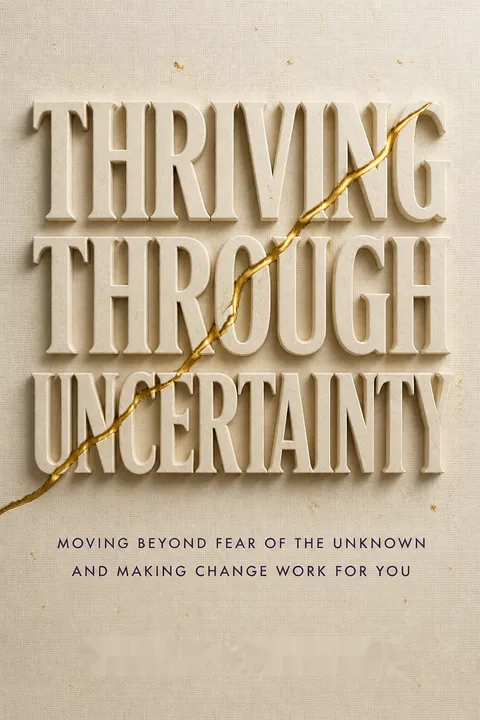
Thriving Through Uncertainty receives mixed reviews, with an overall rating of 4.05/5. Positive reviewers praise its inspirational message, practical advice, and the author's authentic voice. They find it helpful for dealing with anxiety and life transitions. However, some readers criticize the book's spiritual tone, perceived privilege, and writing style. Critics argue it lacks real-world advice and can be overwhelming. Despite the divisive opinions, many readers appreciate the book's focus on self-compassion and embracing uncertainty as a path to personal growth.
People Also Read






Glossary
Inspired Self
Inner supportive guidanceKieves's name for a wiser, more compassionate source of perspective within a person. It may be understood spiritually as guidance from a higher presence, or more personally as the voice one would offer a trusted friend. The term contrasts this perspective with fear-driven self-criticism and is used to support choices aligned with a person's deeper values.
Inspired Self-Dialogue
Guided reflective journalingA journaling practice in which a person first writes candidly about fears or concerns, then responds from an imagined wise and supportive perspective. The guiding voice might represent the Inspired Self, a spiritual presence, a trusted person, or a future self. The aim is to hear fears without letting them monopolize the conversation and to find a response that feels both caring and strengthening.
Win List
Record of meaningful progressA daily or regular list of actions and inner changes that indicate movement in a valued direction. It is not simply a productivity checklist. Entries can include small attempts, a boundary upheld, a shift in perspective, or a moment of support. The practice trains attention to notice progress that a person might otherwise dismiss while focusing only on unfinished goals.
Freewriting
Unedited continuous writingA timed writing practice in which the writer keeps going without pausing to edit, censor, or organize. The writer may follow associations away from the original prompt and return when useful. Kieves presents it as a way to quiet self-judgment and uncover feelings, memories, beliefs, or desires that deliberate planning may leave hidden.
sacred neutrality
Nonjudgmental self-listeningKieves's term for attending to thoughts and feelings with curiosity rather than immediately evaluating, correcting, or converting them into plans. This stance aims to make room for desires and intuitions that might be suppressed by shame or conventional expectations. It is a practice of listening, not a claim that every impulse is wise or should be acted upon.
bread crumb
Clue for a next explorationA small interest, encounter, or impulse that suggests a useful next experience without revealing a complete future plan. Kieves uses the image to encourage people to follow what feels meaningful in the present and learn from the result. A bread crumb is a prompt for exploration, not a guarantee that the path will lead to a particular outcome.
kaizen way
Gradual change through small stepsKieves's reference to the kaizen approach, which emphasizes small, manageable actions rather than overwhelming demands for immediate transformation. In the book, a small step is presented as less likely to trigger fear and avoidance, making continued effort easier. The method is applied to tasks such as organizing, health changes, and pursuing a meaningful project.
upper limits problem
Unconscious cap on successA term Kieves attributes to psychologist Gay Hendricks. It describes an unconscious tendency to restrict one's own success or well-being when positive change exceeds what feels familiar or comfortable. A person may become anxious or undermine progress as opportunities expand. Kieves uses the idea to encourage people to notice discomfort around good outcomes and practice receiving them.
Transformational Love
Love that supports growthKieves's spiritual term for a sustaining love that does not necessarily prevent loss or make circumstances proceed as desired. Instead, it is imagined as a force that supports a person's growth and fuller expression through difficulty. The concept reframes love as consistent support, while distinguishing it from the expectation that every immediate wish will be fulfilled.
True Life
Life aligned with deeper valuesKieves's term for a way of living that expresses a person's deeper desires and capacities rather than merely preserving an inherited identity or externally approved plan. It may not resemble the future the person originally imagined. Discovering it involves listening inwardly, experimenting, and allowing choices to change as understanding develops.
negativity bias
Greater attention to threatsA psychological tendency, discussed in the book through the work of neuropsychologist Rick Hanson, for people to notice and retain negative information more readily than positive experience. Kieves uses the idea to explain why happiness and success can be overlooked or discounted. Her proposed counterpractice is to deliberately notice positive moments without denying genuine threats or pain.
Download PDF
Download EPUB
.epub digital book format is ideal for reading ebooks on phones, tablets, and e-readers.








