

Key Takeaways
Your parents' impossible odds are the prologue to your own story
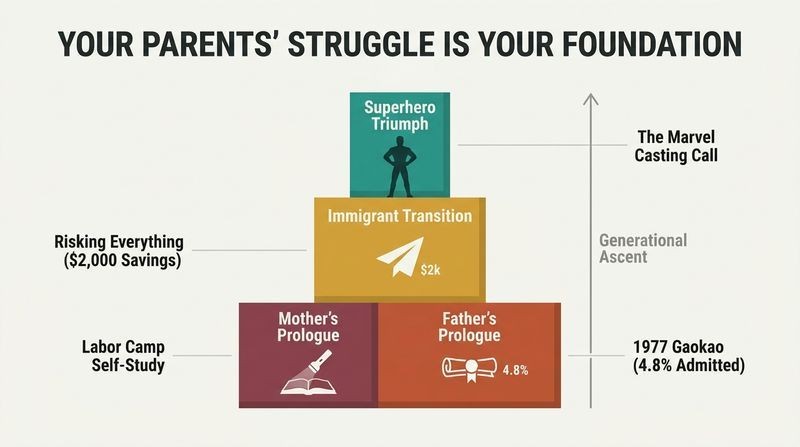
Simu Liu opens with a phone call from Marvel's Kevin Feige casting him as Shang-Chi, then rewinds sixty years to explain why that call belonged to his whole family, not just him. His father aced China's newly reinstated gaokao exam in 1977 as one of eight students hand-picked from over three hundred, entering university when only 4.8% of applicants were admitted after a decade-long shutdown. His mother studied by flashlight under her bed in a rural labor camp, mocked as a frog trying to eat a swan, and became the only woman from her camp admitted to college. Their courage to cross an ocean with two thousand dollars became the foundation for his.
What's striking is how Liu reframes a superhero origin story as a multigenerational relay race rather than a solo triumph. This echoes sociologist research on immigrant mobility, where the second generation often reaps returns on sacrifices they never witnessed. The memoir resists the Western myth of the self-made individual. There is a subtle tension worth noting: the same parental drive that fueled the family's ascent also produced the pain in later chapters. Liu does not resolve this cleanly, which is honest. Gratitude and grievance can coexist, and that refusal to sanitize the ledger gives the book its emotional credibility.
Love expressed only through sacrifice can still feel like abandonment

Liu's parents left him with grandparents in Harbin for the first four and a half years of his life while they built a foothold in Canada. When his father arrived to collect him, Liu called him by his full name, Zhenning Liu, because the man was a stranger. The family orchestrated a wordless departure so the toddler would not cry, denying everyone a proper goodbye. His grandparents were his true safe haven, the people he curled between each night. His parents genuinely believed leaving him behind was the loving, responsible choice, given their poverty and his grandmother's availability. Yet a child cannot metabolize that logic, and the wound of separation shaped every relationship that followed.
Attachment theory illuminates this powerfully. Early separation from primary caregivers can produce lasting difficulties with trust and intimacy, regardless of whether the separation was materially justified. Liu's account is a case study in how rational adult decisions land irrationally on a developing brain. What deepens the insight is the cultural dimension: in many immigrant families, love is enacted through provision, not words or touch. The gap between how love is given and how it is received becomes a lifelong translation problem. Liu's later reconciliation suggests the fix is not blame but naming the mismatch aloud, something both generations avoided for decades.
Chasing your parents' definition of success can quietly become fraud

Liu coasted for years, gaming a system that rewarded him for looking successful rather than being fulfilled. He talked his way into the University of Toronto Schools, wrote a fake injury essay to sneak into Ivey Business School after missing the cutoff by 1.5%, and scored 55% in Finance yet CARBed his way into a Deloitte accounting job through sheer interview charm. He performed the role of a promising young professional so convincingly that even he half-believed it. But he was profoundly miscast: a free-spirited ENFP forced into meticulous bank reconciliations. He faked illness, botched spreadsheets, and dreaded every clock-watching hour until Deloitte fired him eight months in.
Liu names a trap that career psychologists call values incongruence, the corrosive gap between what you do and who you are. His talent for persuasion made things worse: he was skilled enough to keep succeeding at the wrong thing, delaying the reckoning. This connects to research on the sunk-cost fallacy operating across generations, where families keep investing in a path precisely because so much has already been spent. The uncomfortable lesson is that mediocre performance in an authentic direction may serve you better than excellence in a borrowed one. Being fired functioned as the intervention Liu could never give himself.
Rock bottom can be the only door that opens the real path
The day Deloitte fired him, Liu stood on his 46th-floor balcony tallying his failures: 250,000 dollars of wasted education, a mortgage he could not pay, twenty-two years old and unemployed. He briefly wondered how long it would take to die if he jumped. But the next morning he felt not despair but relief, liberated from a life he loathed. Within weeks he was answering Craigslist casting ads, landing an extra role in Guillermo del Toro's Pacific Rim, then a speaking part on the CW's Nikita. In six weeks he went from disgraced accountant to shaking hands with a TV actor on set, earning ten thousand dollars in a week and a half.
Post-traumatic growth research shows that catastrophic loss can catalyze reinvention precisely because it strips away the identity a person was defending. Liu had nothing left to protect, so authentic choices finally became possible. There is survivorship bias to flag: for every firing that launches a Marvel star, many end in prolonged hardship, and Liu had a safety net of citizenship, education, and eventually parental money. Still, the mechanism is sound. The status quo has enormous gravitational pull, and sometimes only an external shock breaks the orbit. Liu's framing of it as the most fortunate misfortune of his life is earned, not glib.
Don't wait for permission; create the opportunities you want to receive
Rather than passively waiting for auditions, Liu built his own momentum. He wrote, produced, and starred in short films including Crimson Defender vs. The Slightly Racist Family, spending 500 dollars on a homemade superhero suit. He got into a filmmaker development program, optioned scripts, and wrote a full treatment for a Marvel character he dreamed of playing. A YouTube creator named Jared drilled the lesson into him: manufacture opportunities instead of waiting for them. Liu argues that owning a dream requires two things: declaring it publicly so you attract collaborators and allies, and taking concrete action, because ideas that never become deeds are just neurons firing into the void.
This is the entrepreneurial mindset applied to the arts, and it aligns with what psychologists call an internal locus of control, the belief that outcomes flow from your actions rather than luck. Liu's business school training, which he mostly wasted academically, resurfaced here as genuine advantage: he treated his career as a startup, reinvesting early earnings into training. The public declaration point is underrated and backed by network science: stated intentions recruit weak ties who surface hidden opportunities. The caveat is that hustle without craft plateaus. Liu paired relentless output with disciplined skill-building in acting classes, and it was that combination, not raw persistence alone, that compounded.
Great acting hides emotion; amateurs perform it
Liu's biggest craft breakthrough was counterintuitive. New actors, driven by insecurity, believe their job is to show the audience what a character feels, telegraphing mad, sad, or happy. But in real life humans go to extraordinary lengths to conceal their feelings, wearing masks and only cracking under genuine pressure. The most powerful performances move us with barely a muscle moving, because we intuitively sense the emotion churning beneath a composed surface. Overacting, by contrast, makes us roll our eyes. Theater training on the 2014 Fringe play About Allegra taught him to live moment by moment through an entire arc rather than delivering lines the same way each take.
This principle extends far beyond acting into leadership, negotiation, and everyday communication. Subtext, the unspoken tension beneath surface behavior, is where meaning actually lives. It connects to the psychology of microexpressions and to the writing maxim show, don't tell. Liu's insight that restraint reads as depth mirrors what makes minimalist performances by actors like Anthony Hopkins devastating. There is a broader life lesson embedded here too: the impulse to broadcast one's feelings often signals insecurity rather than authenticity. Liu explicitly ties his early overacting to his craving for validation, making craft and character growth inseparable in his telling.
Your Asianness is not a liability to overcome; it is a superpower
Growing up, Liu absorbed the message that Asian men were nerdy, asexual sidekicks, and he desperately wanted to be white, even working as an Abercrombie model to prove Asian men could be hot. His mindset flipped in Los Angeles through mentors like Ken Jeong, who opened his set and DMs to a total stranger, and Wong Fu Productions founder Philip Wang, one of the first people Liu met who framed being Asian as an advantage rather than an obstacle. Wong Fu had built a self-sufficient YouTube empire of over three million subscribers by leaning into diasporic identity, telling stories about too-ethnic school lunches, translating for parents, and bubble tea that Hollywood ignored.
Liu traces anti-Asian erasure to concrete history: the 1882 Chinese Exclusion Act and Canada's escalating head tax, which by 1903 hit 500 dollars per person. This grounds identity in policy, not vague grievance. The reframe from deficit to asset parallels disability and neurodiversity movements that recovered stigmatized traits as sources of strength. There is also a market argument he makes implicitly: Black Panther and Crazy Rich Asians proved diverse stories generate blockbuster returns, dismantling the myth that representation is charity. The community-as-superpower thesis has limits, of course. Solidarity does not erase structural gatekeeping. But Liu's evidence that mentorship networks materially changed his trajectory is hard to dispute.
Whatever you do daily, you are getting better at it, including the bad things
Liu borrows the logic of the ten thousand hours idea but flips it darkly. Practice does not only build good skills. Every day you procrastinate, you get better at procrastinating. Every meeting you show up late to, you master tardiness. Every time you stay silent when you should speak, you erode your backbone a little more. He watched himself become genuinely expert at skipping class, cramming, and gaming lazy professors who recycled exam questions, a proficiency that felt like winning but was actually compounding a habit that nearly failed him out of school and later got him fired. Habits form whether or not you are paying attention to which ones.
This is a sharp reframe of habit science. Behaviors are self-reinforcing loops, and neutral repetition strengthens the pathway regardless of whether the outcome serves you. What Liu adds to the standard productivity literature is the insight that avoidance itself is a trained skill. Psychologists call this the reinforcement of escape behavior: dodging discomfort feels rewarding in the moment, which cements the dodge. The practical upshot is diagnostic. Instead of asking whether you are working hard, ask what specifically your daily actions are making you excellent at. Liu's honesty that he was an elite-level slacker, not a passive victim of circumstance, makes the lesson land.
Rejection reveals fit, not worth, once you stop making yourself the story
After moving to Los Angeles, Liu endured two years of near-misses: a Here and Now deal killed by his Kim's Convenience contract, roles yanked by visa bureaucracy, and a Crazy Rich Asians rejection relayed as he lacked the it factor. That phrase gutted him, triggering an anxiety spiral where he replayed auditions and blamed himself as the common denominator. His hard-won shift was recognizing that auditions are collaboration and play, not judgment. Watching hundreds of other actors, he saw talented performers who simply were not right for a role. The realization that it really was not about him freed him to have fun instead of policing things beyond his control.
This maps onto cognitive behavioral therapy's work on personalization, the distortion of reading neutral or complex events as verdicts on the self. Casting decisions hinge on chemistry, height, timing, and a dozen factors an actor cannot control, yet the ego insists on a referendum. Liu's reframe from performer-as-judged to performer-as-collaborator is a locus-of-control move that reduces performance anxiety across domains, from job interviews to dating. The nuance worth adding: detachment from outcome is easier preached than practiced, and Liu admits it took years and real financial stability to internalize. Fit-not-worth is liberating precisely because it is also humbling.
Reconciliation begins when you finally ask your parents to tell their story
Liu's relationship with his parents was violent and estranged through his teens, marked by slaps, lockouts, and a father who mocked his crying and read his private journals. The thaw began pragmatically: needing to master fluent Mandarin dialogue for the show Blood and Water, he called the two people he would least ask for acting help, and they coached him nightly, his father telling him not to overwork himself. Writing this book, Liu interviewed them for hours about the gaokao, the labor camps, the KFC date where he was conceived. Understanding what they survived did not erase his scars, but it transformed his parents from antagonists into fellow dreamers whose story was his own.
There is deep wisdom in the mechanism here: empathy scales with narrative. Liu could not forgive abstractions, but he could understand a specific teenager studying under a bed by flashlight. Family systems therapists use exactly this technique, having estranged members exchange life histories to convert judgment into context. The memoir models intergenerational repair without demanding the false tidiness of full absolution. Liu holds both truths, that his parents loved him fiercely and harmed him, without collapsing one into the other. The urgent, practical prompt he offers readers is to interview their own parents while they still can. His grandparents died before seeing him become a superhero.
Analysis
We Were Dreamers is a memoir that disguises itself as a superhero origin story and reveals itself as an immigrant family epic. Structurally, Simu Liu makes a bold choice: he frames his own narrative inside his parents' improbable ascent from famine-era Harbin and rural labor camps through China's brutally competitive reinstated gaokao to a two-thousand-dollar leap across the Pacific. This scaffolding is the book's central argument, that individual achievement is inseparable from inherited sacrifice, and it distinguishes the work from typical celebrity memoirs built on the self-made myth.
The book's most valuable contribution is its unflinching treatment of intergenerational trauma inside model-minority households. Liu refuses the two easy templates: neither a redemptive gratitude narrative that excuses abuse nor a grievance narrative that flattens his parents into villains. He holds contradiction, love enacted as sacrifice yet received as abandonment, discipline that produced both resilience and lasting fear. This is psychologically sophisticated territory that most memoirs dodge.
A modern reader should note the survivorship bias baked into any celebrity underdog story. Liu's Craigslist-to-Marvel arc worked, but it rode on a genuine safety net: Canadian citizenship, an elite education, parental capital for a condo, and eventually a hit sitcom. The advice to bet everything on your passion reads differently for those without such cushions, and Liu is only partially transparent about this.
Where the book transcends its genre is in connecting personal narrative to structural history. By tracing anti-Asian erasure to the 1882 Chinese Exclusion Act and Canada's head tax, Liu grounds identity politics in policy rather than sentiment. His community-as-superpower thesis, seeded by mentors like Ken Jeong and Wong Fu's Philip Wang, reframes marginalization as latent collective strength. The prose is breezy, pop-culture-saturated, and occasionally over-jokey, but that accessibility is strategic: it smuggles hard truths about abuse, racism, and reinvention into a package young readers will actually finish.
Review Summary
We Were Dreamers receives strong praise for its honest portrayal of Simu Liu's immigrant experience and journey to becoming Marvel's Shang-Chi. Readers appreciate his candid discussion of childhood abuse, parental expectations, and career struggles. Many recommend the audiobook for Liu's engaging narration. Common criticisms include perceived arrogance and cockiness, particularly in later chapters, and insufficient reflection on his reconciliation with his parents. Asian readers especially connect with his experiences as a child of immigrants, valuing his emphasis on representation in media and his vulnerable storytelling about identity and expectations.
People Also Read




Glossary
gaokao
China's national college entrance examChina's fiercely competitive national university entrance examination. Suspended for a decade during the Cultural Revolution and reinstated in 1977 by Deng Xiaoping, it became the gatekeeper to higher education and social mobility. When Liu's parents took it, roughly 5.7 million people competed for spots at fewer than 5% of applicants, making admission a life-altering, near-miraculous achievement for working-class families with no political connections.
CARB technique
Four-part interview answer structureLiu's expanded interview method built on the business-school CAR framework. It stands for Context (set the scene), Action (what specifically you did), Result (the concrete outcome), and Bring it back home (tie the lesson to why the employer should hire you). Liu credits it for talking his way into jobs despite weak grades, treating persuasion as a learnable performance skill.
frog who wants to eat a swan
Chinese idiom mocking unrealistic ambitionA Chinese idiom used to ridicule someone for harboring dreams above their station. Liu's mother was taunted with it by peers at her rural labor camp when she studied for the gaokao. Liu repurposes it as a symbol of defiant ambition, casting his mother as the frog so determined she devoured the swan whole.
burning your face
Being recognizable as an extraAn acting-industry term for when a background performer's face is clearly captured on camera in a production, which then disqualifies them from later auditioning for a named, principal role on that same show. Liu kept his head down as an extra to avoid burning his face and preserve future casting chances.
Big Asian Energy
Pride-based Asian identity as strengthLiu's phrase for the mindset shift from viewing Asian identity as a social liability to embracing it as a source of power and community. Catalyzed by mentors like Ken Jeong and Wong Fu Productions, it reframes diasporic experience, shared cultural touchstones, and solidarity as a superpower rather than something to assimilate away from.
Download PDF
Download EPUB
.epub digital book format is ideal for reading ebooks on phones, tablets, and e-readers.








