

Key Takeaways
Treat the classics as open territory, not a test of who belongs.
The library belongs to everyone. Sparky Sweets opens with a librarian surprised that a man dressed like a streetwise outsider knows Russian literature well enough to ask for a particular translation. The moment exposes an assumption: appearance and manner supposedly reveal who can belong in a library. The book answers by making classic literature accessible through humor, contemporary language, plot summaries, and explanations of themes and symbols.
Rebellion links the books. Sweets playfully recasts a “thug” as someone who resists the roles society assigns. He sees a kinship between that defiance and authors who challenge social, political, or emotional constraints. The point is not that every classic says the same thing, but that stories about power and dissatisfaction can speak across cultural boundaries.
The opening anecdote identifies a real barrier to reading: cultural gatekeeping, not simply difficult vocabulary. Sociologists describe cultural capital as the knowledge and habits institutions treat as signs of belonging. A lively paraphrase can lower that barrier and make literary analysis feel learnable. Still, access requires more than a comic voice. Readers also need enough historical context to distinguish a novel’s world from their own, and enough room to question the guide’s interpretations rather than accept them as the new official answer.
Practice perspective-taking before turning a stranger into a villain.
Look past the rumor. In Harper Lee’s To Kill a Mockingbird, children first know Boo Radley through neighborhood stories, then discover that the withdrawn neighbor is compassionate and saves them. Scout’s view changes because she experiences the world from his porch. The same novel makes the limits of empathy painfully clear at Tom Robinson’s trial: the evidence favors him, but a racist jury convicts him anyway.
Revise your first judgment. In Jane Austen’s Pride and Prejudice, Elizabeth Bennet misreads Darcy after hearing a persuasive account from Wickham. Darcy’s letter complicates her story, and she has to reassess both men and her own confidence in her judgment. Ralph Ellison’s Invisible Man adds a harsher case: people project their own assumptions onto the narrator so completely that they fail to recognize him as an individual.
Perspective-taking is not the same as excusing harm. It helps explain how a person sees the world, while judgment still depends on what that person does and what consequences follow. This distinction matters in both novels: Boo’s isolation does not make him a threat, while the jury’s collective confidence does not make its verdict just. Empathy can challenge stereotypes, but it cannot substitute for evidence, accountability, or attention to unequal power.
Separate the future you want from the past you are trying to restore.
Longing can distort reality. In Romeo and Juliet, young lovers move from meeting to marriage to death in only a few days. The play supplies ominous coincidences that suggest fate, but their haste and the adults’ choices also contribute to the tragedy. The book refuses to let readers settle comfortably on either fate or personal responsibility.
A dream can become a trap. In The Great Gatsby, Jay Gatsby builds wealth and reinvents himself in hopes of recovering his romance with Daisy. He wants her to confirm that the past can be restored, but Daisy is not the idealized figure he has constructed. In The Catcher in the Rye, Holden imagines rescuing children from adulthood, a fantasy shaped by grief and fear of change. Each story shows longing turning dangerous when it denies time and other people’s independence.
Nostalgia is powerful because memory is selective: it can preserve a desired feeling while editing out the conditions that made the past complicated. Gatsby’s money can build a new house, but it cannot make Daisy into the person he remembers. Holden’s wish to protect children also expresses love, yet it asks him to freeze their lives. These stories invite a useful question: does a cherished memory help someone choose a future, or does it become a demand that the future copy the past?
Read symbols as arguments, not as one-answer decoding puzzles.
Meaning changes with context. In Nathaniel Hawthorne’s The Scarlet Letter, the embroidered A begins as a public mark of adultery. Hester’s conduct leads some townspeople to reinterpret it as a sign of her capability. The mark does not change, but the community’s judgment does. Hawthorne uses that shift to complicate the idea that a symbol has one stable meaning.
Track the transformation. In Fitzgerald’s The Great Gatsby, a distant green light first points toward Daisy, then comes to represent Gatsby’s larger, receding hopes. In Ray Bradbury’s Fahrenheit 451, fire begins as an instrument of destruction used by book-burning firemen, then also becomes a source of warmth. Ask what a symbol means at a given moment, who interprets it, and how the meaning changes.
This approach treats symbols as part of a story’s reasoning rather than as a vocabulary quiz with a single answer. The Scarlet Letter is especially useful because interpretation itself becomes social action: the same sign can shame Hester or acknowledge her strength. A symbol’s meaning still needs evidence in the text, though. “It could mean anything” is not close reading. Strong readings explain which details support an interpretation and why competing readings remain possible.
Notice how institutions restrict choices without erasing personal responsibility.
Power sets the terms. In To Kill a Mockingbird, Atticus Finch presents evidence that Tom Robinson is innocent, yet the court reflects the racial hierarchy of its community rather than delivering justice. Lorraine Hansberry’s A Raisin in the Sun shows another form of exclusion: a white neighborhood representative offers the Younger family money to stay away. The family refuses, but its choice takes place within housing discrimination and economic strain.
People also make choices. Chinua Achebe’s Things Fall Apart portrays colonial rule disrupting Igbo life, while also showing tensions within the community’s customs. Okonkwo’s rigidity and fear of appearing weak contribute to his isolation. In The Scarlet Letter, Puritan authorities turn Hester’s private act into public punishment. Together, the books ask readers to see both the structures constraining people and the decisions they make inside those structures.
These stories resist two easy explanations: that individuals control everything, or that circumstances control everything. Institutions distribute power unevenly, shaping which choices are safe, credible, or even available. But people still act, and their actions can reproduce or resist those conditions. This is a useful framework for reading injustice without flattening characters into symbols. A further question is who gets to define the rules, and whose behavior those rules excuse or punish.
Beware the hero who mistakes obsession for moral clarity.
Ambition needs accountability. In Mary Shelley’s Frankenstein, Victor pursues the creation of life, then abandons the being he has made. The creature’s rejection and isolation help shape his later violence, while Victor’s refusal to accept responsibility deepens the damage. The novel asks what creators owe to what they bring into the world.
Certainty can turn destructive. In Herman Melville’s Moby-Dick, Captain Ahab makes revenge on the whale more important than his crew’s safety or other people’s needs. In Fyodor Dostoevsky’s Crime and Punishment, Raskolnikov tests a theory that certain exceptional people may commit murder for a greater good, then discovers that abstract reasoning cannot spare him from the human consequences. Hamlet offers a different failure: prolonged doubt prevents decisive action until events spiral beyond control.
These characters illustrate different distortions of agency. Victor treats invention as achievement without accepting care; Ahab narrows the world to a single target; Raskolnikov turns people into arithmetic; Hamlet struggles to act amid uncertainty. Together they suggest that a worthy goal does not automatically justify its means. Yet the stories do not make hesitation or ambition inherently wrong. The sharper test is whether a person remains answerable to other people, evidence, and consequences while pursuing a goal.
Protect curiosity from cultures that reward speed, comfort, and sameness.
Comfort can become control. In Fahrenheit 451, books are burned, but the society was not simply seized by a censor who imposed a new order. The book describes people choosing speed, entertainment, and uncomplicated answers until serious reading and disagreement become unwelcome. Montag begins to question this life after meeting Clarisse and seeing the devotion of a woman who refuses to abandon her books.
Rules can break down. William Golding’s Lord of the Flies places schoolboys on an island, where a conch shell and shared rules initially support order. As Jack’s group turns toward hunting and violence, the conch loses authority and Piggy’s glasses, associated with reason and the ability to make fire, are stolen. The books offer contrasting warnings: a society can surrender thought for convenience, or lose its restraints under pressure.
Bradbury and Golding focus on different routes to social failure. One imagines people choosing distraction and uniformity; the other tests how quickly group norms collapse when authority weakens. Both make curiosity and shared rules look less automatic than societies often assume. Golding’s bleak picture can be challenged: cooperation is also a human capacity, not merely a thin disguise over violence. That tension makes the novel more productive when read as a warning about conditions, not proof that people are naturally savage.
Treat identity as something negotiated, not handed down by power.
A name is not a whole self. The unnamed narrator of Invisible Man moves through roles imposed by a college, an employer, and the Brotherhood, a political organization that claims to fight oppression. Each expects him to serve its purposes. His invisibility describes how others see their own assumptions instead of seeing him; stepping away from those roles becomes part of his effort to understand himself.
Expression makes room to change. In Alice Walker’s The Color Purple, Celie writes letters through years of abuse and separation. Her bond with Shug Avery helps her question the beliefs that have confined her, while sewing becomes both a source of income and a way to express care. In A Raisin in the Sun, Beneatha’s choices about education and African heritage likewise resist narrow expectations of womanhood and assimilation.
Identity develops through interaction, but not all interactions are equally free. Institutions, families, and racial or gender conventions can impose roles, while friendship and creative work can make alternatives imaginable. The books also warn against treating self-invention as a purely private achievement: Celie’s growth depends on relationships, and the Invisible Man is shaped by organizations even when he resists them. A useful reading question is not only “Who am I?” but “Who benefits from this definition of me?”
Build solidarity before isolation turns suffering into catastrophe.
Connection is a form of survival. Frankenstein’s creature is not born with a settled identity as a monster; repeated rejection helps turn his need for companionship into rage. In Moby-Dick, Ishmael’s friendship with Queequeg offers a counterexample to fear of cultural difference. After Ahab’s pursuit destroys the ship and crew, Ishmael survives by floating on Queequeg’s coffin, a reminder of the bond that preceded the disaster.
Community can heal and harm. The Color Purple ends with Celie reunited with her sister and children after years of separation. Things Fall Apart shows the cost of community fracture under colonial pressure, as well as Okonkwo’s loneliness when he cannot adapt to change. These stories value belonging, but they do not treat every community as just: families and societies can also enforce abuse, conformity, and exclusion.
The collection makes relationship more than a sentimental reward. It can provide recognition, practical help, and the chance to imagine a self beyond isolation. Yet belonging is not automatically good: the same social ties can enforce domination, as Celie’s marriage and Hester’s community demonstrate. Solidarity therefore requires more than closeness. It requires attention to who has a voice, who bears the cost, and whether a group can revise its rules when they harm its members.
Analysis
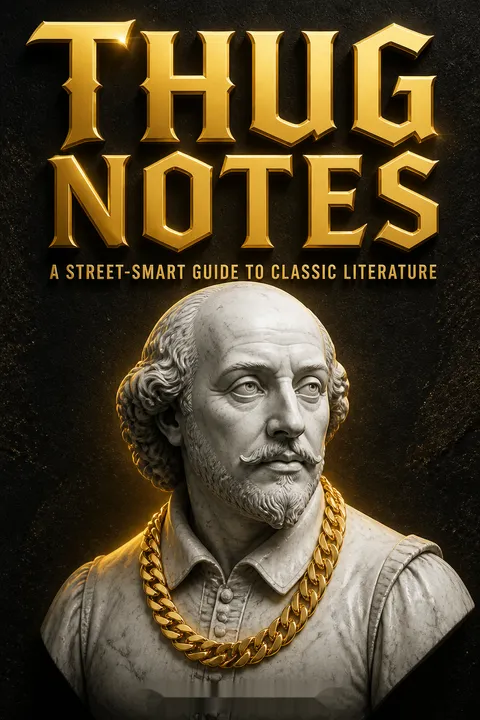
Thug Notes is both a guide to fifteen classics and an argument about who gets to interpret them. Its central move is translation across registers: plot is made brisk, literary vocabulary is explained, and symbols are linked to recognizable conflicts involving status, race, family, desire, and authority. The comic persona is not merely decoration. It challenges the assumption that literary seriousness belongs to one accent, class, or classroom style, and it makes interpretation feel like a skill rather than a credential.
The book’s strongest teaching method is to pair a story detail with a question about what it means. Romeo and Juliet’s compressed timeline raises a dispute between fate and choice; the changing meaning of Hester’s letter makes interpretation itself visible; Gatsby’s light shifts from a private romantic goal to a broader, unattainable hope. These examples model an important habit: plot tells what happened, while close reading asks how the telling shapes judgment. The book also resists simple moral lessons. Frankenstein’s creature is both harmed and harmful, and Achebe’s account of colonial disruption does not present precolonial life as flawless.
The format has limits. Fast, irreverent summaries can make complex works memorable, but they can also flatten historical nuance, confuse a character’s claim with the book’s position, or make violence and sexual abuse feel like punchlines. Some interpretations are presented more confidently than the evidence warrants, even though literary symbols often support competing readings. The best use of the guide is therefore as an inviting first map, not a replacement for the novels or a final authority on them. Its durable lesson is broader than any one interpretation: classics become more accessible when readers are invited to question, compare, and argue, rather than asked to memorize what an expert says they mean.
Review Summary
Thug Notes receives mostly positive reviews for its humorous and accessible approach to classic literature. Readers appreciate the fresh perspective, gangsta-style commentary, and insightful analysis. Many find it engaging and educational, praising its ability to make classics more relatable to younger audiences. Some reviewers note difficulty reading the stylized language but enjoy the audiobook narration. While a few critics feel the book format is less effective than the YouTube videos, most recommend it as a fun companion to classic literature study.
People Also Read


Glossary
unreliable narrator
A narrator whose account is uncertainA narrator whose account cannot be accepted without scrutiny. The narrator may be mistaken, biased, self-protective, or inconsistent, so readers compare what the narrator says with what the story reveals through events and behavior. In The Great Gatsby, Nick Carraway’s judgments and contradictions make readers question how fully his version of Gatsby and the other characters can be trusted.
foil
A contrasting characterA character whose differences from another character make the other’s qualities easier to see. In Hamlet, Laertes acts quickly to avenge his father, while Hamlet hesitates and reasons through his choices. The contrast highlights their different temperaments and approaches to action, rather than simply making one character a copy or opponent of the other.
duality
Two contrasting sidesA pattern that places opposing qualities or forces beside each other, such as fire and destruction, silence and thought, or civilized behavior and violence. In Fahrenheit 451, fire can destroy books and also provide warmth. The contrast helps readers see that the same image or element may carry different meanings depending on its context.
paradox
An apparent contradiction with meaningA statement or situation that seems contradictory but can express a meaningful truth when considered more carefully. In The Great Gatsby, a wealthy character can be described as morally impoverished: the material abundance and ethical emptiness appear opposed, yet coexist. Paradox encourages readers to hold conflicting qualities together rather than resolving them too quickly.
invisibility
Being unseen as an individualIn Ralph Ellison’s Invisible Man, invisibility is not literal disappearance. It describes how other people fail to recognize the narrator as a distinct person because they see their own assumptions and expectations instead. The idea connects personal identity to social power: a person may be physically present while institutions and individuals refuse to perceive his full humanity.
Download PDF
Download EPUB
.epub digital book format is ideal for reading ebooks on phones, tablets, and e-readers.








