

Key Takeaways
Borrow the Titans’ methods, then adapt them to your own constraints
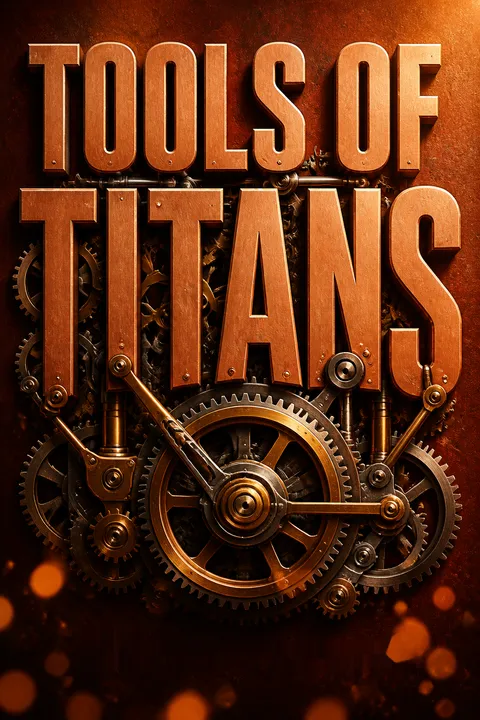
A library of experiments. Tools of Titans gathers advice from nearly 200 people across business, sports, art, science, and public life. Its central claim is not that exceptional people share one secret routine, but that useful habits and beliefs can be borrowed, tested, and combined. Arnold Schwarzenegger rejects the idea that success is self-made, crediting mentors, family, and supporters for helping him build his career.
Keep what fits. The book is deliberately a buffet: Ferriss encourages readers to skip freely, notice what they skip, and look for methods that match their particular strengths and circumstances. More than 80% of his interviewees report some kind of mindfulness practice, yet their diets, schedules, careers, and working styles vary widely.
The book’s most useful organizing idea is also its restraint: collect practices without turning successful people into templates. That resembles the logic of a field guide more than a universal theory. A practice becomes useful only when it fits the person, task, and setting. The danger is survivorship bias: interviews feature people who succeeded, not the many who tried similar routines without the same outcomes. Borrowing should therefore mean testing a tool against lived results, not treating a famous person’s habit as proof.
Use better questions to reveal options your routine thinking hides
Questions change the map. Ferriss argues that strong questions can expose assumptions that ordinary planning leaves untouched. Peter Thiel’s challenge to compress a decade-long plan into six months is not a literal deadline. It is a way to force a person to identify which constraints are real and which are inherited habits. The point is to widen the set of possible moves before deciding what is practical.
Ask what others avoid. Alex Blumberg describes how a basic question about why banks lent to people unable to repay helped unlock a major story about the financial crisis. Ferriss also asked sports experts questions about common mistakes and training progressions, then used their advice to improve his own basketball shooting. Inquiry is a practical skill, not merely a sign of curiosity.
Questions work as attention filters: they make some evidence visible and push other evidence into the background. The most generative ones challenge the frame, rather than merely asking for a better answer within it. Still, provocative questions can create false confidence if the answers are not checked. A dramatic reframing is useful for generating options; evidence, costs, and other people’s expertise are needed to choose among them.
Build health from capability, recovery, and repeatable basics
Train what is missing. Coach Christopher Sommer distinguishes passive flexibility from mobility, which requires strength across a joint’s full range of motion. Ferriss found that working on weak areas such as shoulder extension and upper-back mobility relieved problems that years of focusing on strengths had not addressed. Sommer emphasizes patient, consistent practice, warning that rushing connective-tissue adaptations invites injury.
Protect the foundations. Other profiles stress strength, sleep, movement, and recovery. Kelly Starrett uses simple mobility checks to identify restricted movement, while Ferriss’s sleep advice begins with practical conditions such as darkness and a comfortable temperature. The book also describes fasting, ketogenic diets, supplements, and heat exposure, but these are personal experiments and emerging claims, not general medical instructions. Health decisions belong with qualified clinicians.
The durable insight is to assess function, then train the limitation rather than endlessly polishing a strength. That approach is compatible with rehabilitation, skill learning, and risk management: capacity matters most where the system is weakest. The book’s enthusiasm for self-experimentation is less reliable when it shifts from movement practices to diets, supplements, or disease treatment. Individual anecdotes and small studies can suggest questions, but they cannot establish safety or effectiveness for every reader.
Practice attention before pressure hijacks your decisions
Attention is trainable. Ferriss found that more than 80% of the people he interviewed practiced meditation or mindfulness in some form. He presents it as a way to notice thoughts without automatically obeying them. In his account, a session is not a failure because the mind wanders. The practice is noticing the distraction and returning attention to a chosen focus.
Start small enough to continue. Chade-Meng Tan recommends committing to one mindful breath a day, with any additional practice treated as a bonus. Ferriss suggests guided meditations, short sessions, and accountability as ways to get started. Tony Robbins offers a different route: change one’s physical and emotional state before trying to solve a problem. A few minutes of movement or a deliberate gratitude practice can interrupt a spiral of unproductive thinking.
The important shift is from treating focus as a fixed personality trait to treating it as a capacity that can be rehearsed. Brief practice can create a pause between an impulse and a response, which is valuable in work and relationships alike. Meditation is not a cure-all, and a person may need other forms of support for persistent distress. Its modest promise is still meaningful: attention can be practiced, and small commitments reduce the barrier to beginning.
Name a category, then serve its first true fans
Different beats merely better. A marketing idea highlighted in the book is to create a category where a product can be first, rather than competing as a slightly improved version of an incumbent. Amelia Earhart became known as the first woman to fly solo across the Atlantic, not simply another person to make the crossing. Ferriss applied similar thinking by popularizing “lifestyle design” as a label for a set of practices.
Start with devoted customers. Kevin Kelly’s 1,000 True Fans idea suggests that a creator can build a living through a relatively small group of enthusiastic supporters. As a rough illustration, 1,000 fans providing $100 in annual profit each would yield $100,000. The arithmetic is only a guide. The deeper point is to build direct relationships and offer something people value enough to support repeatedly.
A category gives customers language for recognizing a new kind of value, while a devoted early audience provides feedback and word of mouth. These ideas complement each other: a clear niche makes a small audience easier to find, and a close audience helps a creator refine what the category means. The model is not equally available to every field, and fans do not guarantee income. Pricing, access, and the creator’s capacity to serve them still matter.
Turn learning into small experiments before making costly commitments
Make practice real. Ferriss wanted a business education, so instead of enrolling in an MBA, he set aside $120,000 over two years for startup investments, treating the money as tuition. His first move violated his own plan: he put $50,000 into one company, which later failed. The loss taught him to use clearer rules, smaller checks, and his time and advice as ways to contribute to companies.
Test before scaling. The book favors learning through prototypes, spec work, customer conversations, and carefully bounded trials. A product campaign on Kickstarter can test demand before manufacturing begins. Robert Rodriguez made his first film with the people, locations, and equipment already available to him, treating it as a test rather than waiting for ideal resources. Experiments can produce information even when the original plan fails.
Real-world practice reveals frictions that classrooms and plans can miss: how customers respond, what a task actually costs, and which skills need work. A test is most valuable when it is designed to answer a specific question and limits the downside. Ferriss’s personal MBA was unusually risky and depended on access to investors and financial resources; it is a case study, not a safe template. The transferable lesson is to make learning practical without betting more than the learner can afford to lose.
Defend maker time from the flood of merely interesting work
Attention is a resource. Chris Sacca moved away from a steady stream of meetings and created a mountain retreat where he could focus on learning, building, and selected relationships. Ferriss later received 50 to 100 startup pitches a week and found that opportunities were crowding out the creative work he valued. He chose to pause investing rather than pretend he could comfortably reduce it a little.
Schedule what matters. The book contrasts making work, which needs long, uninterrupted stretches, with management work, which tends to fragment the day. Ferriss recommends defending blocks for creation and using a “hell yes or no” test for invitations. Saying no is not a rejection of ambition; it can protect the conditions needed to do consequential work.
The key distinction is between being occupied and producing something that requires sustained thought. Interruptions carry a hidden switching cost, so calendar space is not merely a convenience but part of the work itself. Yet boundaries cannot be reduced to rejecting every request: care, collaboration, and maintenance also matter. The practical test is whether a commitment serves a chosen priority or quietly replaces it with someone else’s agenda.
Write down the worst case, then price the cost of waiting
Make fear specific. Ferriss’s fear-setting exercise turns vague anxiety into three questions: What is the worst plausible outcome? How could the damage be repaired? What are the likely benefits of acting? He used it when considering an extended trip and found that the feared consequences seemed limited and recoverable compared with the potential gains. The exercise also asks what continued inaction might cost over months or years.
Separate risk from discomfort. The book’s example of a lawyer who left a demanding career after trying paragliding illustrates how a vivid experience can clarify a choice. Fear-setting does not prove that a risk is wise, nor make every loss reversible. Its purpose is to replace a fog of dread with concrete consequences, possible safeguards, and a more honest comparison between action and delay.
Fear often fuses probability, severity, and uncertainty into one undifferentiated alarm. Writing them separately can restore perspective and reveal practical safeguards. The exercise also corrects a common asymmetry: people scrutinize the possible downside of change while treating the cost of staying put as zero. Some decisions really do carry irreversible risks, so the goal is not to glorify boldness. It is to make caution and action answer to the same standard of evidence.
Keep practicing through plateaus because skill grows unevenly
Progress is not linear. Sommer told Ferriss that meaningful strength gains in a difficult gymnastics movement could take at least six weeks, while some connective-tissue adaptations took much longer. Ferriss initially saw little change, then later experienced a sudden jump in range. The lesson is to judge training over a meaningful period, not by the mood of one session.
Expect rough drafts. Pixar co-founder Ed Catmull says early versions of films are often poor and may bear little resemblance to the finished work. The first draft is material to improve, not a verdict on the creator’s ability. Sommer’s advice is to make one long-term commitment rather than repeatedly reconsidering whether to continue. Persistence still needs feedback: repeating a damaging approach is not the same as patient practice.
The examples challenge the expectation that effort should produce visible improvement on a tidy schedule. In complex skills, early practice may build coordination or reveal problems before it creates obvious performance gains. That is a reason to track process and seek informed feedback, not a license to ignore pain or evidence that a method is failing. Patience is most productive when paired with adjustment.
When distress narrows your future, borrow support before trusting its verdict
A crisis distorts scale. Ferriss describes a period when academic trouble, a breakup, and isolation combined into a belief that his future was over. A library notice about a book he had reserved alerted his mother, interrupting a plan he had kept secret. Later, he stepped away from the immediate crisis, focused on health, and found that the problems were difficult but not permanent.
Build safeguards in advance. The book recommends contacting a crisis service or emergency support when someone may be in danger, and involving a trusted person rather than facing the moment alone. Ferriss also describes routines that helped him, including exercise, gratitude, and small acts of service. These personal tools are not substitutes for professional care. The message is to delay irreversible decisions and let another person help widen the view.
This section matters because it treats despair as a state that can narrow perceived options, not as reliable evidence that no future exists. A trusted person can provide connection and time, while professional crisis care can address risks that routines cannot. The author’s story may help readers feel less alone, but it cannot predict another person’s needs. In acute danger, immediate human and clinical support takes priority over self-help exercises.
Analysis
Tools of Titans is less a unified theory than a deliberately messy archive of field notes. Its organizing promise is that practical wisdom can be collected from people who have tested ideas under pressure, then adapted rather than copied. The book moves among health, work, and judgment, but its deeper subject is attention: what people notice, what they measure, what they ask, and which demands they allow to govern their time.
Its strongest contribution is methodological. Ferriss treats advice as something to test in ordinary life. The questions about compressing timelines, identifying a market category, or defining a worst-case scenario can expose assumptions that a conventional plan leaves intact. The collection also resists a single success personality. A night-owl artist, a disciplined military leader, and a meticulous investor may reach excellence through incompatible routines. That variety makes the book more useful than a rigid prescription, provided readers distinguish inspiration from evidence.
That distinction is essential in the health material. The source combines mobility training and sleep habits with dietary, supplement, fasting, and disease-treatment claims of uneven support. A vivid personal result is a reason to investigate, not a general recommendation. The book’s own insistence on experimentation is strongest when experiments are low-risk, measurable, and reversible, and weakest when an anecdote concerns serious illness or medically supervised treatment.
The recurring entrepreneurial message is similarly conditional. Small audiences, direct relationships, and distinctive categories can create leverage, but they do not abolish economics, luck, or unequal access. Ferriss’s investments and network are not easily reproduced by every reader. What is reproducible is the habit of asking what a project teaches, what its downside is, and whether it uses the person’s particular strengths.
The book works best as a prompt library. Its value lies not in absorbing every tactic, but in selecting a few, testing them, and keeping the ones that improve health, agency, or the quality of attention.
Review Summary
Tools of Titans receives mixed reviews, with many praising its wealth of insights from successful individuals across various fields. Readers appreciate the practical advice, motivational stories, and diverse perspectives offered. However, some criticize the book's length, lack of cohesion, and occasional repetitiveness. Many find value in the health, wealth, and wisdom sections, though some feel overwhelmed by the volume of information. The book is often described as a reference guide to be revisited rather than read cover-to-cover. Overall, it's considered a valuable resource for those seeking self-improvement and success strategies.
People Also Read










Glossary
Fear-setting
Maps risks and alternativesA written exercise for making a feared decision more concrete. It asks the person to describe the worst plausible outcome, identify ways to reduce or repair harm, list likely benefits of acting, and consider the cost of inaction. Ferriss uses it to compare risks more clearly, rather than treating vague anxiety as proof that change is unsafe.
1,000 True Fans
Small-scale creator economicsA model associated with Kevin Kelly and presented in the book as an alternative to seeking mass fame. A creator aims to build direct relationships with a relatively small number of devoted supporters who repeatedly buy or fund the work. The figure of 1,000 is illustrative, not fixed; the required audience depends on income needs and the value offered.
Canvas Strategy
Advance by enabling othersRyan Holiday’s term for helping people with greater experience or responsibility succeed, especially early in a career. The approach includes useful behind-the-scenes work, solving problems others overlook, and making collaboration easier. Its purpose is not flattery or permanent subordination, but learning, trust, and a reputation built through contribution rather than demanding recognition first.
Morning Pages
Unedited thought clearingA journaling practice from Julia Cameron’s The Artist’s Way, recommended by several contributors. The writer fills three longhand pages without stopping to edit or evaluate the result. Ferriss uses the practice to move worries and mental clutter onto paper, while Brian Koppelman describes it as a way to reach a more creative state.
Rodriguez list
Inventory usable resourcesRobert Rodriguez’s term for listing the resources already available, then designing a project around them. For his low-budget film El Mariachi, he used accessible locations, acquaintances, and props rather than waiting for a conventional production budget. The list turns constraints into design inputs and can make a project possible before outside funding or ideal conditions arrive.
Red team
Challenge a favored planA group or designated role asked to examine how a proposed plan could fail. Marc Andreessen and General Stanley McChrystal describe using people who are not attached to the plan to find neglected vulnerabilities and test assumptions. The method is intended to improve decisions before commitment, not to block action through endless criticism.
Deloading
Planned reduction of demandsIn athletic training, a planned reduction in exercise volume or intensity that allows recovery before a more demanding phase. Ferriss extends the idea to work by alternating concentrated production with protected periods of reduced reactivity and unstructured time. These intervals are meant to restore capacity and create room for synthesis, not simply to postpone necessary work.
State → Story → Strategy
Change state before planningTony Robbins’s sequence for approaching a problem. First, shift the person’s physical and emotional state; then notice or reshape the interpretation they are giving the situation; only then choose a strategy. Ferriss uses the model to explain why brainstorming while depleted or agitated can narrow perceived options and reinforce unhelpful conclusions.
FAQ
What's Tools of Titans about?
- Compilation of Insights: Tools of Titans by Timothy Ferriss is a collection of insights, tactics, and routines from over 100 world-class performers interviewed on The Tim Ferriss Show.
- Focus on Health, Wealth, and Wisdom: The book is divided into three main sections: Health, Wealth, and Wisdom, each offering practical tips and strategies.
- Diverse Perspectives: Featuring a wide range of guests, from athletes to entrepreneurs, it provides a multifaceted view of success and personal development.
Why should I read Tools of Titans?
- Learn from the Best: The book compiles wisdom from successful individuals, allowing readers to learn from their experiences without having to go through the same trials and errors.
- Actionable Takeaways: Each chapter offers practical tips and strategies that can be easily applied to everyday life.
- Inspiration and Motivation: The stories and insights shared by the titans can inspire readers to pursue their own goals and dreams.
What are the key takeaways of Tools of Titans?
- Mindfulness and Meditation: Over 80% of the interviewed guests have some form of daily mindfulness or meditation practice, highlighting its importance.
- Health and Fitness Routines: Emphasizes the significance of physical health, with various guests sharing their unique fitness regimens and dietary practices.
- Goal Setting and Planning: Many guests discuss the importance of setting clear goals and having structured plans to achieve them.
What are the best quotes from Tools of Titans and what do they mean?
- “Success is achievable if you collect the right field-tested beliefs and habits.”: Success is about adopting effective habits and beliefs that have been proven to work.
- “Calm is contagious.”: Maintaining a calm demeanor can significantly influence the morale and performance of a team.
- “The obstacle is the way.”: Challenges and obstacles can be transformed into opportunities for growth and success.
How does Tools of Titans address the concept of success?
- Redefining Success: Encourages readers to define success on their own terms rather than adhering to societal expectations.
- Focus on Impact: Many guests emphasize the importance of making a positive impact on others and contributing to their communities.
- Balance and Fulfillment: Success is not solely about financial gain but also encompasses personal fulfillment, happiness, and well-being.
What is the Slow-Carb Diet® mentioned in Tools of Titans?
- Dietary Guidelines: Consists of avoiding "white" starchy carbohydrates, eating the same few meals repeatedly, and not drinking calories.
- Cheat Day: Allows for one cheat day per week, where individuals can indulge in their cravings, important for psychological well-being.
- Focus on Progress Measurement: Advises measuring progress through body fat percentage rather than total weight for a more accurate reflection of health improvements.
How can I implement the advice from Tools of Titans in my life?
- Start Small: Begin by selecting a few key habits or routines from the book that resonate with you.
- Experiment and Adapt: Treat the advice as experiments, testing different strategies to see what works best for you.
- Create Accountability: Consider finding a "mindfulness buddy" or accountability partner to help maintain your new habits.
What is the significance of mindfulness practices in Tools of Titans?
- Common Among Successful People: A majority of the interviewed guests have some form of mindfulness or meditation practice.
- Improves Focus and Clarity: Helps individuals cultivate present-state awareness, leading to better decision-making.
- Enhances Emotional Resilience: Regular mindfulness practice can help manage emotions more effectively, improving relationships and overall well-being.
What is the Canvas Strategy mentioned in Tools of Titans?
- Support Others: Involves helping others succeed, which in turn creates opportunities for your own success.
- Be a Great Mentee: To become a great leader or mentor, one must first learn to follow and support those who are already successful.
- Long-Term Relationships: Fosters strong relationships and networks that can be beneficial in the long run.
How does Tim Ferriss define Fear-Setting in Tools of Titans?
- Identify Fears: Involves defining your fears and the worst-case scenarios associated with taking action.
- Assess Impact: Evaluates the potential impact of these fears on your life, showing that most fears are not as catastrophic as they seem.
- Create Action Plans: Outlines steps to mitigate these fears, reducing anxiety and empowering action toward goals.
What specific methods or advice does Tools of Titans offer for improving productivity?
- Morning Pages: Writing three longhand pages every morning helps clear the mind and fosters creativity.
- Deloading Phases: Taking breaks to recharge and prevent burnout can lead to increased productivity and creativity.
- Focus on the 80/20 Principle: Identifying the 20% of activities that yield 80% of results helps prioritize tasks for maximum impact.
How can I apply the lessons from Tools of Titans to my daily life?
- Establish a Morning Routine: Implementing a consistent morning routine can set a positive tone for the day.
- Practice Gratitude: Expressing gratitude daily can improve overall well-being.
- Embrace Discomfort: Challenge yourself to step outside your comfort zone regularly for personal growth and resilience.
About the Author


Download PDF
Download EPUB
.epub digital book format is ideal for reading ebooks on phones, tablets, and e-readers.








