

Key Takeaways
Ask sharper questions to turn other people's experience into a usable field guide
Start with a better question. At 40, Ferriss faced a pile of unanswered questions about what he wanted and how to change direction. Instead of solving them one by one, he asked what the problem might look like if it were easier. That question sparked the book: he sent 11 prompts to accomplished people and received thoughtful replies from more than 100. The prompts ranged from practical purchases to failure, priorities, and advice worth ignoring.
Sequence shapes the answer. Concrete questions help people warm up before harder, more abstract ones. Asking which book someone gives most often is easier and less risky than demanding a single favorite. The lesson is broader than interviewing: clear, answerable questions make reflection and conversation more useful.
The method treats inquiry as a designed experience, not a spontaneous hunt for wisdom. A low-stakes opening lowers the social cost of participation, while increasingly demanding questions invite deeper reflection. That same sequence can improve mentoring conversations, team reviews, and personal journaling. The caution is that a crisp question can still steer an answer toward the questioner's assumptions. Good inquiry leaves room for a respondent to reject the premise, add context, or say that the question does not fit.
Build a varied mentor bench, then adapt advice to your own season
No single mentor has the whole map. The book places more than 100 respondents from fields including sport, science, business, art, and public life beside one another, answering a shared set of questions. Their advice sometimes converges, but often differs. Some advocate bold risk; others describe the value of financial security, apprenticeship, or patience. Ferriss presents the material as a buffet, not a universal program, because readers need different guidance at different stages.
Let disagreement teach. A chef, an investor, an athlete, and a writer can interpret the same problem through different kinds of experience. The useful move is to notice where their recommendations diverge, then ask which conditions made each path work. Advice can become more relevant as circumstances change, so an idea dismissed today may deserve another look later.
A collection of voices acts like an ensemble forecast: varied experience can reveal assumptions that one charismatic authority might hide. Disagreement is not a flaw to smooth away; it is information about context. Yet a large menu can also produce indecision or selective quotation, where a reader picks whichever mentor validates an existing preference. A practical safeguard is to treat advice as a hypothesis, test it against current constraints, and keep the decision with the person who must live with its consequences.
Treat failure as evidence about the next move, not a verdict
Separate the result from the decision. Poker player Annie Duke explains that a strong decision can lose because chance intervenes, while a poor decision can win once. Judging only by the outcome encourages people to repeat bad choices or abandon sound ones. Failure becomes more useful when it reveals what to adjust, what to persist with, or what no longer fits.
A setback can expose a neglected desire. Susan Cain had spent years in corporate law when she was told she would not make partner on schedule. She left the office shaken, then recognized that writing had long mattered to her and began a writing class the next day. The setback did not guarantee a better career; it created room to see one she had avoided. Failure is information, not proof that every risk is wise.
The distinction between decision quality and outcome is especially powerful wherever luck plays a large role. It protects learning from hindsight, which tends to make the past seem more predictable than it was. But stories of failure-turned-success are vulnerable to survivorship bias: the people who can tell them are those whose detours eventually led somewhere visible. A sound lesson is not to celebrate every setback, but to examine it honestly, including the possibility that a strategy needs revision or a goal should be abandoned.
Name what matters before other people's requests fill your calendar
Build the yes-list first. Tim Urban uses two perspective checks: the Epitaph Test asks whether a project belongs in the story of a life; the Deathbed Test asks whether important relationships are receiving enough attention. These prompts help turn vague priorities into decisions about time. Drew Houston made the problem visible by tracking his hours. He expected important work to dominate his schedule, but found that small, reactive tasks consumed much of it while important commitments went unattended.
A refusal can be kind. Several contributors found that delaying a no creates more requests and more discomfort. A short, direct decline is often clearer than a vague promise to consider something. The aim is not to reject everything. It is to stop other people's priorities from quietly displacing one's own.
The calendar audit matters because memory is a poor accountant: people tend to recall intended work more vividly than the interruptions that displaced it. Turning priorities into visible time commitments makes the tradeoff concrete. Still, the ability to say no is not distributed equally. Caregiving, insecure work, and unequal authority can make refusal costly. In those situations, the principle remains useful, but the tactic may be negotiation, delegation, or collective boundary-setting rather than a clean decline.
Choose a game that fits your temperament before chasing its rewards
There is no universal career route. Tim Urban distinguishes work in which a person drives an independent career from work inside an established organization or profession. Neither route is inherently superior. Some people want to build the ship; others do better when someone else handles its direction and finances. Susan Cain's years as a lawyer were not wasted: they gave her knowledge, relationships, and a modest financial cushion that helped her pursue writing without making each page carry the burden of paying the bills.
Fit is more useful than fashion. The book repeatedly resists one-size-fits-all instructions such as always taking risks, always seeking stability, or always following a passion. A path should be judged by the work it enables, the life it supports, and the person's actual strengths, not by how impressive it sounds to outsiders.
This is a corrective to status hierarchies that portray entrepreneurship as inherently braver or more meaningful than employment. Different structures distribute uncertainty, autonomy, and responsibility differently, so temperament is not a minor preference; it affects whether a person can sustain the work. At the same time, a strong sense of fit can be mistaken for comfort. The useful question is not simply whether a path feels easy, but whether its demands are worth bearing and compatible with the life being built.
Focus on the next point of contact, not the distant scoreboard
Bring attention back to the work. Near the end of the book, Ferriss recounts arriving at tennis training injured and overwhelmed. His coach changed the drill: rather than staring at the towel that marked the target, Ferriss focused on the point of impact, the instant the ball met the racket. His shots improved when attention moved from the hoped-for result to the immediate action that could shape it. The point of impact is the present moment where intention meets reality.
Progress is built in small corrections. Powerlifter Ed Coan described making modest gains several times a year over decades, while swimmer Terry Laughlin emphasized patient practice through long plateaus. Both examples favor technique and incremental learning over constant maximum effort. Ambitious goals can set direction, but the next controllable action is where skill develops.
The point-of-impact image connects attention to feedback. A distant outcome offers limited information during execution; the immediate action gives a person something observable to adjust. This resembles skilled practice in fields where rapid feedback improves performance. The idea should not be misread as rejecting planning or results. Targets help orient effort, but fixation on them can interfere with the process that produces them. The productive rhythm is direction from the goal, then attention on the next meaningful action.
Protect recovery before effort becomes a debt your body collects
Rest supports performance. Chef and writer Samin Nosrat says she needs eight to nine hours of sleep to function well and now guards that time, even when it means leaving social events early. Arianna Huffington describes collapsing from exhaustion before changing how she treated sleep, walking, meditation, and breaks. Their examples make recovery part of the work rather than a reward for finishing it.
Reset through the body. Across the profiles, people use walks, naps, swimming, meditation, and exercise to regain focus. Obstacle racer Amelia Boone challenges the idea that rest signals weakness, noting that training gains require recovery. These methods are varied, but the shared principle is to notice whether overload, poor sleep, hunger, or accumulated stress is driving the mental fog before demanding more effort.
Recovery is not merely passive downtime; it helps preserve attention, judgment, and the capacity to learn. That makes it relevant to creative work and leadership, not just athletics. The contributors also show that recovery is individual: one person resets with movement, another with stillness or sleep. Their personal routines should not be mistaken for universal medical prescriptions. If exhaustion is chronic, a walk may soothe the symptoms without changing the workload, health condition, or environment producing them.
Use achievement to serve something larger than your own scorecard
Success needs a wider purpose. Jacqueline Novogratz began her work in Africa believing she could bring solutions, then learned that effective change required listening, humility, and trust with the people she hoped to serve. Tim O'Reilly offers a business version of the same principle: a company should create more value than it captures, because an organization depends on the wider ecosystem around it. These examples shift success from personal status toward contribution and reciprocal benefit.
Relationships are part of the work. Esther Perel recounts how a student's thoughtful follow-up after a campus visit led to an unexpected opportunity. The encounter mattered because she treated the people involved with genuine attention, not simply as stepping stones. The book's closing invitation is active: shape a life through choices, relationships, and useful work rather than waiting for a perfect identity to appear.
Contribution is a stronger compass than prestige because it asks what an achievement does beyond confirming the achiever's importance. Novogratz's change in perspective also guards against a familiar failure of benevolent projects: good intentions can reproduce control when recipients are not treated as agents. The idea applies to companies and personal careers alike, but it needs accountability. Claims of service are not proof of benefit; listening, evidence, and feedback help distinguish genuine contribution from self-congratulation.
Analysis
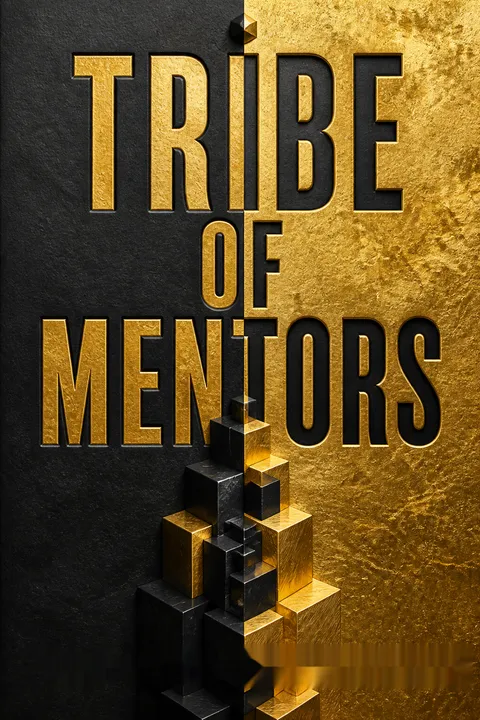
Tribe of Mentors is less a doctrine than a deliberately assembled conversation. Its structure matters: the same questions are put to people with sharply different careers, so readers can compare answers instead of mistaking one expert's biography for a universal formula. Ferriss's central wager is that better questions improve both self-understanding and access to other people's hard-won knowledge. The interview format also makes the book usable in fragments. Readers can enter through a current problem, find a relevant response, and return as their circumstances change.
The anthology's greatest strength is its productive contradiction. Some contributors urge risk, others preparation; some praise relentless effort, others defend rest; some advocate independent thinking, others emphasize apprenticeship and community. These are not errors to reconcile into a single rule. They show that advice depends on temperament, timing, resources, and the costs a person can bear. The reader's task is therefore partly diagnostic: identify the conditions behind a recommendation before borrowing it.
The form also imposes limits. The respondents are accomplished people recounting their pasts, not a representative sample of everyone who tried similar paths. Their stories can clarify choices, but they cannot establish that a particular habit caused a particular success. Retrospective accounts often make uncertain turning points sound inevitable. Ferriss's buffet metaphor offers a partial defense: select, test, and discard rather than obey. The book is most valuable when used as a prompt for experiments, not as a catalogue of recipes guaranteed to work.
Its deeper message is that mentorship need not require a single formal mentor. A person can assemble guidance from books, interviews, colleagues, coaches, and failures, then develop judgment by comparing them. The resulting independence is not self-sufficiency. It is the ability to learn from others without handing them authorship of one's life.
Review Summary
Tribe of Mentors receives mixed reviews, with many praising its wealth of advice from successful individuals across various fields. Readers appreciate the diverse perspectives and practical tips offered. Some find the book repetitive due to its question-and-answer format, while others value the insights gained. Common themes include meditation, gratitude, and continuous learning. Critics argue the book is too long and lacks organization. Overall, most readers find valuable takeaways, though some struggle with the book's length and structure.
People Also Read






Glossary
What would this look like if it were easy?
Reframes a difficult problemA question Ferriss uses to interrupt the assumption that worthwhile problems must be solved through maximum strain. It encourages a search for a simpler framing, a more elegant route, or a different way to define the task. In the book, asking it about a daunting set of life questions leads Ferriss to seek advice from a broad group of mentors.
Epitaph Test
Checks a work commitmentA decision prompt described by Tim Urban. When considering a work opportunity, a person asks whether they would want the project to be part of how their life is remembered. If the answer is clearly no, the opportunity may not be important enough to justify the time. It helps distinguish meaningful work from commitments accepted through habit or pressure.
Deathbed Test
Checks relationship prioritiesA perspective-taking prompt described by Tim Urban for evaluating how time is spent with important people. It asks whether a person would be satisfied, near the end of life, with the amount and quality of time given to a relationship. The test highlights that meaningful relationships compete with work and other demands, so protecting them requires deliberate choices.
Five whys
Traces a problem's causeA questioning technique used by Mike Maples Jr. to move from a visible failure toward its underlying causes. Each answer prompts another why, often revealing a process flaw rather than a person to blame. His sales example traces a missed target through fewer calls, fewer leads, fewer outreach emails, and inadequate staffing plans, shifting attention toward correction and learning.
point of impact
The immediate action pointFerriss's term for the moment a person's action meets the world and can be observed or adjusted. In his tennis lesson, it means the instant the ball contacts the racket. Focusing there, rather than staring at the desired target, helped him improve his shots. The concept generalizes to attending to the next controllable action instead of becoming fixated on a distant result.
New Month Resolutions
Monthly behavior experimentsRyan Shea's approach of trying one deliberate behavior change or temporary restriction during each month, instead of relying only on New Year's resolutions. Examples include daily reading, meditation, or a month without news feeds. The limited time frame makes experimentation more manageable and helps distinguish habits worth continuing from restrictions that are not useful.
FAQ
What's Tribe of Mentors about?
- Collection of Insights: Tribe of Mentors is a compilation of advice and insights from over 100 successful individuals across various fields, curated by Tim Ferriss. It distills their experiences into actionable advice.
- Diverse Perspectives: Contributors include athletes, entrepreneurs, artists, and scientists, providing a rich tapestry of viewpoints on success, failure, and personal growth.
- Practical Tools: The book emphasizes practical tools and strategies that can be implemented immediately, making it a useful guide for anyone looking to improve their life or career.
Why should I read Tribe of Mentors?
- Learn from the Best: By reading this book, you gain access to the collective wisdom of successful individuals who have navigated challenges and achieved greatness.
- Actionable Insights: Each mentor shares specific advice and techniques that can be applied to various aspects of life, from productivity to mental health.
- Personal Growth: The book encourages self-reflection and personal development, helping you to identify your strengths and weaknesses.
What are the key takeaways of Tribe of Mentors?
- Embrace Failure: Many contributors discuss how failures have set them up for later success, emphasizing that setbacks are often valuable learning experiences.
- Focus on Relationships: Building and maintaining strong relationships is highlighted as crucial for personal and professional growth.
- Mindfulness and Presence: Being present and mindful in daily life is a recurring theme, with many mentors stressing its importance for navigating modern complexities.
What are the best quotes from Tribe of Mentors and what do they mean?
- “What would you do if you weren’t afraid?” - Jesse Williams. This encourages confronting fears to pursue true desires.
- “Hard choices, easy life. Easy choices, hard life.” - Jerzy Gregorek. Emphasizes the long-term benefits of making difficult decisions now.
- “Discipline equals freedom.” – Jocko Willink. Suggests that self-discipline leads to greater freedom and opportunities.
How does Tribe of Mentors differ from Tools of Titans?
- Focus on Mentorship: Tribe of Mentors centers on the wisdom and advice of mentors, while Tools of Titans compiles tactics and routines.
- Personal Reflection: Tribe of Mentors is more introspective, sharing Ferriss's journey of self-discovery.
- Diverse Contributors: The contributors in Tribe of Mentors are a broader mix, providing a wider range of insights.
What specific methods or advice does Tribe of Mentors offer for personal development?
- Daily Journaling: Enhances self-awareness and tracks personal growth, helping clarify thoughts and feelings.
- Fear Practice: Involves acknowledging and engaging with fear, using it as a source of strength.
- Mindfulness Techniques: Practices like breath awareness and body scans are recommended to cultivate present-moment awareness.
How can I apply the lessons from Tribe of Mentors to my life?
- Identify Your Mentors: Reflect on who your mentors are and seek their guidance, learning from their experiences.
- Set Clear Goals: Use the advice from the book to set specific, actionable goals and track your progress.
- Practice Gratitude: Incorporate a gratitude practice into your daily routine to foster a positive mindset.
What are some common themes among the mentors in Tribe of Mentors?
- Resilience in Adversity: Many mentors share stories of overcoming challenges, emphasizing resilience.
- Continuous Learning: A commitment to lifelong learning and personal growth is prevalent.
- Authenticity and Integrity: Being true to oneself and maintaining integrity is highlighted as crucial.
How does Tribe of Mentors address the concept of failure?
- Learning from Failure: Failure is seen as a stepping stone to success, with many mentors sharing their "favorite failures."
- Redefining Success: Success is viewed as a journey, allowing for a more forgiving view of failure.
- Embracing Vulnerability: The book advocates for being open about struggles, fostering deeper connections.
What are the 11 questions Tim Ferriss asks his mentors in Tribe of Mentors?
- Books that Influence: "What is the book (or books) you’ve given most as a gift, and why?"
- Impactful Purchases: "What purchase of $100 or less has most positively impacted your life in the last six months?"
- Favorite Failures: "How has a failure, or apparent failure, set you up for later success?"
What are some practical exercises or tools mentioned in Tribe of Mentors?
- Fear-Setting Exercise: Involves defining fears, identifying worst-case scenarios, and outlining steps to mitigate them.
- Meditation Practices: Techniques like mindfulness and Transcendental Meditation are recommended for focus and stress reduction.
- Goal-Setting Frameworks: Encourages setting SMART goals for clarity and accountability.
How can I find my own mentors as suggested in Tribe of Mentors?
- Networking: Attend industry events and engage in conversations to meet potential mentors.
- Online Platforms: Use social media and professional sites like LinkedIn to reach out to individuals you admire.
- Local Communities: Join clubs or meetups related to your interests to build relationships and find mentorship opportunities.
About the Author


Download PDF
Download EPUB
.epub digital book format is ideal for reading ebooks on phones, tablets, and e-readers.








