


Key Takeaways
Build confidence by giving cats territory to own and a daily job to do.
Confidence, not performance. In Buenos Aires, Galaxy’s translated talk stalled when the audience did not know what he meant by mojo. He found a way to show it instead: a relaxed, assured stride. He calls a cat’s equivalent Cat Mojo, meaning confidence rooted in feeling secure at home, not swagger meant to impress. The Raw Cat is his name for the inherited hunter and prey animal still present in a house cat, with enduring needs for activity and secure territory.
Different cats, same goal. Galaxy’s three archetypes describe confidence, anxious overcontrol, and fearful withdrawal. They are practical lenses, not permanent labels. The goal is not to turn every cat into a social butterfly. It is to make the home secure enough for each cat to explore, rest, and share space with less vigilance.
The territory metaphor gives guardians something tangible to improve: resources, safe routes, and opportunities to act on instinct. It also reframes confidence as a product of surroundings, not a fixed trait. That fits a broader principle in behavioral ecology: animals respond to the conditions and choices available to them. Still, ownership is a human metaphor, and it can be overread as a cat demanding exclusive control. The useful interpretation is more modest: a cat needs reliable access to valued places and ways to avoid conflict.
Turn play into a hunt, then let food close the loop.
Make play prey-like. Galaxy’s HCKE shorthand describes the hunting sequence that organizes a cat’s daily activity. A wand toy should move like prey, with pauses for watching and stalking, quick bursts of movement, and chances to catch and hold it. A ball left on the floor or a laser chase alone may not provide the same satisfying endpoint. The play does not need to look athletic. A slow, focused stalk can be real engagement, especially for older or less mobile cats.
Build a household rhythm. Link play and meals to predictable moments, such as before work or before bed. Galaxy recommends scheduled meals rather than food available all day, so food follows activity and has a clear place in the routine. Cats naturally tend to be active around dawn and dusk, but a household can shape a workable rhythm around its own schedule.
This approach treats enrichment as an activity with a beginning, middle, and end, rather than as a pile of toys. That distinction matters: engagement depends on the animal’s participation, not the object’s novelty alone. The advice is strongest when adapted to age, mobility, and preference, since not every cat wants the same prey simulation. The book also makes strong claims in favor of raw food. Its behavioral insight does not require that dietary choice; any diet should be nutritionally complete and selected with veterinary guidance.
Design the whole home as a safe, climbable territory.
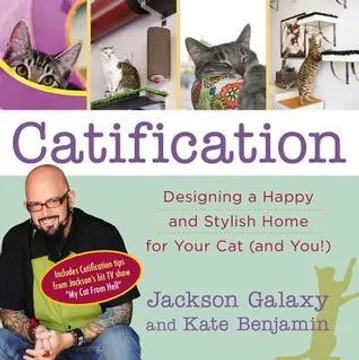
Think beyond floor space. Cats use height as part of their territory. A chair, shelf, or sturdy cat tree can provide a lookout, resting place, or route past a dog or another cat. Galaxy calls the process of adapting a shared home to feline needs Catification. It can include vertical paths, beds, scratching surfaces, and window perches, arranged to make movement easy rather than forcing cats through narrow, conflict-prone routes.
Make familiarity visible. A base camp is a comfortable, socially meaningful room that helps a cat settle during a move, introduction, or other disruption. Familiar bedding and scratching surfaces carry the cat’s scent into new areas as the territory expands. A simple home map can mark preferred resting spots, food, litterboxes, and conflict points, showing where resources are missing or traffic gets blocked.
This is environmental design applied to animal welfare. Rather than demanding that a cat ignore a crowded hallway or an inaccessible perch, the guardian changes the available routes and choices. That resembles the idea of affordances in design: a setting makes some actions easy and others difficult. The approach can work even in small homes, though elaborate shelving is not a requirement. A few well-placed, stable perches and clear escape routes may matter more than creating a visually impressive cat landscape.
Read the whole cat, not one tail flick or pee spot.
Signals need context. Cats communicate through posture, ears, eyes, whiskers, scent, and sound. A tail held high often accompanies a friendly approach; flattened ears or a tucked body can signal fear; a swishing tail may warn that interaction is becoming too much. None of these signs stands alone. The same posture can mean different things depending on what is happening nearby and what the cat is doing.
Let the cat choose contact. Galaxy recommends a soft gaze and slow blink rather than staring, then offering a finger for the cat to investigate. Allow the cat to approach and guide touch. Watch for turning away, twitching skin, or rising tension, and stop before a warning becomes a bite. Belly-up posture may indicate trust, but it is not automatically an invitation to touch the belly.
The strongest lesson is not to memorize a feline dictionary, but to notice patterns and respect boundaries. This resembles consent-based interaction: a pause or withdrawal is information, not a challenge to overcome. A slow blink can be a useful low-pressure greeting, though it should not be treated as a guaranteed declaration of affection. Body language is probabilistic. The more carefully a guardian attends to context and the cat’s response, the less likely a single gesture will be mistaken for a universal rule.
Investigate behavior as evidence, not an insult aimed at you.
Start with what happened. A cat urinating on a bag or furniture is not necessarily expressing revenge or dislike. It may reflect stress, a change in the home, conflict with another animal, litterbox aversion, or a medical problem. Galaxy’s Cat Detectivism means recording observable facts, such as the time, location, recent changes, and what happened immediately before and after an incident. A home map or camera can reveal patterns that memory misses.
Check health first. Sudden aggression, changes in elimination, overgrooming, unusual vocalizing, and withdrawal can signal pain or illness. Cats often conceal discomfort, so a behavior problem is not safely diagnosed as purely behavioral without veterinary assessment. Only after urgent medical causes are considered should the guardian test environmental explanations and adjust routines or resources.
This method resembles functional behavior assessment: observe what happens before and after a behavior, then form a testable explanation rather than assigning motive. It is especially valuable because emotional interpretations can escalate household conflict. The discipline has limits, however. A log cannot rule out disease, and a plausible environmental explanation is not a clinical diagnosis. Treating observations as evidence means staying open to revision, including when the first explanation feels intuitively convincing.
Replace punishment with a clear alternative and a worthwhile reward.
Teach the desired action. Galaxy’s No/Yes Technique pairs a boundary with an acceptable alternative. If a cat jumps onto a kitchen counter, for instance, remove food that attracts the cat and offer a nearby perch where the cat can watch household activity. Reward use of the perch. The aim is not simply to block an action, but to meet the need that made it appealing.
Make reinforcement clear. Clicker training uses a sound to mark a behavior, followed promptly by a treat. Punishment, such as yelling or spraying water, may interrupt an action but can make the person frightening without teaching the cat what to do instead. When a guardian stops rewarding a behavior that has repeatedly earned attention, the behavior may briefly intensify. Planning for that possibility helps prevent an exhausted human from accidentally rewarding the escalation.
The practical distinction is between suppressing an action and changing its payoff. That principle is central to learning theory: a behavior reinforced by attention or access to food is more likely to recur. The alternative must genuinely serve the same function, or it will not compete well. Environmental deterrents can sometimes help protect a boundary, but consistency and safety matter. The temporary increase after reinforcement stops is possible, not a promise that every unwanted behavior will disappear if ignored.
Move fearful cats forward in tiny steps, never by flooding them.
Set a manageable challenge. A Challenge Line is the boundary between what a cat can currently tolerate and what feels frightening. Move it gradually: place food or a favorite treat near that boundary, then shift it a little as the cat becomes comfortable. If the cat stops eating, hides, or shows rising tension, the step was too large. A safe hiding place can be replaced gradually with a secure retreat that still lets the cat remain part of household life.
Make introductions predictable. When cats meet, start with separate spaces, then pair the other cat’s scent with meals, let them explore each other’s areas at different times, and introduce brief visual contact before shared activity. Progress depends on calm, repeatable encounters, not a fixed timetable. The acceptable outcome may be peaceful tolerance rather than close friendship.
This is graded exposure: approach a feared stimulus in small enough doses for learning to occur without overwhelming the learner. The concept is useful, but it demands careful attention to distress. A cat that appears compliant may still be frightened, and removing every hiding option or rushing contact can make matters worse. The book’s emphasis on backing up a step is important. Some animals remain incompatible despite patient introductions, so safety and welfare matter more than achieving a picture-perfect friendship.
Make litterboxes easy to reach, clean, unscented, and plentiful.
Treat the box as essential territory. Galaxy recommends one litterbox per cat, plus one extra, with boxes spread around the home rather than grouped together. A box should be easy to enter, large enough for the cat to turn around, and placed where the cat can approach and leave without being trapped. He favors uncovered boxes, unscented litter, and daily scooping. Individual cats may prefer different textures, depths, or locations, so observe use and offer choices.
Look for causes, not shortcuts. Peeing near a box can indicate pain or an aversion to the box; marking near exterior doors may point to territorial stress; accidents in a home with multiple cats may reflect blocked routes or conflict. A veterinary exam is essential at the first sign of a litterbox change. Do not scold the cat or carry it to the box. Record what happens, clean the area, and investigate.
The recommendations combine access, cleanliness, and choice, three variables that guardians can actually test. Distributing boxes also reduces the chance that one animal can guard a single route. The plus-one count is a useful starting guideline rather than a guarantee: space, mobility, and household layout still matter. The broader point is sound. Elimination outside the box is a symptom with several possible causes, so advice about box design should complement, not replace, medical evaluation.
Cross your own discomfort to protect a cat’s health and dignity.
Prepare before care becomes urgent. Cats that only encounter a carrier before a stressful trip can learn to avoid it. Leave the carrier open as a resting place, add familiar bedding, and reward calm exploration before practicing short closures and brief trips. Similar preparation can make medication, nail care, and veterinary visits less alarming. A calm, practiced routine helps the guardian avoid transmitting panic to the cat.
Choose welfare over convenience. The book urges regular veterinary care, attention to weight and mobility, and indoor protection paired with enrichment or safe outdoor access. It also treats end-of-life decisions as a responsibility to assess the animal’s suffering rather than postpone a decision solely to avoid human grief. These choices require judgment and veterinary counsel, not a single rule that fits every cat.
Caregiving is often hardest when affection collides with tasks an animal resists. Preparation reduces that conflict by making necessary handling familiar rather than sudden. The same ethical frame applies to weight management and end-of-life care: short-term discomfort may serve long-term welfare, but the guardian must distinguish a temporary challenge from avoidable suffering. That distinction calls for professional input and close observation. Compassion is not simply sparing a cat every unpleasant experience; it is making difficult interventions as safe and humane as possible.
Analysis
Total Cat Mojo is part natural history, part behavior manual, and part argument about how people should relate to companion animals. Its organizing claim is that many household problems become more intelligible when viewed through a cat’s inherited needs for hunting, safety, and territory. The Raw Cat metaphor makes those needs memorable, while the practical advice translates them into play, predictable meals, vertical space, litterbox access, and deliberate introductions.
The book’s strongest contribution is its refusal to treat behavior as moral theater. Peeing is not revenge by default; biting is not proof of malice; hiding is not necessarily a harmless personality quirk. That shift can protect both the relationship and the animal, especially when it prompts observation and veterinary care before punishment. The advice is most persuasive when it offers testable changes to the environment and asks guardians to measure the cat’s response.
The framework is also broad enough to risk explaining too much. Territorial anxiety is a useful hypothesis, but not every problem can be reduced to territory, and a confident-sounding behavioral interpretation can obscure pain, illness, or individual variation. The author’s insistence on veterinary assessment helps counter this risk. His dietary preferences and some categorical recommendations deserve more caution than the central behavioral lessons: a raw diet is not necessary to provide enrichment, and any feeding plan should be nutritionally complete and medically appropriate.
The deeper ethical argument is that guardianship means adapting a shared home rather than demanding that a cat fit human convenience at every turn. That does not require surrendering every household boundary. It requires asking what function a behavior serves, offering a workable alternative, and recognizing when safety or medical care takes priority. The book is most useful as a disciplined way to ask better questions, not as a universal diagnostic formula.
Review Summary
Total Cat Mojo is highly praised by most readers as a comprehensive, accessible guide to understanding feline behavior. Reviewers appreciate Galaxy's compassionate approach, beautiful illustrations, and practical advice on topics like litter boxes, play, multi-cat households, and territory. Many note it's invaluable for both new and experienced cat guardians. Some criticism includes repetition of content, limited novelty for longtime fans of the show, and occasional unhelpful advice for complex multi-cat tensions. Overall, readers find it an essential reference that deepens their understanding of cats.
Glossary
Cat Mojo
confidence in homeGalaxy’s term for a cat’s grounded confidence, expressed through relaxed behavior and a sense of security in its territory. He argues that confidence grows when cats have dependable resources and meaningful outlets for inherited drives, especially hunting. It is an aspirational state, not a demand that every cat become outgoing or sociable.
Raw Cat
ancestral feline drivesGalaxy’s name for the inherited instincts and needs that domestic cats retain from their wild ancestors. The idea emphasizes that indoor cats still have strong motivations to hunt, monitor their surroundings, protect access to resources, and remain alert to danger. It is a behavioral lens, not a separate animal living inside the pet cat.
Hunt, Catch, Kill, Eat (HCKE)
play-to-meal sequenceA shorthand for the linked activities of hunting, catching, killing, and eating, which Galaxy uses to describe a satisfying predatory sequence. Guardians can approximate it through interactive play that allows stalking and capture, followed by a meal. The sequence is intended to give indoor cats structured activity and a clear endpoint to play.
Three Rs
routine, ritual, rhythmGalaxy’s framework for organizing daily life around predictable Routines, Rituals, and Rhythm. Repeated activities such as play, meals, rest, and household interaction are fitted to the family’s regular energy patterns. The aim is to make important events more predictable for the cat while incorporating feline needs into the household’s schedule.
Mojo Archetypes
confidence patternsA set of three descriptive patterns Galaxy uses to discuss how cats experience territory and social contact. The Mojito Cat is relatively confident and welcoming, the Napoleon Cat responds to insecurity with territorial overcontrol, and the Wallflower withdraws or hides. The categories are intended as flexible guides for choosing support, not fixed diagnoses.
Challenge Line
tolerable growth boundaryThe current boundary between what a cat can comfortably handle and what creates significant fear or stress. Guardians can encourage gradual progress by offering a manageable next step, such as moving food slightly farther from a hiding place. If the cat becomes distressed, the challenge should be reduced rather than forced.
Catification
cat-friendly home designGalaxy’s term for modifying a shared home so cats can use it safely and confidently. Changes may include elevated resting places, scratching surfaces, familiar scent-bearing objects, and unobstructed routes between resources. The goal is to support feline behavior while making the home workable for the humans and animals who share it.
Eat Play Love
positive shared activityA structured exercise used during introductions, especially between cats. Each animal is occupied with valued activities such as food, play, or attention while the other is present at a controlled distance. The exercise aims to build positive associations through repeated calm encounters, with distance and duration adjusted to the animals’ responses.
Cat Detectivism
behavioral fact-findingGalaxy’s method for investigating a behavior without assuming that it is spiteful or random. Guardians record observable details such as location, timing, recent changes, and other animals’ movements, then look for patterns. Medical causes should also be considered, particularly when behavior changes suddenly or involves elimination, appetite, mobility, or grooming.
Mojo Map
home behavior blueprintA floor plan marked with the cat’s important locations and routines, including resting places, food, litterboxes, routes, and incidents of conflict or elimination outside the box. The map helps guardians notice crowded pathways, contested resources, and patterns that may be difficult to see from memory alone. It can be revised as the household changes.
About the Author
Other books by Jackson Galaxy
Download PDF
Download EPUB
.epub digital book format is ideal for reading ebooks on phones, tablets, and e-readers.








