

Plot Summary
Fez at the Waterline
On December 1, Nell Bellamy watches two supposed lifeguards lead her hungover husband Theodore away after a Portuguese man-of-war stings him. They never bring him back. The police assume he drowned, but the Shriners find only his fez at the waterline.
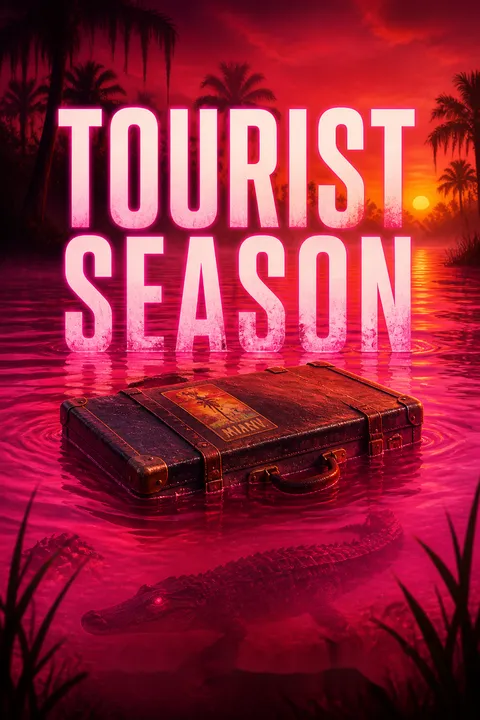
That same day, water-skiers recover a red suitcase containing B. D. Harper, Miami's tourism-minded Chamber of Commerce president. The autopsy reveals his legs were removed after death and a toy alligator lodged in his throat.
Harper had been dressed like a vacationer and coated in coconut-scented suntan lotion, a grotesque transformation that makes his killing look staged. With Bellamy missing and Harper dead, South Florida has two crimes that seem unrelated but carry the same deliberate theatricality.
The novel opens by making tourism itself part of the crime scene. Bellamy is persuaded to trust the very costume that sells Florida as safe, while Harper is literally remade as the kind of visitor he spent his career courting. The crimes' absurd details invite laughter, but the missing man and mutilated corpse keep the comedy from becoming harmless. Their contrast also introduces the book's central tension: public images can be manufactured, yet the consequences of believing them are painfully real.
The Wrong Man's Oldsmobile
Police arrest Ernesto Cabal, a Cuban car burglar caught driving Harper's stolen Oldsmobile, and charge him with murder. Private investigator Brian Keyes, hired to help Cabal's public defenders, finds a poor fit between the defendant and the elaborate killing. Cabal admits buying the car cheaply from a powerful Black stranger, but cannot name him.
Detective Al Garcia shows Keyes a letter signed by El Fuego and the Nights of December, claiming Harper's death as the start of a campaign and promising another victim. The police dismiss the threat as a crank's boast. Keyes does not. The autopsy's strange staging, Cabal's limited imagination, and the letter's warning leave him looking beyond the convenient arrest.
Cabal's arrest gives the authorities a usable ending before they have a credible account of the crime. Keyes recognizes the difference between evidence that places a suspect near a crime and evidence that explains it. His skepticism is ethical as much as professional: he is reluctant to let a vulnerable defendant become the city's scapegoat simply because the public wants reassurance. The anonymous letter widens the case from homicide to performance, but the police's reflex to discard it shows how badly institutions can misread danger when acknowledging it threatens business.
The Man at Pauly's
At the Flamingo Isles motel, Garcia shows Keyes Harper's clothes, blood traces, tanning lotion, and the room rented by a thin Cuban and a muscular Black man. Witnesses saw the pair escort Harper away with a red suitcase. Keyes then goes to Pauly's Bar seeking Cabal's car seller. The bartender identifies the stranger as Viceroy Wilson, a former Miami Dolphins fullback.
Wilson arrives and knocks Keyes unconscious before he can question him. Outside, Keyes meets Nell Bellamy, who is searching for Theodore with two Shriners. She hires him after showing him a second El Fuego letter, this one telling her that her husband was taken to frighten tourists away. The murder and disappearance now share a signature.
The motel evidence strengthens the case against Cabal while also exposing how easily witnesses can mistake one small Cuban man for another. Wilson's fist makes the danger immediate and personal, but Nell's letter supplies the link the police are unwilling to see. Keyes accepts her case not because he can promise a rescue, but because her evidence changes the meaning of the missing-person report. His work begins to pull him away from detached investigation and toward responsibility for the people the official story leaves behind.
The Empty Pontiac
Skip Wiley, the Miami Sun's gifted and increasingly erratic columnist, vanishes after threatening his psychiatrist during an examination arranged by managing editor Cab Mulcahy. Wiley's car is found running in Interstate 95 traffic, with no sign of him.
Mulcahy asks Keyes, Wiley's former newsroom colleague, to find him quietly. Keyes hesitates because Wiley once became his rival for Jenna's love, but accepts after learning Jenna herself requested him. Before the search can settle, Ricky Bloodworth reports that Cabal has hanged himself in jail.
Keyes is furious: the frightened defendant had wanted to fight, but his lawyer pushed him toward a plea. Jenna points Keyes toward Wiley's childhood refuge near the Everglades, giving him a place to start.
Wiley's disappearance recruits Keyes through an old wound rather than through professional neutrality. His jealousy, concern, and memory of the newsroom are tangled together, making the search emotionally compromised from the outset. Cabal's suicide sharpens the cost of premature certainty: a case treated as solved has helped drive a possibly innocent man to despair. Wiley's disappearance and Cabal's death also set two kinds of failure beside each other, one caused by a system that closes questions and the other by a man who may be trying to force them open.
A Canoe Without an Oar
Following Jenna's lead, Keyes finds Wiley's weather-beaten cabin beside Otter Creek Village, a retirement development pressed against the wetlands. Fresh cowboy boots suggest someone has been there. Keyes crosses the canal in a rented canoe, but the oar disappears and the boat becomes trapped in water weeds.
After dark, a figure on the porch signals someone underwater, who overturns Keyes's canoe. Wiley's companions pull him from the swamp and bind his wrists with sawgrass.
There Keyes meets Wilson, Cuban militant Jesus Bernal, and Seminole businessman Tommy Tigertail. Wiley identifies them as the Nights of December and explains that they intend to frighten tourists and developers out of Florida. He orders Keyes to carry proof back, but warns him not to reveal Wiley's identity.
The swamp turns Keyes's investigation into an ordeal of dependence: he arrives under his own power, then loses the tool that would let him leave. The revelation of the group gives the crimes a political aim, but not a coherent one. Wiley has recruited men whose grievances differ sharply, and he holds them together by translating each into his own environmental crusade. The scene also makes Keyes a witness rather than a detective with control over evidence. Wiley wants testimony, but only on terms that preserve his campaign.
Pavlov's Due
Wiley has his men bring Ida Kimmelman, an Otter Creek widow, to the clearing after her poodle disappears. He claims that she and the endangered crocodile Pavlov are competing for the same territory, then orders her into the water. Keyes throws himself at Wilson to stop him, but Bernal stabs Keyes in the side and Wilson knocks him down.
As Keyes lies bleeding, Wilson and Bernal cast Ida into the pond. Pavlov attacks, and Ida vanishes beneath the surface. The next morning Tommy Tigertail carries Keyes away by airboat, treating his wound with Seminole remedies and leaving him on a bus bound for a hospital. Keyes survives, but returns with proof that the group's campaign has crossed into murder.
Wiley's staged contest exposes the cruelty beneath his ecological rhetoric. He borrows the language of natural balance to excuse a choice he and his allies control completely, then makes Keyes watch so the violence will become persuasive evidence. Ida is not a symbol to herself; she is a frightened widow whose ordinary frustrations lead her outdoors in search of a dog. Tommy's care for Keyes complicates the group without redeeming it. The same alliance that claims to defend the vulnerable has made a powerless woman part of its propaganda.
A Story Buried Twice
At the hospital, Keyes tells Nell Bellamy that Theodore is dead and that the criminals took his swimming trunks; he cannot recover a body because Pavlov has swallowed the evidence. The Shriners, grieving but angry, offer to help him.
Meanwhile Bloodworth links Harper, Bellamy, and Ida through the El Fuego letters, but lead detective Harold Keefe calls the messages a hoax and treats Cabal's death as proof of guilt. Garcia privately agrees that the case remains open, yet his superiors suspect him of writing the letters and remove him from active investigation.
The Chamber of Commerce fears that public knowledge will empty hotels. Its effort to protect the season leaves the killers free and makes Keyes and a sidelined Garcia the only people pursuing the truth.
The story's victims become harder to ignore, but the institutions tasked with protecting them treat knowledge as a public-relations hazard. Nell's grief is not softened by the recovery of evidence; Keyes can offer her the truth, not closure. The Shriners' decision to stay turns private mourning into practical resistance. Garcia's demotion shows that the cover-up is not simply ignorance. Officials understand enough to fear the consequences, and choose economic confidence over public safety.
Florida's New Weather
The Nights of December escalate. A bomb attached to Keefe's car at a toll booth costs the detective his toes. A second blast at the Palmetto Country Club kills psychiatrist Remond Courtney and two visiting golfers.
Bernal then plants a mine at a greyhound track, killing dogs and turning a race into a public terror display. More tourists disappear, and Pavlov, sick from fresh water, is moved toward Biscayne Bay. After escaping the truck, the crocodile reaches a hotel pool and kills a drunken college student.
The accumulating attacks destroy Keefe's claim that the letters are a police hoax. Garcia is finally given a covert task force, while Keyes is asked to protect Orange Bowl queen Kara Lynn Shivers, the public figure the group may target next.
The violence shifts from coded spectacle to open threat, and each new act humiliates officials who tried to contain the story. The attacks are not strategically consistent: Bernal's bombs, Wilson's force, and Pavlov's animal violence express different impulses, all serving Wiley's hunger for attention. The crocodile's escape makes nature more than a metaphor; it is a living danger displaced by the group's own use of it. With Kara Lynn, the campaign moves toward a symbol the city cannot easily dismiss or conceal.
The Queen's Bodyguard
Keyes meets Kara Lynn and her father, Reed Shivers, who wants his daughter on the televised parade float despite the threat. Kara Lynn understands that if she withdraws, another contestant may take her place, so she decides to ride.
Keyes becomes her bodyguard and discovers that beneath the practiced beauty-pageant smile she is wary, funny, and more perceptive than her father. As they spend time together, their guardedness eases into attraction.
Jenna, who encouraged Kara Lynn to enter pageants, remains connected to both sides of Keyes's life and refuses to help him find Wiley. The assignment gives Keyes someone he genuinely wants to protect, turning the coming spectacle from a case to solve into a danger he cannot observe from a safe distance.
Kara Lynn's choice is not simple vanity or obedience. She recognizes that leaving the role would not remove the target, only transfer it to a less prepared young woman. That calculation gives her agency inside a system that displays her as decoration. Keyes, meanwhile, is forced to confront the difference between watching danger and standing beside its likely victim. His growing tenderness does not make him more objective, but it does make the stakes unmistakable.
A Bomb and a Banner
Bernal builds a bomb for Garcia, but Bloodworth steals the package from the detective's desk and opens it in a restroom. The blast destroys the stall and leaves the reporter deaf, burned, and without fingertips.
Soon afterward, the Nights attack the Friendship Cruise from a helicopter, dropping bags filled with snakes onto the crowded deck. Passengers leap into the sea, but the Coast Guard rescues everyone. The helicopter later crashes, and debris bearing Wilson's football jersey leads officials to announce that the gang is dead.
Garcia doubts the tidy ending. Reviewing Wiley's old columns, he recognizes that the columnist had written sympathetically about Wilson, Bernal, and Tigertail before their crimes began. The false death report buys the surviving conspirators time.
The bomb's intended target and actual victim reveal how the group's violence escapes even its makers' control. Bloodworth's ambition makes him culpable in taking the package, but it does not make his mutilation deserved. The cruise attack turns a luxury excursion into a mass panic while preserving the gang's preferred image of spectacle. The supposed crash offers the public an ending shaped for convenience, yet Garcia's reading of Wiley's own journalism restores a human pattern beneath the noise: the columnist had been gathering his future cast.
Garcia's Last Suspect
After the press declares the Nights dead, Bernal kidnaps Garcia and drives him toward the Keys, intending to force him to sign a confession of betrayal against Cuba. Keyes follows in his MG, but loses time to a nearly empty fuel tank. At a remote jetty, Bernal shoots Garcia with a sawed-off shotgun and orders him into the sea.
Keyes arrives and fires his Browning at Bernal, killing him before the wounded detective drowns. He carries Garcia back to the car and gets him to hospital. The encounter confirms that the campaign is not over, despite the claimed helicopter deaths. Keyes returns to Kara Lynn's protection, while Garcia's warning and the missing bodies keep the threat alive in their minds.
Bernal's kidnapping reveals the personal grievance beneath his revolutionary pose: he treats Garcia's family history as a weapon and demands that the detective perform the confession he has written for him. Garcia refuses, even when physically helpless. Keyes's intervention marks a decisive change in his relationship to violence. He no longer arrives to document an aftermath; he acts, and someone dies by his hand. The rescue saves Garcia, but it also leaves Keyes carrying a consequence he cannot edit or correct.
The Queen at Halftime
Kara Lynn's Orange Bowl parade passes without an attack, and the city begins to believe the threat has ended. During the next day's football game, Wilson disguises himself as a security guard and buys a Notre Dame player's uniform.
At halftime, while the crowd watches the spectacle on the field, he charges toward Kara Lynn and lifts her from the float. Tommy Tigertail smashes an airboat through a staged Seminole scene and races across the wet turf to collect them. The Shriners pursue on motorcycles.
Burt catches Wilson by the leg, and a gunshot kills the former football star before Tommy escapes with Kara Lynn. Keyes reaches Wilson too late to stop the abduction, but the rescue attempt turns the stadium into the exact television spectacle Wiley wanted.
The parade's uneventful passage is a false reassurance: it protects the city's image for one night while leaving the real plan untouched. Wilson's return to football form converts his athletic past into a weapon, and the halftime show supplies a ready-made audience. The Shriners' motorcycles, introduced as comic searchers, become a protective force, though they cannot prevent the kidnapping. Wilson's death interrupts the spectacle but does not resolve it. Public attention, Wiley's actual objective, has already been secured.
Osprey Island's Fuse
Keyes searches Wiley's coffin of clippings and finds the missing article: developers plan to blast and build on Osprey Island. He realizes this is the target of Wiley's final campaign and follows him there with Jenna.
They find Kara Lynn tied up beside eight hundred pounds of dynamite, set to destroy the island at dawn with her and its wildlife. Keyes shoots Wiley in the leg, frees Kara, and learns where the boat is moored.
Wiley reveals how Keyes once invented a newspaper interview with a bereaved family rather than intrude on their grief, a confession that no longer unsettles Keyes as Wiley intends. Jenna stays with Wiley; Keyes and Kara escape by boat as the blast warning sounds. Wiley climbs toward an eagle, and the book leaves his fate unresolved.
The final plan condenses Wiley's delusion into a literal moral trap: he claims to value every life equally, then treats Kara's death as acceptable evidence for his cause. Keyes's choice to shoot Wiley is not a triumphant victory but an attempt to interrupt a fuse before argument can. Wiley's memory of Keyes's fabricated story exposes the journalist's old shame, yet Keyes no longer lets that shame dictate his actions. Jenna's choice to remain with Wiley preserves their bond while separating her from Keyes. The eagle offers a final image of life beyond human control, not a guaranteed rescue.
The Story Goes to Print
On New Year's Day, the Miami Sun prints Wiley's farewell column alongside Mulcahy's account of how the newspaper concealed the columnist's role while Keyes searched for him. The paper also reports Bernal's death without pretending that the helicopter crash settled the case. Keyes reads the column in his office, where Jenna insists she cannot believe Wiley is dead and asks him to comfort her.
He recognizes that she helped sustain Wiley's scheme, even if she did not know every detail, and refuses to resume their old intimacy. The closing pages leave the dynamite's blast and Wiley's fate unconfirmed. Keyes has become someone who acts rather than watches, but he cannot turn the violent month into a clean ending.
The newspaper's publication of Wiley's confession is a belated correction, not a cleansing one. Mulcahy admits institutional failure, while the Sun's readers receive the truth only after the campaign has already taken lives and maimed the living. Keyes's refusal to return to Jenna's emotional orbit marks a quieter resolution than the action climax: he no longer mistakes longing for obligation. Yet the ending withholds certainty about Wiley and the island. The book denies the reader the same easy closure that officials repeatedly manufactured.
Analysis
Tourist Season turns a regional crime spree into a struggle over who gets to define Florida. The Chamber of Commerce sells sunshine as a product; Wiley counters with a campaign designed to make the same place look uninhabitable. Both sides understand that images move people, but the novel refuses to make their methods morally equivalent. The officials' concealment protects revenue and leaves citizens exposed. Wiley's counterpublicity makes the violence itself a message, converting actual people into evidence for a cause they did not choose.
Keyes is the novel's ethical hinge because he knows the seductions and failures of journalism from inside. He once invented a story rather than intrude on bereaved parents, then mistook withdrawal for a defensible limit. Wiley sees that retreat as cowardice and exploits Keyes's shame. Yet Keyes's final development is not a conversion to Wiley's appetite for action. He intervenes to save Garcia and Kara Lynn while rejecting the idea that a worthy end can justify turning human beings into props. His movement is from passive witnessing toward accountable action.
The ensemble gives the conflict its political texture. Tommy's inherited loss, Wilson's racial and economic resentment, and Bernal's hunger for recognition are not interchangeable motives. Wiley gathers them into a coalition by promising that each grievance can be amplified, but his performance of leadership cannot contain the consequences. Jenna's affection for him and the city's loyalty to its tourist image show how complicity often begins through selective attention: people accept the attractive parts of a story and postpone judgment about the rest. The ending declines a clean verdict. The Sun finally prints Wiley's confession and its own failure, but exposure cannot restore the dead or guarantee that the island survives. The eagle's uncertain flight leaves open the question the book has been asking beneath its comic machinery: when people claim to speak for a place, do they protect its inhabitants, or merely use them to make the argument louder?
Review Summary
Tourist Season receives mixed reviews, with an average rating of 3.91/5. Many praise Hiaasen's dark humor, satirical take on Florida's environmental issues, and quirky characters. Some find the plot engaging and the writing style unique. However, critics note the book's length, occasional pacing issues, and underdeveloped characters. As Hiaasen's first solo novel, some reviewers see it as a precursor to his later, more refined works. The eco-terrorism theme and portrayal of Florida's culture and landscape are central to discussions, with readers divided on the effectiveness of the social commentary.
People Also Read
Characters
Brian Keyes
Reluctant private investigatorA former Miami Sun reporter who now works as a private investigator, Keyes is observant, decent, and uncomfortable with the violence that surrounds his cases. His sensitivity once made him leave journalism, yet he still carries the reporter's instinct to follow evidence and test official stories. His history with Skip Wiley and Jenna makes the search for Wiley unusually personal, while his work for Nell Bellamy and Kara Lynn repeatedly challenges his preference for distance. Keyes is neither a swaggering detective nor a natural action hero. He hesitates, doubts himself, and notices the human cost of what others turn into headlines. His central tension is whether witnessing suffering honestly is enough, or whether he must sometimes intervene.
Skip Wiley
Charismatic radical columnistThe Miami Sun's celebrated columnist is a brilliant writer, an erratic colleague, and a man who understands how public attention can be manufactured. Wiley's anger at Florida's development is rooted in a genuine attachment to the state's vanishing wilderness, but he filters that concern through spectacle, provocation, and a performer’s appetite for control. He can make an argument vivid enough to recruit people with very different grievances, and he is skilled at treating his own eccentricity as proof of insight. His bond with Jenna and his old friendship with Keyes give him an intimate audience even as his ambition pushes him beyond ordinary moral limits. He wants the world to notice what it would rather advertise away.
Jenna
Loyal, strategic partnerJenna is a magnetic, self-possessed woman who shares a complicated history with Keyes and a life with Wiley. She is intelligent enough to understand the appeal of Wiley's environmental anger and charming enough to deflect questions that might expose what she knows. Her warmth is genuine, but it can coexist with a strategic instinct to keep others close without making promises. Jenna dislikes passivity and admires people willing to act, a preference that shapes both her romantic choices and her tolerance for Wiley's ideas. She is not merely a prize between two men: she helps create the emotional conditions around them and understands that affection can become complicity when it shields someone from consequences.
Kara Lynn Shivers
Reluctant public symbolThe nineteen-year-old Orange Bowl queen is beautiful by the standards of the pageant circuit and increasingly skeptical of the machinery that displays her. Her father has shaped her name, ambitions, and public image, but Kara Lynn retains a sharp wit and a clear sense of what she does not want. She understands that withdrawing from a dangerous public role may simply put another young woman in her place, so she weighs personal safety against responsibility to others. Her connection with Keyes grows through candor rather than flattery. Kara Lynn's intelligence allows her to see when people are using her as a symbol, even when she cannot control the danger that follows.
Al Garcia
Streetwise homicide detectiveA Miami homicide detective and Keyes's friend, Garcia is blunt, funny, and more independent-minded than his superiors would like. He understands both police procedure and the city's habit of putting tourism revenue ahead of uncomfortable facts. Though he initially accepts the evidence against Cabal, he remains open to Keyes's doubts and quietly continues to question the official account. Garcia's loyalty is practical rather than sentimental: he shares what he can, protects his sources, and expects others to do their part. His Cuban family history gives the terrorists a personal angle for manipulating him, but his identity is not reducible to their political demands.
Daniel Viceroy Wilson
Fallen football radicalKnown as Viceroy, Wilson is a former Miami Dolphins fullback whose career, body, and finances have all been damaged by forces he believes exploited him. He turns his resentment into a selective criminal code, preferring crimes against the wealthy and powerful to ordinary street theft. His impressive strength and lingering athletic instincts make him dangerous, but his loyalty to the Nights is also emotional: he wants a cause and a team after losing both status and direction. Wilson's nostalgia for football remains potent, and his old identity as a celebrated athlete continually intersects with his new identity as a radical.
Tommy Tigertail
Seminole strategist and heirA Seminole businessman who helped turn reservation bingo into a major source of tribal income, Tommy is quiet, capable, and deeply shaped by his people's history of dispossession. He understands modern finance as well as the Florida wetlands, yet prosperity does not erase his awareness of what development has cost. Tommy's loyalty to his community is more grounded and less theatrical than Wiley's crusade. He watches before acting and carries inherited grief privately, rather than converting it into speeches. His presence complicates the group's political story: he has genuine reasons to resent land loss, but his participation does not make every act done in the name of that grievance just.
Jesus Bernal
Theatrical Cuban bomb-makerBernal is a former member of an anti-Castro terrorist movement who prizes discipline, dramatic communiques, and the recognition he believes his earlier failures denied him. His education and skill with language contrast with his erratic bomb-making, which repeatedly turns intended precision into farce or catastrophe. He resents Wiley's loose leadership but also wants the notoriety Wiley can provide. Bernal's politics are partly conviction and partly a route toward professional importance. He is especially sensitive to being mocked, overlooked, or treated as a subordinate.
Nell Bellamy
Persistent missing-wife seekerNell is Theodore Bellamy's practical, affectionate wife, a Midwestern visitor who tries to embrace Florida without letting its strangeness defeat her. When her husband vanishes, she organizes the Shriners, searches the beach, and hires Keyes rather than accept the police's easy conclusion. Her composure does not mean she is untouched by grief; it is the discipline that lets her keep acting while others underestimate her. Nell's trust in Keyes is grounded in instinct and necessity, and her refusal to surrender the search gives the case its human measure.
Theodore Bellamy
Midwestern Shriner touristNell's husband is a loyal Shriner and real-estate man visiting Miami for a convention. He is a poor swimmer and an enthusiastic, easily embarrassed tourist who wants to enjoy the trip his wife has planned. His ordinary vacation makes him an especially stark contrast to the political meaning others impose on him.
B. D. Harper
Tourism booster-in-chiefThe president of Miami's Chamber of Commerce has spent his career selling South Florida as a destination. Harper is genial, conventional, and skilled at avoiding offense, with public relations stunts and slogans standing in for deeper civic vision. His work embodies the city's appetite for cheerful promotion.
Ernesto Cabal
Small-time car burglarCabal is a petty burglar who sells fruit to supplement his income and dreams of enjoying a good car for once. He is streetwise but no criminal mastermind, and his fearfulness sits beside a tough exterior. His uncertain account of buying Harper's Oldsmobile makes him an easy suspect, while his limited capacity for planning exposes the gap between police convenience and actual evidence.
Cab Mulcahy
Conscientious newsroom editorThe managing editor of the Miami Sun is thoughtful, patient, and proud of journalistic standards, but he is also responsible for a paper that depends on Wiley's popularity. His loyalty to Wiley is longstanding and personal, which makes it harder for him to distinguish concern from professional self-protection. Mulcahy wants to preserve both the columnist and the newspaper, an impossible balance once Wiley's conduct becomes dangerous.
Ricky Bloodworth
Ambitious novice columnistBloodworth is an eager young reporter who wants more than a job: he wants a recognizable journalistic persona and a path to national prominence. His enthusiasm often outruns his judgment, and he is drawn to vivid details and career-making scoops. He is not without talent, but his hunger to be noticed makes him vulnerable to professional vanity and bad decisions.
Dr. Joe Allen
Forensic medical examinerDade County's chief medical examiner is meticulous, experienced, and accustomed to the city's extraordinary violence. His careful autopsy work gives Keyes an expert perspective that challenges the police's early conclusion about Harper's killer.
Ida Kimmelman
Discontented retired transplantA widow at Otter Creek Village, Ida is proud, opinionated, and privately disappointed by the retirement life she and her husband chose. She enjoys small luxuries and can be unkind to her poodle, yet her irritability is rooted in a life narrowed by money and circumstance. Her ordinary routines make her sharply distinct from the grand political meanings Wiley tries to assign her.
Harold Keefe
Career-minded lead detectiveKeefe leads the Harper investigation and is concerned with police authority, public confidence, and his standing in the department. He prefers a closed case to an unsettling theory and is willing to treat inconvenient evidence as noise. His certainty is less the product of careful insight than of institutional pressure and ambition.
Reed Shivers
Ambitious pageant fatherKara Lynn's father is a successful tax lawyer who treats his daughter's beauty-pageant career as a family investment. He believes he is helping her, but his ambitions often eclipse her wishes and safety. His polished manner and fixation on public recognition make him a compact portrait of parental control disguised as opportunity.
Callie Davenport
Keyes's moral breaking pointA little girl whose kidnapping and murder became the defining crisis of Keyes's reporting career. Though absent from the present investigation, her case explains his refusal to treat other people's grief as material to be mined.
Renee LeVoux
Canadian visitor in dangerA young Montreal visitor whose holiday is interrupted by the Nights of December. She is an ordinary tourist caught inside a scheme that turns strangers into instruments of publicity.
Plot Devices
The El Fuego letters
Link crimes through threatsThe typed letters claim responsibility for Harper's death, warn that more victims will follow, and frame the violence as a political campaign against tourism and development. Each message is addressed to someone connected to a victim, allowing the reader and Keyes to see a pattern before the police accept one. Their theatrical phrasing also gives the perpetrators a public identity without immediately exposing who is writing them. Because officials dismiss the letters as hoaxes, they become both clues and measures of institutional denial.
The tourist disguise
Turn murder into spectacleHarper's body is dressed in vacation clothes, smeared with suntan lotion, and packed into a suitcase after his legs are removed. A rubber alligator causes his death, while the costume and lotion make the corpse look like a grotesque tourist display. The staging gives the crime a signature that is too elaborate for an ordinary robbery and foreshadows the group's use of violence as publicity. It also reflects Harper's own career selling an idealized version of Miami.
Publicity as weapon
Make fear do the recruitingWiley treats news coverage as an instrument for changing behavior. The group stages crimes to generate attention, while the Chamber of Commerce and police try to suppress or soften the same stories to protect tourism. This contest shapes decisions from Keefe's false closure to the public response to the cruise attack. Publicity does not merely describe the plot's violence; it is the intended mechanism by which the violence is supposed to empty Florida of visitors. The strategy also exposes how easily a media spectacle can be mistaken for a political achievement.
Pavlov the crocodile
Make ecological rage lethalTommy Tigertail brings an endangered crocodile from Biscayne Bay into the Everglades, where the animal's need for salt water eventually forces its return. Wiley uses Pavlov to stage a killing and make his environmental argument physically undeniable. The crocodile later escapes into a hotel pool and kills a student, extending the danger beyond the conspirators' control. Pavlov is both a real animal with specific needs and a symbol the group exploits, which makes the creature's role more unsettling than a simple weapon.
The Orange Bowl spectacle
Hide an attack in celebrationThe parade and football game provide enormous audiences, elaborate staging, security routines, and a city reluctant to disrupt its most valuable public image. Authorities concentrate on the parade, while the conspirators exploit halftime and the stadium's spectacle to reach Kara Lynn. The events make the audience's attention a physical obstacle: police hesitate to act before cameras, and viewers struggle to distinguish an attack from performance. This device pays off the novel's repeated collision between tourism promotion, television, and violence.
About the Author



Download PDF
Download EPUB
.epub digital book format is ideal for reading ebooks on phones, tablets, and e-readers.








