

Key Takeaways
Treat today’s economy as a made system, not an inevitable one
A broken promise. In 2009, Chicago Buick dealer Nick D’Andrea received a letter ending his franchise. GM had pressured him to borrow heavily to add a Pontiac dealership, then bankruptcy restructuring shut that business down. His story opens a larger history: American life shifted from an order organized around durable institutions, to one ruled increasingly by financial transactions, and then toward technology networks. Each arrangement was built through decisions, not delivered by fate. The book calls the finance-centered figure who welcomes rapid change and distrusts established institutions “Transaction Man.” He may be a financier, consultant, or technology executive, but the defining feature is a belief that flexible deals can solve problems better than durable collective structures.
Rules have authors. D’Andrea eventually recovered financially, but his dealership disappeared, and the new rules remained incomprehensible to him. His experience captures the book’s central question: who gets to decide how economic life is organized, and who pays when the arrangement changes? The story’s force lies in tracing those rules back through political choices, corporate ideas, and institutional shifts, rather than treating the financial crisis as a freak accident.
The opening insists that economic arrangements are political creations, even when they appear technical or natural. That is a useful corrective to explanations that treat markets as weather: people can identify who designed the rules, which interests they protect, and where accountability sits. The historical sequence also warns against assuming that a new system simply replaces the old. Institutions, transactions, and networks overlap; the change is often in which one has the leverage to set terms. A story like D’Andrea’s makes that abstract distribution of power visible in a household’s debt and a neighborhood’s lost employer.
Judge institutions by whom they protect, and whom they leave outside
A partial shelter. Ann Collier Neal’s life shows how large organizations could offer ordinary people stability. After a difficult childhood on Chicago’s West Side, steady work and a union helped her and her husband buy a home in Chicago Lawn. Her church, employer, and neighborhood ties gave her footholds in a world that had often been precarious. Yet the protection was uneven: Black families had been violently excluded from the neighborhood, and Ann herself had faced racial hostility when she moved there. The postwar institutional order could provide jobs, pensions, and routes into homeownership, but it did not distribute those benefits fairly.
Security has boundaries. As factories, shops, and familiar institutions receded, Ann worked to keep her block safe through a neighborhood club and relationships with residents. Her story complicates both nostalgia for the old order and the idea that institutions are merely bureaucratic obstacles. Institutions can make security possible, while their rules and boundaries determine who receives it. The relevant question is not simply whether a society has strong institutions, but whether people who need their protection can enter, influence, and rely on them.
This distinction is essential: institutional stability is not the same as justice. A workplace pension may reduce household risk, while racial exclusion prevents a neighbor from getting the job that would qualify them for one. The same structure can be protective for insiders and coercive for outsiders. This is a familiar problem in organizational sociology: rules create predictable cooperation, but they also draw boundaries around membership. The account’s strength is refusing to treat community warmth as a substitute for power. Ann’s block club matters precisely because it gives residents some authority over the conditions shaping their daily lives.
Berle’s answer to corporate power was stronger government, not smaller companies
Tame the giant. Adolf Berle came of age as corporations became powerful enough to shape whole industries and communities. In 1932, he and economist Gardiner Means argued that ownership and control had separated: millions might own shares, while a small managerial group ran the corporation. Berle saw this as a problem of public power, not merely investor rights. He rejected Louis Brandeis’s preferred remedy of breaking large firms apart. Since giant corporations seemed permanent, Berle wanted a strong federal government to regulate them and make their scale serve wider social purposes.
Ideas met crisis. Berle’s analysis helped shape Franklin Roosevelt’s economic program during the Depression. The government guaranteed bank deposits, regulated securities, and expanded its role in economic life. Berle favored even more direct planning, though he often lost arguments to advisers who preferred narrower regulation or economy-wide management. His position was a form of “Clash of the Titans liberalism”: a large state counterbalancing large private power. The aim was not to abolish capitalism, but to make corporations answerable to a public authority strong enough to match them.
Berle’s model exposes a tension that still matters: concentrated private power may require public power to check it, but the public authority can itself become concentrated and difficult to challenge. The model’s appeal is practical, not just philosophical. If a corporation sets the terms of employment, credit, or local commerce, calling it private does not erase its public consequences. Yet Berle’s confidence in expert government leaves a democratic question: how do affected people shape the regulator’s decisions? The book’s account suggests that technical competence and public legitimacy are separate requirements, not interchangeable virtues.
The Treaty of Detroit made big employers part of America’s safety net
A negotiated compact. In 1950, after years of labor conflict, General Motors and the United Auto Workers agreed to a five-year contract. Workers gained regular cost-of-living increases, health insurance, pensions, and greater job security. The deal came to be known as the “Treaty of Detroit.” GM accepted these obligations in return for labor peace and a union focused on workers’ economic interests rather than managing the corporation. The arrangement helped establish a broader expectation: large companies could provide benefits and stability that the federal welfare system did not fully supply.
A web, not a monolith. The compact reached beyond factory employees. Independent auto dealers, suppliers, unions, local banks, and governments formed a dense ecosystem around companies like GM. Dealers depended on their franchises, but they also organized politically and won laws protecting their businesses. Chicago Lawn’s mortgages, jobs, and neighborhood life likewise relied on local ties connected to distant corporations and public agencies. The order was not simply corporations commanding everyone. It was a negotiated balance among institutions, with access to that balance determining who could build a more secure life.
The Treaty of Detroit shows how social policy can be delivered through bargaining rather than a single national program. That can make benefits tangible and adaptable to a workplace, but it ties protection to employment and to the fortunes of a particular company. When the employer contracts or relocates, the safety net can unravel with it. The wider ecosystem matters too: independent businesses may look small, yet their survival depends on powerful firms and laws. The arrangement is neither pure community autonomy nor pure corporate control. Its stability comes from negotiated interdependence, and its vulnerability comes from uneven bargaining power.
Markets turned corporations from social anchors into assets to rearrange
A new diagnosis. Michael Jensen and his University of Chicago colleagues challenged the assumption that corporate managers naturally served their companies’ owners. Their “principal-agent problem” describes the conflict between shareholders, the principals who supply capital, and executives, their agents, who may pursue status, comfort, or expansion instead of profits. Jensen and William Meckling argued that incentives and ownership should make managers more responsive to investors. Jensen’s research also found little evidence that professional mutual fund managers could reliably beat the market, strengthening the case for market prices over expert judgment.
Control becomes tradable. The “market for corporate control” meant that investors could use takeovers to replace managers they considered ineffective. In the 1980s, leveraged buyouts, mergers, and hostile takeovers gave this idea practical force. Jensen welcomed debt as a discipline on executives, while critics saw firms loaded with obligations and workers losing secure jobs. The corporation was increasingly judged as a portfolio of assets that could be sold, split, or recombined, rather than a lasting institution with obligations to employees and communities.
The principal-agent lens is powerful because it asks who bears the consequences of a decision and who receives its rewards. It also clarifies why managerial discretion can serve private interests under the language of public responsibility. But the lens can become too narrow when financial performance is treated as a complete measure of organizational health. A company can raise short-term returns by shifting risk to workers, suppliers, or towns. The relevant question is not whether markets discipline managers, but which costs and time horizons their prices register. Metrics do not eliminate values; they decide which values count.
Financial deregulation advanced through small decisions with enormous combined consequences
A quiet reversal. As inflation eroded the appeal of regulated bank savings, rules loosened across finance. In 1978, airline deregulation demonstrated how consumer choice and lower prices could be used to challenge established systems. Similar arguments helped justify financial changes: banks sought more freedom to pay depositors and take risks, while pension funds were allowed to invest less conservatively. The 1980 creation of 401(k) plans accelerated the shift from employer-guaranteed pensions to individual retirement accounts exposed to markets. In 1999, the Financial Services Modernization Act dismantled much of the separation between commercial and investment banking.
Risk changed address. The repeal of restraints did not mean government disappeared. It often meant that firms received more freedom while retaining access to public protections, such as insured deposits or emergency assistance. In 2000, the Commodity Futures Modernization Act blocked federal regulators from overseeing much over-the-counter derivatives trading. Brooksley Born warned that the opaque market could create systemic danger, but senior economic officials rejected her push for stronger oversight. These were political decisions, often presented as technical modernization. Together, they helped make a larger, faster, more interconnected financial system.
Incremental policy change is hard to evaluate because each step can appear reasonable in isolation. A rule loosens to improve consumer returns; another permits new products; a third leaves those products outside established supervision. The cumulative effect may be a system whose risks no single agency can see. This is a problem of institutional design: regulators need both information and authority, while firms have incentives to move activity toward whichever venue imposes fewer constraints. The account does not require assuming that every deregulator intended a crisis. It shows why good intentions cannot substitute for tracing how rules interact.
When distant markets failed, Chicago Lawn absorbed the damage house by house
Credit without care. In Chicago Lawn, storefront mortgage brokers sold loans to residents who often could not understand or afford them. Some borrowers received loans with payments far beyond their incomes; others were promised low initial rates that later surged. Brokers could profit from originating loans even when borrowers defaulted. By 2007, the average mortgage in the neighborhood equaled 120 percent of a home’s stated value. When foreclosures followed, empty houses brought vandalism, gang activity, and declining confidence in the block.
No automatic rescue. The crisis connected local homes to distant investors and complex securities, while responsibility for preventing harm was fragmented. Neighborhood organizers helped residents seek loan changes, persuaded banks to negotiate, and rehabilitated vacant properties. They eventually arranged hundreds of loan modifications and restored more than a hundred houses. The broader financial collapse showed the same pattern at a larger scale: highly leveraged institutions faced sudden failure, and public authorities stepped in to protect the system. Ordinary homeowners did not receive an equivalent blanket rescue.
This case makes the distribution of financial risk concrete. A loan can be profitable for the originator and disastrous for the borrower, especially when the seller is rewarded for volume rather than repayment. Securitization can spread risk, but distance also makes it harder for any participant to understand the borrower’s circumstances or take responsibility for the outcome. The local response demonstrates the value of knowledge held close to the problem. Still, community organizations cannot replace a fair lending system or compel every creditor to cooperate. Local repair is vital, but it cannot bear the full burden of structural failure.
Turn people hit by economic decisions into organized political constituencies
A response from below. When GM and Chrysler used bankruptcy restructuring to terminate hundreds of dealerships, affected owners faced sudden closure, debt, and layoffs. Nick D’Andrea and other dealers could not rely on their old ties to the companies. They organized nationally, traveled to Washington, met legislators, and made the employment losses visible. Congress eventually created a process for dealers to challenge terminations through arbitration. Their success came not from proving that every dealership was efficient, but from making a decision’s consequences politically costly to ignore.
Local organization matters. Chicago Lawn’s housing advocates used a similar approach. They learned the mortgage system, brought foreclosure evidence to lawmakers, negotiated with banks, and worked block by block to keep families housed. These efforts reflect pluralism: the idea that people organize around distinct interests and bargain through politics, rather than expecting distant experts to identify one solution that serves everyone. The method is demanding and imperfect, but it gives affected groups a way to contest rules made without their participation.
Collective action turns private injury into public information. A dealer’s loss can be dismissed as an isolated business failure; a coordinated group can show how a policy affects jobs, families, and local economies. This is a practical answer to the information imbalance between centralized decision-makers and people living with the results. The caveat is that groups differ in their access to money, time, and political connections. Organization alone does not guarantee fairness. A pluralist system needs protections for the right to organize and safeguards against wealthy actors buying a louder voice.
Network platforms promise career freedom while rebuilding concentrated corporate power
The network as employer. Reid Hoffman imagined LinkedIn as a new center for working life after companies stopped offering many employees long careers and pensions. Instead of relying on one employer, users could maintain professional profiles and relationships that helped them find jobs. The company’s ideal was a vast “Economic Graph,” connecting workers, employers, and opportunities. This vision fit Silicon Valley’s faith in flexible work, rapid growth, and technology as a way to bypass slow institutions.
Scale has a price. Online networks become more valuable as more people join, which can make the leading platform difficult to displace. LinkedIn grew past a hundred million members, went public, and was eventually bought by Microsoft for $26.2 billion. Meanwhile, leading technology companies accumulated enormous influence, sold user data, and often insulated founders from shareholder control through special voting shares. The network society may widen access to contacts, but it does not automatically distribute power or security. For workers, freedom from a single employer can also mean less predictable work and fewer guarantees.
Digital networks can create real opportunity by connecting people beyond the limits of geography and close personal circles. Their promise is strongest where existing institutions exclude or overlook people. Yet a platform that coordinates millions of users is not institution-free. It sets rules, controls access, and captures value from the activity it enables. Network growth can therefore democratize participation while concentrating ownership. The useful test is not whether a platform makes connection easier, but whether users have meaningful rights, alternatives, and a share in the value their participation creates.
Build pluralist institutions that keep any single solution from ruling everyone
No master key. The book’s alternatives each offer a total solution. Berle trusted a state powerful enough to govern corporations. Jensen trusted markets to discipline managers. Hoffman trusted networks to empower individuals. Yet concentrated state power, unchecked markets, and dominant platforms can all exclude people while claiming to serve the common good. Political theorist Arthur Bentley offered a different tool: pluralism, the view that politics is made through competing groups pressing their interests and bargaining with one another.
Conflict can be productive. Pluralism does not mean every interest is equally powerful or every result is just. It means no group should be assumed to embody the public interest by itself. Labor, neighborhood organizations, small businesses, civil rights groups, and others need the ability to organize and press their claims. This requires institutions capable of protecting participation and limiting concentrations of economic and political power. The goal is not to restore a vanished past. It is to make economic change answerable to people who otherwise have little influence over it.
Pluralism’s strongest contribution is its humility: policy-makers and entrepreneurs may be public-spirited yet still misunderstand what their plans cost other people. Organized disagreement can expose blind spots that a unified master plan would miss. The model also recognizes that bargaining is not inherently a defect; it can prevent one powerful actor from defining everyone else’s interests. Its limitation is that unequal resources distort the contest. Pluralism therefore depends on more than tolerating conflict. It requires democratic rights, countervailing organizations, and institutions strong enough to make participation consequential.
Analysis
The book’s most useful move is to treat economic organization as a sequence of political settlements rather than a contest between abstract ideals. Its recurring human stories give that claim a test: Nick D’Andrea’s dealership, Ann Neal’s block, and Chicago Lawn’s foreclosure crisis reveal how national choices become local constraints. The institutional era provided durable benefits to many, but also excluded Black Americans and depended on corporate stability. The transaction era corrected some managerial abuses, yet made employment and community ties easier to discard. Networks widened communication, but their owners accumulated new forms of control.
The sequence should not be mistaken for clean succession. Institutions remain inside transactions, and platforms themselves become powerful institutions. The better distinction is between systems that make obligations durable and systems that make relationships easier to exit. The latter can improve efficiency and personal choice, but exit is not equally available to a worker with savings and a borrower facing foreclosure. The book’s account of deregulation is persuasive where it shows how separately modest rules produced systemic exposure. Its broader claims about the inevitability of concentrated power deserve caution: concentration is a recurring tendency, not a law of nature, and policy can shape its extent.
Pluralism is the proposed corrective, not a frictionless answer. Group bargaining can reveal overlooked costs and give affected people leverage, but groups with money and professional access can dominate weaker ones. Democratic institutions must therefore do two jobs: enable organized contest and prevent the contest from being captured. This interpretation also avoids romanticizing the past. The postwar compact offered real security, but depended on race and employment boundaries that denied protection to many. A future settlement should preserve the institutional capacity to provide security while making membership broader and public decisions more accountable. The central lesson is not that institutions are always good, or markets always bad. It is that durable power needs durable counterpower.
Review Summary
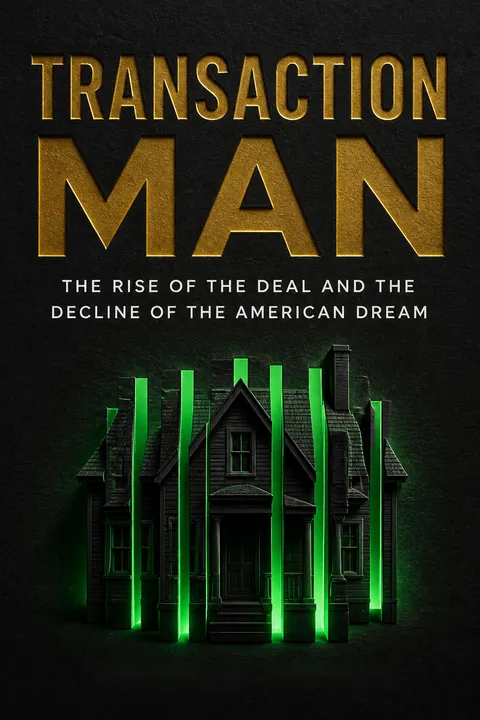
Transaction Man explores the evolution of economic theories and corporate structures in America over the past century. Lemann examines three eras: the institutional era of large corporations, the transactional era of finance-driven markets, and the current network era of tech giants. Reviews praise the book's historical insights and its critique of grand economic theories, though some find the structure and conclusions lacking. Many readers appreciate Lemann's analysis of how these shifts have impacted ordinary Americans, particularly through the lens of a Chicago neighborhood.
People Also Read









Glossary
Transaction Man
deal-oriented social archetypeThe book’s name for a contemporary outlook that prizes speed, flexibility, and individual action while distrusting established institutions. Transaction Man sees problems as solvable through deals, market mechanisms, or disruption, and tends to regard negotiation, regulation, and inherited obligations as impediments. The term describes a way of thinking, not a specific occupation or personality.
Clash of the Titans liberalism
state counters corporate powerThe book’s label for the Progressive liberal approach associated with Theodore Roosevelt and, later, Adolf Berle. It accepts large corporations as features of modern economic life and argues that government must become powerful enough to regulate and direct them. Its preferred counterweight to concentrated private power is a strong central state, rather than breaking large firms into smaller units.
Treaty of Detroit
1950 GM labor compactThe name given to the 1950 five-year agreement between General Motors and the United Auto Workers. Workers received cost-of-living wage increases, health insurance, pensions, and greater security. GM gained labor peace and a union focused on workers’ economic conditions rather than shared management. The agreement became a model for the corporate benefits and stability associated with postwar employment.
principal-agent problem
conflict between owners and managersA conflict arising when one party, the principal, hires another, the agent, to act on its behalf but cannot fully control the agent’s choices. In the corporate theory of Michael Jensen and William Meckling, shareholders supply capital while executives manage the company. Executives may pursue status, comfort, or expansion instead of maximizing returns for shareholders, especially when ownership and control are separated.
market for corporate control
takeovers discipline managersThe idea that investors can challenge poorly performing corporate management by acquiring enough ownership to replace it or redirect the company. In practice, this includes mergers, hostile takeovers, and leveraged buyouts. Advocates argue that the threat of acquisition makes executives answerable to owners and market value. Critics emphasize the debt, job losses, and social disruption these transactions can produce.
Metcalfe’s law
network value grows with usersA principle used in the book to explain why online networks become more valuable as their membership expands. Each added user can create connections with other users, making a large network more useful than a smaller rival. This dynamic can help a platform grow rapidly and become difficult to displace, but it can also concentrate power and value in the company that owns the network.
pluralism
organized interests share powerA political approach, associated in the book with Arthur Bentley, that understands public decisions as outcomes of groups organizing, competing, and bargaining. It rejects the assumption that one leader, expert, institution, or market can reliably identify the good of everyone. Pluralism depends on people’s ability to organize and participate, as well as institutions that prevent powerful groups from monopolizing influence.
About the Author
Other books by Nicholas Lemann

Download PDF
Download EPUB
.epub digital book format is ideal for reading ebooks on phones, tablets, and e-readers.








