

Key Takeaways
Treat Facebook as identity-based advertising, not search advertising
Different moments, different ads. Search users announce what they want now: someone typing “guitar” is actively looking for guitar information or products. Facebook users are there to connect, browse, and pass time. Its ads therefore rely less on immediate searches and more on a person’s interests, identity, and social connections. The book’s “front porch” image captures this mood: people gather to talk, not to shop on command.
The strategic shift. An ad that succeeds in search can flop on Facebook if it answers a need the user has not expressed. Instead of treating Facebook as another keyword marketplace, marketers must earn attention from people engaged in something else. That changes the ad, the offer, and the path from first impression to sale.
This distinction is a useful correction to the idea that all digital attention has the same intent. Search resembles a request for help, while a social feed resembles a room where attention is shared among friends, entertainment, and news. The same person can move between these modes within minutes. That makes context as important as audience identity. The metaphor also has a limit: social users do buy, and search users are not always ready to buy. The useful question is not which channel is inherently better, but what mental state the message enters.
Test channel fit before making Facebook your traffic engine
Some offers fit naturally. The book favors local consumer businesses, distinctive products, entertaining experiences, and offers tied to identity or shared beliefs. Commodity products and complex business-to-business sales may require more explanation and patience. The authors propose assessing fit before committing substantial spending, rather than assuming every business should prioritize Facebook.
A working example. Tom Meloche marketed tutoring software to home-schooling families. He reports that Facebook clicks cost about 37 cents, and that 11,000 clicks across 15.5 million impressions helped him attract beta users for about $4,100, far below the $20,000 he had budgeted for Google. He chose Facebook because the audience and product aligned, not because one platform always wins.
The fit test functions like a lightweight investment screen: it directs limited time and money toward the channel where a business can make a relevant offer. This is especially valuable for small firms, whose constraint is often attention as much as budget. Still, one founder’s result cannot establish a general cost advantage. Audience size, competition, pricing, and the quality of the offer all matter. The broader lesson is to run a bounded comparison using the business’s actual economics, rather than treating a memorable success story as a forecast.
Cap every experiment, then let evidence earn a bigger budget
Limit the downside first. New ads are guesses, even when they are carefully designed. The book’s safeguards are small budgets and short campaign durations. A beginner might spend around $10 a day and let a campaign run for only a few days, then extend it if results justify the risk. A daily limit without an end date can quietly become a substantial monthly expense.
Learn in small steps. The authors advise checking new campaigns frequently, changing one element at a time when diagnosing performance, and measuring what happens. If an image change improves response, retain it; if it does not, try another. The point is not to predict a winning ad perfectly. It is to make mistakes affordable and shorten the distance between a guess and useful evidence.
This is experimental design translated into a practical budget rule. A capped test protects the firm from confusing activity with progress, while a deliberate change makes results easier to interpret. The approach also reduces the emotional cost of failure: a weak ad becomes information rather than a verdict on the business. Small tests do have a statistical limitation. With few impressions and clicks, apparent winners may be chance outcomes. Spending caps should control risk, while test size should still be large enough to support a sensible comparison.
Narrow the audience until the message feels personally local
Target for relevance. Facebook targeting in the book spans geography, demographics, interests, and social connections. A local pottery studio, for example, should focus on people nearby who are plausible customers, not on a vast general audience. Estimated reach shows how many users fit the selected criteria, helping advertisers see how each targeting choice changes the potential audience.
Make segments speak. Instead of placing several unrelated interests into one generic ad, create separate ads that name and address each group. A mail-order pie business might use state-specific language and images, while sales reports can reveal which regions actually produce customers. The authors’ broader point is to test segments rather than assume that everyone who could buy will respond to the same message.
Segmentation works because relevance is relational: a detail that feels personal to one audience can feel irrelevant to another. Local references and distinct creative can signal that an offer belongs in a person’s world, not merely that an algorithm found them. Yet narrow targeting can create false confidence. Profile data is incomplete, and small segments may be too limited for reliable testing. The strongest practice pairs a plausible audience hypothesis with observed purchases, not just clicks or platform estimates.
Offer useful company before asking for a purchase
Start a conversation. The “front porch” approach means giving people a reason to engage before pressing for a sale. A pottery seller might show how the work is made, explain what makes a piece distinctive, and share useful information before asking someone to buy. A free guide or demonstration can begin that exchange and give a potential customer a next step.
Trust compounds through service. Richard Sheridan’s software firm shared extensive material and training on its methods while building its reputation. A Coca-Cola representative eventually contacted the firm after encountering that material. The lesson is not to give everything away without purpose. It is to make the free material genuinely useful, connect it to the seller’s expertise, and provide a clear path for interested people to continue the relationship.
This strategy resembles the logic of reciprocity, but its best version is more than a psychological trick. Useful teaching lets a buyer assess competence before taking a risk, and it gives the seller a chance to understand the buyer’s questions. The Sheridan story illustrates how generosity can open doors, especially in complex services where trust precedes a contract. The necessary boundary is strategic relevance: free content should help the audience and reveal the seller’s strengths, rather than become an expensive substitute for a viable offer.
Let the image stop the scroll, then make one clear promise
Win the first glance. Facebook ads are small, so the image carries much of the initial burden. The authors suggest testing photographs of people, product images, unusual visuals, and short readable words embedded in the image. A picture of a crying child, for example, may catch a parent’s attention more sharply than a generic family scene. The audience’s response, not the marketer’s taste, decides whether the image works.
Continue the same story. The headline should connect to the targeted audience, while the body should make a specific offer and tell people what to do. The landing page should fulfill that promise, ideally using visual cues that reassure visitors they arrived in the right place. Ads need replacement as audiences tire of seeing them, so the book recommends preparing new images and variations rather than waiting for response to fade.
The image-first approach recognizes a basic constraint of interface design: users often decide whether to attend before they read. It also makes creative testing accessible to businesses without a dedicated copywriter. But attention is only an intermediate outcome. An image that attracts clicks from curiosity or shock can bring poorly matched visitors, and a vivid promise can damage trust if the destination does not deliver. The right test therefore evaluates not only click-through rate, but also whether the resulting visitors take the next meaningful action.
Study customers for surprising overlaps, not just obvious interests
Look for the side door. “Right angle marketing” means finding an unexpected connection between a customer group and an offer, rather than advertising only what is obviously related to its interests. The book tells of a mail-order matchmaking business for Christian men whose owner discovered that more than half of his customers were truck drivers. Their work often involved long periods away from home, a connection that suggested new advertising locations and language.
Use patterns as hypotheses. Customer profiles, page interests, sales records, and conversations can expose shared tastes or circumstances. The authors also describe adding references to two well-known novels that resonated with a site’s visitors. The change initially lifted opt-ins by 24 percent, then settled at an 11 percent improvement. Such patterns suggest what to test; they do not prove why a person buys.
This is a form of qualitative market research: an unexpected correlation can reveal a need that product categories conceal. The truck-driver example matters because the useful discovery was not a clever slogan, but a shared circumstance that changed where and how the service could reach people. The danger is mistaking a pattern for a causal explanation. Customers may share an interest for unrelated reasons, and a striking subgroup can be small. Treat each discovery as a testable hypothesis, then check whether it improves qualified leads and sales.
Choose CPC for downside control, CPM for proven efficiency
Two ways to pay. With CPC, or cost per click, the advertiser pays when someone clicks. With CPM, or cost per thousand impressions, the advertiser pays for each thousand displays whether anyone clicks or not. CPC can limit exposure while new ads are being tested. CPM can reduce the effective price per click when an ad earns a strong response, but it places more risk on the advertiser.
Use the numbers. If an ad’s click-through rate is 1 percent, 1,000 impressions produce about 10 clicks. At a 75-cent CPM, those clicks cost about 7.5 cents each before considering other costs. A weak or fatigued ad can make the same impression purchase wasteful. The book therefore ties bidding choice to performance, monitoring time, and the advertiser’s tolerance for risk.
The bidding comparison makes risk allocation visible: CPC transfers more of the uncertainty to the platform, while CPM makes the advertiser responsible for earning attention. The arithmetic is simple, which is its strength. It forces a marketer to translate impressions into an expected click cost rather than accept a recommended bid blindly. The calculation still stops too early if clicks do not become leads or customers. CPM is not intrinsically efficient, and CPC is not intrinsically safe if the resulting traffic has poor commercial value.
Measure the sale, not the click
Follow the whole path. Click-through rate and cost per click describe only the ad’s ability to attract attention. The book distinguishes a lead, who clicks; a prospect, who shares contact information or otherwise opts in; and a customer, who pays. A sample campaign brought in 1,547 leads at 38 cents each, but only 129 prospects and 13 customers. The reported cost per customer was about $45, a figure that matters far more than the initial click price.
Track every handoff. The authors recommend recording leads, cost per lead, prospects, cost per prospect, customers, and cost per customer, while identifying the source of each contact. A tracking URL can connect an ad to later actions. Improve the landing page and follow-up process as well as the ad; otherwise, cheaper traffic can simply produce a larger pile of unconverted visitors.
This is the book’s strongest defense against vanity metrics. A funnel makes the causal chain inspectable: weak sales may come from poor targeting, a mismatched landing page, or inadequate follow-up, not necessarily from the ad itself. The distinction also improves decision-making across teams because each stage has a concrete definition. Attribution remains imperfect, particularly when purchases happen after several interactions or through another channel. Even so, incomplete measurement is more useful than treating a click as proof that the campaign works.
Build fans you can reach, but never rent your whole business
Turn attention into access. A Facebook page can make existing customers easier to reach with offers, events, and reminders. The book describes “like inflation”: as users follow more pages, a business’s ordinary updates may reach fewer of its fans. Paid messages and sponsored stories can help reconnect with that audience. Events offer a fresh reason to communicate when a familiar ad has become tiresome.
Keep a home of your own. The authors warn against building a company entirely on Facebook’s property. A page can disappear or rules can change, so businesses should also maintain their own website and customer list. They make the same resilience argument about traffic sources: a business dependent on one platform or on free search traffic is vulnerable. Durable marketing combines rented reach with assets the business controls.
The community strategy and the ownership warning belong together. A platform can provide low-friction access to people who already recognize a business, while also controlling whether that access continues. This is a classic dependence problem: convenience today can create strategic fragility tomorrow. The practical answer is not to reject platforms, but to convert attention into durable relationships through permission-based contact, useful service, and multiple acquisition channels. The book’s precise platform examples are historical, but the underlying risk of relying on a single intermediary remains broadly applicable.
Analysis
This 2011 manual is best read as a strategy book wrapped around a fast-changing advertising interface. Its durable contribution is not a set of button-by-button instructions. Facebook’s targeting fields, ad formats, and operating rules described here belong to a particular moment and should not be assumed to match the platform today. The enduring argument is that social advertising begins with a different kind of audience knowledge than search advertising: marketers must understand people’s identities and relationships, then build a message and conversion path suited to that context.
The book’s strongest through-line is disciplined commercial learning. Start with a hypothesis about audience fit, cap exposure, test creative, inspect who responds, and follow the result through to revenue. It treats advertising as a chain rather than a single transaction, and it warns that cheap clicks can disguise a broken offer or weak follow-up. That insistence on unit economics keeps the work grounded in the business rather than the interface.
Its weaker tendency is to present the platform’s targeting power with exuberance. Profile information is incomplete, interest overlap does not establish causation, and a high click-through rate may reflect curiosity instead of purchase intent. The authors’ own examples are strongest when they treat patterns as opportunities to investigate, not guarantees. Read this book, then, as an enduring apprenticeship in testing, customer understanding, and platform risk, not as current technical documentation.
Review Summary
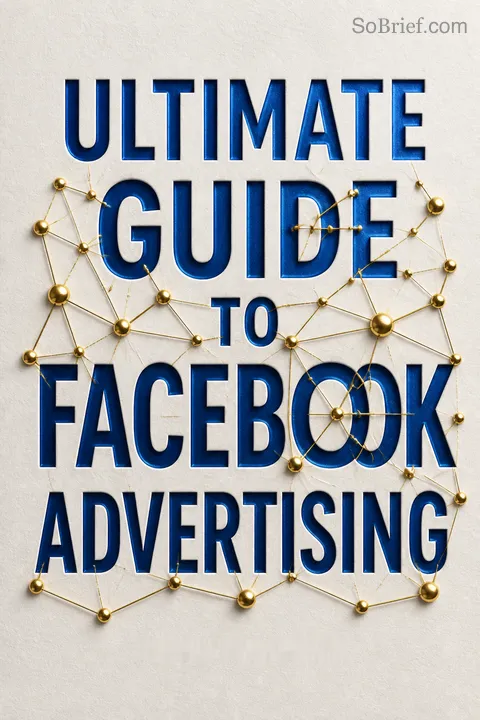
Ultimate Guide to Facebook Advertising receives mixed reviews, with an average rating of 4.04/5. Many praise its comprehensive coverage of Facebook advertising strategies, step-by-step guidance, and valuable insights. Readers appreciate the book's focus on finding the right audience and creating effective ads. However, some criticize it for being outdated, overly promotional of the author's services, and lacking in-depth analysis. The book is recommended for beginners but may be less useful for experienced advertisers. Overall, it's considered a solid resource for understanding Facebook advertising basics.
People Also Read









Glossary
Right angle marketing
Unexpected audience-product fitA method of finding connections between an audience and an offer that are not immediately obvious. Rather than advertising only to people whose stated interests directly match a product, the marketer looks for shared circumstances, preferences, or habits that may explain why a group is especially receptive. Each discovered connection is a hypothesis to test, not proof of a buying motive.
Sociographic targeting
Targeting social connectionsAdvertising based on how people are connected to a business or to its audience. In the book’s Facebook context, advertisers could reach people who had connected with a page, event, group, or application, exclude existing followers, or reach friends of followers. The idea is to use relationships as an additional audience signal, alongside location, demographics, and interests.
Front porch
Social, low-pressure sellingThe book’s metaphor for marketing in a social setting where people primarily gather to connect rather than shop. A business earns attention by offering interesting conversation, useful information, demonstrations, or entertainment before asking for a sale. The metaphor distinguishes social advertising from search advertising, where a user may already be looking for a specific solution.
Estimated reach
Potential audience sizeThe platform’s estimate of how many users match an advertiser’s selected targeting criteria. The book recommends watching this estimate change as location, age, interests, and other criteria are adjusted. It can help marketers understand the approximate scale of an audience, but it does not show how many people will actually see an ad or become customers.
Ad fatigue
Declining response after repetitionA decline in an advertisement’s response as the same audience sees it repeatedly. The book treats fatigue as an expected signal that people need a different image, message, or topic, rather than automatic evidence that the audience has no interest in the offer. Monitoring frequency and preparing fresh creative can help marketers respond before paid impressions lose value.
Like inflation
Falling organic post visibilityThe book’s label for the declining usefulness of a page follower as a guarantee that future updates will appear in that person’s feed. As users follow more pages, a business’s updates may be filtered unless the person interacts with them. The authors therefore recommend not treating a large follower count as assured access to the entire audience.
CPC
Payment per clickCost per click, a bidding method in which the advertiser pays when a user clicks an ad. In the book’s account, CPC can be useful for testing new ads or limiting exposure when performance is uncertain, because impressions that produce no clicks do not directly incur a click charge. The resulting clicks still need to be measured for business value.
CPM
Payment per thousand impressionsCost per thousand impressions. The advertiser pays for each thousand times an ad is displayed, regardless of whether users click. The book presents CPM as a way to lower effective click costs when targeting and creative generate a strong response, while warning that the advertiser bears the cost of impressions that fail to attract attention.
FAQ
What's Ultimate Guide to Facebook Advertising about?
- Focus on Paid Advertising: The book emphasizes leveraging Facebook's vast user base through paid advertising, contrasting it with traditional social marketing methods.
- Targeting Strategies: It covers geographic, demographic, psychographic, and sociographic targeting to help advertisers effectively reach their ideal audience.
- Practical Steps: Provides practical steps for creating ads, managing campaigns, and analyzing performance, making it suitable for both beginners and experienced marketers.
Why should I read Ultimate Guide to Facebook Advertising?
- Expert Insights: Authored by Perry Marshall, a recognized expert in online advertising, offering valuable insights and strategies.
- Actionable Advice: Includes step-by-step instructions, making it easy to implement the strategies discussed.
- Stay Competitive: Understanding Facebook advertising is crucial for businesses to compete effectively in the digital marketplace.
What are the key takeaways of Ultimate Guide to Facebook Advertising?
- Importance of Targeting: Effective targeting is essential for reducing costs and increasing conversion rates, using Facebook's tools to reach specific audiences.
- Ad Creativity Matters: Highlights the significance of creative ad design, using compelling images and headlines to capture attention.
- Continuous Testing: Advocates for ongoing testing and optimization of ads to improve performance over time.
What are the best quotes from Ultimate Guide to Facebook Advertising and what do they mean?
- "Your mission is to buy a click for $1 and to turn it into $2.": Encapsulates the core goal of turning ad spend into profit through effective strategies.
- "Selling on the front porch is about engaging people where they are.": Emphasizes connecting with potential customers in a way that resonates with their interests.
- "Ads are not just about selling; they are about building relationships.": Highlights nurturing customer relationships through engaging content and interactions.
How does Ultimate Guide to Facebook Advertising define ad fatigue, and why is it important?
- Ad Fatigue Explained: Occurs when an audience becomes tired of seeing the same ad repeatedly, leading to decreased engagement.
- Signal for Change: Suggests viewing ad fatigue as a signal to refresh ad content, not as a failure.
- Strategies to Combat Fatigue: Offers strategies like rotating ads and creating new content to re-engage the audience.
What targeting strategies does Ultimate Guide to Facebook Advertising recommend?
- Geographic Targeting: Emphasizes targeting users based on location to reach local customers effectively.
- Demographic and Psychographic Targeting: Uses demographic information and psychographic data to refine audience targeting.
- Sociographic Targeting: Focuses on users' social connections, enabling advertisers to reach friends of existing customers.
How can I create compelling ad copy according to Ultimate Guide to Facebook Advertising?
- Engaging Headlines: Craft attention-grabbing headlines that pique interest and encourage clicks.
- Clear Call to Action: Include a clear and compelling call to action, guiding the audience on what to do next.
- Emotional Triggers: Use emotional triggers in ad copy to connect with the audience on a deeper level.
What is the significance of A/B testing in Ultimate Guide to Facebook Advertising?
- Optimize Ad Performance: Allows comparison of different ad versions to see which performs better, improving click-through and conversion rates.
- Data-Driven Decisions: Encourages decisions based on data rather than assumptions, ensuring effective marketing strategies.
- Continuous Learning: Fosters a culture of continuous learning and adaptation based on real-time feedback.
How does Facebook advertising differ from Google AdWords according to Ultimate Guide to Facebook Advertising?
- Different Mindsets: Facebook advertising focuses more on social engagement rather than direct search intent.
- Targeting Approach: Google targets users based on search queries, while Facebook uses interests and social connections for nuanced strategies.
- Ad Format and Interaction: Facebook ads blend into the social experience, requiring engaging content that resonates personally.
How can I create my first Facebook ad quickly as suggested in Ultimate Guide to Facebook Advertising?
- Step-by-Step Guide: Provides a quick guide to setting up your first ad in just 10 minutes, including account setup and ad creation.
- Design and Targeting: Emphasizes designing an eye-catching ad and selecting the right audience for maximum engagement.
- Budgeting Tips: Advises starting with a low budget and short campaign duration to minimize risk while testing effectiveness.
What role do Facebook events play in advertising strategies discussed in Ultimate Guide to Facebook Advertising?
- Engagement Opportunities: Provide a platform for businesses to engage with their audience interactively, allowing deeper connections.
- Combatting Ad Fatigue: Suggests using events to refresh marketing efforts and combat ad fatigue with new topics.
- Targeted Promotions: Events can be promoted to specific fans, ensuring the right audience is reached and encouraging participation.
How does Ultimate Guide to Facebook Advertising suggest measuring the success of Facebook advertising campaigns?
- Tracking Metrics: Recommends tracking key metrics like click-through rates, conversion rates, and cost per acquisition.
- Using Insights: Facebook’s analytics tools provide valuable insights into audience engagement and ad effectiveness.
- Continuous Improvement: Emphasizes using data to continuously improve campaigns, adjusting strategies based on audience behavior.
About the Author

Download PDF
Download EPUB
.epub digital book format is ideal for reading ebooks on phones, tablets, and e-readers.








