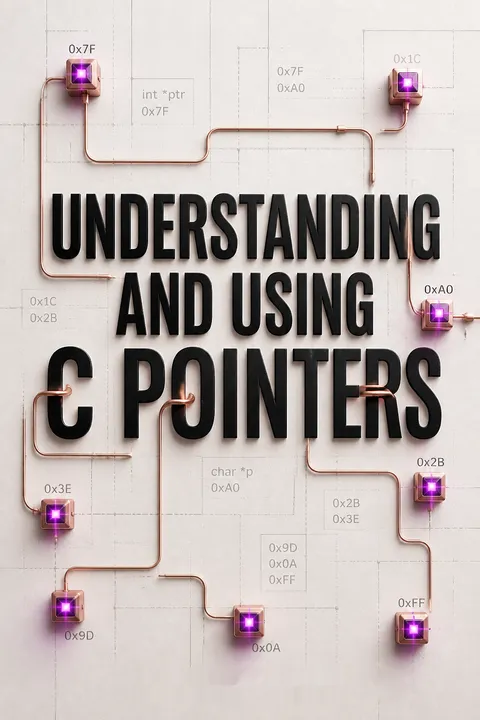


Key Takeaways
Learn memory first: a pointer is an address interpreted through its type
Start with memory. A pointer stores an address, not the object itself. C programs use static or global storage for data that lasts throughout the program, automatic storage for local variables during a function call, and dynamic storage for memory requested from the heap. The pointer's type guides operations such as dereferencing and arithmetic, but it does not prove that the address is valid or that the memory contains the expected value.
Draw the moving parts. A simple memory diagram can show a pointer variable in one location and the object it references in another. This helps explain why changing a pointer differs from changing its target. Addresses displayed by a program are usually virtual addresses, which the operating system maps to physical memory.
What's useful here is the separation of location from meaning. An address is merely a coordinate; the type supplies the program's interpretation of the bytes at that coordinate. This resembles the distinction between a file path and the file's contents, except that C lets code act directly on the address. That freedom is the source of both speed and danger. A type can catch some mismatches during compilation, but it cannot certify that an object is alive, large enough, or still located there.
Track each object's lifetime before you keep or return its address
Follow the lifetime. A function call creates a stack frame containing parameters and local variables. When the function returns, that frame is no longer available, even if its old bytes remain visible in memory. A pointer to a local variable therefore becomes invalid after the function exits. Static data lasts for the program's lifetime, while dynamically allocated memory remains available until it is freed.
Make the return decision explicit. A function can safely return a pointer to persistent static data, or to heap memory that the caller is responsible for freeing. It can also fill a buffer supplied by its caller. Returning a pointer to a local array is not safe: a later call can reuse and overwrite its former stack space.
This is a lifetime problem disguised as an address problem. The same distinction appears in resource management more broadly: possessing a reference does not mean the referenced resource remains valid. C leaves that relationship largely to programmer discipline, so interfaces should make it clear who creates data, who may use it, and who ends its lifetime. Static storage can avoid premature expiration, but shared reusable buffers introduce another constraint: one call can overwrite a previous call's result.
Treat heap allocation as an ownership contract, not a one-line call
Allocate deliberately. `malloc` requests a number of bytes and returns a pointer, or `NULL` if the request cannot be met. The memory is not initialized, so code should calculate sizes with `sizeof`, check the result, and initialize the data before reading it. `calloc` requests space for elements and clears the allocated bytes to zero.
Keep the original address safe. Every successful allocation must remain reachable until it is freed. Losing that address creates a memory leak. `realloc` may move a block, so store its result in a temporary pointer; if it fails, the original allocation remains available. Free each allocation once, and do not use its contents afterward. The heap manager may keep bookkeeping beyond the bytes requested, and allocated blocks need not be adjacent.
The word ownership is a useful way to make manual memory management legible: an allocation creates an obligation, and freeing discharges it. This is conceptually close to linear resource systems, where a resource should have one clear path to release. C does not enforce that model, especially when several pointers refer to the same block. A temporary for realloc is not stylistic fussiness; it preserves the old resource if the attempted replacement fails.
Pass addresses to change data, and pointer addresses to replace pointers
Remember what gets copied. C passes function arguments by value, including pointers. A function given an integer receives a copy, so changing that parameter does not change the caller's integer. Passing the integer's address lets the function modify the original value through dereferencing. Passing an address can also avoid copying a large structure.
Add another level when needed. A function that must assign a new address to the caller's pointer needs the address of that pointer, often expressed as a pointer to a pointer. For example, a function allocating an array can write the returned heap address into the caller's pointer this way. A pointer to `const` data offers a different contract: the function may read the target but may not modify it through that pointer.
This distinction is a compact model for many confusing C interfaces: a function can mutate an object without being able to replace the caller's reference to that object. The extra indirection in a pointer-to-pointer is not magic; it simply gives the function access to the pointer variable itself. The tradeoff is readability. If an interface requires multiple levels of indirection, a small diagram or a clearer result structure can often communicate the contract better than dense pointer notation.
Use arrays with explicit bounds, dimensions, and layout assumptions
Do not confuse array and pointer. An array name often converts to the address of its first element, and indexing can be expressed through pointer arithmetic. But an array has its storage and size; a pointer is a separate variable holding an address. Thus `sizeof` on an array gives its storage size, while `sizeof` on a pointer gives the pointer's size. Once an array is passed to a function, its length is not automatically carried along, so pass the relevant element count too.
Keep the shape available. Ordinary multidimensional arrays are stored contiguously in row-major order. A function using two-dimensional indexing must know the row width to calculate element addresses. An array of pointers can instead refer to separately allocated rows, allowing jagged shapes, but those rows are not necessarily contiguous.
The central lesson is that layout information is part of the data contract. An address alone cannot tell a function how many elements are safe to access or how a matrix is organized. This is why interfaces that pass a buffer, length, and dimensions are easier to audit than interfaces that pass only a pointer. C's flexible representations are valuable, but their flexibility shifts bookkeeping into the API, where omitted shape information can become an out-of-bounds read or write.
Treat C strings as bounded byte buffers with a required terminator
Count the terminator. A C byte string is a sequence of characters ending with the NUL character, written `\0`. Its length excludes that final byte, so allocating space for a copied string requires its length plus one. `NULL` is a pointer value, not the same thing as the string terminator. A character array is not necessarily a string unless it contains the terminator.
Give operations enough room. `strcmp` compares string contents; `==` compares addresses. `strcpy` and `strcat` do not allocate destination space, so their destination must already be large enough. String literals may be stored in shared, read-only memory, so code should not modify them. When formatting into a buffer, `snprintf` accepts the buffer size and limits how much it writes.
Strings reveal how much hidden metadata C omits. A modern string object commonly carries both its address and length; a C string encodes its endpoint in the data itself, requiring every operation to find or preserve the terminator. That representation is compact and interoperable, but it makes capacity a separate fact that functions must receive or establish. The safest habit is to treat capacity as part of the buffer's identity, not as an optional detail.
Let pointers connect data structures, but define who owns each node
Build structure from links. A linked list uses a pointer in each node to reach the next node; a queue and stack can use the same links while enforcing different removal orders. A binary search tree uses left and right pointers to organize values for searching. These structures can grow as needed without requiring one contiguous array, but each node must be allocated and eventually released.
Account for nested memory. Allocating a structure does not allocate memory for its pointer fields, and freeing the structure does not automatically free what those fields reference. The book's person example stores names in separately allocated strings, so cleanup must release those strings as well as any heap-allocated structure. A reusable pool can reduce repeated allocation overhead, at the cost of keeping unused objects reserved.
Pointer-based structures make topology explicit: the organization lives in the links, not in adjacent storage. This can simplify insertion and removal, though it does not make every operation faster. Linked lists, for instance, require traversal to reach an item by position, while arrays offer direct indexing and locality. The right structure depends on the work being performed. Explicit ownership is essential either way, because a node's links describe reachability, not responsibility for freeing the objects it references.
Assume unchecked pointer mistakes can become security vulnerabilities
Bounds are not enforced. C permits code to index beyond an array or write past a string's storage. Such buffer overflows can corrupt nearby data, crash a program, or create opportunities for an attacker. Other high-risk mistakes include dereferencing an uninitialized pointer, using memory after it is freed, freeing the same block twice, and passing an untrusted string as a `printf` format string.
Layer your defenses. Pass buffer sizes to functions, validate allocation results, initialize pointers, and use compiler warnings and static analysis to find suspicious code. The book also describes operating-system defenses: Address Space Layout Randomization makes memory locations harder to predict, while Data Execution Prevention blocks execution from regions marked nonexecutable. These measures reduce risk but do not repair incorrect pointer logic.
The striking feature of memory corruption is that a local programming error can cross a trust boundary. A write intended for one array may alter a neighboring value or control data, which is why reliability and security are linked in C. Defensive operating-system features raise the cost of exploitation, but they are not substitutes for bounds and lifetime correctness. Static analysis is valuable because pointer failures often depend on paths through a program that are difficult to reproduce with ordinary tests.
Use function pointers when behavior must be selected at runtime
Separate mechanism from policy. A function pointer stores the address of a function with a compatible signature. Passing one to a sorting routine lets the caller choose how strings are compared, such as case-sensitive ordering or ordering that ignores letter case. The sorting algorithm stays the same while its comparison rule changes. An array of function pointers can similarly dispatch operations by an index or command.
Respect the signature. The compiler's checks cannot protect against every incorrect call through a mismatched function pointer. Parameters, return type, and calling convention must agree with the actual function. The same technique supports callbacks, where a function is supplied to be invoked in response to an operation or event. A null function pointer must be checked before calling it.
Function pointers introduce a small form of dependency inversion: the algorithm accepts a behavior instead of hard-coding one. This improves reuse when the variable part is well-defined, as in a comparison rule. The cost is a less direct call path and a more important interface contract. A callback's signature specifies what information can cross that boundary, so careful type definitions and clear ownership of callback data matter as much as the dispatch itself.
Only promise no aliasing or hardware volatility when the environment guarantees it
Treat optimization hints as contracts. Aliasing occurs when multiple pointers refer to the same memory. The `restrict` qualifier tells the compiler that a pointer is not being used through competing aliases in the relevant operation, enabling certain optimizations. If code violates that promise, behavior is undefined. Casting between unrelated pointer types can also violate strict aliasing assumptions and produce unexpected results.
Match the tool to the problem. `volatile` is used for memory that can change outside ordinary program flow, such as a hardware port, so accesses are not treated as ordinary cached values. It does not protect shared data between threads. The book's multithreaded dot-product example uses a mutex to guard the shared sum. Hardware addresses and byte order are platform-specific, so low-level casts require platform knowledge.
These qualifiers are best understood as declarations of reality to the compiler, not as requests that make reality true. restrict can help optimization only when the no-alias condition is already satisfied. Likewise, volatile concerns observable memory access, while synchronization concerns coordination between concurrent operations. Confusing those jobs invites subtle failures. This is a broader lesson in systems programming: an optimization promise, a hardware property, and a concurrency guarantee are distinct contracts.
Analysis
The book's organizing idea is that pointer syntax becomes intelligible when it is attached to a model of memory. Its progression moves from addresses and storage duration to allocation, function calls, arrays, strings, structures, security, and specialized uses. That sequence is more than a teaching convenience. Each topic adds a new question to the same basic inquiry: what object is at this address, how large is it, who may change it, and how long does it remain valid?
The most consequential distinction is between reachability and ownership. A pointer can make an object reachable without establishing who must free it. Multiple pointers can refer to the same allocation, and a structure can contain pointers to allocations that its own lifetime does not govern. This explains why memory leaks, dangling references, and double frees are not isolated syntax errors. They are failures to maintain a consistent account of object lifetime across functions and data structures.
The book also shows how C trades runtime guardrails for representation flexibility. Arrays, heap blocks, linked nodes, callbacks, and hardware addresses can all be manipulated through addresses, but the language does not automatically carry bounds, shape, or ownership alongside those addresses. The programmer must encode that missing context in types, parameters, conventions, and tests. That flexibility is powerful in systems programming, but it raises the cost of ambiguous interfaces.
A useful modern reading is therefore not simply a catalog of pointer tricks. It is an introduction to making implicit contracts explicit. Readers should retain the diagrams and the distinctions between array and pointer, pointer and target, stack and heap, and `volatile` and synchronization. Some compiler and platform examples reflect the book's 2013 publication date, and details of standards support vary across implementations. Current C standards, compiler documentation, and security guidance should be consulted when applying specific portability claims. The core mental models remain valuable, especially the insistence that addresses alone do not guarantee valid objects.
Review Summary
Understanding and Using C Pointers receives high praise for its clear explanations of a typically challenging topic. Readers appreciate its concise yet comprehensive coverage, from basics to advanced concepts. Many found it invaluable for learning or reviewing pointer usage in C. The book is lauded for its approachability, practical examples, and security considerations. While some criticize certain examples and errata, most reviewers consider it an excellent resource for both beginners and experienced programmers seeking to deepen their understanding of C pointers and memory management.
People Also Read




Glossary
stack frame
Function-call storageA region of automatic storage associated with an executing function call. It holds items such as parameters, local variables, and return information. A function call creates its frame, and returning removes it from active use. A pointer to a local variable in that frame should not be used after the function returns.
dangling pointer
Pointer to expired memoryA pointer that still contains an address after the referenced object or allocation is no longer valid. This can happen after heap memory is freed or after a function returns a pointer to one of its local variables. Dereferencing a dangling pointer has undefined behavior and may expose stale data, corrupt memory, or crash the program.
memory leak
Unreleased, unreachable allocationA memory leak occurs when dynamically allocated memory is no longer useful but the program fails to release it. A common cause is losing the only pointer to an allocation by overwriting it or incrementing it past the original address. Leaked memory remains unavailable for reuse by the program and can eventually prevent further allocations.
pointer aliasing
Pointers share an objectAliasing occurs when two or more pointers refer to the same memory location. A change through one pointer can therefore affect what is observed through another. Aliasing is common and useful, but it complicates ownership, memory release, and compiler optimization. Freeing through one alias does not invalidate the other pointer variables automatically.
strict aliasing
Restrictions on cross-type accessStrict aliasing rules limit when an object may be accessed through pointers of different types. Compilers may rely on these rules to optimize code. Accessing the same object through incompatible pointer types can violate the rules and produce undefined behavior, even when a particular compiler and machine appear to produce the expected result.
restrict
No-alias optimization promiseThe restrict qualifier communicates that, during the relevant use of a pointer, the pointed-to object is accessed through that pointer rather than competing aliases. This promise can allow the compiler to optimize memory operations. It does not prevent aliases from being created, and violating the promise makes the program's behavior undefined.
opaque pointer
Hidden implementation referenceAn opaque pointer refers to a data structure whose full definition is hidden from the code that uses it. A public interface exposes the pointer type and permitted operations, while implementation details remain in a separate source file. This reduces dependence on internal layout and allows the implementation to change without requiring users to understand its structure.
function pointer
Address of callable behaviorA function pointer stores the address of a function with a particular parameter and return type. It can be called directly, passed to another function, returned, or stored in an array. Function pointers enable runtime selection of operations, including comparison rules in sorting routines and callbacks invoked by other code.
jagged array
Rows with varying lengthsA jagged array is a two-dimensional arrangement in which rows may contain different numbers of elements. In C, it can be represented by an array of pointers, with each pointer referring to a row of its own length. Unlike a conventional multidimensional array, its rows need not occupy one contiguous block of memory.
Address Space Layout Randomization (ASLR)
Randomized memory placementASLR is an operating-system security technique that varies the locations of program memory regions, such as the stack, heap, or code. Random placement makes it harder for an attacker to predict addresses needed by some exploits. It reduces predictability but does not prevent a program from containing memory-safety defects.
Data Execution Prevention (DEP)
Blocks execution from data regionsDEP is a hardware or software defense that marks selected memory regions, such as the stack or heap, as nonexecutable. It can stop an attack that attempts to place malicious instructions in such a region and transfer control to them. DEP limits one exploitation technique but does not prevent memory corruption itself.
FAQ
1. What is "Understanding and Using C Pointers" by Richard Reese about?
- In-depth focus on pointers: The book provides a comprehensive and focused exploration of pointers in the C programming language, going beyond the basic coverage found in most C books.
- Memory management emphasis: It delves deeply into memory management concepts, including the stack, heap, and dynamic memory allocation, which are essential for mastering pointers.
- Practical examples and models: Richard Reese uses practical code examples and memory models to illustrate how pointers work in real-world scenarios.
- Coverage of advanced topics: The book also addresses advanced pointer topics such as function pointers, pointer arithmetic, security issues, and object-oriented techniques in C.
2. Why should I read "Understanding and Using C Pointers" by Richard Reese?
- Bridges knowledge gaps: The book fills in gaps left by general C programming books, offering a detailed understanding of pointers and memory management.
- Improves programming skills: Mastery of pointers is crucial for writing efficient, secure, and robust C code, and this book provides the tools to achieve that.
- Relevant for multiple backgrounds: Whether you are a beginner, an experienced C/C++ programmer, or coming from Java/C#, the book enhances your understanding of how memory and pointers work "under the hood."
- Security and reliability focus: It addresses common pointer-related bugs and security vulnerabilities, helping you write safer code.
3. What are the key takeaways from "Understanding and Using C Pointers"?
- Pointers are central to C: Understanding pointers is essential for effective C programming, especially for dynamic memory management and data structures.
- Memory regions matter: The book clarifies the differences between static/global, automatic (stack), and dynamic (heap) memory, and how pointers interact with each.
- Common pitfalls and best practices: It highlights frequent pointer mistakes (like dangling pointers, memory leaks, and buffer overflows) and offers strategies to avoid them.
- Advanced pointer usage: Readers gain practical knowledge of function pointers, pointer arithmetic, and using pointers for object-oriented and multithreaded programming in C.
4. How does Richard Reese define and explain pointers in C?
- Pointer as address holder: A pointer is defined as a variable that stores the address of another variable, object, or function in memory.
- Type-specific pointers: Pointers are usually declared with a specific type, but the type is for compiler checks; the pointer itself only holds an address.
- Pointer declaration syntax: The book explains pointer declaration syntax, the use of the asterisk (*), and recommends reading complex declarations backward for clarity.
- Initialization and null pointers: Reese emphasizes the importance of initializing pointers, the concept of NULL, and the difference between uninitialized and null pointers.
5. What are the main types of memory in C, and how do pointers interact with them?
- Static/Global memory: Used for statically declared and global variables, allocated at program start and deallocated at termination; pointers can reference these variables.
- Automatic (stack) memory: Local variables within functions are allocated on the stack; pointers can reference them, but become dangling if the function returns.
- Dynamic (heap) memory: Allocated and freed at runtime using functions like malloc and free; pointers are essential for managing and accessing this memory.
- Lifetime and scope: The book details how the lifetime and scope of variables in each memory region affect pointer validity and program behavior.
6. How does "Understanding and Using C Pointers" cover dynamic memory management?
- Manual allocation and deallocation: The book explains how to use malloc, calloc, realloc, and free for dynamic memory management.
- Memory leaks and dangling pointers: It discusses common problems like memory leaks (losing the address of allocated memory) and dangling pointers (using freed memory).
- Best practices: Reese recommends always freeing allocated memory, checking for NULL after allocation, and setting pointers to NULL after freeing.
- Advanced techniques: The book introduces nonstandard techniques like garbage collection, RAII (Resource Acquisition Is Initialization), and exception handling for memory management.
7. What are the key pointer operations and arithmetic explained in the book?
- Dereferencing and address-of: The book covers the use of the dereference (*) and address-of (&) operators for accessing and assigning memory addresses.
- Pointer arithmetic: It explains how adding or subtracting integers from pointers moves them by multiples of the pointed-to type's size, and how to subtract pointers to find distances.
- Pointer comparisons: Reese details how to compare pointers for equality, inequality, and relative ordering, especially within arrays.
- Pointer to void and casting: The book discusses the use of void pointers for generic programming and the importance of proper casting between pointer types.
8. How does Richard Reese address arrays, strings, and their relationship with pointers?
- Array-pointer relationship: The book clarifies that while array names can decay to pointers, arrays and pointers are not the same and have different behaviors in assignments and sizeof operations.
- Passing arrays to functions: It explains how arrays are passed as pointers, the need to pass array sizes, and the differences between one-dimensional and multidimensional arrays.
- Strings as char arrays: Strings in C are arrays of char terminated by a NUL character; pointers are used extensively for string manipulation and dynamic allocation.
- Common string operations: The book covers safe string handling, copying, concatenation, and the risks of buffer overflows with standard library functions.
9. What advanced pointer concepts are covered, such as function pointers and multiple indirection?
- Function pointers: The book provides detailed explanations and examples of declaring, assigning, and using pointers to functions, including arrays of function pointers and callbacks.
- Multiple levels of indirection: It covers pointers to pointers (double pointers), their use in functions (e.g., modifying a pointer argument), and in managing complex data structures.
- Returning pointers from functions: Reese discusses safe and unsafe practices for returning pointers, especially the dangers of returning pointers to local (stack) variables.
- Polymorphism and object-oriented techniques: The book demonstrates how to simulate object-oriented behavior in C using function pointers and opaque pointers.
10. How does "Understanding and Using C Pointers" address security issues and common pointer mistakes?
- Buffer overflows: The book explains how improper pointer and array usage can lead to buffer overflows, a major source of security vulnerabilities.
- Dangling and wild pointers: It details the dangers of using uninitialized or freed pointers, and how to avoid these issues.
- Double free and memory leaks: Reese discusses the risks of freeing memory twice and losing track of allocated memory, and how to prevent such bugs.
- Safer coding practices: The book recommends using assert, static analysis tools, and careful pointer initialization and deallocation to write more secure C code.
11. What are some best practices and advice from Richard Reese for working with pointers in C?
- Always initialize pointers: Uninitialized pointers can cause unpredictable behavior; initialize to NULL or a valid address.
- Check allocation results: After malloc or similar calls, always check if the returned pointer is NULL before use.
- Free memory responsibly: Match every allocation with a corresponding free, and set pointers to NULL after freeing to avoid dangling references.
- Use const and restrict: Use const for pointers to data that should not be modified, and restrict to help the compiler optimize and prevent aliasing issues.
12. What are the best quotes from "Understanding and Using C Pointers" by Richard Reese, and what do they mean?
- "Pointers are complex enough to deserve more in-depth treatment." — Emphasizes the centrality and complexity of pointers in C, justifying the book's focused approach.
- "A solid understanding of pointers and the ability to effectively use them separates a novice C programmer from a more experienced one." — Highlights that pointer mastery is a key milestone in C programming expertise.
- "There is nothing inherent to a pointer’s implementation that suggests what type of data it is referencing or whether its contents are valid." — Reminds readers that pointers are just addresses; type safety and validity are up to the programmer and compiler.
- "The power and flexibility of pointers is exemplified when used to create and support data structures." — Underlines how pointers enable dynamic, efficient, and flexible data structures in C.
- "Improper use of pointers is often at the root of many security problems." — Stresses the importance of careful pointer management for writing secure and reliable C programs.
Download PDF
Download EPUB
.epub digital book format is ideal for reading ebooks on phones, tablets, and e-readers.








