

Key Takeaways
Choose the exposure that shapes the image, not just its brightness
Correct is not creative. A camera meter can indicate a technically balanced exposure, but that does not tell the photographer whether the image should freeze a wave, blur it into a veil, or isolate one flower from its background. Peterson calls the chosen setting that serves the picture a creatively correct exposure. Several combinations of aperture and shutter speed can record the same overall brightness while creating very different images. In his surf example, a fast shutter captures the crashing water sharply, while a slow one softens it.
Take control of the result. A student with a strong eye could not explain how she had made her successful photographs because she relied on automation. Learning manual exposure helped her understand and repeat the decisions behind them. The point is not that every image requires manual mode. It is that the photographer, rather than the meter, decides what the exposure should communicate.
This is a useful distinction between measurement and intention. A meter can estimate a tonal average, but it cannot rank sharpness, motion, or background separation according to the photographer's priorities. The idea resembles constrained optimization: first define the desired result, then select settings that achieve it. Manual mode is particularly valuable as a learning instrument, though it is not inherently more artistic. Automation can serve experienced photographers well when its limits are understood.
Learn the triangle by trading aperture, shutter speed, and ISO deliberately
Three controls, one exposure. The Photographic Triangle is Peterson's name for the relationship among aperture, shutter speed, and ISO. Aperture controls the size of the lens opening, shutter speed controls how long light reaches the sensor, and ISO sets the sensor's sensitivity. Changing one factor by a full stop doubles or halves the light contribution, so another factor can compensate to maintain the same overall exposure.
Practice the exchanges. For example, at a fixed ISO, moving from f/4 to f/5.6 halves the light through the lens. Doubling the exposure time restores the overall brightness. Raising ISO from 100 to 200 also allows the same exposure to be made in half the time, but Peterson warns that very high ISO can cost color and contrast. Learning these relationships makes manual settings comprehensible rather than mysterious.
The triangle works because it turns a camera interface into a causal model. Changing a setting becomes a prediction about light, rather than a guess followed by trial and error. That kind of mental model transfers across camera bodies and generations of technology. One nuance is that ISO does not increase the light reaching the sensor; it changes how the recorded signal is rendered. The practical trade-off remains: sensitivity can buy shutter speed, while image quality may change.
Use aperture to decide what deserves sharpness
Depth is a choice. Depth of field means the range in a photograph that appears acceptably sharp. A small aperture, shown by a large f-number such as f/16 or f/22, generally expands that range. Peterson uses it for storytelling compositions that connect foreground, middle ground, and background. A wide aperture, such as f/4 or f/5.6, narrows the sharp area and can separate a flower or portrait from distracting surroundings. A middle aperture such as f/8 or f/11 is useful when depth of field matters less.
Look beyond landscapes. In macro photography, focus becomes especially delicate because the sharp zone can be extremely thin. Aperture also affects the shape of out-of-focus lights, called specular highlights. A wide-open aperture can render them round, while stopping down can make them polygonal. Peterson favors small apertures for deep focus, but they are a choice, not a universal rule.
Aperture is not merely a brightness control. It directs attention by deciding which parts of a scene remain legible, linking photographic technique to visual hierarchy in design and painting. The useful qualification is optical: very small apertures can introduce diffraction, reducing fine detail. That does not make f/22 wrong when front-to-back sharpness matters. It means the photographer weighs depth against crispness at the intended viewing size, rather than treating any f-number as a permanent best practice.
Set shutter speed according to the motion you want viewers to feel
Time changes the story. A fast shutter can freeze movement, while a slow shutter records it as blur. Peterson describes photographing a train moving at more than 120 miles per hour with a 1/60-second exposure: the train's blur communicates speed within a sharp landscape. For a waterfall, a much longer exposure can turn rushing water into a soft, continuous shape. A tripod helps keep stationary parts of the scene sharp during long exposures.
Move with the subject. Panning means following a moving subject with the camera during a slow exposure. If the movement is smooth, the subject can stay relatively sharp while the background streaks. That background matters: Peterson's early attempt to pan a Frisbee against an empty blue sky failed because there was nothing behind it to blur. The right shutter speed depends on subject speed, distance, direction, and the effect intended.
Shutter speed offers a particularly clear example of a technical setting changing a viewer's experience of time. Motion blur can signal energy, speed, or duration, while a frozen instant invites inspection of details normally missed. The failed Frisbee image illustrates an important compositional principle: a technique depends on the whole scene, not just the central subject. Motion effects are also inherently variable, so digital review is useful for refining the shutter speed rather than expecting a single formula to work everywhere.
Study the light's direction and timing before you chase a subject
Light has a direction. Frontlight falls toward the subject from the camera's direction and tends to illuminate it evenly. Sidelight creates highlights and shadows that suggest three-dimensional form. Backlight comes from behind the subject and can produce silhouettes or make translucent leaves and petals glow. Overcast light is soft and even, often useful for portraits, flowers, and wooded scenes where direct sun would create harsh contrast.
Wait for the scene to change. Peterson compares two photographs of the same lavender landscape: one made while a cloud covered the sun, and another after waiting about ten minutes for the light to return. The second image gained warmth, contrast, and visual force. Early morning and late afternoon often bring low-angle light and long shadows, while midday sun tends to be harsh. Weather and season change the scene as much as the subject does.
The advice to wait is really advice to treat a photograph as a relation among subject, light, and time. This is close to field observation in ecology: repeated attention reveals patterns that a single visit hides. The book's preference for dawn and late afternoon is especially apt for warm directional light, but not every subject benefits from it. Soft overcast light can be more revealing for color and texture, so the goal is not a golden-hour ritual. It is recognizing what a particular light does.
Distrust the meter when white, black, or backlight dominates
The meter averages reflected light. A camera's reflected-light meter is calibrated to interpret a scene as an average middle gray, often described as 18% reflectance. When a frame is dominated by bright snow, the meter can reduce exposure until the snow looks gray. When it sees a large dark area, it can add exposure and make the dark subject look too light. Peterson's example of black coal shows why a reading from the subject itself can mislead.
Choose a better reference. For bright outdoor scenes, Peterson often meters from blue sky, then locks or manually sets that exposure before recomposing. For some green-heavy scenes, his named technique Mr. Green Jeans means metering from green and setting the exposure about two-thirds of a stop below the meter's recommendation. A gray card provides another reference. These are starting methods, not substitutes for checking the image.
This is a lesson in measurement bias: instruments faithfully apply their calibration, even when the situation violates its assumptions. Snow and coal do not become average gray merely because a meter treats them that way. The specific sky and green shortcuts can be handy, but reflectance varies with illumination, angle, and subject. Modern exposure displays and histograms offer additional evidence, especially for protecting bright detail. The broader skill is noticing when the meter's average conflicts with the tones the scene should retain.
Use filters to solve exposure conflicts the camera cannot
Filters change the available choices. A polarizing filter reduces glare from reflective surfaces such as wet leaves, water, glass, and metal. Its effect is strongest when the camera points at a right angle to the sun. A neutral-density filter reduces light across the whole frame, allowing a slower shutter speed for blurred water or a wider aperture in bright conditions. Peterson's preferred ND filter reduces light by three stops.
Balance bright and dark areas. A graduated neutral-density filter darkens only part of the frame, typically a bright sky, helping it approach the exposure of a darker foreground. In Peterson's beach example, the sky and wet sand differed by four stops. A graduated filter reduced the sky's brightness so both areas could retain detail in one exposure. The filter must be aligned with the boundary it is meant to darken, and a tripod helps with careful composition.
Filters are best understood as ways to alter the scene before the sensor records it. That can preserve a natural-looking result with less dependence on later editing, while also enabling effects such as softened water that a fast shutter cannot create. Their limits matter: a polarizer can unevenly darken a wide blue sky, and a graduated filter may not fit an irregular skyline. The craft lies in matching the tool to the geometry and tonal structure of the scene.
Bracket for HDR only when the scene can hold still
Combine exposures for wider tonal range. High Dynamic Range, or HDR, photography merges several photographs of the same scene made at different exposure levels. The brighter frames preserve shadow detail, while darker frames retain highlights. Peterson recommends using automatic bracketing, often in one-stop increments, and keeping aperture fixed so depth of field stays consistent. A tripod helps the frames align before they are combined in software.
Watch for movement. HDR can fail when objects shift between exposures. Peterson's city-street example contains ghostlike pedestrians because they moved across the series. A waterfall is a better candidate because its movement repeats in roughly the same area; traffic flowing along a road can also work. The number of exposures depends on the scene's contrast, so bracketing is a way to cover a range, not a guarantee that every frame needs the same number of shots.
HDR extends the camera's ability to represent scenes whose brightest and darkest areas exceed what a single exposure can record. The requirement that frames align turns the technique into a problem of both exposure and registration. Repetitive movement is less disruptive than unpredictable movement, which explains the waterfall contrast. HDR also invites an aesthetic decision: preserving detail everywhere can flatten the hierarchy that makes a scene feel dramatic. A wider tonal record is a resource, not an obligation to display every tone equally.
Use flash to shape contrast and preserve deliberate ambient effects
Flash can fill missing light. Fill flash brightens shadows that would otherwise disappear in a high-contrast scene. Peterson photographs tulips in direct sunlight and shadow, then uses a remote TTL flash to brighten the dark background and smooth the composition. In another example, he deliberately underexposes a cloudy sky, then uses flash to illuminate foreground flowers without sacrificing the dark mood behind them.
Choose the flash effect. A ring flash surrounds the lens and provides close, relatively even light for macro subjects. Rear-curtain sync fires the flash near the end of an exposure, so ambient light can record motion trails before the flash sharply illuminates the subject. Both techniques depend on balancing flash with available light. The flash need not dominate the photograph; it can contribute only the light needed to preserve detail or make motion readable.
Flash is often treated as a blunt fix for darkness, but these examples make it a selective tool for managing contrast. The ambient exposure establishes the scene's atmosphere, and flash can add detail where that exposure alone would lose it. This is conceptually similar to local lighting in theater, where one area is emphasized without erasing the setting. The main caution is that flash direction and power affect the result: automation helps with exposure, but it cannot decide whether the light looks natural or distracting.
Choose white balance for the mood, not just neutral color
Color depends on the light. White balance compensates for the color cast of different light sources. Peterson prefers the Cloudy setting for most outdoor photographs because it warms the image, even on sunny days. He sometimes switches to Tungsten at dusk because it makes the sky appear deeper blue. These are deliberate stylistic choices, not universal corrections; an accurate neutral rendering may be preferable for other subjects.
Keep options open. Shooting RAW lets a photographer change white balance during post-processing, which makes experimentation less risky than committing to one setting in a JPEG. Peterson also recommends comparing settings rather than assuming the camera's automatic choice is always the most appealing. White balance cannot recreate the long shadows of morning or late afternoon, however. It can shift color, but it cannot make midday light behave like sunset.
White balance reveals that photographic color is partly interpretation. The camera can neutralize a cast, but a warmer or cooler rendering may better express the scene's atmosphere. RAW capture separates that aesthetic decision from the initial exposure, allowing the photographer to revise it without changing the recorded light. The important limit is that color correction cannot replace directional structure. A blue cast can suggest dusk, but it cannot manufacture dusk's shadows, contrast, or changing illumination.
Analysis
Understanding Exposure is a practical manual whose deepest lesson is not simply how to set a camera. It teaches a decision order: decide what the image should do, choose the aperture or shutter speed that produces that effect, then use the meter to solve for the remaining exposure. That order turns technical knowledge into authorship. Exposure becomes a way of translating a three-dimensional, changing scene into a flat image, not a contest to make the meter land on zero.
The book is effective because it repeatedly links an abstract control to a visible consequence. The same exposure value can yield either frozen surf or blurred water; the same flower can be isolated or lost in a sharp background. Its field stories make this relationship memorable, and the manual-mode exercises give beginners a practical route out of opaque automation. The advice also scales well: once aperture, shutter speed, and ISO are understood as exchangeable controls, a photographer can approach unfamiliar cameras with less intimidation.
Its confidence is also a source of limitation. Recommendations such as routinely using f/22, preferring Cloudy white balance, or relying on a particular sky or green reference can be useful heuristics, but they are not laws of optics or metering. Diffraction can soften detail at small apertures, color preferences vary, and reflected brightness changes with conditions. The book's 2010 digital context also predates many contemporary camera features. These caveats do not undermine its central teaching; they clarify how to use it. The durable skill is not memorizing settings, but knowing what a setting changes, recognizing the assumptions built into the meter, and judging whether the resulting image serves the intended visual story.
Review Summary
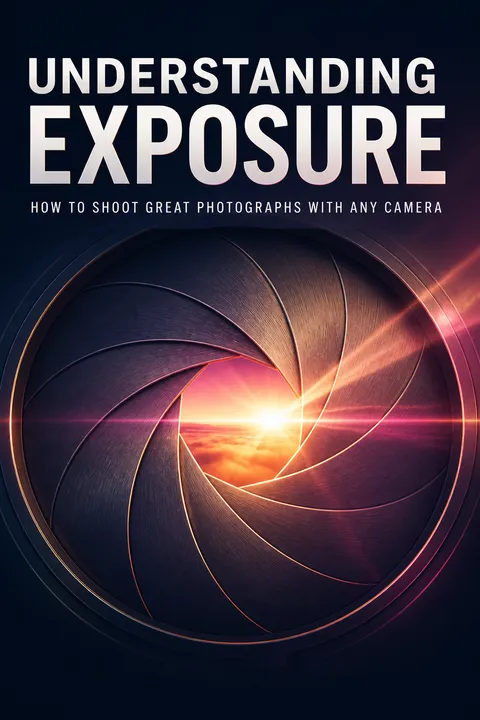
Understanding Exposure receives mostly positive reviews, praised for its clear explanations of photography basics like aperture, shutter speed, and ISO. Readers find it helpful for beginners and intermediates, with practical tips and illustrative examples. Some criticize outdated content and repetitive writing. The book is commended for demystifying manual mode and creative exposure techniques. While some find it too basic or lacking in certain areas, many recommend it as an essential guide for those looking to improve their photography skills and move beyond automatic settings.
People Also Read



Glossary
Photographic Triangle
Three linked exposure controlsPeterson's term for the relationship among aperture, shutter speed, and ISO. Aperture controls the lens opening, shutter speed controls how long light reaches the sensor, and ISO sets sensitivity. Adjustments to one control can be compensated for by changing another, preserving overall exposure while changing depth of field, motion rendering, or image quality.
creatively correct exposure
Exposure chosen for effectAn exposure selected not merely because a camera meter indicates a balanced brightness, but because its aperture and shutter speed create the intended image. It may freeze action, blur movement, extend depth of field, or isolate a subject. Multiple settings can yield similar overall brightness while producing different visual results.
storytelling composition
Foreground-to-background sceneA photograph arranged to connect foreground, middle ground, and background as parts of one visual scene. Peterson commonly recommends a wide-angle lens, a small aperture, and preset focus to render the scene sharply from near to far. Foreground detail can create a sense of depth and lead the viewer into the image.
singular-theme composition
Isolated sharp subjectA composition that gives visual priority to one subject by keeping it sharp while rendering foreground or background elements out of focus. A wide aperture and often a telephoto lens reduce depth of field, helping the main subject stand apart from visual clutter. Peterson also calls this an isolation composition.
critical aperture
Lens's strongest aperture rangePeterson's name for the aperture range he associates with strong sharpness and contrast when depth of field is not a major concern. He identifies f/8 to f/11 as common choices. The optimum range varies among lenses and cameras, so the term is a practical guide rather than a universal specification.
18% reflectance
Meter's middle-gray referenceThe approximate reflectance value that Peterson says a reflected-light camera meter treats as its neutral reference. Because the meter seeks an average middle tone, it can render very bright snow or very dark coal closer to gray than they appear in reality. Photographers compensate by choosing a different reference or adjusting exposure.
Sky Brothers
Sky-based metering referencesPeterson's collective name for using different parts of the sky or its reflection as exposure references in challenging scenes. Blue sky can help with bright frontlit subjects, sky beside the sun can guide backlit scenes, dusk sky can guide evening exposures, and reflected sky can help preserve detail in water reflections.
Mr. Green Jeans
Green-based exposure shortcutPeterson's nickname for a metering technique used when a scene contains substantial green. The photographer meters from the green area and sets exposure about two-thirds of a stop below the meter's suggested reading. The method is intended to produce a suitable tonal result, but green reflectance varies with light and scene conditions.
specular highlights
Out-of-focus points of lightSmall bright sources or reflections that appear as out-of-focus shapes in a photograph. Their shape is influenced by the lens aperture, while their apparent size and softness depend partly on distance and focus. A wide-open aperture can render them round; stopping down can make them polygonal.
HDR: High Dynamic Range Exposures
Merged exposures preserve tonesA technique that combines multiple photographs of the same scene, each made at a different exposure, to retain detail across a wider range of highlights and shadows than one exposure can record. The images need to align. Movement between frames can create ghosting, so stable scenes or repetitive motion are easier to combine.
FAQ
What's "Understanding Exposure" by Bryan Peterson about?
- Focus on Exposure: The book is a comprehensive guide on understanding and mastering exposure in photography, regardless of the camera you use.
- Photographic Triangle: It introduces the concept of the Photographic Triangle, which includes aperture, shutter speed, and ISO, as the foundation of achieving correct exposure.
- Creative Techniques: The book emphasizes creatively correct exposures, teaching photographers how to use exposure settings to enhance the artistic quality of their images.
- Practical Examples: It provides practical examples and exercises to help photographers apply the concepts in real-world scenarios.
Why should I read "Understanding Exposure" by Bryan Peterson?
- Improve Photography Skills: The book is ideal for photographers looking to improve their understanding of exposure and enhance their photography skills.
- Comprehensive Guide: It offers a detailed explanation of exposure, making it suitable for both beginners and experienced photographers.
- Creative Inspiration: Bryan Peterson provides creative techniques and ideas that can inspire photographers to experiment and develop their unique style.
- Practical Advice: The book includes practical exercises and examples that help readers apply the concepts and improve their photography in various lighting conditions.
What are the key takeaways of "Understanding Exposure" by Bryan Peterson?
- Exposure Basics: Understanding the Photographic Triangle—aperture, shutter speed, and ISO—is crucial for achieving correct exposure.
- Creative Exposure: There are multiple correct exposures for a scene, but only one or two are creatively correct, enhancing the image's artistic quality.
- Light Metering: Proper use of the camera's light meter is essential for determining the right exposure settings.
- Practical Application: The book emphasizes hands-on practice with exercises to reinforce the concepts and improve photography skills.
What are the best quotes from "Understanding Exposure" and what do they mean?
- "Every photograph is a lie, but it is within that lie that a mountain of truth is revealed!" This quote highlights the idea that photography can manipulate reality to convey deeper truths or artistic expressions.
- "Understanding exposure is not hard at all, as more than 300,000 photographers have already discovered." It reassures readers that mastering exposure is achievable and has been successfully done by many.
- "The world of truly creative exposures opens up, and not surprisingly, with each and every page you turn, you’ll be enjoying even greater photographic journeys." This emphasizes the book's goal of expanding the reader's creative potential in photography.
How does Bryan Peterson define "Exposure" in "Understanding Exposure"?
- Lightproof Box Concept: Peterson describes every camera as a lightproof box with a lens at one end and a digital card or film at the other, where exposure is the light that hits the photosensitive material.
- Correct Exposure: A correct exposure is a combination of the right aperture, shutter speed, and ISO settings that allow the right amount of light to hit the sensor or film.
- Creative Exposure: Beyond just being correct, a creatively correct exposure uses these settings to enhance the artistic quality of the photograph.
- Exposure as a Question: Photographers often ask, "What should my exposure be?" and the answer is always to achieve a correct exposure that suits the creative intent.
What is the Photographic Triangle in "Understanding Exposure"?
- Three Components: The Photographic Triangle consists of aperture, shutter speed, and ISO, which together determine the exposure of a photograph.
- Aperture: Controls the volume of light entering the lens and affects depth of field, influencing how much of the image is in focus.
- Shutter Speed: Determines how long the light is allowed to hit the sensor, affecting motion blur or freeze in the image.
- ISO: Represents the sensitivity of the sensor to light, impacting the exposure and potential noise in the image.
How does Bryan Peterson explain the importance of light in "Understanding Exposure"?
- Light as Frosting: Peterson describes light as the best possible frosting on the cake of photography, enhancing but not defining the exposure.
- Types of Light: The book covers different lighting conditions, such as frontlight, sidelight, and backlight, and their impact on exposure.
- Best Light: The best light often occurs during early morning or late afternoon, providing warm and vivid tones that enhance photographs.
- Light and Exposure: While light is important, achieving a creatively correct exposure is paramount to capturing compelling images.
What are the seven creative exposure options in "Understanding Exposure"?
- Storytelling Apertures: Use small apertures (f/16, f/22) for images with great depth of field, telling a story from foreground to background.
- Isolation Apertures: Use large apertures (f/2.8, f/4) to isolate a subject with shallow depth of field, focusing attention on a singular theme.
- "Who Cares?" Apertures: Use middle apertures (f/8, f/11) when depth of field is not a concern, focusing on critical sharpness and contrast.
- Shutter Speed Techniques: Includes freezing motion, panning, and implying motion with various shutter speeds to creatively capture movement.
How does Bryan Peterson suggest using a light meter in "Understanding Exposure"?
- Heart of the Triangle: The light meter is central to achieving correct exposure, measuring the light that reflects off the subject.
- Metering Techniques: Peterson explains different metering modes, such as center-weighted, spot, and matrix/evaluative, and their applications.
- Sky Brothers: Introduces the concept of using the sky as a reference for metering in challenging lighting conditions.
- Practical Tips: Provides practical advice on where to take meter readings from to achieve the desired exposure.
What is the role of aperture in depth of field according to "Understanding Exposure"?
- Aperture Control: Aperture is a hole in the lens that controls the amount of light entering and affects the depth of field in an image.
- Depth of Field: Smaller apertures (larger f-stop numbers) increase depth of field, making more of the image in focus from front to back.
- Creative Use: Aperture choice is crucial for storytelling compositions with great depth of field or isolation compositions with shallow depth.
- Optical Law: The smaller the aperture, the greater the area of sharpness, allowing photographers to control the focus and blur in their images.
How does Bryan Peterson address the use of filters in "Understanding Exposure"?
- Polarizing Filters: Used to reduce glare from reflective surfaces and enhance color saturation, especially effective at a 90-degree angle to the sun.
- Neutral-Density Filters: Reduce light intensity, allowing for larger apertures or slower shutter speeds without overexposure.
- Graduated ND Filters: Have a gradient of density to balance exposure between bright skies and darker foregrounds in a scene.
- Practical Applications: Peterson provides examples of when and how to use these filters to achieve desired effects in various lighting conditions.
What exercises does Bryan Peterson include in "Understanding Exposure" to practice exposure techniques?
- Manual Mode Practice: Encourages setting the camera to manual mode and practicing adjusting aperture and shutter speed for correct exposure.
- Creative Exposure Exercises: Includes exercises for seeing creatively correct exposures by experimenting with different aperture and shutter speed combinations.
- Light Exploration: Suggests documenting the changing light in a familiar location over a year to understand its impact on exposure.
- Motion Techniques: Provides exercises for practicing panning and implying motion with stationary cameras to capture dynamic images.
Download PDF
Download EPUB
.epub digital book format is ideal for reading ebooks on phones, tablets, and e-readers.








