Key Takeaways
1. Emotional Disorders Share Core Vulnerabilities, Requiring a Unified Approach
Taken together, this evidence suggests that there may be a common set of vulnerabilities contributing to the development of anxiety, depressive, and related disorders that can become a more efficient focus of treatment than the diverse symptoms themselves.
Beyond specific diagnoses. Traditional mental health treatments often narrowly focus on discrete symptoms of individual disorders like panic disorder or social anxiety. However, research reveals significant overlap and high comorbidity among anxiety and depressive disorders, suggesting a shared underlying pathology. This "transdiagnostic" perspective highlights that many emotional disorders stem from common vulnerabilities, making a unified treatment approach more efficient and effective.
Three core vulnerabilities. The Unified Protocol (UP) targets these shared vulnerabilities, which include:
- High negative affect (neuroticism): A temperamental propensity to experience negative emotions frequently and intensely.
- Negative view of emotions: Believing emotional experiences are inherently bad, weak, or dangerous.
- Maladaptive regulation strategies: Efforts to avoid or suppress emotions that ultimately backfire and maintain symptoms.
Efficient and comprehensive. By addressing these core emotional processes, the UP can simultaneously treat co-occurring conditions, reducing the training burden for clinicians and offering a more holistic solution for patients. This approach aligns with modern understandings of psychological disorders, viewing them on a "spectrum" rather than as isolated diagnostic boxes.
2. Emotions Are Adaptive Signals, Not Problems to Be Eliminated
The main premise of this treatment is that individuals with emotional disorders use emotion regulation strategies— namely attempts to avoid or dampen the intensity of uncomfortable emotions— which ultimately backfire and contribute to the maintenance of their symptoms.
Emotions serve a purpose. Many patients seek treatment hoping to eliminate uncomfortable emotions entirely, but the UP emphasizes that all emotions, positive and negative, are inherently functional and adaptive. They provide crucial information about our environment and motivate us to act. The goal is not eradication, but rather to bring emotions back to a functional level where they can be appreciated as helpful guides.
The "ARC" of emotions. Understanding how emotions unfold is key to managing them. The "ARC" model helps patients track:
- Antecedents (A): Events or situations that trigger emotions (immediate or distant).
- Response (R): The three components of emotion—thoughts, physical sensations, and behaviors/urges.
- Consequences (C): The short-term (often relief) and long-term (often perpetuation of distress) effects of our emotional responses.
Maladaptive coping backfires. While avoiding or suppressing emotions might offer short-term relief, these strategies prevent new learning and reinforce the belief that emotions are intolerable or dangerous. This creates a vicious cycle, maintaining high levels of negative affect and contributing to the persistence of symptoms.
3. Cultivate Mindful Emotion Awareness for Nonjudgmental Presence
Mindful Emotion Awareness refers to approaching emotions in a nonjudgmental, present- focused way.
Observing without judgment. Mindful Emotion Awareness is a foundational skill in the UP, teaching patients to observe their emotional experiences objectively, without labeling them as "good" or "bad." This nonjudgmental stance helps break the cycle of self-criticism and aversion that often intensifies distress. Instead of immediately trying to change how they feel, patients learn to accept emotions as they are, recognizing them as temporary states.
Anchoring in the present. Emotional reactions are frequently driven by ruminations about the past or anxieties about the future, rather than the immediate context. Present-focused awareness encourages patients to ground themselves in the "here and now," noticing their thoughts, physical sensations, and behavioral urges as they unfold. This allows for a more accurate assessment of the current situation, distinguishing between true threats and "false alarms."
Practice makes perfect. Mindful Emotion Awareness is best learned through experience. The UP incorporates exercises like guided meditations and mindful mood inductions (e.g., listening to emotion-eliciting music) to help patients practice this skill in controlled settings. The ultimate goal is to apply this "anchoring in the present" to daily life, choosing deliberate responses rather than reflexive, emotion-driven ones.
4. Develop Cognitive Flexibility to Reframe Automatic Thoughts
The problem with thinking traps is that they prevent us from acknowledging a range of different interpretations or considering the context in which something occurs.
Thoughts shape emotions. Our interpretations of situations profoundly influence our emotional responses. The UP helps patients recognize "automatic thoughts"—quick, often negative appraisals that occur without conscious awareness. These thoughts act as filters, focusing on certain aspects of a situation while excluding others, and can lead to increased negative emotions.
Identify thinking traps. Two common "thinking traps" are particularly targeted:
- Jumping to conclusions (probability overestimation): Assuming a negative outcome is highly likely with little evidence.
- Thinking the worst (catastrophizing): Predicting the most disastrous scenario and underestimating one's ability to cope.
These traps limit perspective and fuel maladaptive emotional cycles.
Increase interpretive flexibility. The goal isn't to eliminate negative thoughts, but to foster cognitive flexibility—the ability to consider multiple interpretations of a situation. Patients learn to question their automatic thoughts, gather evidence, and generate alternative, more balanced perspectives. This process, often guided by specific questions, helps patients gain distance from their thoughts, seeing them as possibilities rather than absolute truths, and thereby reducing their emotional impact.
5. Counter Maladaptive Emotional Behaviors with Deliberate Alternative Actions
By Alternative Action, we mean engaging in an action that is different, and often opposite, to what a patient typically does when experiencing a strong emotion.
Behaviors maintain distress. Emotional behaviors are actions taken to manage strong emotions, often providing short-term relief but perpetuating distress in the long run. These include overt avoidance (e.g., skipping social events), subtle behavioral avoidance (e.g., limiting eye contact), cognitive avoidance (e.g., thought suppression), and safety signals (e.g., carrying medication "just in case"). These behaviors are negatively reinforced, making them difficult to break.
Paradoxical effects of suppression. An exercise demonstrating thought suppression (e.g., trying not to think of a white bear) illustrates how attempts to push away thoughts or emotions often increase their frequency and intensity. This highlights the counterproductive nature of many emotional behaviors and builds a rationale for actively countering them.
Embrace alternative actions. To break these cycles, patients learn to identify their emotional behaviors and deliberately engage in "Alternative Actions." These are new behaviors that are often opposite to the usual avoidant response. For example, instead of withdrawing when sad, one might call a friend. While initially more difficult, these actions lead to different, more adaptive long-term consequences, fostering a sense of mastery and reducing emotional intensity over time.
6. Confront Physical Sensations to Build Tolerance and Reduce Aversion
However, having conducted interoceptive exposure with patients with a wide range of diagnoses, we believe strongly that this intervention can benefit any patient who experiences noticeable physical sensations as part of their strong uncomfortable emotions— which is to say almost all patients, even if they do not initially identify fear of physical sensations as a problem.
Physical sensations fuel emotions. Physical sensations (e.g., racing heart, dizziness, muscle tension) are a core component of emotional experiences and can significantly contribute to distress. How these sensations are interpreted—as threatening or benign—determines their impact. For instance, a racing heart might be terrifying during a panic attack but exhilarating on a roller coaster, demonstrating that sensations are not inherently dangerous, but our interpretation of them is.
Interoceptive exposure. This module focuses on "interoceptive exposure," systematically provoking physical sensations analogous to those experienced during strong emotions (e.g., running in place for elevated heart rate, spinning for dizziness). The purpose is to:
- Increase awareness of these sensations.
- Build tolerance to them.
- Break the conditioned association between sensations and fear/aversion.
Violate negative expectations. Patients are encouraged to engage in these exercises repeatedly, at full intensity, without distraction or avoidance. The key is to identify feared consequences (e.g., "I'll pass out," "I'll lose control") and then violate those expectations through direct experience. This process teaches patients that they can cope with these sensations, and that the sensations themselves are not harmful, even if uncomfortable.
7. Emotion Exposures Are the Crucible for Consolidating New Skills
We refer to these exposures as Emotion Exposures because the primary focus of the exposure is not the specific situation, image, or activity but rather the emotion itself.
Putting skills into practice. Emotion Exposures are the culminating phase of the UP, designed to provoke strong emotional responses so patients can actively apply all the skills learned previously. Unlike traditional exposures focused solely on specific situations, these target the emotion itself, helping patients experience it fully without avoidance. This is where significant, lasting change often occurs.
Types of exposures: Exposures can take various forms, tailored to the patient's specific triggers:
- Situation-based: Entering feared environments (e.g., crowded subway).
- Imaginal: Confronting distressing thoughts, worries, or memories (e.g., imagining a worst-case scenario).
- Physical sensation: Intentionally inducing uncomfortable bodily feelings (often combined with other types).
The goal is to reduce avoidance patterns and develop new, non-distressing associations with emotional experiences.
Learning, not just reduction. The primary objective is not immediate emotional reduction, but rather new learning. Patients learn that they can tolerate intense emotions, that feared outcomes often don't materialize, and that their ability to cope is greater than they perceived. Therapists provide corrective feedback, prevent subtle avoidance, and reinforce efforts, gradually increasing the difficulty of exposures to build mastery and confidence.
8. Sustained Motivation and Consistent Practice Drive Lasting Change
Application and practice of the concepts in “real life” are what will lead to noticeable, lasting changes.
Motivation is dynamic. Patient motivation is crucial for treatment success, but it's understood to fluctuate. The UP addresses this early on with motivational interviewing techniques, helping patients clarify their personal goals and weigh the pros and cons of changing versus staying the same. This proactive approach helps preempt ambivalence and fosters a stronger commitment to the demanding work of therapy.
Homework is essential. The vast majority of learning and change happens outside the therapy room through consistent homework and practice assignments. These assignments reinforce session concepts and allow patients to apply new skills in their daily lives. Regular review of homework helps identify obstacles, correct misunderstandings, and track progress, which serves as a powerful motivator.
Therapist as collaborator. The therapist's role is not an authority figure, but a collaborator. By working together, therapist and patient design the most effective treatment plan, with the patient providing feedback on what works and what doesn't. This partnership enhances patient engagement and self-efficacy, crucial for navigating the challenges of emotional change.
9. Anticipate Setbacks and Plan for Long-Term Resilience
Addressing patient expectations regarding the recurrence of symptoms is an effective strategy for preempting the likelihood of symptom recurrence from spiraling into full- blown syndrome relapse.
Progress isn't linear. As treatment concludes, patients often express anxiety about ending therapy or the possibility of symptom recurrence. It's vital to emphasize that emotional life naturally has ups and downs, and progress is rarely linear. Experiencing a temporary return of symptoms is normal and does not signify failure or a "relapse" to square one.
Develop a relapse prevention plan. The final module focuses on reviewing accomplishments, reinforcing skills, and planning for the future. Patients are encouraged to:
- Maintain practice: Continue using learned skills and engaging in exposures.
- Set long-term goals: Plan for activities previously avoided due to symptoms.
- Self-monitor: Regularly review progress and identify early signs of maladaptive patterns.
- Adopt a nonjudgmental stance: Apply mindful awareness to future emotional fluctuations.
Empowerment for independence. The ultimate goal is for patients to become their own therapists, confident in their ability to manage future emotional challenges independently. By understanding that they have developed new, adaptive ways of responding to emotions, patients are better equipped to navigate life's stressors and maintain their gains long after formal treatment ends.
Last updated:
Review Summary
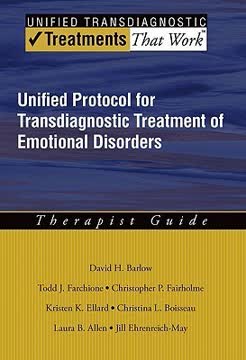
The Unified Protocol for Transdiagnostic Treatment of Emotional Disorders receives positive reviews (4.14/5) from therapists and readers. Reviewers praise its practical, structured approach for treating anxiety, depression, and other emotional disorders through cognitive-behavioral therapy. They appreciate the easy-to-follow format, gradual skill-building, helpful troubleshooting tips, and companion workbook for clients. Multiple reviewers note its effectiveness with diverse emotional disorders and value it as a career-long resource. Some find the technical title off-putting, though the content remains accessible and implementable in various therapeutic contexts.
Similar Books