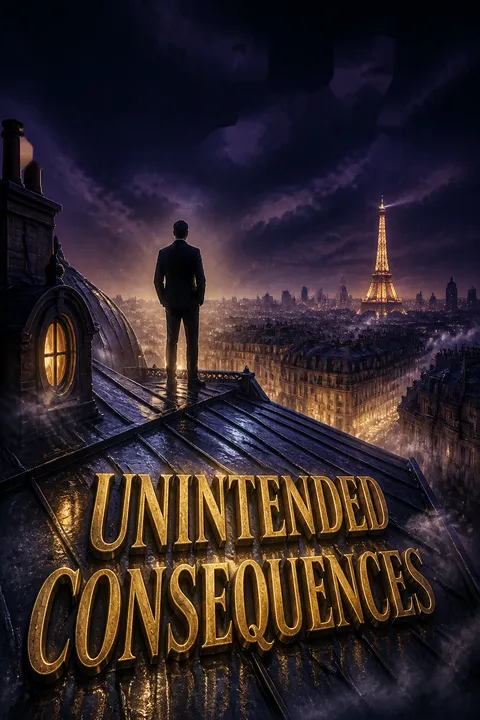


Plot Summary
Four Days Missing
Stone Barrington wakes in a locked room at the American Embassy in Paris with no memory of the four days since his friends’ wedding. Embassy doctor Keeler explains that a dangerous sleeping drug has erased the interval, and that Stone may have been awake and moving while under its influence. His passport and CIA consultant card explain why a taxi driver brought him to the embassy, but not why he came to France.
Stone discovers a first-class ticket, a large envelope of euros, and luggage containing a dinner jacket he would not have packed without a reason. His secretary, Joan, recalls an unknown caller, then a sudden Paris trip arranged by messenger. Her fragments give him a destination, not an explanation.
The story begins with a gap in Stone’s own account of himself. His professional habits depend on memory, observation, and the ability to reconstruct events, yet he must investigate a period in which his body acted without his conscious witness. The ticket and cash are not merely clues; they are material evidence that someone else may have authored his choices. By making Stone both detective and damaged evidence, the novel turns amnesia into a problem of agency. His first task is not to solve a crime but to determine whether his recent life still belongs to him.
The Blaise Invitation
At the Plaza Athénée, Stone receives an unsigned black-tie invitation and is paired at dinner with Helga Becker, a striking Swedish divorcée. Their host, Marcel duBois, treats Stone as a valued acquaintance though Stone cannot remember meeting him.
After dinner Marcel reveals his Blaise, a powerful, exceptionally quiet supercar, and lets Stone drive it. He offers Stone one at a steep discount, and Stone accepts, further deepening the mystery of Marcel’s generosity.
Richard LaRose, introduced as an American commercial attaché, recognizes Stone but conceals their connection. Helga and Stone spend the night together, then arrange another dinner. Stone has acquired a car, a lover, and a place in Marcel’s circle, but still cannot say why he was invited.
Marcel’s hospitality is seductive because it gives Stone a vivid present to occupy while his past remains inaccessible. Luxury becomes a form of misdirection: the car, food, and Helga’s attention make the situation feel chosen, even though Stone has no memory of choosing it. His willingness to accept the Blaise is characteristic confidence, but it also exposes how easily charm can replace evidence. LaRose’s disguised role quietly changes the dinner from a social gathering into an intelligence environment. The scene’s pleasure and unease coexist, making Stone’s lost agency feel less like confinement than an invitation he cannot verify.
The Tail in Montmartre
Stone’s dinner with Amanda Hurley, an art curator he supposedly met on the flight, gives him his first account of the plane: an older woman in a Chanel suit spilled a drink over him. Amanda’s questions about the embassy and LaRose reveal that she knows more about intelligence work than her biography suggests.
LaRose confirms that Amanda once served the CIA and left under suspicion, while warning that Russian watcher Yuri Majorov is tracking Stone. On a walk through galleries, Stone buys a painting and Amanda recognizes it as the work of his mother, Matilda.
Majorov follows them. A frightening report of a fatal St. Barts crash briefly convinces Stone that his closest friend, Dino Bacchetti, and Dino’s new wife have died. Dino calls moments later, alive and safe, but the scare sharpens Stone’s sense of how little he can control.
The investigation widens through people who know more than they initially admit. Amanda’s expertise makes her simultaneously useful and suspect, while Majorov’s silent presence turns ordinary public space into a field of observation. Stone responds by testing people rather than accepting their stories, a return to his police instincts. The false report of Dino’s death briefly strips away his urbane composure: beneath the flirtation and appetite for risk lies a deep dependence on old friendship. The episode also establishes the novel’s key tension between visibility and knowledge. Stone is watched by others, yet cannot reliably see the forces arranging his own movements.
The Agency’s Mistake
CIA deputy director Lance Cabot arrives in Stone’s suite and admits that an Agency plan went wrong: the drug was meant for Aldo Saachi, not Stone. Lance had arranged the flight to bring Aldo under control, but an operative mistakenly dosed Stone instead. With the missing days still blank, Lance asks Stone to use Marcel’s trust to make the wealthy businessman a CIA asset.
Stone resists, then learns from managing partner Bill Eggers why Marcel summoned him: Marcel wants to buy The Arrington, the Los Angeles hotel Stone helps oversee. At lunch, Marcel offers a billion dollars for the business, excluding its land. Stone declines to sell and proposes a European hotel partnership instead, giving him a legitimate reason to keep meeting Marcel.
Lance’s confession converts Stone’s private mystery into institutional collateral damage. The Agency can explain the drugging, but its explanation does not restore the days or undo the risks imposed on him. Its attempt to turn the accident into an opportunity reveals a familiar logic of power: once harm has occurred, officials seek a useful outcome rather than accountability. Stone’s refusal to sell The Arrington is more than a business judgment. His attachment to the hotel’s history and his son’s childhood home gives him a nonfinancial boundary that neither wealth nor intelligence work can easily override.
Paris Turns Violent
After a concrete truck smashes the armored car carrying Stone, Lance, and LaRose, the driver dies and the attacker disappears. LaRose connects the truck to Marcel’s construction company, but Stone refuses to accept the suspicion as proof.
At the Paris Auto Show, a warning from Lance allows police to find and disable bombs planted in two Blaises. Meanwhile, Stone recognizes Majorov at a business lunch and later learns that Aldo Saachi has been shot dead in Helga’s hotel suite.
Police question Helga, but the American ambassador secures her release and LaRose sends her to Sweden. LaRose explains that Aldo was part of a criminal network pressuring Marcel. When a storm closes the airport, Stone warns Marcel of the danger; they leave Paris together the next morning.
Paris shifts from polished performance to physical threat, and the contrast matters. The same elite spaces that made Stone feel welcomed now provide access to targets, schedules, and vulnerabilities. LaRose’s suspicions about Marcel are plausible but incomplete, reminding Stone that intelligence is often inference presented with confidence. Helga’s position is similarly unstable: her glamorous social life sits beside undisclosed Agency work and lethal danger. The sequence forces Stone to exchange passive curiosity for protective judgment. He cannot recover his lost memories before acting, so he must decide whom to trust using partial evidence, a condition that will define the rest of the crisis.
New York Under Siege
Stone brings Marcel to New York and introduces him to security executive Mike Freeman, while the two men negotiate a hotel partnership. Marcel agrees to sell a stake in The Arrington and fund European expansion.
The Agency and Strategic Services reinforce Stone’s house, arm Marcel’s protectors, and arrange safer transport. Still, a black van appears near Stone’s Connecticut home, where attackers set the house alight and cut the telephone lines. Stone and his guests escape; Viv Bacchetti pursues the van, which crashes in the woods.
Back in New York, a gunman posing as a courier fires at the house, but the new armored glass stops the bullets and Agency guards kill him. Only after these attacks does Stone learn that the newspaper has publicized Marcel’s whereabouts.
Security becomes the visible architecture of anxiety: armored glass, armed guards, protected vehicles, and increasingly restricted movement. Yet each layer is reactive, installed after attackers have already found a way in. Stone’s social reflex is to host and protect, but that generosity makes his home a predictable gathering point. Viv’s decisive pursuit shows how practical skill can cut through the paralysis created by surveillance and uncertainty. The attacks also expose the limits of information control. A public newspaper profile can undo the discretion that security teams carefully construct, leaving Stone to question whether protection can ever compensate for a target’s visibility.
Stone Is the Target
After the hotel agreement is signed, Lance and LaRose take Stone to a secure CIA office and correct the story they have allowed him to believe. Marcel was not the real objective. A criminal network called SQUID wants The Arrington, and Stone’s ownership influence makes him the obstacle. The shot near Amanda, the attacks on the cars, and Aldo’s intrusion into Helga’s suite were all aimed at killing Stone, with others treated as expendable.
The drugged flight was supposed to incapacitate Aldo for interrogation, and the embassy story about the taxi driver was invented to conceal the operation. Stone agrees to keep moving as bait, wearing body armor and riding in a guarded van, though he resents becoming an instrument in someone else’s plan.
The revelation reorganizes the novel’s apparent plot: the luxurious patron, the endangered hotelier, and the missing memories are all tied to a campaign against Stone. The Agency’s earlier omissions now look less like convenient secrecy than a deliberate effort to direct his behavior. Stone’s anger is not simply a response to danger; it is a response to being managed under the guise of protection. Still, he accepts the bait role because refusing would expose Marcel and others to further harm. His choice is a qualified recovery of agency: he cannot undo the manipulation, but he can decide what risk he is willing to carry.
The Rooftop Exchange
At Dino’s housewarming, Helga leaves to retrieve her handbag and vanishes. Guards find Stanley unconscious, and tracking her Agency phone leads Stone, Dino, Holly Barker, and the police to a Brooklyn garage. Stone is taken in a decoy exchange, allowing SQUID to capture him and Helga together. On a parking-garage rooftop, Majorov demands Stone’s shares in The Arrington.
Helga frees her hands, wounds one guard, and seizes a knife; when Majorov’s men turn on her, Stone grabs a pistol and shoots back. Before they can secure Majorov, an armed helicopter arrives and opens fire. A CIA Black Hawk piloted by LaRose pursues it over the waterfront. The enemy helicopter explodes over the sea, while Majorov disappears among the survivors.
The hostage exchange turns the novel’s central conflict into a physical contest over ownership: Majorov wants Stone’s shares, but Stone and Helga refuse to let his signature become a substitute for consent. Helga’s resourcefulness is not ornamental courage; it changes the balance of force at the precise moment Stone is outnumbered. The helicopter battle then enlarges the scale of the conflict without providing complete closure. Majorov’s disappearance preserves the uncertainty of real security work, where defeating an operation does not necessarily mean eliminating its organizer. Stone survives, but survival is achieved through cooperation rather than solitary mastery.
A House Reassembled
Stone, Helga, and the surviving team return from the rooftop battered but alive. Marcel prepares to fly back to Paris with upgraded security, while Helga decides to return to Sweden. The hotel partnership is in place, and Majorov remains missing; two helicopter-crash survivors are captured, but he is not among them. Dino and Viv settle into the new Park Avenue apartment Viv bought despite his resistance.
Marcel sends Stone a year of service from Fred Flicker, a retired Royal Marine trained as a butler and chauffeur, along with cases of wine. Stone’s secretary, Joan, also negotiates the purchase of the neighboring house to expand the household. The last delivery is less elegant: Bill Eggers sends Stone fifteen pounds of moose meat.
The ending restores ordinary life through concrete arrangements rather than a claim that danger has vanished. Marcel’s business alliance, Dino and Viv’s new home, and Stone’s altered household all convert upheaval into durable structure. These domestic resolutions echo the book’s larger concern with control: Stone cannot dictate what the Agency conceals or whether Majorov survives, but he can choose whom to shelter and what to build around them. Fred’s arrival extends the story’s comic register, while the unwanted moose meat gives the final beat an earthy counterweight to Parisian luxury. The threat recedes; friendship and household continue.
Analysis
Unintended Consequences builds its thriller around a precise irony: Stone is surrounded by people whose professional purpose is to know what is happening, yet he is the person least able to trust his own account. The amnesia is not simply a puzzle mechanism. It makes agency unstable. Stone travels, accepts invitations, spends money, and enters relationships during a stretch he cannot remember, so the usual distinction between his choices and other people’s designs becomes difficult to maintain.
The intelligence apparatus intensifies that instability. Lance and Rick possess information Stone needs, but they ration it according to operational priorities. Their secrecy may serve national or institutional goals, yet it also makes Stone a usable instrument before he understands the operation. The book does not portray competence as the same thing as ethical clarity. The Agency can provide powerful protection and still conceal the truth from the person it is protecting.
The novel’s social and commercial worlds are equally entangled. Marcel’s dinner parties, the Blaise launch, gallery openings, hotel negotiations, and diplomatic receptions offer access to influence, but they also make people visible to rivals. Luxury is not a refuge from violence; it is one of the signals that attracts it. The Arrington becomes the sharpest example of this overlap, since a corporate asset carries intimate family meaning for Stone while functioning as a target in a criminal takeover.
Stone’s strongest resource is not force but judgment under incomplete conditions. He tests accounts, resists easy conclusions about Marcel, and accepts danger when his friends face greater exposure. His independence is real, though never absolute: loyalty binds him to people and places more strongly than any contract. The conclusion restores order through agreements, homes, and household routines, but Majorov’s disappearance prevents security from becoming certainty. The lasting resolution is therefore not the elimination of risk. It is Stone’s renewed ability to choose whom he trusts and what he is willing to protect.
Review Summary
Unintended Consequences receives mixed reviews, with an average rating of 3.94 out of 5. Readers appreciate the fast-paced plot and new characters but criticize the predictable storyline and lack of character development. Some enjoy the lavish lifestyle descriptions, while others find them excessive. The book's opening amnesia plot device intrigues some readers but disappoints others. Fans of the Stone Barrington series generally find it entertaining, though some feel the series has declined in quality over time.
Characters
Stone Barrington
Polished, stubborn investigatorStone is a New York lawyer, former police detective, and CIA consultant whose confidence depends on reading people and keeping control of a room. He enjoys good food, beautiful women, expensive cars, and the freedom to choose his own course, but he is not indifferent to responsibility. His attachment to his son, his home, and old friends gives his independence a moral center. When events deprive him of memory and expose him to other people’s plans, he relies on observation, skepticism, and practical courage. He dislikes being ordered about, yet his loyalty repeatedly draws him into risks he would rather refuse. His polished ease conceals a serious instinct for protecting others.
Marcel duBois
Charming European magnateMarcel is a French investor and industrialist whose wealth supports a life of exquisite hospitality and ambitious ventures, including the Blaise supercar. He prizes intelligence, efficiency, and mutually beneficial agreements more than the theatrical combat of negotiation. His son’s death remains a private grief beneath his public composure, and the car bears the son’s name. Marcel is generous toward Stone, but his interest in The Arrington is also a serious business proposition. He moves comfortably between personal warmth and corporate calculation, making him difficult to reduce to either a patron or a tycoon. His openness to new partnerships contrasts with his caution about compromising his country’s interests.
Helga Becker
Glamorous, capable companionHelga is a tall Swedish divorcée who moves confidently through Paris’s wealthy international circles. She is witty, direct, and comfortable with her physical presence, while her apparent ease masks discipline and a strong appetite for independence. Marcel’s introductions bring her together with Stone, and their attraction grows quickly. Helga is more than a social ornament: she reads people sharply, notices danger, and knows how to hold her own under pressure. Her connection to intelligence work gives her life a guarded dimension, but she resists being treated as someone else’s possession or project. She values pleasure and self-determination, and she expects others to respect both.
Lance Cabot
Calculating intelligence chiefLance is a senior CIA officer on the verge of directing the Agency. He is strategic, self-assured, and adept at translating personal relationships into institutional opportunities. He relies on Stone’s access and judgment, but his methods often involve withholding information until disclosure serves a purpose. Lance’s sense of patriotic mission is genuine, though it does not prevent him from treating other people’s safety and consent as variables in an operation. His relationship with Stone is an uneasy blend of dependence, irritation, and professional respect. He expects resistance and knows how to apply pressure, yet he also understands the value of trust, even when he strains it.
Richard LaRose
Resourceful undercover officerLaRose, usually called Rick, is a CIA field officer posing as a commercial attaché at the Paris embassy. A multilingual operative with a rough past, he is observant, adaptable, and more comfortable with danger than with conventional polish. Stone helps him navigate Paris’s social codes, including clothing and the circles around Marcel. Rick repays the help with surveillance, analysis, and protection, though he sometimes keeps crucial facts to himself. His competence is matched by a dry sense of humor and a willingness to improvise when plans fail.
Holly Barker
Driven intelligence leaderHolly is Stone’s close friend and a senior CIA officer whose ambition is inseparable from her sense of service. She values the work enough to make difficult choices about her personal life, and she is candid when she decides she cannot give both career and romance equal attention. Holly is sharp, disciplined, and protective of people in her orbit, while her authority requires her to think in systems and operational priorities. Her New York team becomes important as Stone’s danger escalates.
Amanda Hurley
Guarded art-world expertAmanda is an art curator and adviser who buys for corporate collections and knows Paris’s galleries intimately. She is intelligent, socially fluent, and observant enough to notice details Stone would prefer to conceal. Her questions can feel like flirtation or interrogation, and her carefully presented biography leaves parts of her life unexplained. She shares Stone’s interest in art, including the work of his mother, but her guardedness makes easy trust impossible.
Yuri Majorov
Patient Russian operativeMajorov is a Russian figure with roots in the former intelligence services and a presence in Paris’s business and art circles. He is watchful, patient, and skilled at making pressure appear to come from several directions at once. His connections extend beyond ordinary commercial competition, and he treats people as leverage in pursuit of larger aims. Majorov’s calm manner is part of his danger: he can discuss business while arranging violence.
Dino Bacchetti
Stone’s blunt lifelong friendDino is Stone’s former NYPD partner and closest friend, now a senior police official. He is direct, suspicious, and loyal, with a practical understanding of danger that complements Stone’s more improvisational style. His marriage to Viv asks him to adapt to a new domestic life and greater professional responsibility, changes he meets with comic resistance. Beneath the grumbling, Dino remains dependable when the stakes become physical.
Vivian Bacchetti
Decisive security professionalViv, Dino’s new wife and a former detective, brings tactical skill and confidence to her work with Strategic Services. She is organized, decisive, and unwilling to wait indefinitely for Dino to adjust to marriage or a larger home. Her practical leadership contrasts with his attachment to familiar routines. Viv approaches both security and domestic planning as problems that can be solved with preparation and nerve.
Mike Freeman
Strategic security executiveMike heads Strategic Services, a major security firm with intelligence-world roots. He is commercially astute and operationally serious, able to translate threats into concrete plans for people, vehicles, and buildings. His relationship with Stone combines friendship and professional trust. Mike is also capable of humor, but he does not mistake a dangerous situation for a game.
Bill Eggers
Stone’s pragmatic law partnerBill is Stone’s managing partner at Woodman & Weld and an old friend who helped him return to law after leaving the police. Practical and unsentimental, he can recognize a strong business opportunity without being dazzled by its scale. He understands Stone’s strengths well enough to push him toward negotiations he would rather delegate, while providing the legal judgment and institutional support those negotiations require.
Joan Robertson
Unflappable office anchorJoan is Stone’s secretary, trusted confidante, and the person who keeps his professional and household logistics running. She is observant enough to detect a suspicious delivery and brave enough to prepare for danger rather than wait for instructions. Her dry practicality makes her a steady presence amid the disruption, and Stone respects her judgment.
Aldo Saachi
Mysterious Parisian fixerAldo presents himself as a wealthy, socially connected European with uncertain origins. He appears at Marcel’s gatherings and in Paris’s art scene, watching more than he explains. His polished presence conceals a harder professional purpose, making him a troubling figure in the city’s overlapping social and political circles.
Dr. Keeler
Embassy medical specialistKeeler treats Stone after the drugging and explains the likely effects of the memory loss. Calm and professionally curious, he gives Stone a medical framework for the blank days without pretending that he can restore them on demand.
Stanley Manoff
Tenacious security guardStanley is a skilled guard assigned to protect Stone. He is persistent enough to follow Stone to Maine without advance notice and serious enough to keep watching after others would stand down. His instinct to remain armed and alert sometimes clashes with Stone’s preference for discretion.
Frederick Flicker
Marine turned butlerFred is a retired Royal Marine who later trained as a butler and chauffeur. His military discipline, driving skills, and genuine Cockney background give him an unusual range of household talents. Marcel sends him to Stone as a carefully chosen personal gift.
Plot Devices
Hypnotol Amnesia
A missing-days investigationThe drug Hypnotol erases Stone’s memory of several days, leaving him to reconstruct his own movements from travel documents, other people’s accounts, and later memory flashes. It creates the central mystery while making Stone vulnerable to explanations supplied by people with their own agendas. The lost interval is eventually tied to a CIA operation aimed at Aldo Saachi, though Stone receives the drug by mistake. The device therefore links personal disorientation to institutional secrecy and makes reliable testimony a central concern.
The Blaise
A luxury business prizeMarcel’s supercar establishes his wealth, engineering ambition, and affection for his deceased son, whose name the vehicle bears. Marcel’s unusually generous offer to Stone signals a connection neither man can explain at first. The car also draws public attention, becomes the focus of a high-profile launch, and links the Paris social world to Marcel’s wider business interests. Its quiet cabin and remarkable speed make it a luxury object, but its role in the story is to show how beauty and commerce can attract both admiration and predation.
The Arrington Shares
The concealed motive for violenceStone’s influence over The Arrington gives the criminal network a reason to target him, although the early attacks appear connected to Marcel’s wealth and business empire. The hotel is not just a valuable asset: it is tied to Stone’s family history and to his son’s trust. The proposed sale and European partnership keep Stone in Marcel’s orbit, while the later revelation reframes the violence as a coercive attempt to seize the hotel. The shares turn corporate control into a matter of bodily survival.
Encrypted Phones and Security
A shifting line of trustLance supplies secure phones, a diplomatic passport, weapons, body armor, and protected vehicles as the danger grows. These tools let Stone communicate with intelligence officers and move through a threat environment, but they also demonstrate how thoroughly the Agency can shape his choices. Physical defenses such as armored glass and the Mercedes van repeatedly stop attacks, while compromised information and misdirected protection keep exposing new weaknesses. The devices make security tangible without making it absolute.
About the Author
Other books by Stuart Woods




Download PDF
Download EPUB
.epub digital book format is ideal for reading ebooks on phones, tablets, and e-readers.








